Press Release
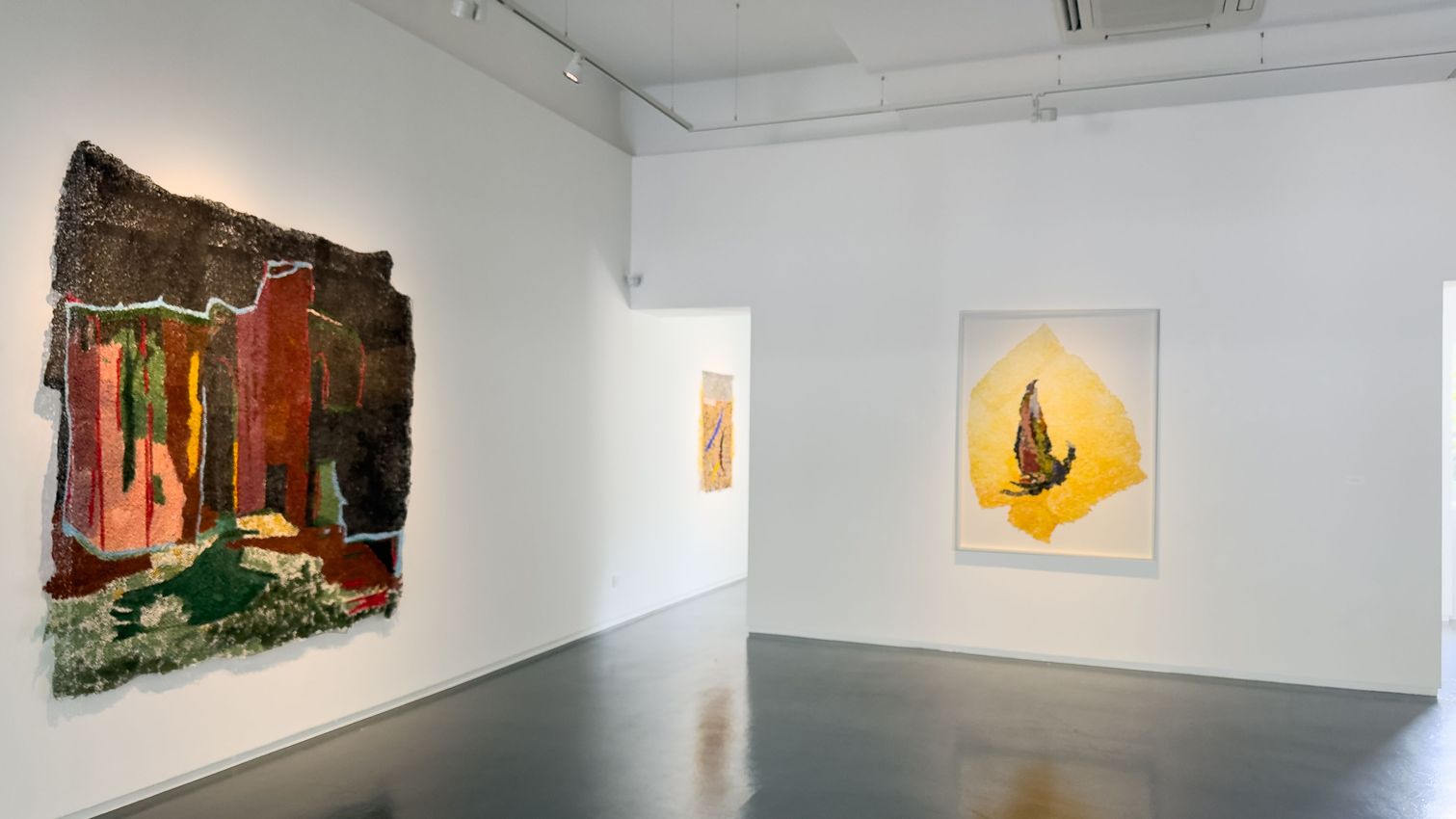
Sundaram Tagore Chelsea is pleased to present Marked: Contemporary Takes on Mark-Making, an exhibition showcasing the work of Hosook Kang, Hassan Massoudy and Golnaz Fathi.

Each of these dynamic artists was born in the East, but lives and works in the West. Each also employs a distinctive mark-making technique, subtly merging the traditions and artistic mores of their cultures of origin with contemporary Western visual language.

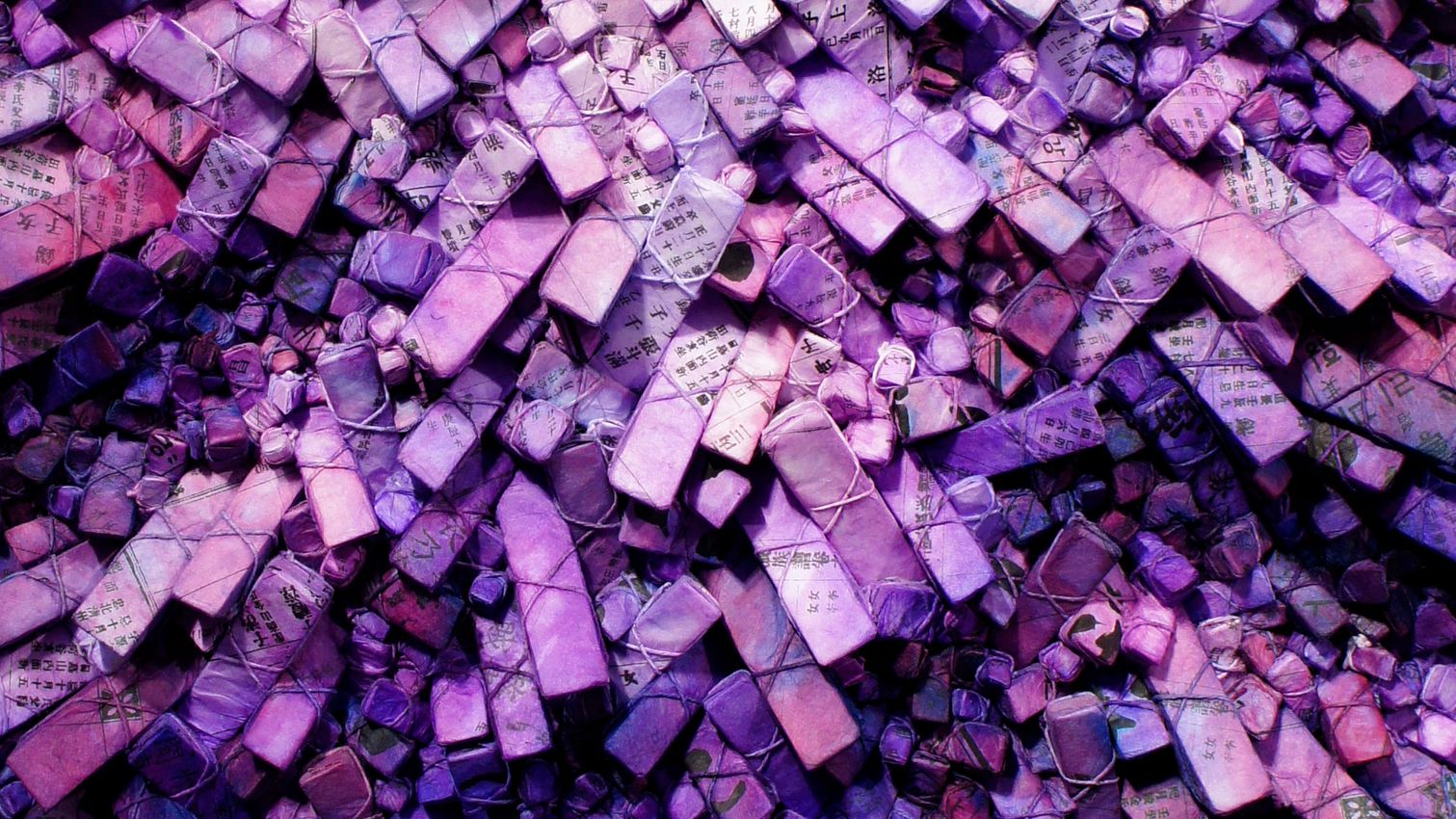
Combining bold action painting and steady mark-making, Korean-born New York painter Hosook Kang creates optical effects through a process of layering intricate dot patterns and gestural brushstrokes.

Kang’s paintings depict nature as she sees it in her imagination. She starts with a background of abstract forms—her vision of the completed painting—then covers the canvas with a painted net of structured units that create a skin-like overlay. To bring her original vision back into focus, Kang fills each unit with colours that correspond to the background, adding a three-dimensional quality. Obsessively detailed and orderly, these works are simultaneously meditative and pulsing with energy.

Her works reference traditional Korean motifs, such as elements of nature, yet her focus on abstraction and the richness of colour root her work firmly in the Western tradition.

Hosook Kang was raised in Daegu, Korea, and attended the Pratt Institute, Brooklyn. She has exhibited her work at Gallery Korea, Korean Cultural Service New York and Daegu Culture and Arts Center, Korea.

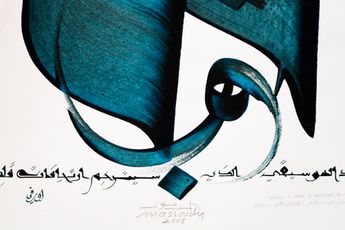
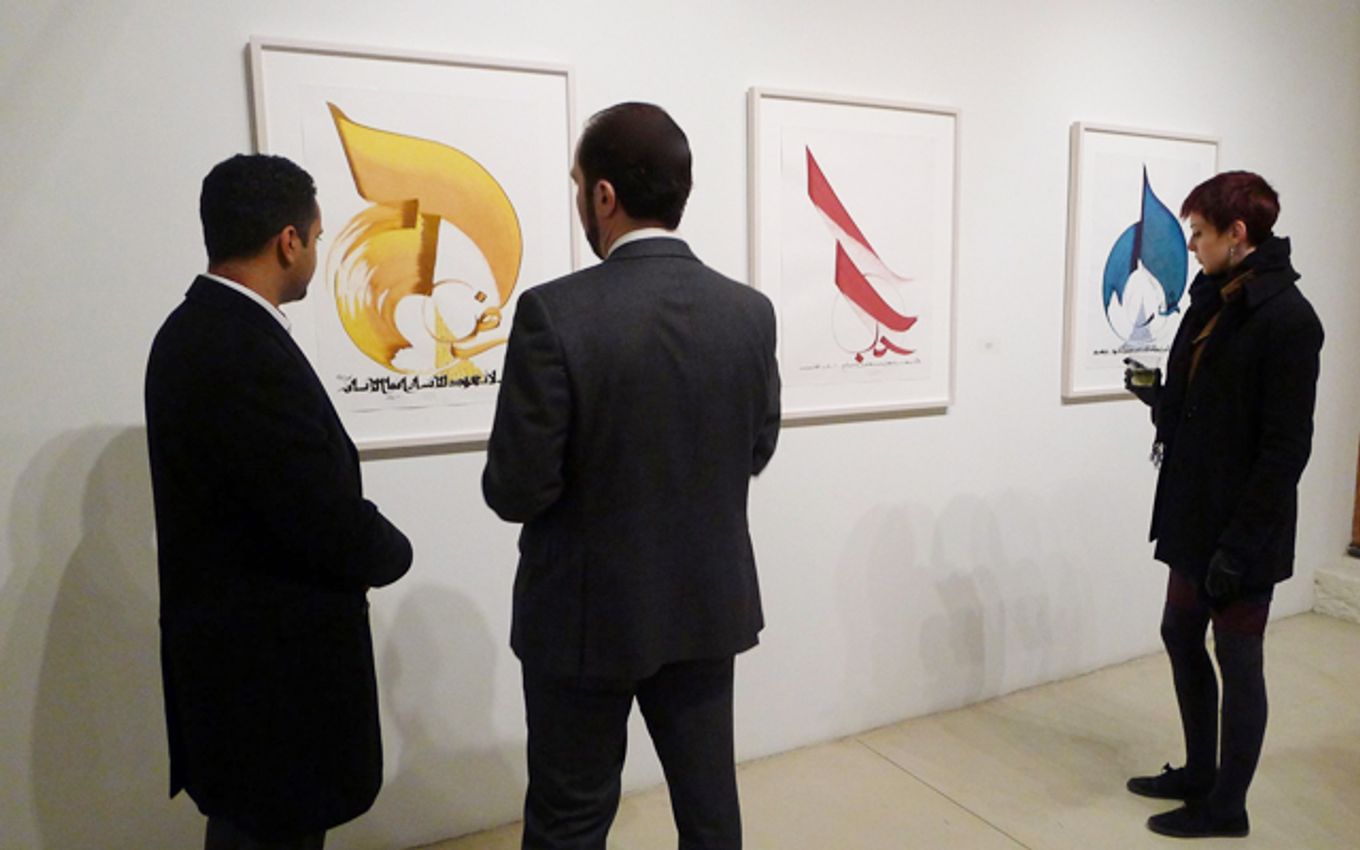
Classically trained calligrapher Hassan Massoudy inscribes oversized letters in vibrant colour on paper to create sublime, visually compelling works that bring traditional Arabic script into a contemporary context.

Massoudy, who was raised in Iraq and is based in Paris, sources words from Eastern and Western authors, poets and philosophers. He selects a passage, which he writes at the bottom of a sheet of paper, then extracts a single word, enlarging it to monumental proportions over the entire surface of the paper.

In accordance with tradition, Massoudy makes his own tools and inks, but breaks from the Arabic custom of using black ink by incorporating a bold palette of blues, greens, yellows and reds. Although executed with the utmost control, his letters are gestural, fluid and charged with energy, as he skillfully transforms the written word into an emotionally evocative pictorial element.

Born in Najef, Iraq, in 1944, Massoudy moved to Baghdad in 1961 to study classical calligraphy. He moved to France in 1969, continuing his education at the Ecole des Beaux-Arts in Paris. He has shown his work at The Kennedy Center, Washington DC; the British Museum, London; Musée d’Avranches, France; Centre d’Art Contemporain, Abbaye de Trizay, France; and the Palais des Congrès, Grasse.

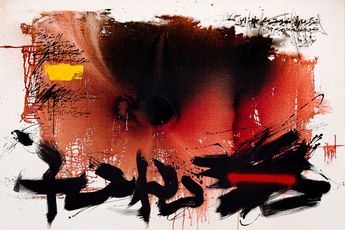
Iranian artist Golnaz Fathi, who divides her time between Tehran and Paris, works in fine pen, mostly on varnished raw, rectangular, polyptych canvases, in a limited palette of white, black, red and yellow. She layers the surface of the canvas with thousands of minute marks that echo the curvilinear forms of Persian calligraphic letters and words. These intricate lines coalesce into minimalist compositions that can be read in multiple ways—as landscapes, electronic transmissions or atmospheric phenomena. She refrains from titling her works, which allows the viewer free reign to assign his or her own interpretation.

The basis of Fathi’s practice is siah-mashq, a traditional exercise in which the calligrapher writes large, cursive letters across the page in a dense, semi-abstract formation. The letters aren’t meant to form words or convey meaning, but rather strengthen the skill of the scribe. Fathi reinterprets this technique, drawing inspiration from various Western and Eastern sources, including American Abstract Expressionism, as well as the work of Iranian and Middle Eastern modernists who pioneered the use of the written word as a pictorial element in the late 1950s and early 1960s. The strength of her work lies in the emotion suggested by the rhythmic gestures of her mark-making.

This exhibition showcases two video installations titled Let’s Blow Them Away and Dance Me to the End of Night. This is a new medium for the artist.

Born in Tehran in 1972, Fathi mastered classical calligraphy at Azad University and the Iranian Society of Calligraphy. Her work is in the collections of the British Museum, London; Brighton & Hove Museum, England; Carnegie Mellon University, Doha; the Islamic Arts Museum Malaysia, Kuala Lumpur; the Asian Civilisations Museum, Singapore; and The Farjam Collection. She has exhibited extensively around the word, including at the Tehran Museum of Contemporary Art and the Chelsea Art Museum, New York.

Artists Exhibiting

Also Exhibiting at Sundaram Tagore Gallery

About the Gallery

Established in 2000 in New York City, Sundaram Tagore Gallery represents established and emerging artists from around the globe, specialising in work that is aesthetically and intellectually rigorous, infused with humanism and art historically significant. The gallery was founded with a mission to show that some of the best and most meaningful art was being created by artists deeply engaged in cross-cultural explorations. Our international roster of artists cross cultural and national boundaries, synthesising Western visual language with forms, techniques and philosophies from Asia, the Subcontinent and the Middle East. More than twenty years later, we continue to champion artists, particularly women and those from underrepresented cultures, whose work exemplifies our interconnectedness.

View Gallery Profile
Address
542 West 26th Street
New York
United States
Opening Hours
Tuesday – Saturday
10am – 6pm
(1)
New York 542 West 26th Street
Sundaram Tagore Gallery
542 West 26th Street, New York, United States

Opening hours
Tuesday – Saturday
10am – 6pm
The art world in focus