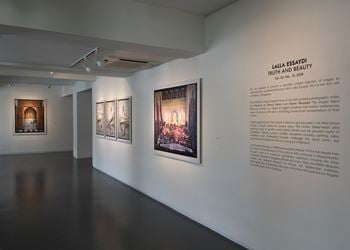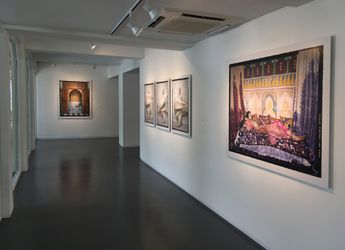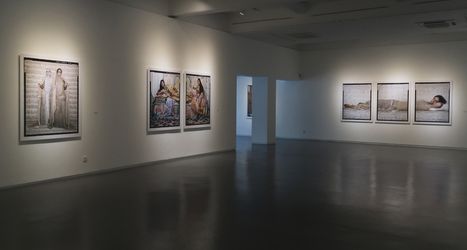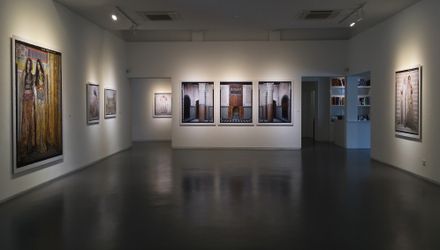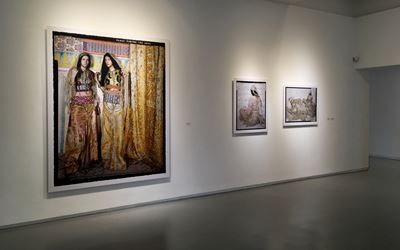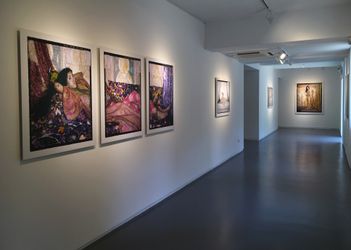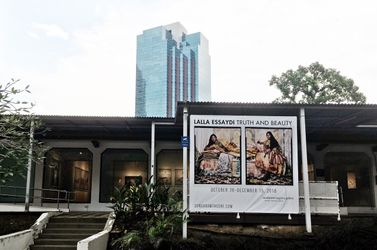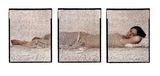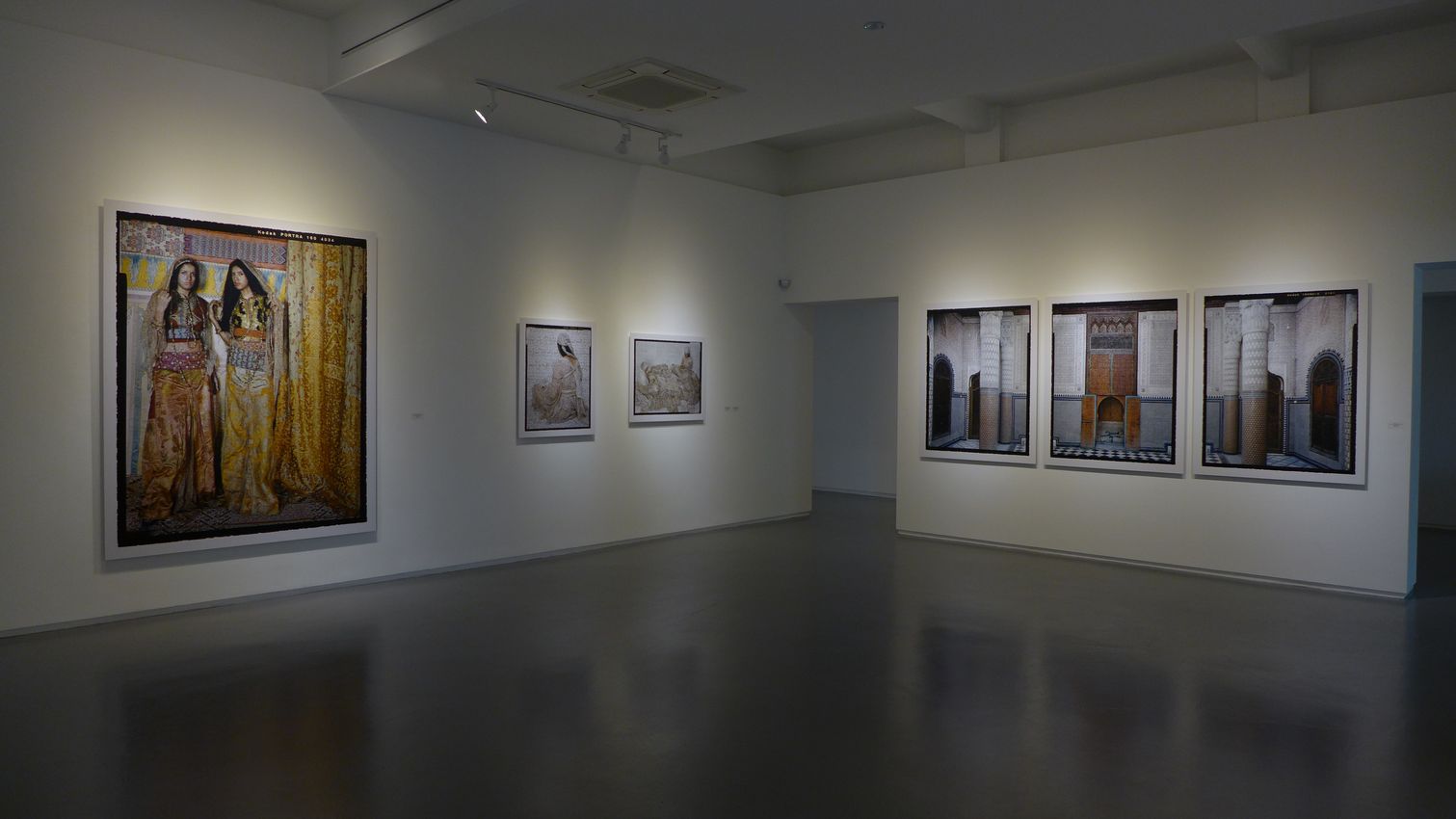
For the first time at Sundaram Tagore Gallery, a specially curated selection of images by internationally acclaimed Moroccan artist Lalla Essaydi will be on view. This exhibition brings together three of Essaydi’s most powerful photographic series: ‘Les Femmes du Maroc, Harem’ and ‘Harem Revisited’.
Lalla Essaydi was born and raised in Morocco and educated in the West before moving to Saudi Arabia for several years. The United States-based artist explores issues of gender, cross-cultural identity and the prevalent myths of Orientalism. Working across multiple disciplines—including painting, video, installation and photography—Essaydi challenges the social norms and hierarchies that shaped her life as a young girl in Morocco.
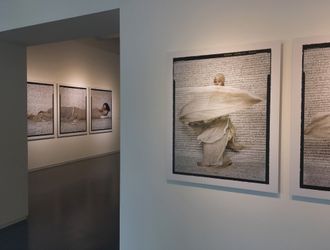
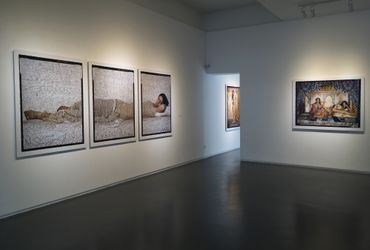
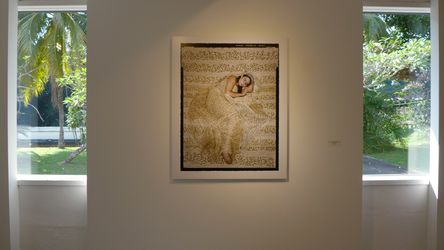
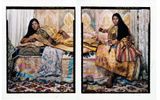
This exhibition comprises more than 20 large-scale colour photographs, including several of Essaydi’s iconic multi-panel works. The images present Moroccan women in a range of staged narratives that explore contemporary power structures, while also confronting conventional representations of Arab women, formed in part by Western perceptions of Islamic culture.
In her photographs, Essaydi explores spaces both real and symbolic. Raised in a traditional Muslim household, which included designated areas just for women, Essaydi is intimately familiar with how Arab women’s personal histories are interlinked with segregated spaces. Traditionally in Islamic culture, men move about freely in public spaces, while women are often confined to private realms, away from public view. Over time, physical borders come to define social hierarchies and for women, stepping outside these boundaries, literal or otherwise, can lead to confinement in an actual space. Through her creative practices, Essaydi has come to understand how these longstanding cultural mores have informed her views as an artist and as a woman living between two worlds.
In her Les Femmes du Maroc series, Essaydi appropriates Orientalist imagery from historical Western paintings, placing models in classical odalisque positions, similar to Ingres’ Grande Odalisque, which depicts a reclining nude harem slave in an imagined Orient. Essaydi reinterprets such classical artworks by compositionally distilling the concept. She eliminates the lavish colour and opulent architectural surroundings and instead covers the models from head to toe with Arabic calligraphy—another recurring theme in her work. By focusing exclusively on women, who are arranged in ubiquitously fetishistic positions, Essaydi skillfully critiques established views of Arab women in Western art, and by extension, in contemporary culture.
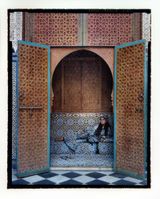
Essaydi’s images also consider the importance of art and architecture in Islamic culture. In her Harem and Harem Revisited series, the decorative treatment of the models and their surroundings reflects a long tradition in Islamic art in which entire surfaces are covered with dazzling calligraphic, geometric or botanical patterns. In Harem #7, for example, the model, wearing garments adorned with the same elaborate pattern as the surrounding tiles and carved woodwork, could easily recede into the scenery, viewed as another decorative object. Essaydi redirects this assumption by inscribing the models’ faces, hands and feet with Arabic calligraphy, the practice of which is traditionally dominated by men. However her text is rendered in henna—an art form practiced only by women. The text, which is not legible, suggests a personal narrative, one in which Essaydi’s voice breaks the silence of confinement and dismantles the notion of women as passive objects of fantasy.
‘By reclaiming the rich tradition of calligraphy and interweaving it with the traditionally female art of henna,’ she says, ‘I have been able to express, and yet, in another sense, dissolve the contradictions I have encountered in my culture: between hierarchy and fluidity, between public and private space, between the richness and the confining aspects of Islamic traditions.’
Artist Talk
Lalla Essaydi will talk about her work on Saturday, October 27, from 3 to 5 PM, at Sundaram Tagore Singapore at Gillman Barracks. This talk is free and open to the public. RSVP to rsvpsg@sundaramtagore.com by October 20 to hold a spot; seating is limited.
About the Artist
Lalla Essaydi was born in Morocco in 1956 and received a Master of Fine Arts degree from the School of the Museum of Fine Arts at Tufts University in Massachusetts. She has exhibited her work across the globe, including at the Asian Civilisations Museum and the National Museum of Singapore; the Los Angeles County Museum of Art and The San Diego Museum of Art, California; The Museum of Fine Arts, Boston; and the Smithsonian Institution’s Museum of African Art and the National Museum of Women in the Arts, Washington D.C. Her work is in numerous permanent collections, including the Asian Civilisations Museum, Singapore; Musée du Louvre, Paris; the British Museum, London; the National Museum of African Art, Smithsonian Institution, Washington, D.C.; the Art Institute of Chicago; the Brooklyn Museum of Art; the Los Angeles County Museum of Art; the Museum of Fine Arts, Houston; and the Mathaf: Arab Museum of Modern Art, Doha. She divides her time between New York, Boston and Marrakesh.


Lalla Essaydi was born in Morocco in 1956 and received a Master of Fine Arts degree from the School of the Museum of Fine Arts at Tufts University in Massachusetts. She has exhibited her work across the globe, including at the Asian Civilisations Museum and the National Museum of Singapore; the Los Angeles County Museum of Art and The San Diego Museum of Art, California; The Museum of Fine Arts, Boston; and the Smithsonian Institution’s Museum of African Art and the National Museum of Women in the Arts, Washington D.C. Her work is in numerous permanent collections, including the Asian Civilisations Museum, Singapore; Musée du Louvre, Paris; the British Museum, London; the National Museum of African Art, Smithsonian Institution, Washington, D.C.; the Art Institute of Chicago; the Brooklyn Museum of Art; the Los Angeles County Museum of Art; the Museum of Fine Arts, Houston; and the Mathaf: Arab Museum of Modern Art, Doha. She divides her time between New York, Boston and Marrakesh.


Established in 2000 in New York City, Sundaram Tagore Gallery represents established and emerging artists from around the globe, specializing in work that is aesthetically and intellectually rigorous, infused with humanism and art historically significant. The Singapore branch opened in 2012.

A respected voice in contemporary art discourse.
Focusing on ambitious storytelling and insightful art-world commentary. Ocula Magazine publishes in-depth interviews, critical essays and timely analysis on the artists, exhibitions and ideas driving the global art world.
Learn more about Ocula Magazine
Showcasing the best of the art world.
Ocula partners with galleries from around the world to highlight their artists, artworks and exhibitions. Gallery membership is by application and invitation, with each member vetted by an independent panel.
Learn more about Ocula Membership

Specialises in the sale of major artworks.
Led by a team with deep ties to the world’s leading auction houses, galleries and collectors. Ocula’s advisory team offers bespoke services to high-net-worth clients from around the world who are looking to acquire the best of contemporary and modern art.
Learn more about our team and services