


Press Release

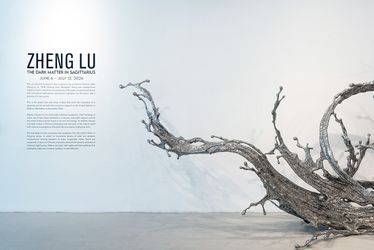
We are pleased to present an exhibition of new sculptures by acclaimed artist Zheng Lu (b. 1978, Chifeng, Inner Mongolia). Zheng has created three bodies of work in which he revisits themes of the past, reveals recent formal and conceptual explorations, and shares a glimpse into the future with a preview of a new series.

Zheng is known for his technically ambitious sculptures, often focusing on water, which have been exhibited in museums and public spaces around the world. He has said that his work is informed by the emphasis on technique he experienced at the Central Academy of Fine Art in China combined with a rigorous conceptual practice he learned while a student in Paris at École des Beaux-Arts.

This is the artist’s first solo show in New York since the installation of a gleaming twenty-foot-tall steel sculpture adjacent to the United Nations in midtown Manhattan in November 2023.

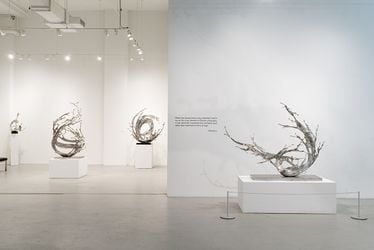
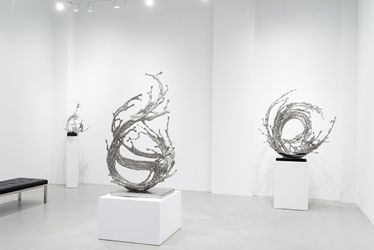
The first body of work in The Dark Matter in Sagittarius comprises sculptures from Zheng’s Water in Dripping series, which has garnered international attention.

WATER AS A THEME

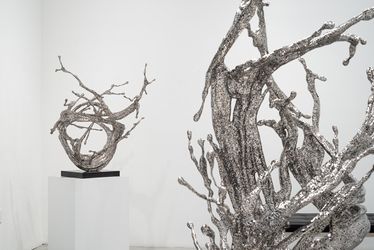
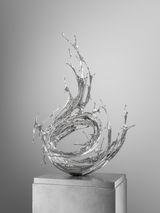
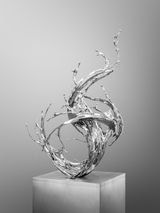
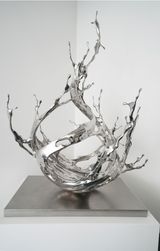
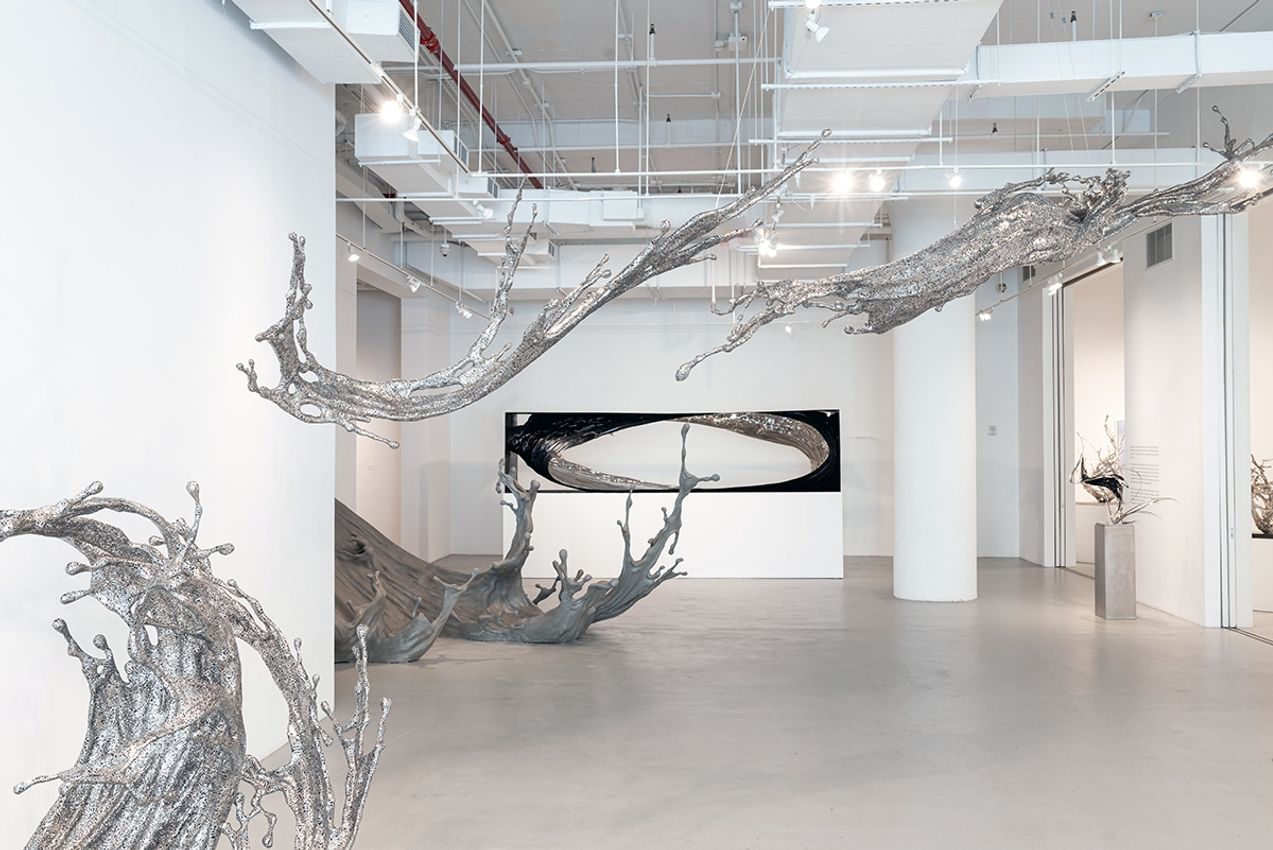
Pulsing with movement, Zheng’s dynamic stainless-steel compositions evoke splashes of water suspended midair. The series is influenced by traditional Chinese philosophy—and often calligraphy, an art form the artist practiced growing up in a literary family. In some works, Zheng uses language as a pictorial element, composing the surface of the sculptures out of thousands of Chinese characters derived from texts and poems of historical significance.

For Zheng, water is an amorphous medium that can take on abundant meaning, from an element essential to existence to a substance symbolic of change, self-reflection and the passage of time. ‘Water has always been a very important motif in my art,’ he says. ‘As a key element in Chinese philosophy, it was observed, visualised and ruminated upon rather than examined in terms of logic.’

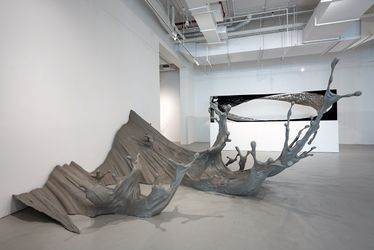
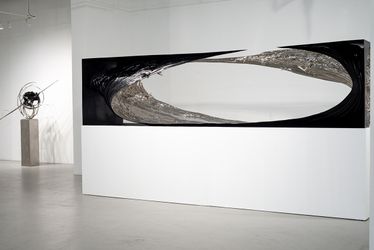
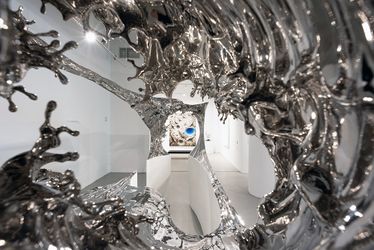
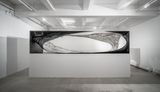
In a pair of corresponding large-scale installations, Zheng captures the power of water in different ways. Colosseum is a massive cube-shaped sculpture with a large, perforated center. Contained within, is a liquid vortex that appears on the cusp of breaking free from its rigid confinement. The rolling waves crashing against the walls of the cube form a window or portal through which viewers, while observing the work, can also see one another as if spectators in an arena or ancient amphitheater.

ART AND TECHNOLOGY

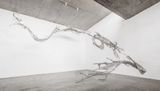
Colosseum II embodies another of the artist’s ongoing interests, which is the fusion of art and technology. Zheng created fragments of cresting waves out of resin using a 3D printer. The rippling fluid forms convey the artist’s reverence for nature, while the technology he used to bring the imagery to life provides the freedom to produce similar works as site-specific installations, retrofitted to any space.

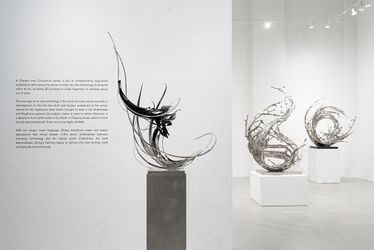
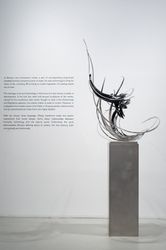
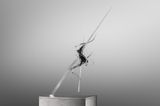
This idea, described by the artist as ‘the marriage between humanity and machinery,’ is the focus of a new series currently in development. Zheng debuts the first two steel and lacquer sculptures in the series, named for the mysterious dark matter thought to inhabit the Andromeda and Sagittarius galaxies. The subject matter is water in motion. However, in a departure from earlier works in his Water in Dripping series, which is more strictly representational, these forms are highly distilled.

Zheng starts with high-speed photography to capture water droplets in motion. He then uses computer programs to map complex three-dimensional compositions, which he digitally manipulates and refines until they are ready for metal 3D printing. Zheng views the use of technology in his art-making as a natural progression, similar to the adaptive process of evolution in nature.

‘The sculptures do not come from a simple transformative process,’ he says ‘Rather, they are the outcome of repeated exchanges between humans, computers and machines.’ Zheng likens the process to the digestive system of ruminant animals, such as cows and sheep, who swallow clumps of grass, store it in their stomachs and then repeatedly chew and re-ingest it until it becomes digestible.

Collectively, the work in the exhibition demonstrates Zheng’s defining desire to venture into new territory, both conceptually and technically. In each series, he skillfully merges concepts rooted in Chinese philosophy and elements of the natural world with material explorations that push the boundaries of physical form. With his unique visual language, Zheng Lu transforms water into poetic expressions that reveal deeper truths about relationships between humanity, technology and the natural world.

ABOUT ZHENG LU

Zheng Lu graduated from Lu Xun Fine Art Academy, Shenyang, with a bachelor of fine arts degree in sculpture in 2003. In 2007, he completed a master of fine arts degree in sculpture from the Central Academy of Fine Art, Beijing, while also attending an advanced study program at the École Nationale Supérieure des Beaux-arts in Paris.

The artist has participated in numerous museum exhibitions in China and abroad, including at the National Museum of China, Beijing; Long Museum, Shanghai, and Shanghai Duolun Museum of Modern Art; Museum on the Seam, Jerusalem; Musée Océanographique, Monaco; and Musée Maillol, Paris. In 2015, the artist’s work was featured in a solo exhibition at the Museum of Contemporary Art Taipei, one of the leading institutions in the region. In 2023, his work was featured at Asia Society Texas in Houston in Summoning Memories: Art Beyond Chinese Tradition.

Zheng’s sculptures are installed in public spaces across China and abroad, including a colossal illuminated orb in Shenzhen Bay; a massive cascading work at Hengdian World Studios, known as Chinawood, in Hangzhou, China; a twenty-three-foot tall steel sculpture installed in a residential area on Jersey in the Channel Islands; and his most recent project, a twenty-foot-tall stainless-steel sculpture on view in Dag Hammarskjöld Plaza adjacent to the United Nations in New York.

Read More

Installation Views

About the Artist

The gravity-defying sculptural works of Zheng Lu are deeply influenced by his study of traditional Chinese calligraphy, an art form he practiced growing up in a literary family. Zheng Lu uses language as a pictorial element, inscribing the surface of his stainless-steel sculptures with thousands of Chinese characters derived from texts and poems of historical significance.

View Artist Profile

Also Exhibiting

About the Gallery

Established in 2000 in New York City, Sundaram Tagore Gallery represents established and emerging artists from around the globe, specialising in work that is aesthetically and intellectually rigorous, infused with humanism and art historically significant. The gallery was founded with a mission to show that some of the best and most meaningful art was being created by artists deeply engaged in cross-cultural explorations. Our international roster of artists cross cultural and national boundaries, synthesising Western visual language with forms, techniques and philosophies from Asia, the Subcontinent and the Middle East. More than twenty years later, we continue to champion artists, particularly women and those from underrepresented cultures, whose work exemplifies our interconnectedness.

View Gallery Profile
Address
542 West 26th Street
New York
United States
Opening Hours
Tuesday – Saturday
10am – 6pm
(1)
New York 542 West 26th Street
Sundaram Tagore Gallery
542 West 26th Street, New York, United States

Opening hours
Tuesday – Saturday
10am – 6pm
The art world in focus