




AKI SASAMOTO
b. 1980, JapanAki Sasamoto uses performance, sculpture, video and dance to create installations and improvised shows. Her installations feature found objects that she has often sculpturally altered, and the movement and wordplay in her performances respond to their environments, exploring how body and space interact. Everyday objects are treated unconventionally, challenging perception and encouraging viewers to realign their expectations of the limits of sculpture or performance.
Early Years
Aki Sasamoto was born in Yokohama in 1980 and attended an international boarding school in Wales during the mid-1990s. She moved abroad for study again, gaining a mathematics scholarship to study at Wesleyan University in Connecticut. However, maths did not hold her attention—after gaining a BA in dance and studio art from Wesleyan, she moved to New York City to join the city’s performance art and dance scene. “I really didn’t have any direction—that’s why I ended up in art, totally unplanned,” she has said. She took her MFA in visual arts from Columbia University, and built a career combining art, theatre and dance, eventually moving out of New York City and to New Haven, Connecticut, teaching sculpture at the Yale School of Art.
Aki Sasamoto: Artworks
Aki Sasamoto’s artworks are accessible both as installations and performance pieces (she will often stage a few improvisational performances over the course of a site-specific installation), blended by her choreography and engaging viewers through sensory interaction. Her works are immersive experiences, asking viewers to consider time, memory and behaviour. Her encounters with domestic objects feature strongly, whether she’s folding herself into a writing desk or performing while inside an industrial washing machine. Wider global themes—such as ecosystems, as she explored in 2020’s Phase Transition—are also explored, asking the viewer to consider their connections to everyday spaces, and to question what they see.
- Food Rental (2015, and later iterations) was originally commissioned by the High Line in New York City. Sasamoto created a “with a menu for micro performance”. Sasamoto distorted familiar food cart interactions, replacing them with structured improvisational performances.
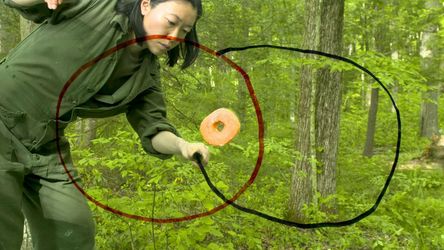
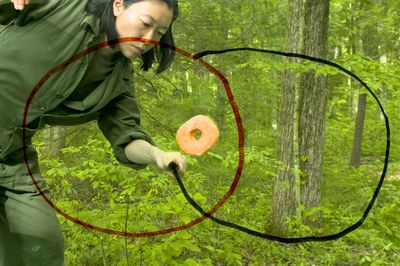
- The video Do Nut Diagram (2018) sees Sasamoto subverting the idea of the traditional “lecture” as a way of imparting information, drawing and annotating doughnut-shaped forms on a massive piece of glass, installed in the woods. (A real doughnut also features.)
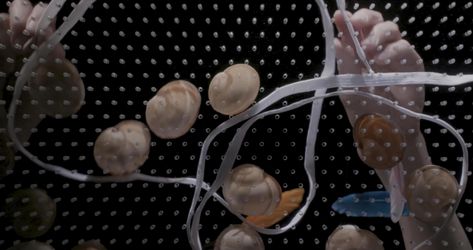
- Sink or Float (2022), Sasamoto’s installation for the 59th Venice Biennale turned familiar found objects—snail shells from her son’s collection, coffee cup lids, sponges, and more—into improvisational dancers. Industrial sinks were fitted with clear acrylic plastic sheeting and an air-conditioning system that blew air into the sink space and caused the objects to “dance”
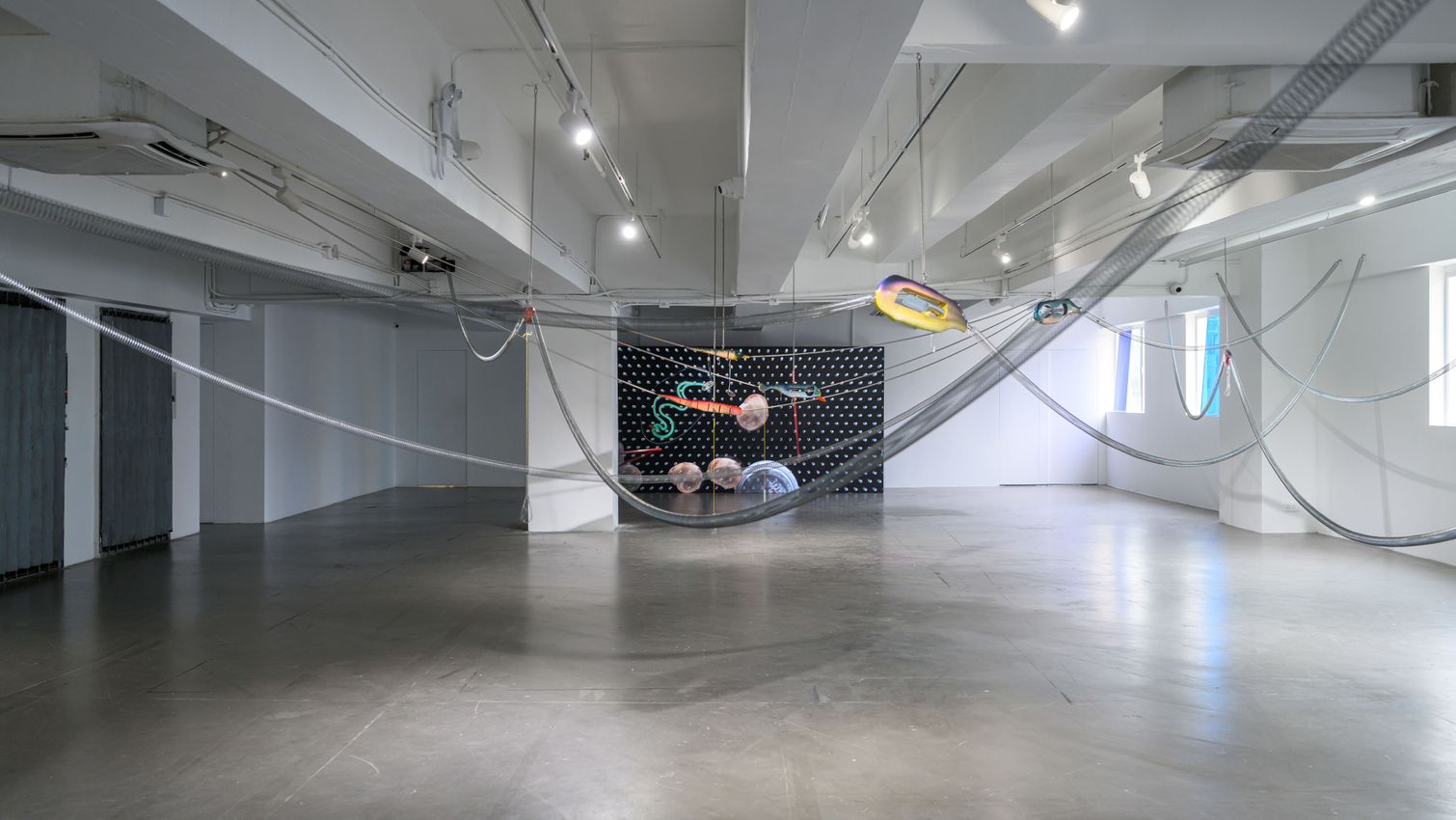
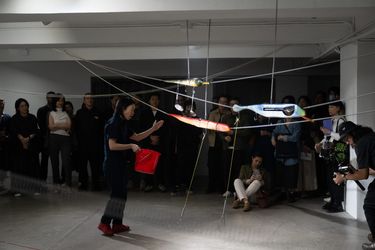
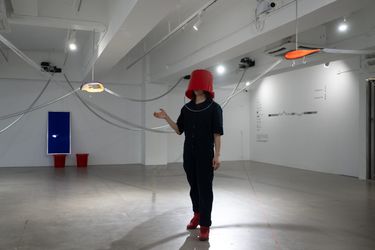
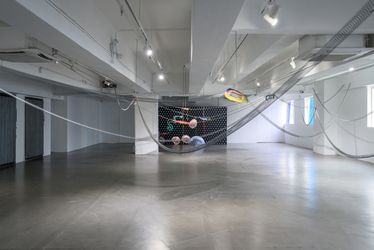
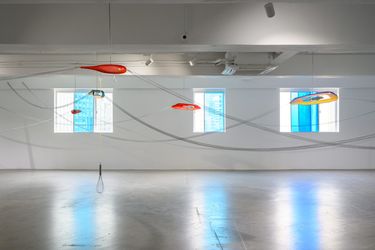
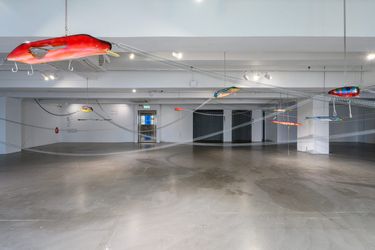
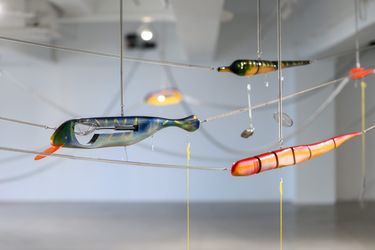
- Sounding Lines (2024, Hong Kong and New York City) featured large handmade fishing lures, stretched across the space on long sprints. Every so often, a motorised arm hit the spring, creating a wave through the lure. During live performances, the floating lures were moved around to create different harmonic patterns.
Aki Sasamoto: Exhibitions
Select Solo Exhibitions
- shed, HangarBicocca, Milan (2026)
- Grilled Diagrams, Studio Voltaire, London (2026)
- Aki Sasamoto’s Life Laboratory, Museum of Contemporary Art Tokyo, (2025)
- Sounding Lines, Para Site, Hong Kong and Bortolami, New York City (2024)
- Point Reflection, Queens Museum, New York City (2023)
- Squirrel Ways, American Academy of Arts and Letters, New York City (2023)
- Float Sink Float, Take Ninagawa, Tokyo (2022)
- Clothes Line, White Rainbow, London (2018)
- Delicate Cycle, SculptureCenter, Long Island, New York (2016)
Selected Group Exhibitions
- Poets of Physics, Museum of Contemporary Art and Design, Manila (2026), Philippines
- an archive and/or a repertoire, Tufts University Art Galleries, Boston (2025)
- Connecting Bodies: Asian Women Artists, National Museum of Modern and Contemporary Art, Seoul (2024)
- Still in Motion, San Jose Museum of Art, California (2024)
- 15, Take Ninagawa, Tokyo (2023)
- On Point, Herzliya Museum of Contemporary Art, Tel Aviv, (2023)
- Busan Biennale 2022: We, on the Rising Wave, Museum of Contemporary Art Busan (2022)
- Venice Biennale 2022: The Milk of Dreams, Arsenale, Venice (2022)
- Travelers: Stepping into the Unknown—NMAO’s 40th Anniversary Exhibition, National Museum of Art, Osaka (2018)
- Collection Asian Landscapes, 21st Century Museum of Contemporary Art, Kanazawa (2018)
- A Spoken Word Exhibition, Jeu de Paume, Paris (2013)
- Omnilogue: Journey to the West, Lalit Kara Academy, Delhi (2012)
- Greater New York: 5 Year Review, MoMA PS1, New York City (2010)
Further reading
- Aki Sasamoto’s official website
- Literature accompanying Delicate Cycle (2016)
- 2018 interview from Yale Daily News
- Article from Studio International about Aki Sakamoto’s installation at the Kochi-Muziris Biennale 2016
- 2018 interview from Living Content
Aki Sasamoto FAQs
Does Aki Sasamoto make site-specific installations?
Yes, Aki Sasamoto frequently creates site-specific installations: Random Memo Random at the Kochi-Muziris Biennale in 2017 featured a two-metre-deep hole with a trampoline at the bottom. The centrepiece of 2026’s Grilled Diagrams at Studio Voltaire in London was a custom-billed industrial griddle, surrounded by objects including a lemon wrapped in cord and 11 potatoes suspended from elastic.
What is Aki Sasamoto’s artistic practice?
Aki Sasamoto blends performance and installation, incorporating sculpture, collaboration and movement. Her installations and improvisations create situations where people and objects interact in unexpected ways, asking viewers to reconsider the relationship between body and space.
What are Aki Sasamoto’s influences?
Aki Sasamoto has spoken about her admiration for Swiss choreographer Yvonne Meier, with whom she has collaborated. She has also been interested in the work of American experimental composers Max Neuhaus and Alvin Lucier.
Did Aki Sasamoto really climb inside a washing machine?
Yes, in 2016’s Delicate Cycle, which Sakamoto performed at SculptureCenter in Long Island, she washed sheets, moved around the venue’s basement in circular movements, and climbed into the machine. She accompanied this with improvised monologue about childhood memory and other parts of her life.
Ocula

Explore Aki Sasamoto's Exhibitions



Representative Artworks
View exhibition
View exhibition
View story
View story
View story
View story








Explore and Follow Artists Shaping Contemporary Art
A respected voice in contemporary art discourse.
Focusing on ambitious storytelling and insightful art-world commentary. Ocula Magazine publishes in-depth interviews, critical essays and timely analysis on the artists, exhibitions and ideas driving the global art world.
Learn more about Ocula Magazine
Showcasing the best of the art world.
Ocula partners with galleries from around the world to highlight their artists, artworks and exhibitions. Gallery membership is by application and invitation, with each member vetted by an independent panel.
Learn more about Ocula Membership
Specialises in the sale of major artworks.
Led by a team with deep ties to the world’s leading auction houses, galleries and collectors. Ocula’s advisory team offers bespoke services to high-net-worth clients from around the world who are looking to acquire the best of contemporary and modern art.
Learn more about our team and services