





Griddle Me This
Life’s minutiae fascinate Aki Sasamoto, and her latest exhibition and series of improvised performances span cooking, drawing and considerations of life and death. Save to My Ocula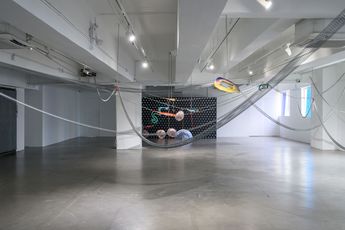
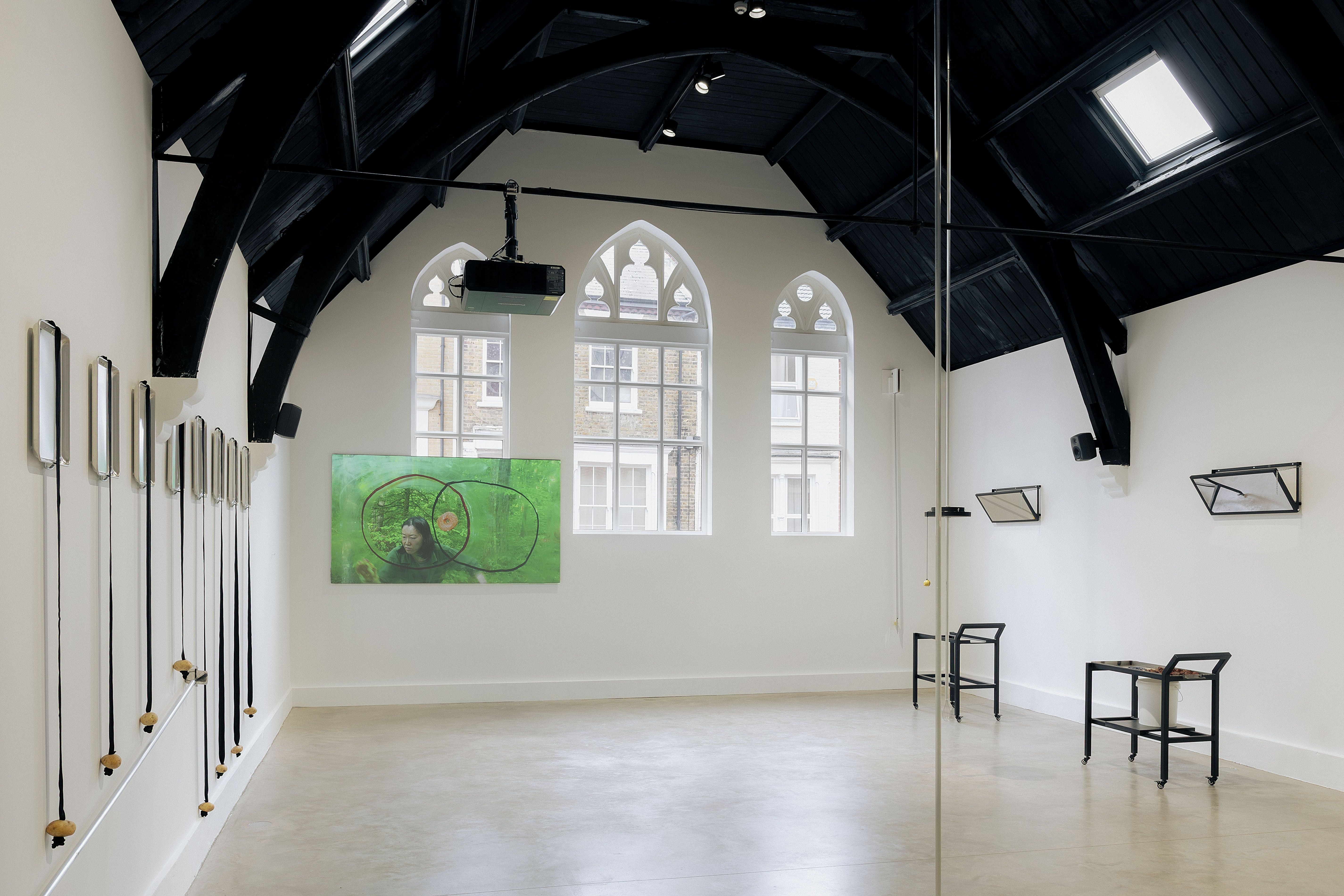
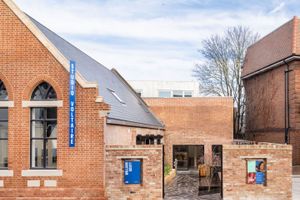
“It’s crazy how many things you can do with the potato,” Aki Sasamoto says. While attending a boarding school in Wales during the mid-1990s, she was struck by the endless formal permutations of the vegetable in the canteen food. “Every day there was a different form of potato: mashed potato, fried potato, jacket potato, the curly one, a latke-like thing…” She laughs. “It’s like, how many different versions can there be?” I meet the Japanese artist at Studio Voltaire in London on a rainy day in February 2026 and she’s visibly amused, having just been given a hardcover copy of 1977 recipe anthology The Potato Cookbook, filled with countless ways to prepare the humble vegetable. It’s an inside joke on the occasion of Sasamoto’s latest solo exhibition opening, which spans her sculpture and performance-based practice—a nod to the 11 potatoes that have been pierced like beads by Sasamoto and suspended on irregular lengths of elastic.
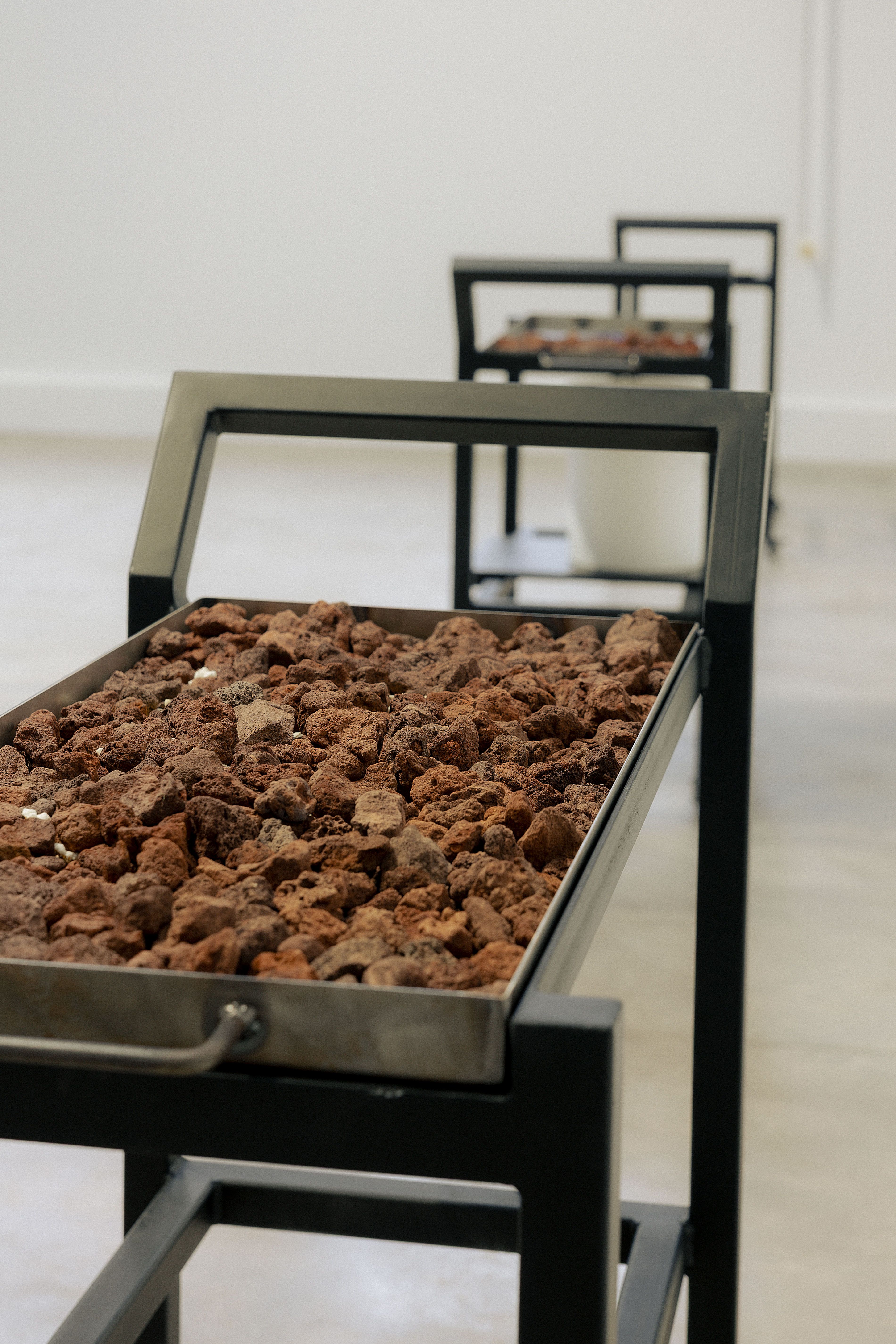
Titled Grilled Diagrams, Sasamoto’s exhibition feels like a catering joint on steroids. Devoid of performers, it reads as a stage set lying in wait for its star act. The centrepiece is a three-metre-long, custom-built griddle station housed under a stainless steel canopy, with two voluminous extractor vents stretching up like antennae into the vaulted ceiling of the Victorian-era former mission hall. Elsewhere in the space hangs a solitary lemon, wrapped with a black cord and suspended on a round disc (which, as I later discover during her performance staged on the night following the opening of the exhibition, can rotate at speed); an elongated whisk and kitchen knife; and a trio of industrial catering trolleys filled with coloured glass gems, piles of volcanic rock and popcorn.
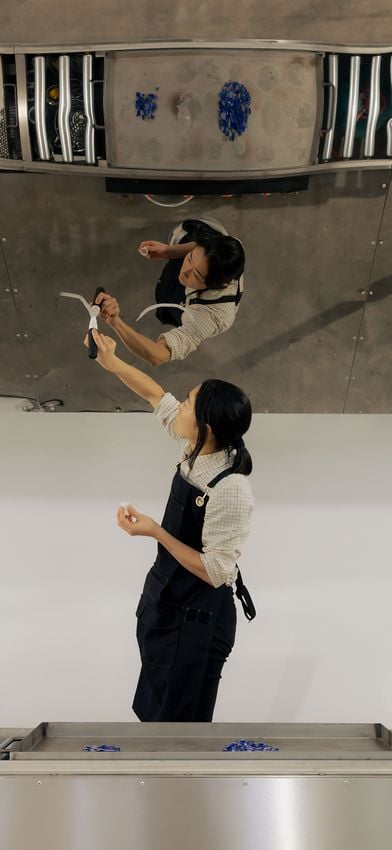
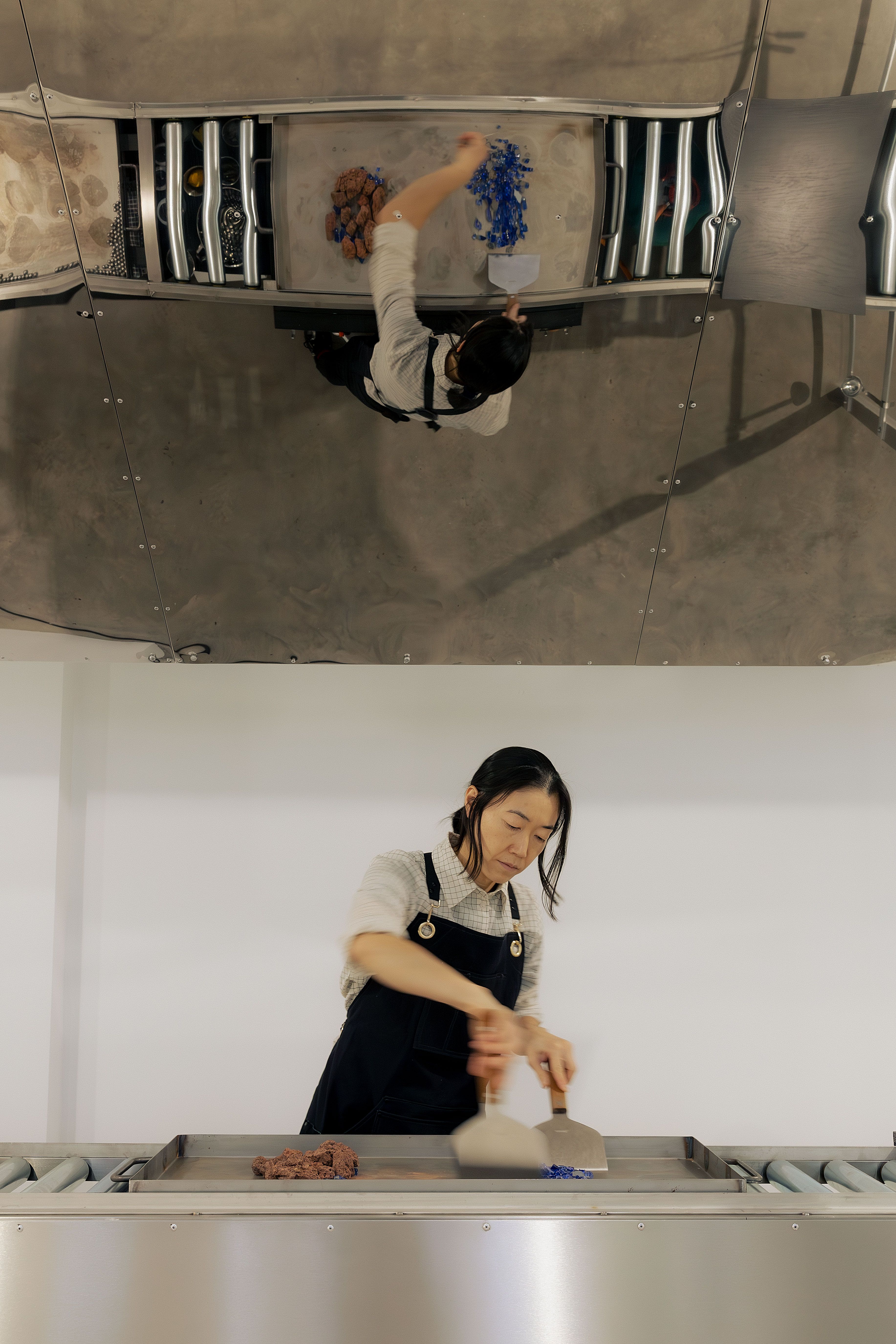
While there is a sterility to the show in its dormant state, the space contrastingly becomes messy during Sasamoto’s improvised live performances. On one evening in February, Sasamoto stepped into the centre of the crowded gallery, her petite stature comically at odds with the absurdly outsized culinary infrastructures. She began by pulling and smashing the potatoes against a series of steel trays that served as the counterweight in their suspended state, resulting in several of them breaking apart on impact with a satisfying thud. She proceeded to scribble puzzling notes and doodles with whiteboard markers on to mirrors installed high on the walls (“How to find/How to form” on one; the word “Density” and the outline of what could be a winding river on another), and used an elongated, mechanically powered whisk to mix an unidentifiable (and inedible) batter, before frying up pancakes with said batter on the griddle.
“I never plan what to say. That’s how I find out what this work does for the live body”
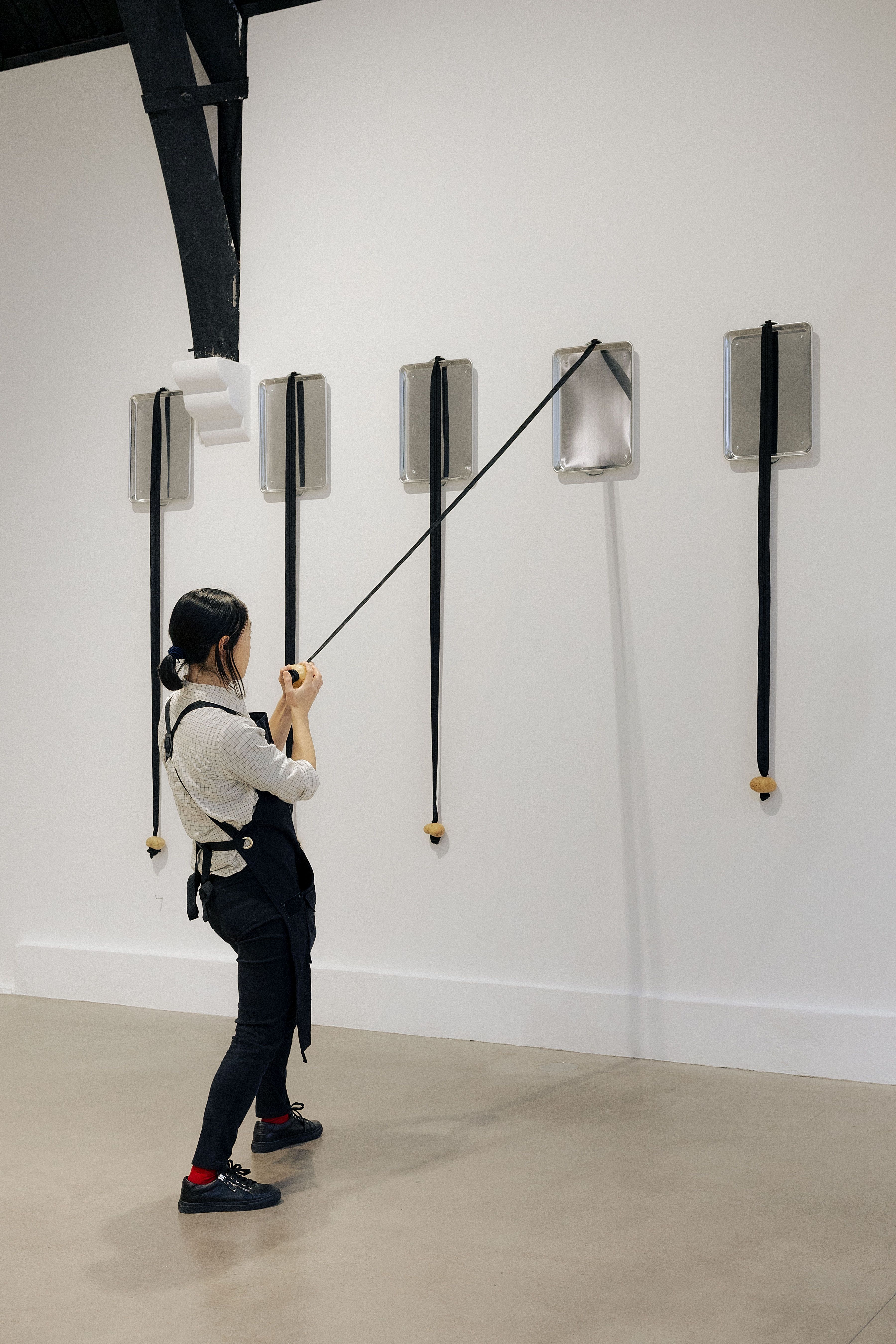
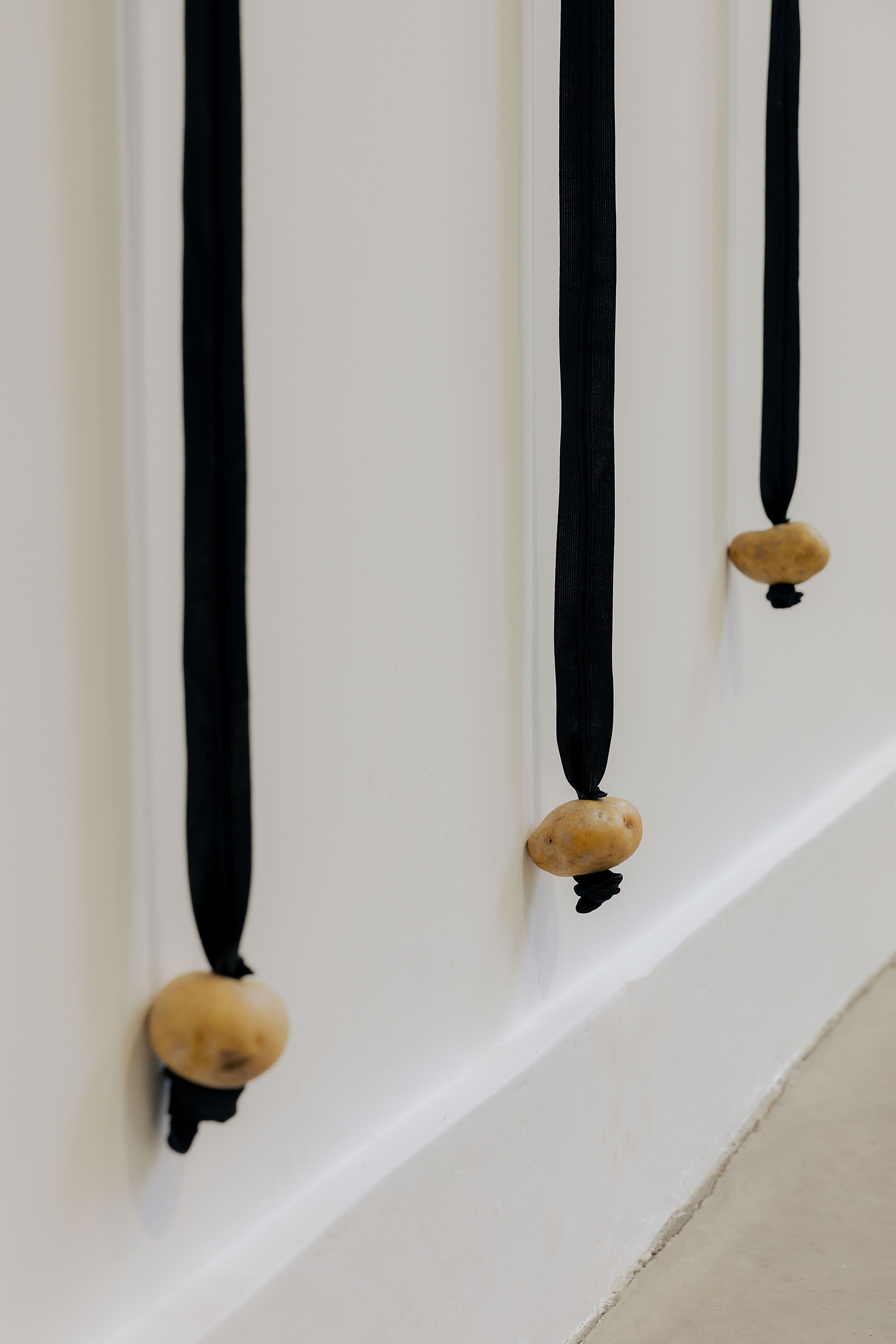
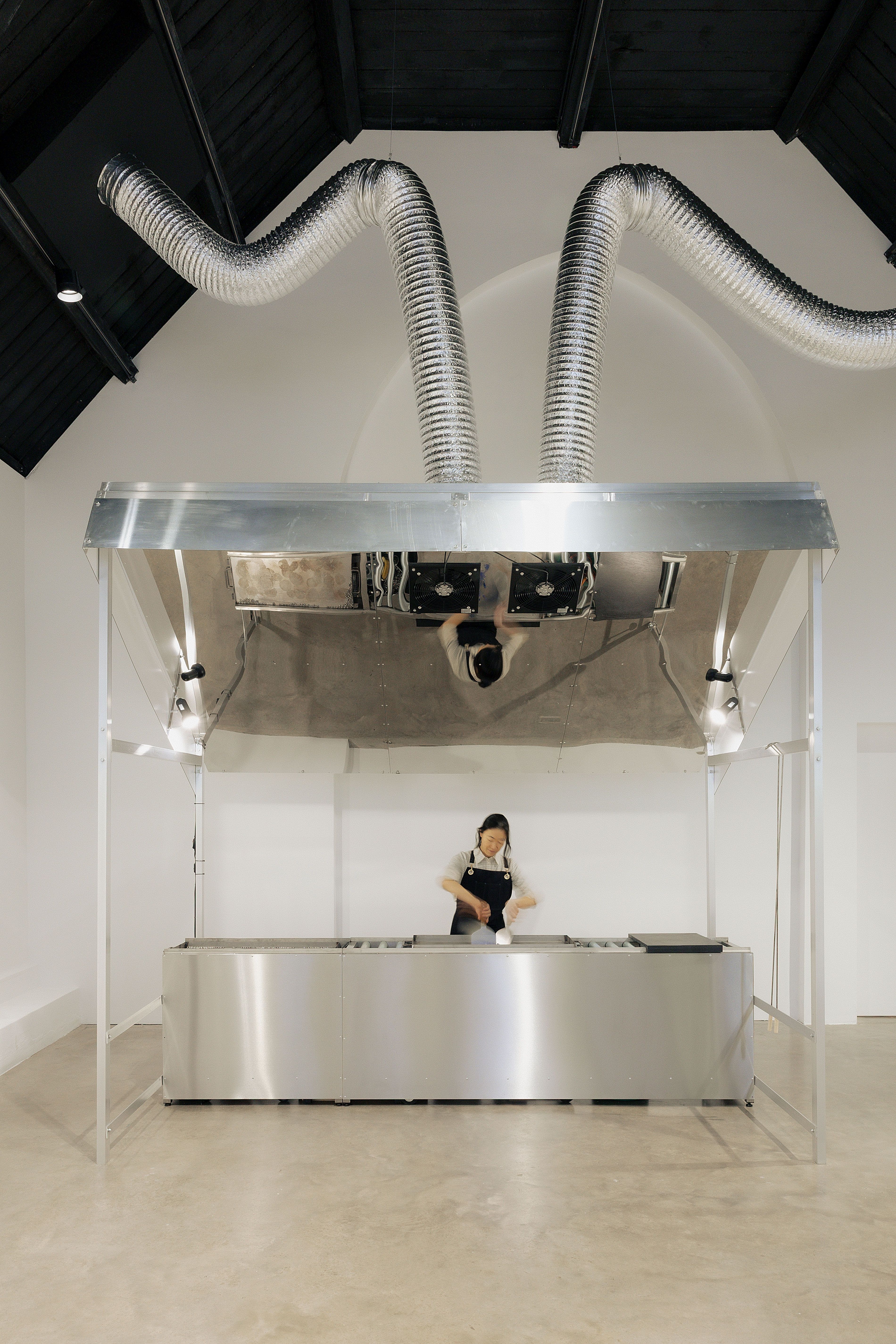
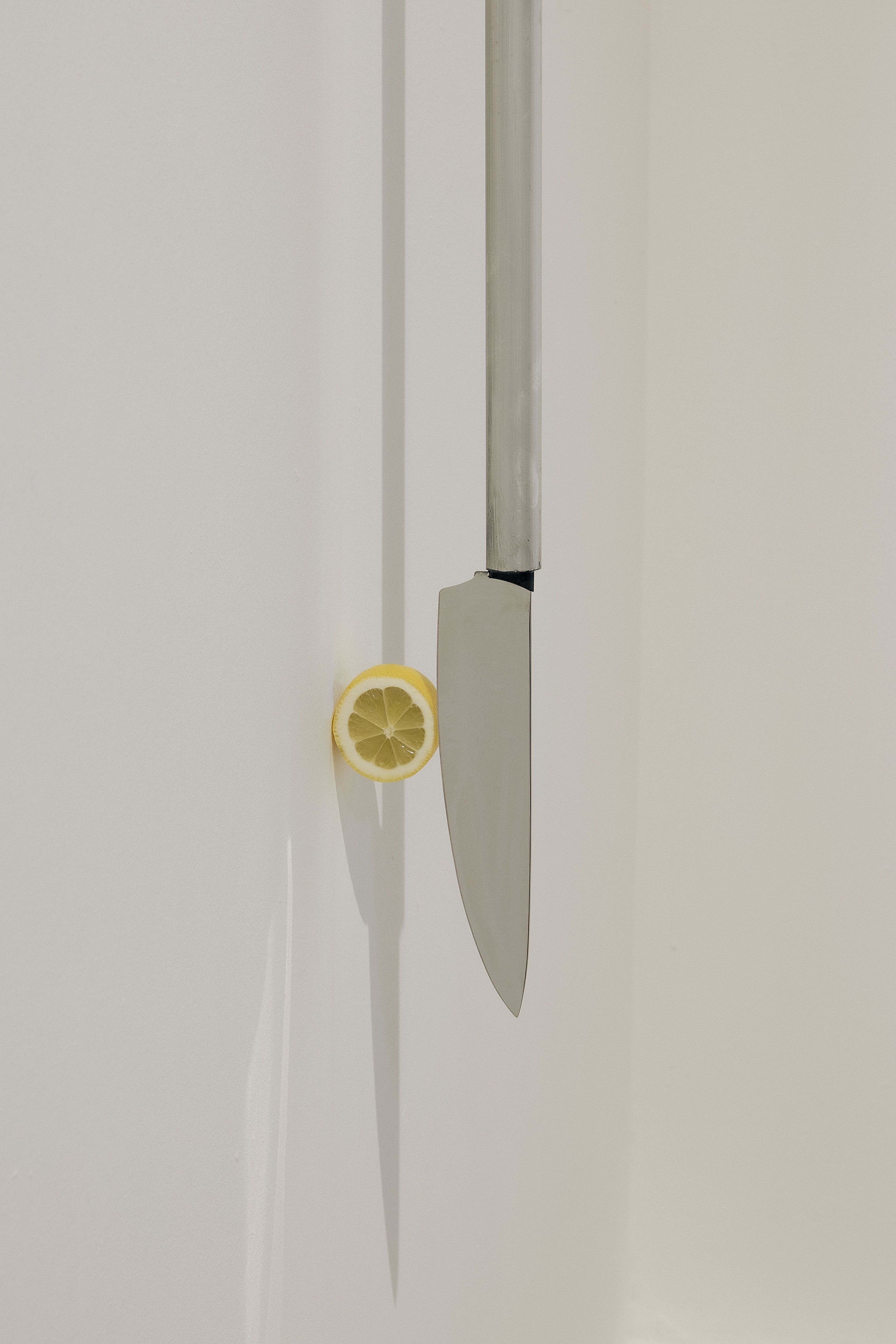
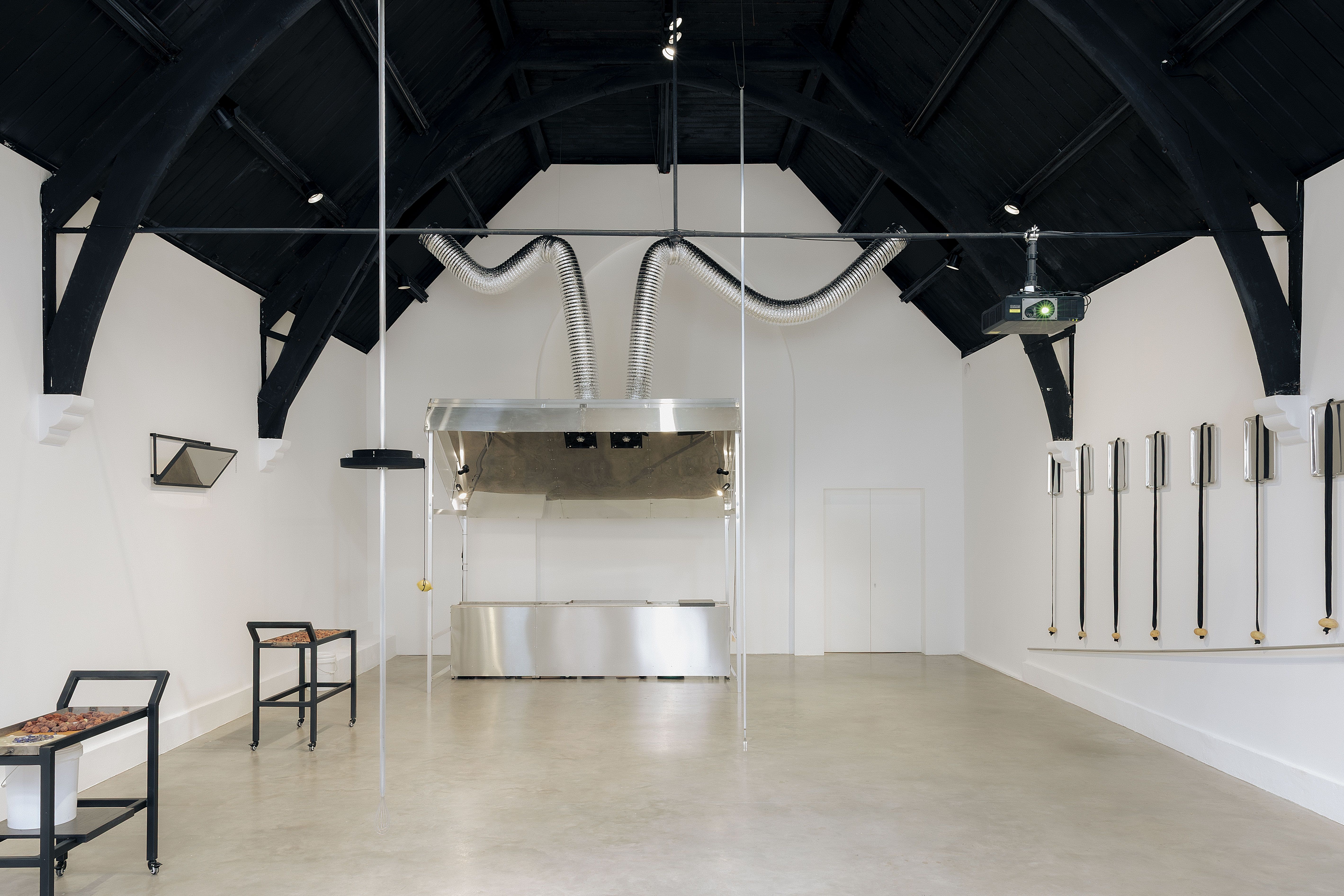
She cleanly sliced a wall-fixed lemon with a guillotine-like knife, while intermittently monologuing about rocks and minerals (“Now I want to find a rough stone”), reconnecting with an old roommate in London, and the recent deaths of two close friends (“One of them was buried and one was burned”). “The idea is that it’s already written in the installation,” Sasamoto says of her approach to improvisation, with the sculptures forming the blueprint for her actions. “I never plan what to say. That’s how I find out what this work does for the live body, the performing body, on the spot.”
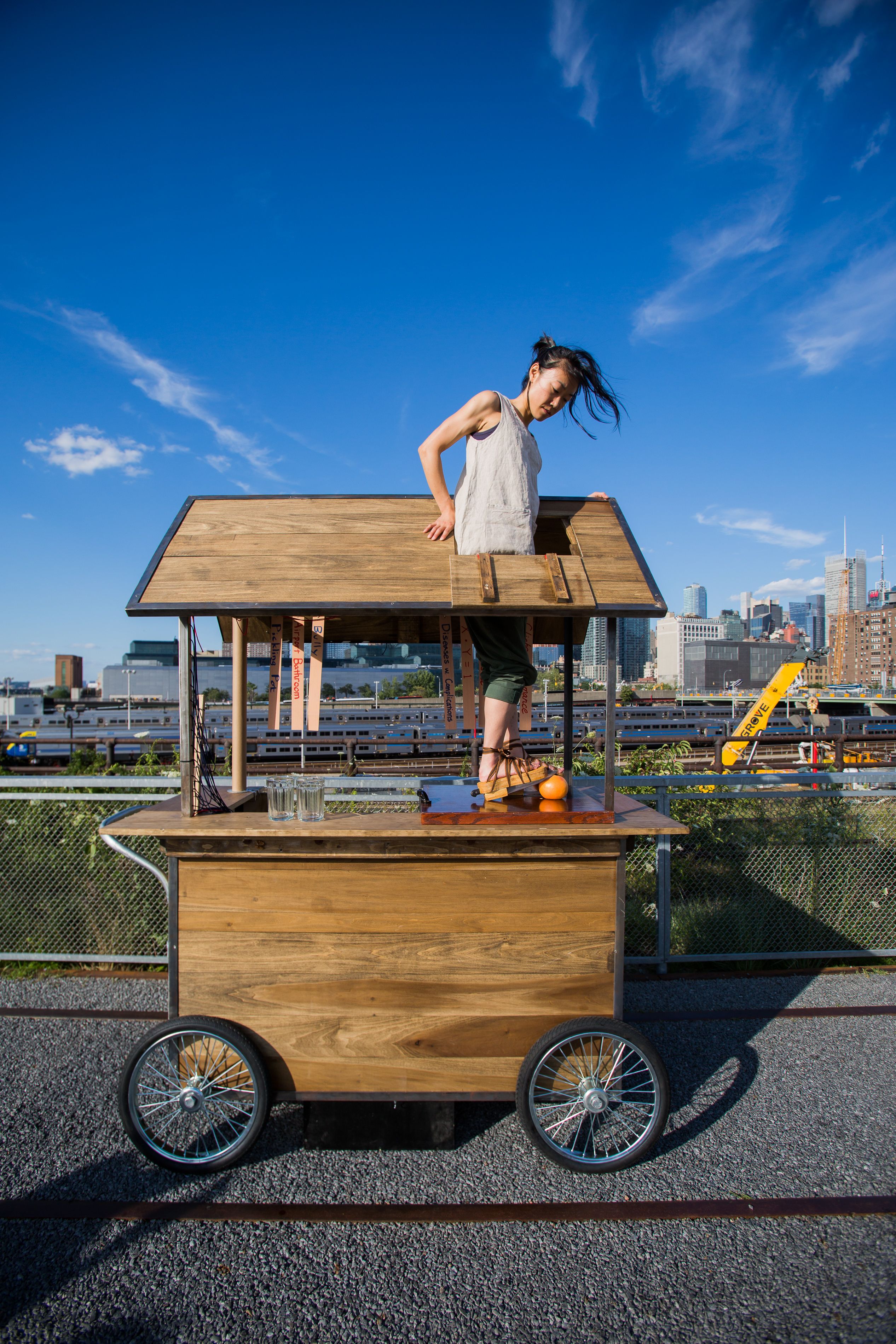
Food has frequently featured in Sasamoto’s works; the ubiquity of the materials and their associated preparation processes are an entry point through which to complicate an expectation of order and rationality, but also a vehicle for thinking about permutations of form. “I guess it’s all just material,” she says. Her early performance cooking show (2005) sought to pull apart the fragmented logic of cookbooks and cooking shows, while in 2015, she performed Food Rental at NYC’s High Line, orienting herself around a custom-built food cart for a “menu” of micro-performances from which audience members could order.
“The closest pub was a 40-minute walk away. You’d only see your school mates and sheep”

Sasamoto’s video performance Do Nut Diagram (2018), which features in the exhibition at Studio Voltaire, shows the artist as a pseudo-lecturer amid a verdant forest setting, making annotations and drawing a Venn diagram on a transparent screen. At one point, a single, plain doughnut is suspended in the centre of the screen; later, an insect is seen traversing its glazed surface. Subverting the didactic function of the lecture-presentation, Sasamoto questions what happens when systems for categorising information are stripped of their semantics, instead becoming something closer to free association.
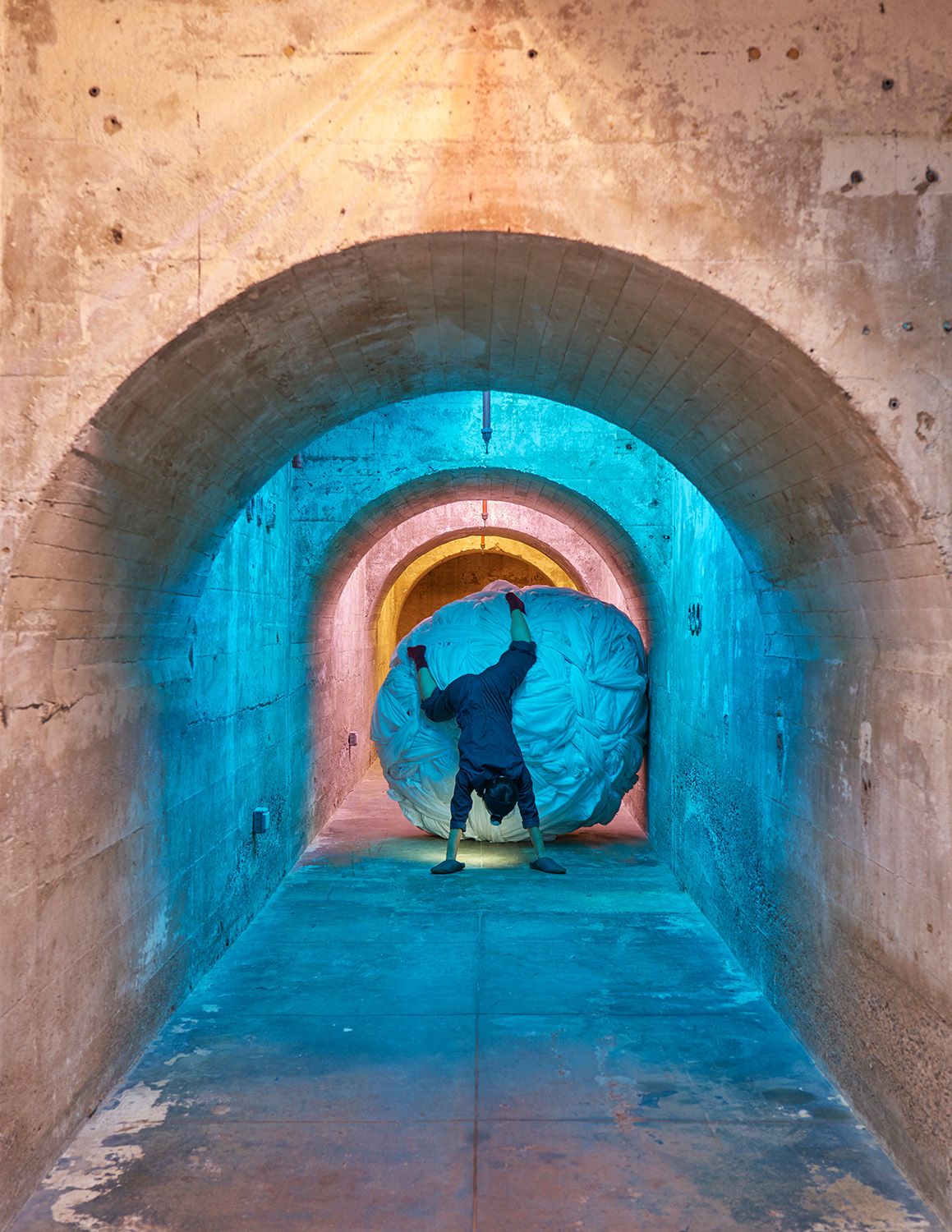
As a teenager growing up in Yokohama during the 1990s, Sasamoto knew already that Japan wasn’t where she wanted to be. “I didn’t have a direction, but I had a lot of energy,” she says. “I was rebellious in a way that made Japanese society very hard. First, I was a woman, but I also didn’t understand my queerness at the time. I had a very hard time dealing with the environment I was in.” During her time in Wales, Sasamoto found advantage, not restraint, in the remoteness of her school, located in Llantwit Major, overlooking the Bristol Channel. “The closest pub was a 40-minute walk away. You’d only see your school mates and sheep. I think that isolation worked to take away certain types of stimuli and really let you focus on dealing with that microcosm, rather than being buried in a very big world.” That same granularity of perception, with a reverence for the minutiae of life, remains evident in Sasamoto’s practice, whether she is scaling up the activities of dung beetles, as in her 2016 performance with an outsized ball of bedsheets, Delicate Cycle, or examining the direction of spirals in snail shells in Point Reflection (2023).
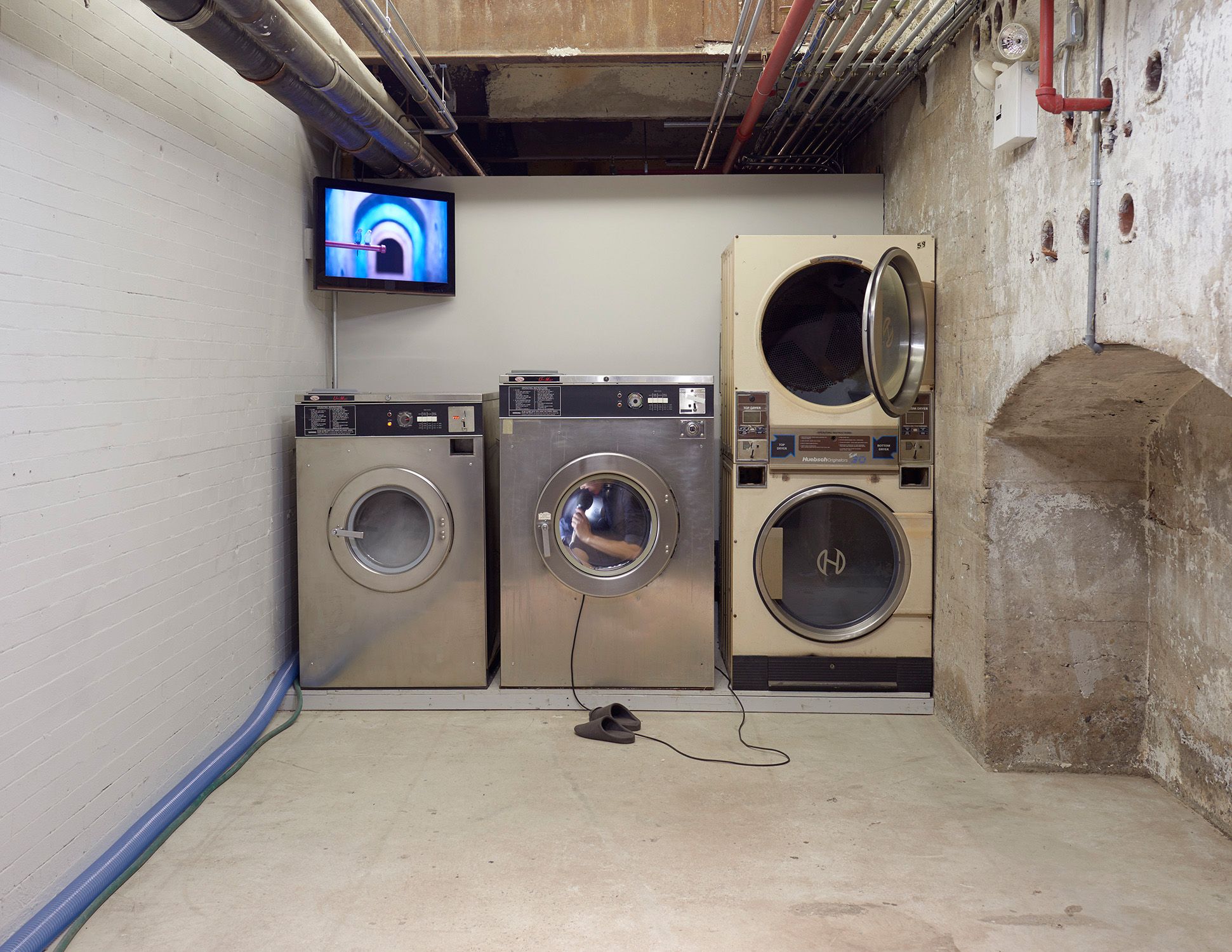
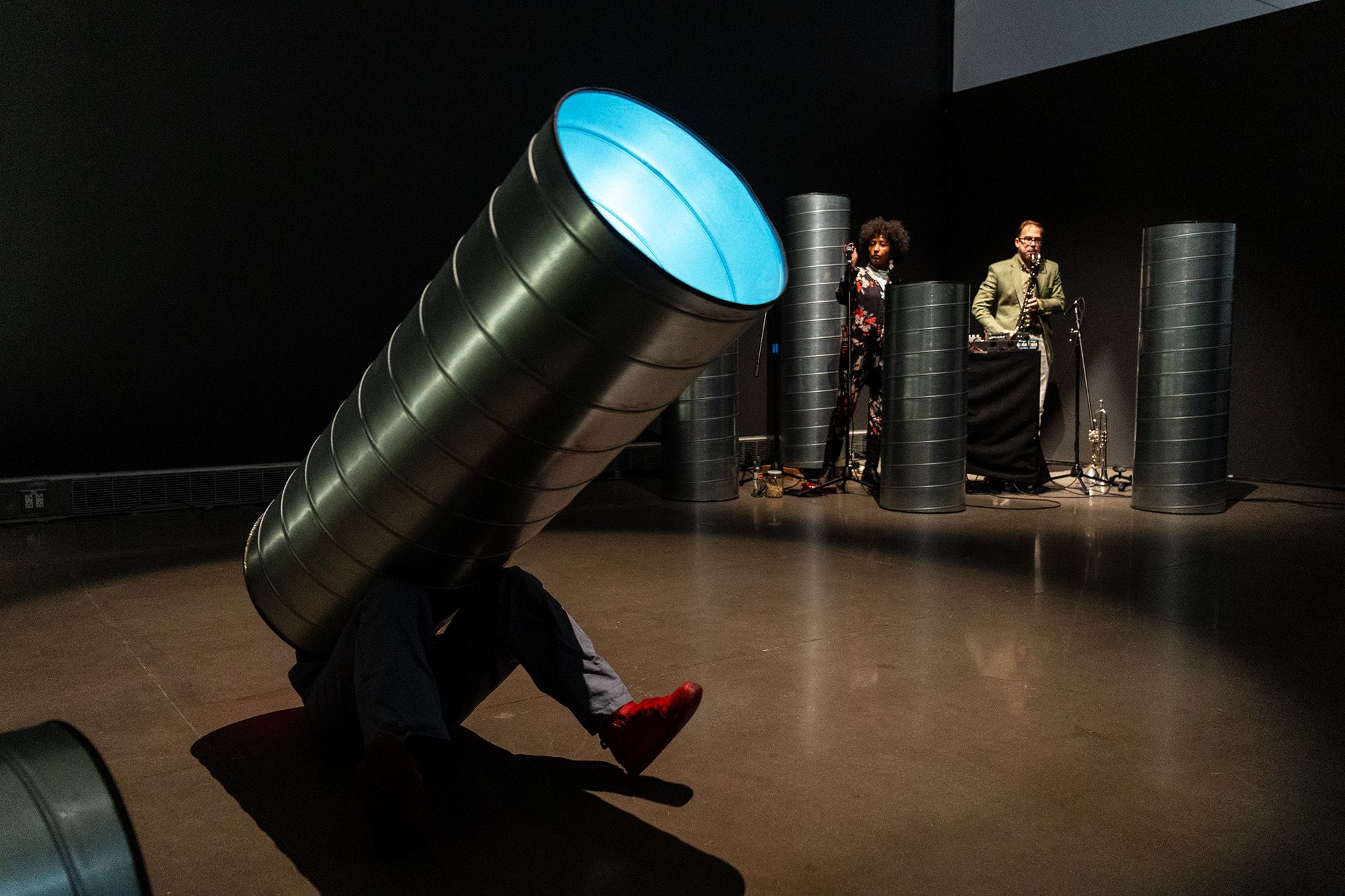
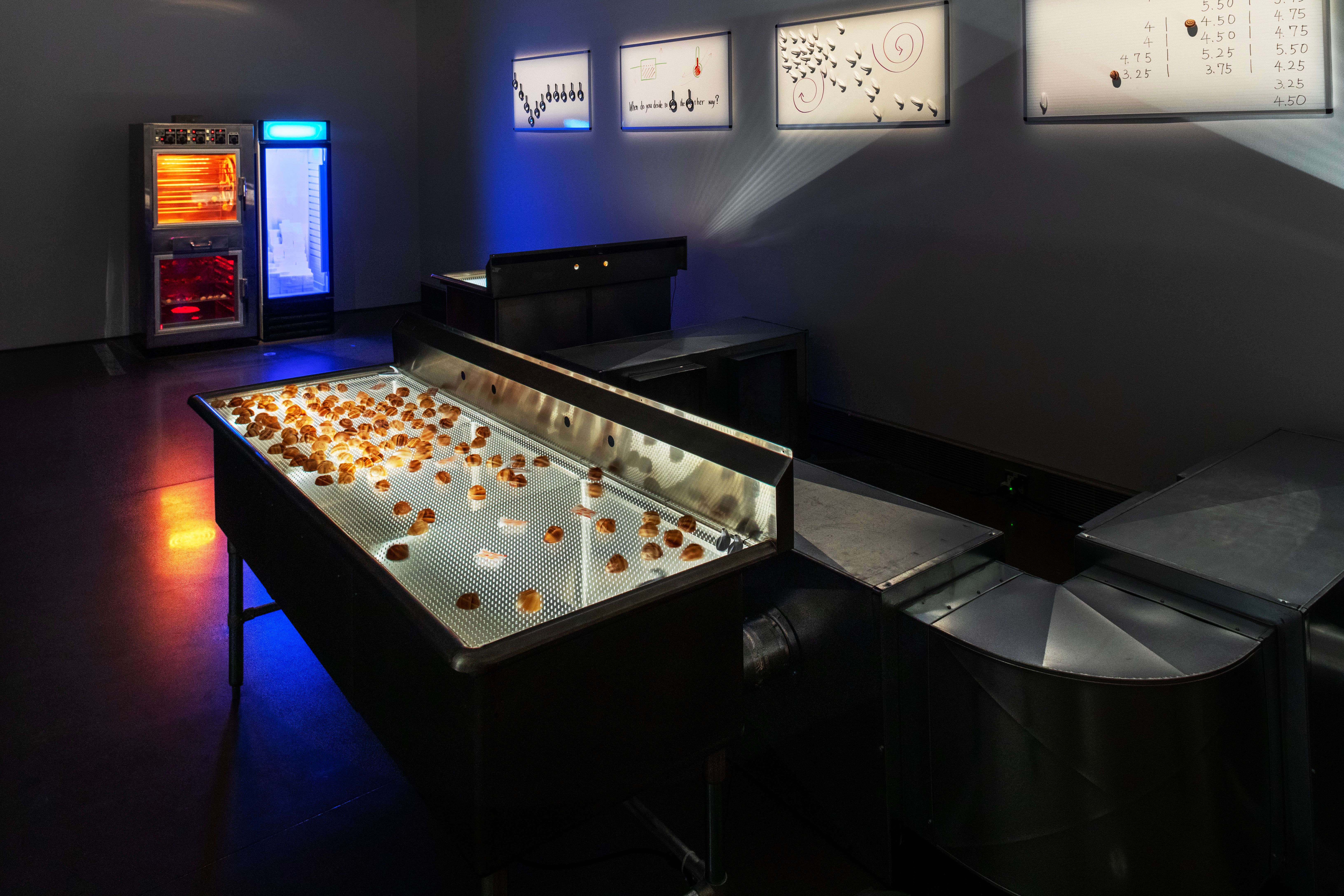
After returning to Japan in her late teens, Sasamoto moved to the United States on a mathematics scholarship to study at Wesleyan University, “a very artsy, creative college” in Connecticut. With an interest in subjects ranging from psychology to physics to history, she found herself immersed in everything on offer yet increasingly alienated from the discipline and rigour of maths. “I really didn’t have any direction—that’s why I ended up in art, totally unplanned,” she says. A move to New York in pursuit of joining the city’s improvisational dance and performance art scene led her to work with one of her major influences, the Swiss contemporary choreographer Yvonne Meier, with whom she collaborated on multiple dance performances. “In the early 2000s, there was a lot more creative exchange,” she reflects. “That energy drew me in.”
Sasamoto continued to perform and make work in the city for some two decades, fluidly moving between the disciplines of art, dance and theatre, exhibiting in the likes of SculptureCenter, Soloway and the Whitney Museum, and performing in spaces including Danspace Project and Chocolate Factory Theater. In recent years, she has based herself in New Haven, Connecticut, where she has taught sculpture at the Yale School of Art since 2018. She lives with her partner (also a sculptor) and her seven-year-old son Ray, a pivotal influence in her life and practice and the commandeer of her preoccupation with minerals. “My kid is into rocks, so I ended up doing that with him. It’s been happening the past five, six years,” she says. “His obsession then becomes mine. We’ll go to the library and read about rocks.”
“I didn’t have a direction, but I had a lot of energy”

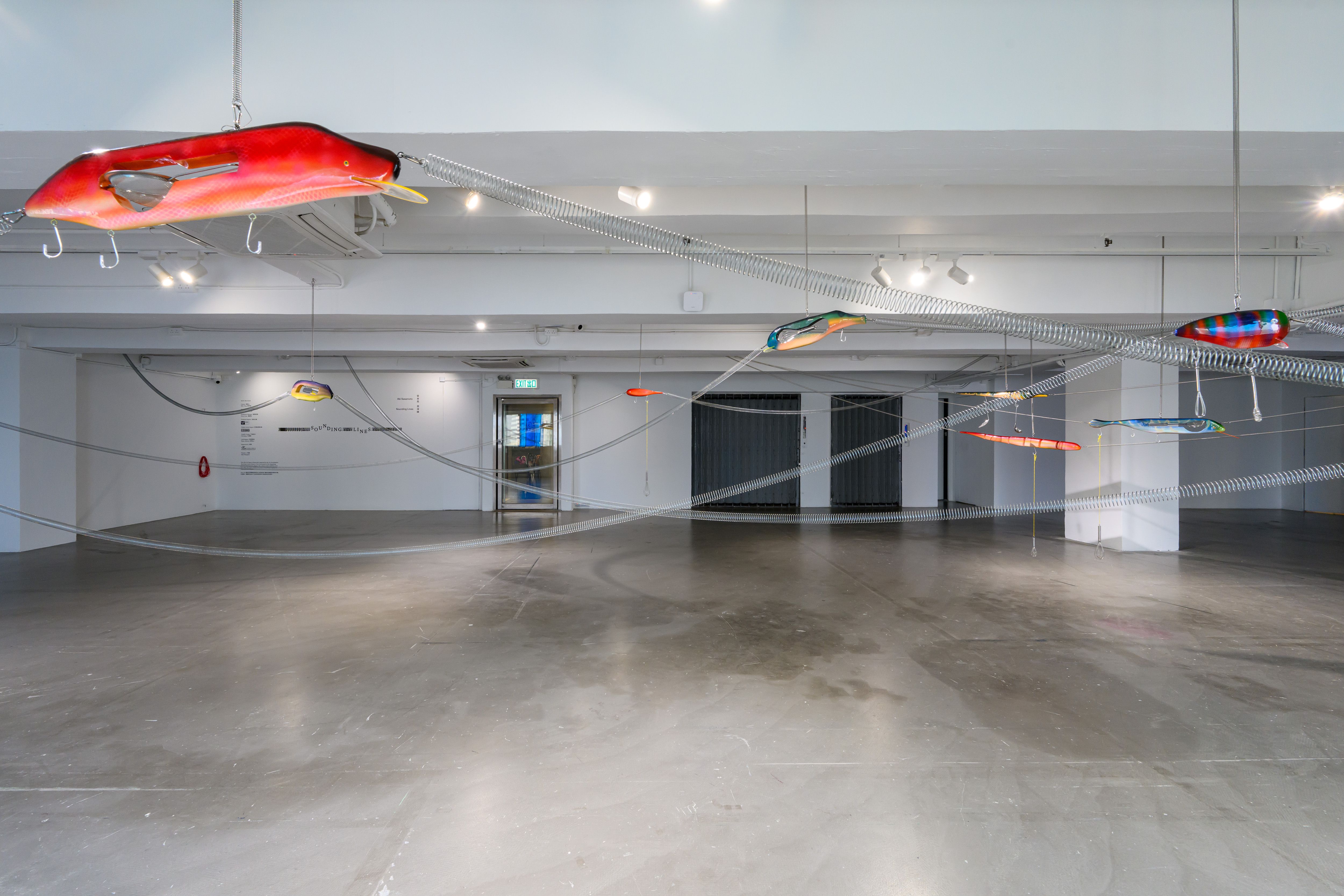
The colourful fishing lures used by anglers, which are often shaped like miniature fish, also entered her sculptural vocabulary through her family’s shared enjoyment of fishing. “We started to make lures, and [my kid] wanted to go bigger. So at some point we started to make a really big lure,” she laughs. “He has good ideas.” Sounding Lines, Sasamoto’s 2024 solo show at Hong Kong’s Para Site was the manifestation of this activity: a hanging installation of enlarged fishing lures and objects like kitchen utensils, connected by a web of motorised coiled springs.
As an educator as well as an creator, she advocates for the importance of demythologising the concept of a pure career artist. “I have a kid, and I’m teaching, and I’m making work. It’s very important for younger people to see all of that,” she says. Yet, as she makes clear, it is precisely these kinds of questions around real-life practicalities, and the continued to drive to make work, that are the most important when it comes to sustaining a creative practice. “Maybe that doesn’t feel very philosophical or whatnot, but it’s important to show—hey, longevity is possible.” —[O]
Main image: Aki Sasamoto, Do Nut Diagram (2018) (still). Courtesy the artist and Take Ninagawa.







A respected voice in contemporary art discourse.
Focusing on ambitious storytelling and insightful art-world commentary. Ocula Magazine publishes in-depth interviews, critical essays and timely analysis on the artists, exhibitions and ideas driving the global art world.
Learn more about Ocula Magazine
Showcasing the best of the art world.
Ocula partners with galleries from around the world to highlight their artists, artworks and exhibitions. Gallery membership is by application and invitation, with each member vetted by an independent panel.
Learn more about Ocula Membership
Specialises in the sale of major artworks.
Led by a team with deep ties to the world’s leading auction houses, galleries and collectors. Ocula’s advisory team offers bespoke services to high-net-worth clients from around the world who are looking to acquire the best of contemporary and modern art.
Learn more about our team and services