In Christian art and literature, the garden is a sacred space. From the Garden of Eden in Genesis, it serves as a complex symbol concerning the origin of human existence, the awakening of knowledge, moral choice, eternal loss, and spiritual return. In the modern era, the garden motif continues to embody the enduring pursuit of beauty while also becoming intertwined with critiques of social class. However, as Yi-Fu Tuan argues, the garden is by no means a gift of nature or divine providence, but rather a man-made creation. Its seemingly harmless, playful atmosphere, exquisite aesthetics, and religious connotations successfully conceal its reliance on power.
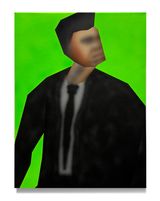
Gao Hang creates paintings using an airbrush, blending visual styles such as 3D-rendered models, low-pixel aesthetics, and vector polygons. On fluorescent, solid-colored canvases reminiscent of system default backgrounds, he simulates the aesthetic texture of early digital screens. Titled The Garden of Humans, the exhibition literally showcases Gao Hang’s observations of contemporary humanity: a vibrant collection of self-presentations in which people on social media compete for attention like flowers vying to outshine one another. It is also a virtual garden, a hybrid space interweaving diverse cultural objects and specimens from art history. The gallery itself becomes a simulator that emphasizes the garden’s artificiality, attempting to alert viewers to the underlying power structures within the digital realm while prompting reflection on propositions of authenticity and truth in the construction of civilisation and technological development.
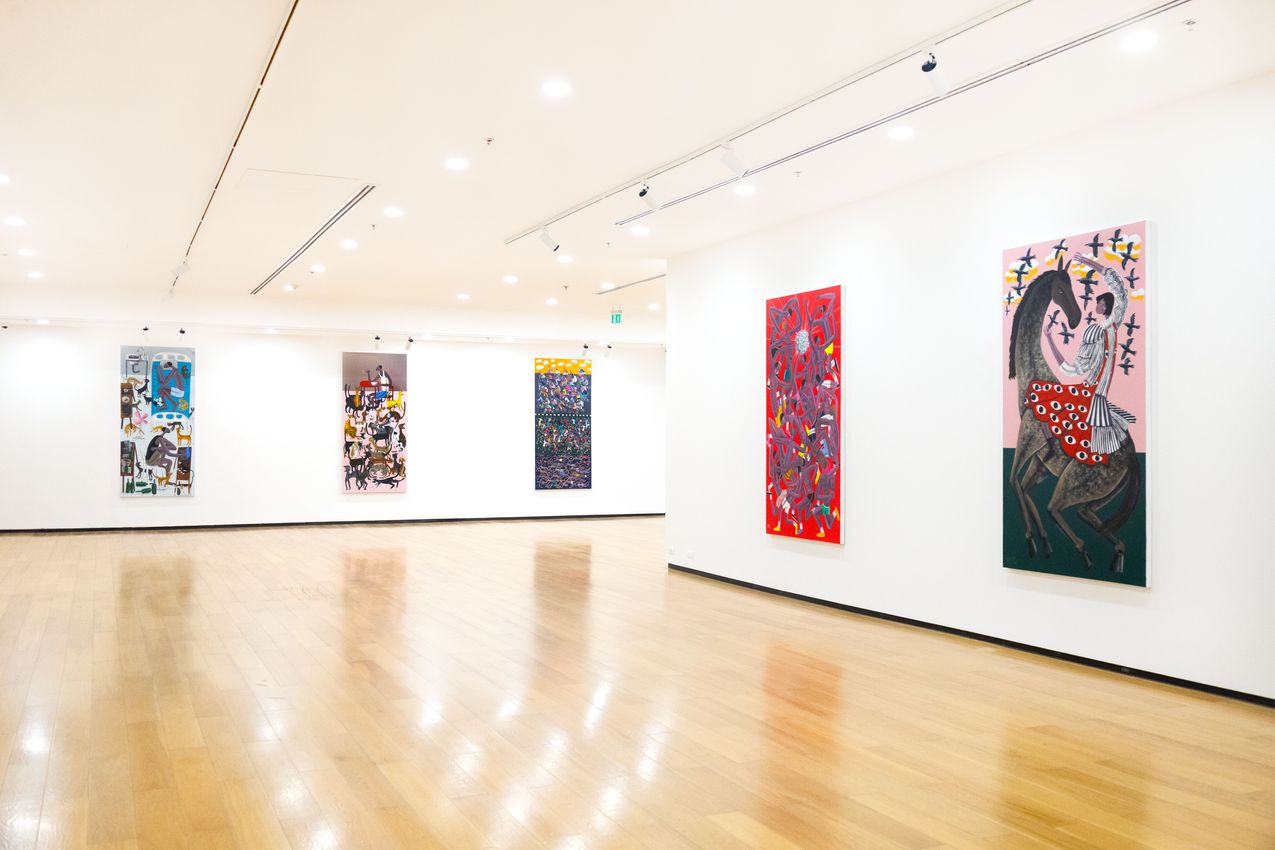
Within the exhibition space, Gao Hang’s figure paintings each occupy their own territory on the walls, displaying their postures to the fullest extent. From the fashionable fusion of traditional Asian medical treatment and modern mental illness within a Western social context depicted in Acupuncture Cures Depression, to the sexualized display of the body in Angel of the Day, the gallery embodies the artist’s abstract insights into mass behavior on social media: “In this infinitely expanding network volume, radiant personalities with ‘fluorescent colors’ compete for attention, using exaggerated and peculiar postures to retain fleeting traffic.” This phenomenon corresponds to what Byung-Chul Han calls a ‘carnival of display’: in a display society driven by traffic, individuals who appear to be freely expressing themselves are, in reality, engaged in voluntary self-exploitation and compulsive performances of ‘authenticity.’ When people constantly require recognition from others to validate their own existence and value, display itself becomes alienated into a form of performance and labor. The stiff, sharply defined figures in Gao Hang’s works are products of this ‘compulsion for authenticity.’ The incongruity and affectation revealed in their movements stem from the distortion caused by friction between individual vitality and digital discipline. This garden of humans thus becomes a microcosm of contemporary meritocracy: seemingly vibrant flowers bloom, yet each is invisibly pruned by the shears of an algorithmic gardener, forming a lifeless, plastic flowerbed. As the boundary between displayed life and real life becomes increasingly blurred, the very concept of reality itself grows ever more suspect.
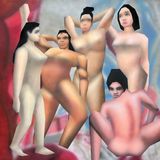
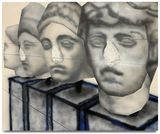
Gao Hang’s Garden of Humans is also a site where time and space intermingle. Different historical periods intersect with fragments of contemporary life, assembled and displayed within imagined scenes. Continuing his core concept of ‘Digital Primitivism,’ the artist employs the visual language of the early stages of virtual civilisation. Through a process that resembles archaeological excavation and parody within art history, the visual archive of human emotions, thoughts, beliefs, and desires, he attempts to unearth obscured clues about the human condition in contemporary life. Viewers navigate hybrid samples from different stages of civilisation from a perspective akin to a 3D game: Picasso’s Les Demoiselles d’Avignon transformed into Les Demoiselles d’Playstationtwo; ancient sculptures unearthed in early modern Italy reappearing in So Ancient Romans Don’t Have Noses; and microcosms of contemporary culture concerning youth, race, and sociality interwoven throughout. This approach reminds us that art history itself is a constructed and critiqued artifact, one that systematically integrates continuity within change and difference, while also attempting to explain change through continuity.
An Ancient OX offers a direct representation of Gao Hang’s ‘cave painting for internet civilisation.’ The hunting scenes on the walls of the Lascaux caves mirror humanity’s primal impulse for new modes of expression. It is precisely during moments of technological rupture or transformation in painting methods that humanity’s most authentic needs and responses are revealed. Here, art history and the history of technological development intertwine, compelling viewers to return to Gao Hang’s civilisational self-awareness, termed ‘Digital Primitivism’: how do new technological media shape our ways of seeing, understanding, and representing the world? Can the legacy of early digital culture become a vessel for reflecting on contemporary technological alienation? In today’s era of rapidly evolving AI technology, Gao Hang endows the history of digital civilisation with a cultural-anthropological dimension, attempting to preserve the pioneering spirit and primal passion of early technological development within the broader understanding of civilisational progress.
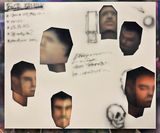
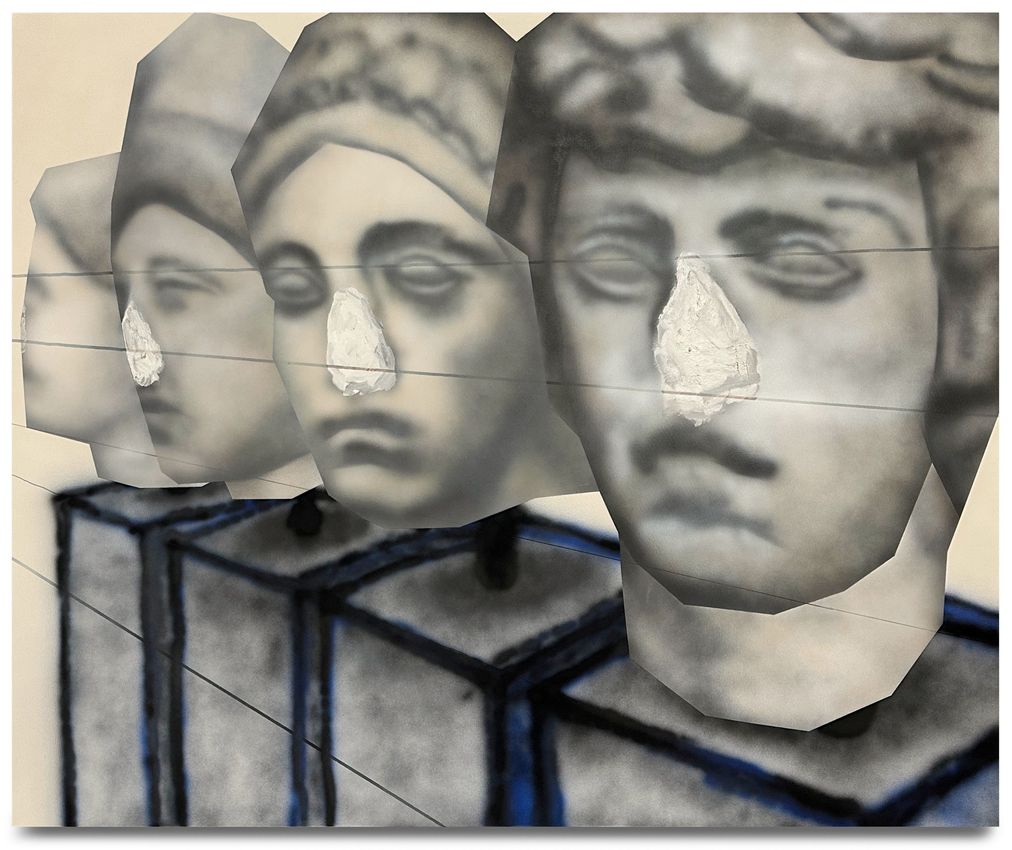
In his new work Head Study, Gao Hang introduces the act of drawing, juxtaposing rough, multi-angle 3D-rendered heads with blurred handwritten marks. The former is generated by algorithms, while the latter constitutes the physical trace left by the artist’s repeated contemplation and experimentation. This contrast gives rise to a sharper existential inquiry concerning our credence in the world we inhabit. As the very existence of truth has been challenged by thinkers such as Jean Baudrillard and Nick Bostrom, viewers are confronted with a fundamental question: is the reality we perceive, and the life we live, merely part of a grander simulation? As the world on screen evolves from crude representation to verisimilitude, Gao Hang perceives that both technology and painting, in this context, become tools, or byproducts, of self-exploration. Even if our world were merely a virtual construct created by a higher life form, this paradoxically renders ‘the world before our eyes’ sufficiently real: it is the only world accessible to us, and therefore deserving of deep study and understanding. Through this lens, we may recalibrate our credence in the nature of reality itself. Gao Hang’s virtual garden of spectacle, a hybrid space of cultural codes, is inherently absurd and playful, like a glitch flashing within consistency and continuity. By deliberately creating these subtle ruptures, the artist allows viewers to glimpse a space closer to the harsh truths underlying the development of technological civilisation.
Gao Hang (高航) is a Chinese artist now living and working in Houston, Texas. Gao illustrates modern human online behaviours with a sense of humour and absurdity while ironically commenting on the people’s need for instant gratification on digital screen. His recent solo exhibitions were shown in major galleries in America and Europe, including The Hole Gallery in New York; Waluso Gallery in London; Pulpo Gallery in Murnau, Germany, and L21 Gallery in Palma, Spain. Gao’s artworks and articles were covered in global publications such as L’Officiel, Artforum, Art in America, The Hypebeast, and RADII.


Tang Contemporary Art was established in 1997 in Bangkok, later establishing galleries in Beijing and Hong Kong. Tang Contemporary Art is fully committed to producing critical projects and exhibitions to promote Contemporary Chinese art regionally and worldwide, and encourage a dynamic exchange between Chinese artists and those abroad.

A respected voice in contemporary art discourse.
Focusing on ambitious storytelling and insightful art-world commentary. Ocula Magazine publishes in-depth interviews, critical essays and timely analysis on the artists, exhibitions and ideas driving the global art world.
Learn more about Ocula Magazine
Showcasing the best of the art world.
Ocula partners with galleries from around the world to highlight their artists, artworks and exhibitions. Gallery membership is by application and invitation, with each member vetted by an independent panel.
Learn more about Ocula Membership

Specialises in the sale of major artworks.
Led by a team with deep ties to the world’s leading auction houses, galleries and collectors. Ocula’s advisory team offers bespoke services to high-net-worth clients from around the world who are looking to acquire the best of contemporary and modern art.
Learn more about our team and services