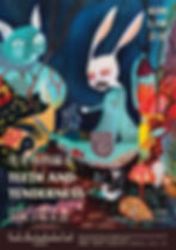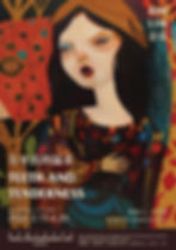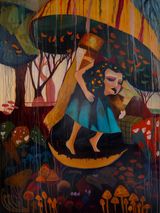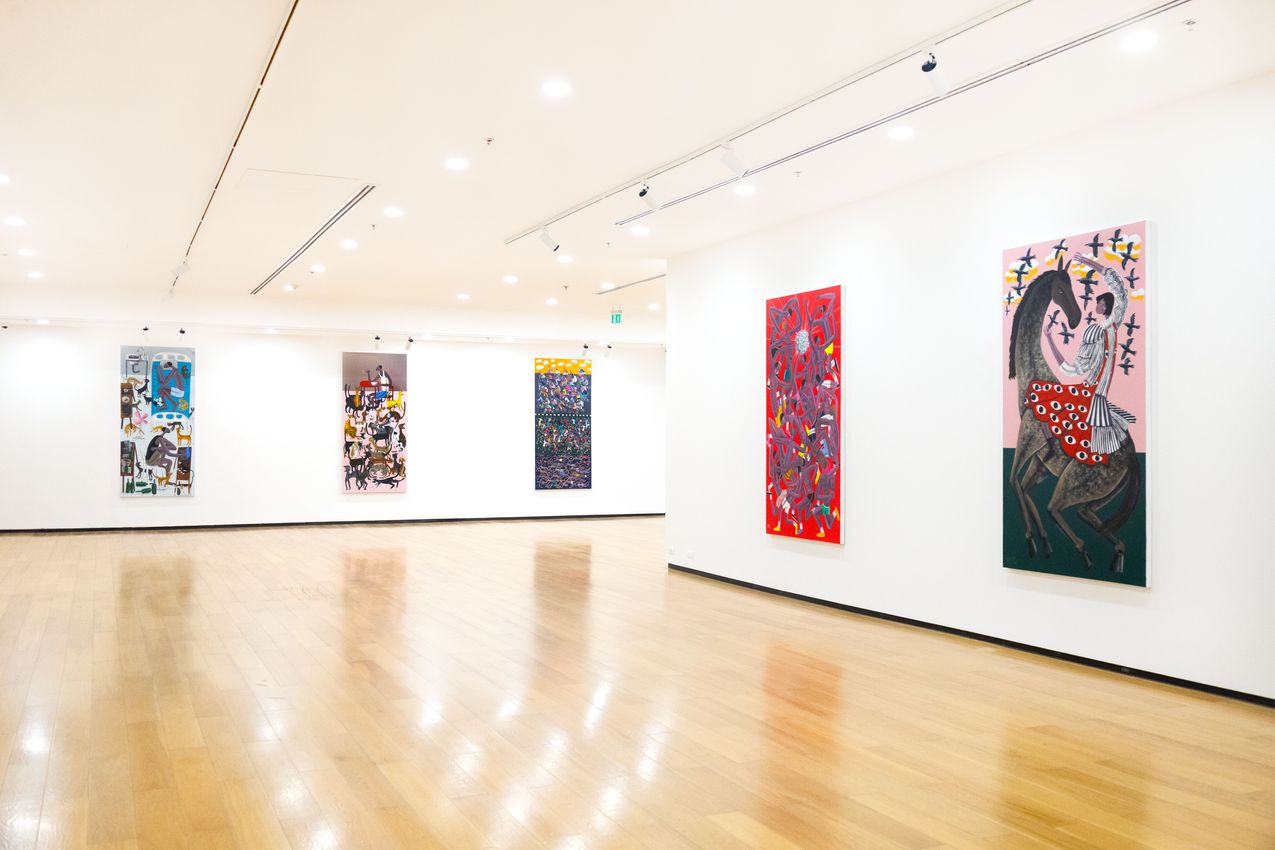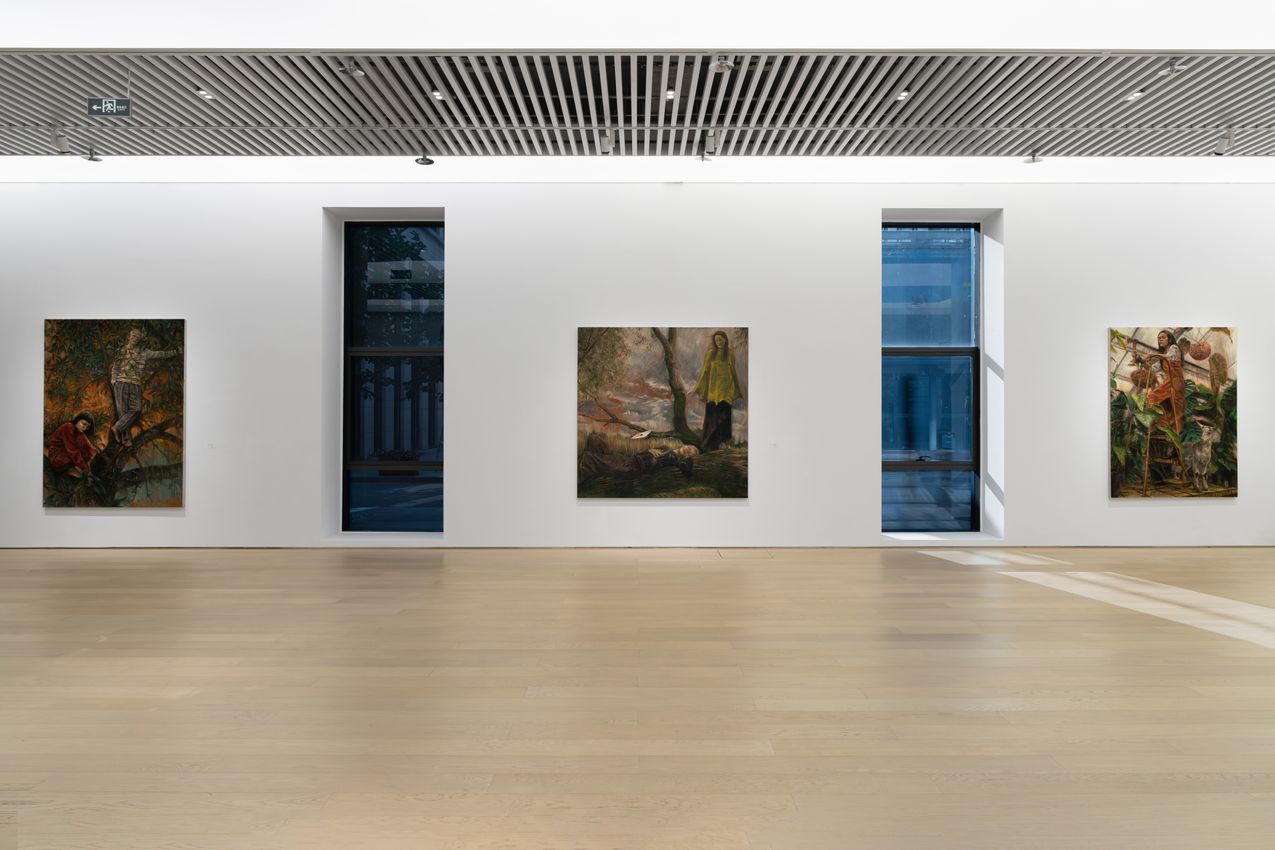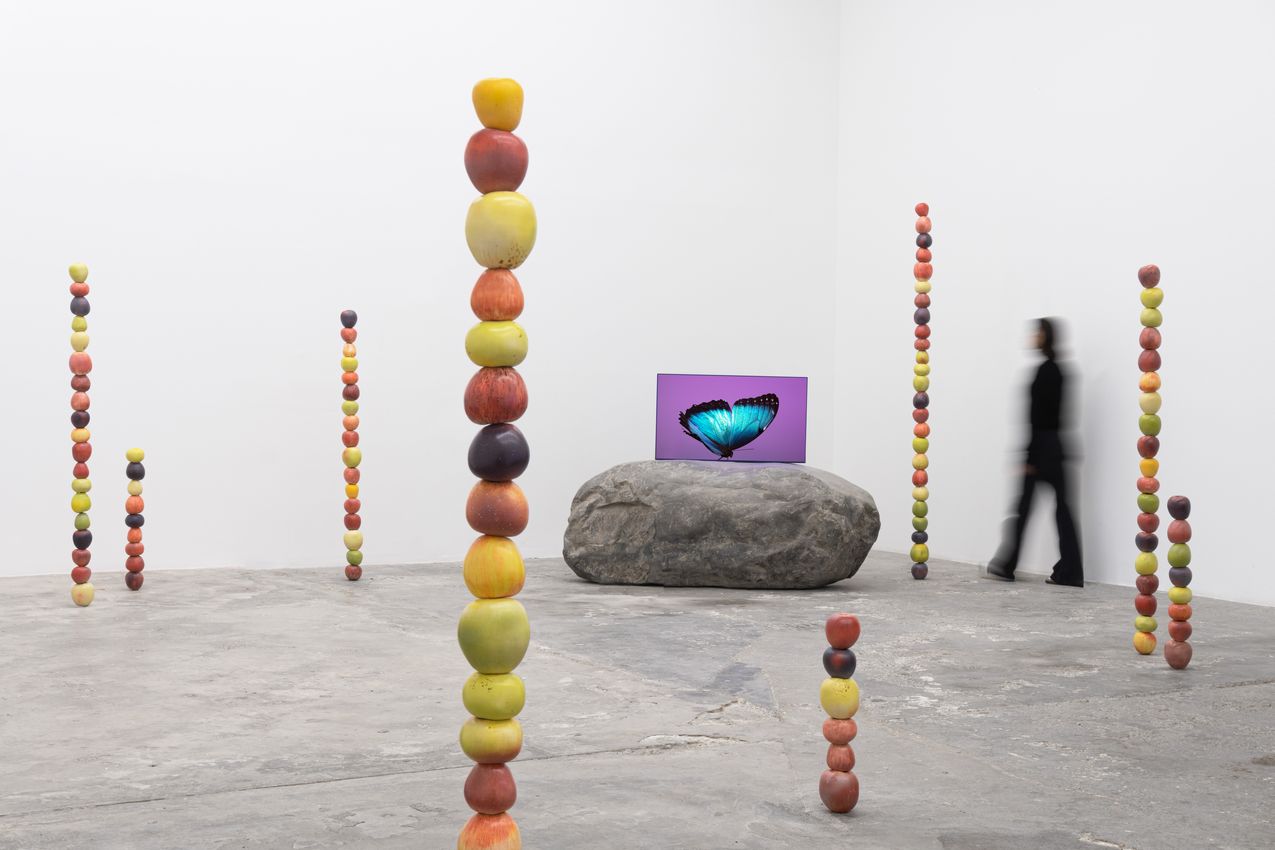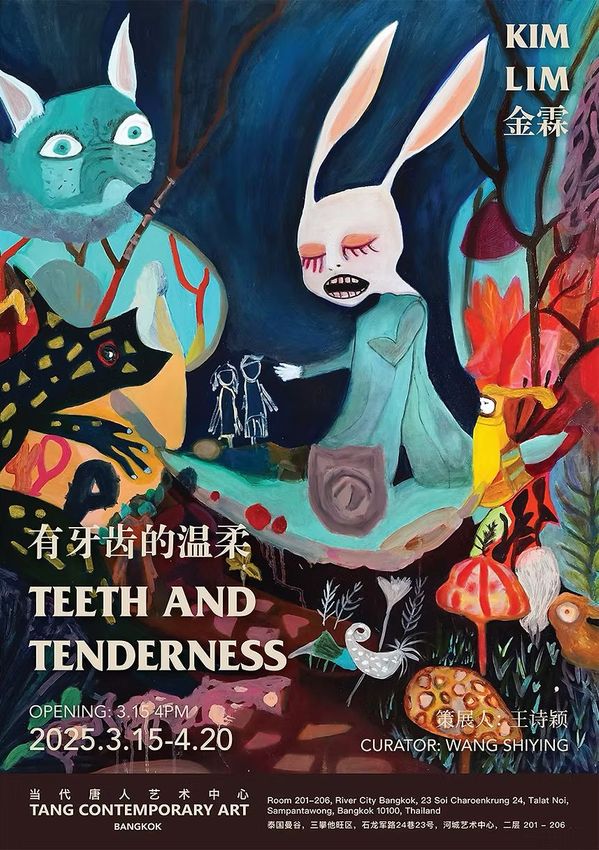
Kim Lim has created a serene garden on her canvas, a landscape woven with branches, grass, and vibrant colour fields that encircle and protect unease and sensitive caution, organising speech and confession. Within this gentle scenery lies not only vulnerability but also a soft yet resilient strength. Under a colourful sky supported by umbrella-like mushrooms and intersecting tree trunks, amidst vines as delicate as silk threads and entangled leaves, sharp lines are accentuated by delicate forms, revealing teeth as clear as geometric dividers. Amidst the warmth of the imagery, the appearance of teeth pierces through the soft hues, akin to a conspiracy of tenderness and violence. The tiny rows of teeth and the multi-layered depth of the landscape collectively point to the spiritual tension of breaking free from constraints, as metaphorically suggested by the artist.
When Alice falls into the chaotic, magical world, the girl in the blue dress traversing the looking-glass world sheds the social armour of the “obedient lady” and experiences a deeper sense of freedom. In the artwork, the imagery of teeth embodies a stubborn resistance born from fragility. In the artist’s narrative experiment, every vulnerable creature is softened and diffused within protection, possessing both the cold hardness to confront all things and the crisis of dissolving fragility. This hardness also bears the marks of tenderness left behind. The symbol of teeth is not only a resistance to the traces of trauma but also a structural support and a crucial element in breaking through the confines of imprisonment. Isn’t this a form of “inner freedom”? In the communal relationships of modern society, connections are not only tied to specific work and geographic contexts but also to technical and derivative relationships. Martha Nussbaum argues that the foundation of a good life lies in its vulnerability, rooted in realms beyond control and dependent on activities governed by others. Under the pervasive impact of digital technological power, the sensitivity of individual consciousness awakening is amplified amidst the rapid and fluid changes of life. The fissures in existence are not merely a matter of luck or fortuitous circumstances but also the conditions and social power relations that inflict harm and confinement.
Judith Butler argues that trauma, the body, and the vulnerability of life are not merely visible marks on the body; trauma also manifests as social and structural injustices, representing how power operates on individual bodies through various means. These “visible traces” are lasting imprints of long-term external mechanisms, metaphorically reflecting the erosion of individuals by social structures and culture. Every modern individual requires not only a protective shell and a nurturing environment but also a set of “hard teeth,” which does not signify aggression or violence but rather a subtle strength. As seen in the artist’s work The Wild She Wears, a fashionable woman’s head remains shrouded in unease even when facing harmless animals. The sharp geometric shapes contrasted with soft tones create a delicate inner tension. The angular geometry gives an impression of hardness, but when we shift our gaze to the animal imagery between the colour blocks, a tender sentiment immediately emerges. Softness requires the armour of hardness—a shelter needed by the isolated, insignificant self in the face of a complex and rapidly changing environment.
In Kim Lim’s creations, every step leaves traces that simultaneously bring destruction and renewal, embedding vulnerability and dependence within a soft yet resilient self-protection. The “goodness” of each individual is not isolated; it is deeply interconnected with the “goodness” of others. The teeth depicted on the canvas are not relics of violence; rather, the courage to break through fragility always grows where confinement is most severe. True resilience lies in the ability to remain soft amidst cracks. Tenderness need not ally with fragility; it can wear the armor of thought. Her work weaves the possibility of redemption into every firm bite, each one gentle yet powerful.
Text by Wang Shiying


In her sculptures and works on paper defined by their simple, Minimalist aesthetic, Singaporean-British artist Kim Lim explored line, colour, and form, as well as the relationship between the mediums of sculpture and printmaking.


Tang Contemporary Art was established in 1997 in Bangkok, later establishing galleries in Beijing and Hong Kong. Tang Contemporary Art is fully committed to producing critical projects and exhibitions to promote Contemporary Chinese art regionally and worldwide, and encourage a dynamic exchange between Chinese artists and those abroad.

A respected voice in contemporary art discourse.
Focusing on ambitious storytelling and insightful art-world commentary. Ocula Magazine publishes in-depth interviews, critical essays and timely analysis on the artists, exhibitions and ideas driving the global art world.
Learn more about Ocula Magazine
Showcasing the best of the art world.
Ocula partners with galleries from around the world to highlight their artists, artworks and exhibitions. Gallery membership is by application and invitation, with each member vetted by an independent panel.
Learn more about Ocula Membership

Specialises in the sale of major artworks.
Led by a team with deep ties to the world’s leading auction houses, galleries and collectors. Ocula’s advisory team offers bespoke services to high-net-worth clients from around the world who are looking to acquire the best of contemporary and modern art.
Learn more about our team and services