



In Nature’s Way...
On my mind all year, in this work for Glasgow.
We should live our lives – in Nature’s way. Currently, we are – in Nature’s way.
This exhibition is dedicated to centuries of women who have washed clothes and bathed themselves in all sorts of vessels, creeks, streams, rivers, oceans, and in the laundry/bath house that is now The Modern Institute.
– Suzanne Jackson, 2022
For her first exhibition at The Modern Institute, Savannah-based artist Suzanne Jackson presents a new body of sculpted paintings. Jackson’s life’s work is multifaceted; spanning five decades, Jackson has excelled as a painter, poet, dancer, teacher, curator and theatre designer. Breaking away from the structure of stretched canvas or paper, Jackson re-examines the medium and abstraction as a genre.
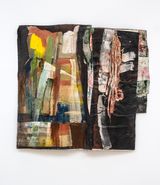
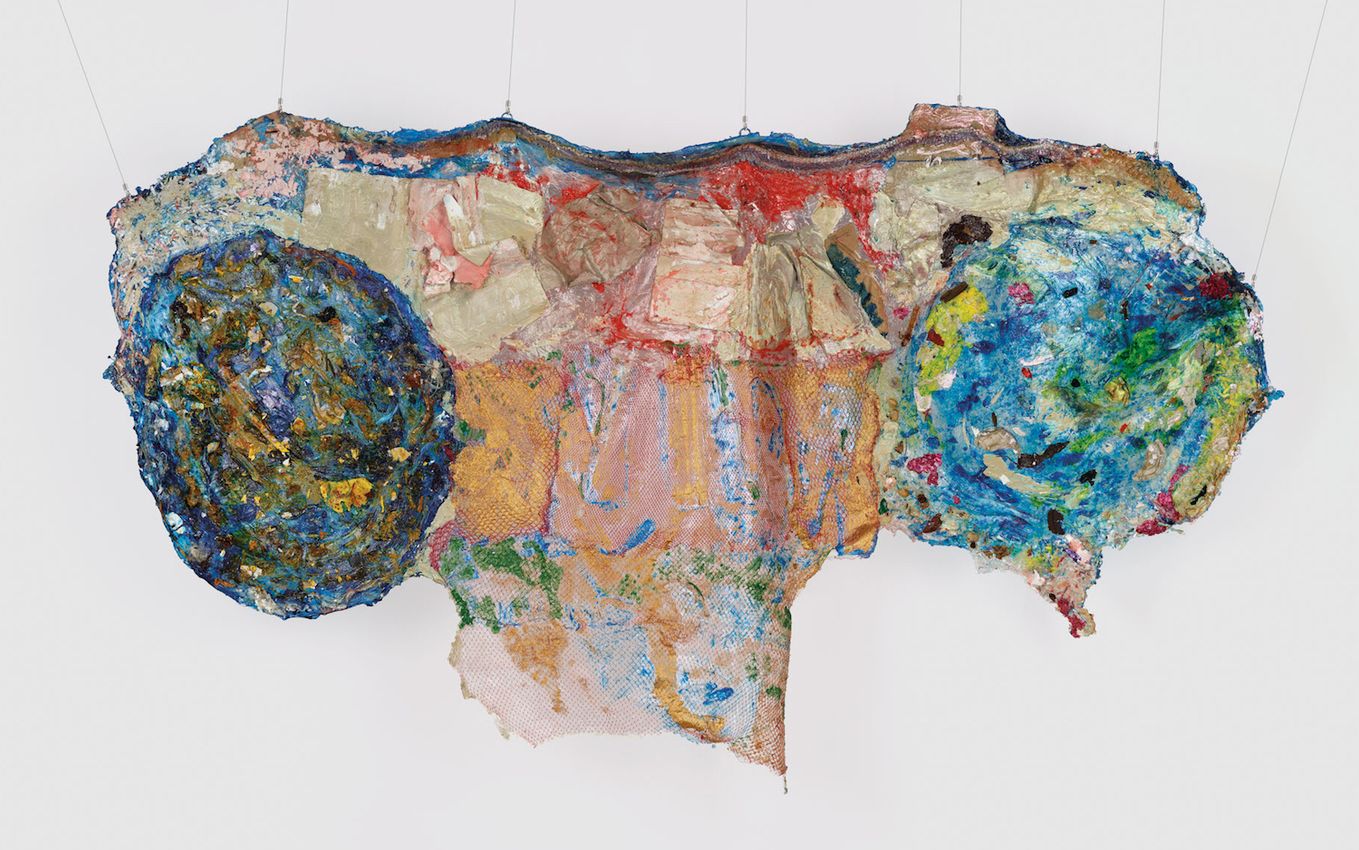
Jackson’s home and studio space in Savannah are one. Her everyday living is intertwined with her studio practice, each woven with the other, both equal in providing Jackson a skin in which she can use her surroundings freely. Upcycling is at the core of her practice, which leads Jackson to include found components in her work: man-made or natural objects, varying from produce bag netting and carpet trimmings to seeds and pressed flowers, as well as flakes of peeled paint from her hand, which she recycles and stores for future use. Remnants of household objects are given a new life and reused; ‘Quick Jack Slid’ includes elements of a wicker chair, broken by a friend, the item is logged as if a museum object and given a new purpose within the artwork, a body to stabilise the other limbs. Another work, ‘deepest ocean, what we do not know, we might see?’’, uses paint from the exterior of Jackson’s home, a rich red colour. The work draws on Jackson’s formative figurative works; suggests four visible figures in the foreground, each a distinct form, diverse in colour and surface, gesturing to one another, as if conversing. Jackson is conscious and considerate with her materials displaying them with a past, present and future.
Jackson deploys acrylic paint as if it were watercolour, directly onto sheets of plastic, adding layer upon layer of washy pigment, creating fragments of abstract figures and nature motifs. Referencing her theatre background, Jackson incorporates discarded bogus paper, the sheeting used to protect a stage while painting sets, crimping, pinching, and pleating it into her progressively textural surfaces. These ‘anti-canvases’ are hung to dry, allowing Jackson to add multiple layers without the need for the support of a traditional canvas frame. Smaller works are suspended from the gallery walls; the larger pieces hang or free stand in the exhibition space, architecturally sculpting and splicing the gallery. Jackson’s life work unintentionally informs her paintings with the fluidity and vibrancy of her gestures, the brush strokes act as choreography or musical notations, storytelling through mark-making.
Jackson first moved westward with her mother and father to San Francisco, and then her family continued north to the Yukon Territory. She came of age in Alaska, later returning to the Bay area to study painting and theatre at San Francisco State College and dance in the Pacific Ballet. In 1967 Jackson settled in Echo Park, Los Angeles, attending Charles White’s drawing class at Otis Art Institute. Jackson engaged a community of artist and activist peers—including David Hammons, Timothy Washington, Alonzo Davis, Dan Concholar, Senga Nengudi, George Evans, Gloria Bohanon, Betye Saar and Emory Douglas via her gallery space, Gallery 32. Her first solo exhibition in Los Angeles was held at the Ankrum Gallery in 1972.
Suzanne Jackson (b.1944 St Louis, Missouri; lives and works in Savannah, Georgia). Selected solo shows to include O-Town House, Los Angeles (2019), Danville Museum of Fine Arts, Danville, Virginia (2010), and Fashion Moda, New York (1984).
Jackson’s work has featured in institutional exhibitions including Life Model: Charles White and His Students, Los Angeles County Museum of Art, Los Angeles (2019); West by Midwest, Museum of Contemporary Art, Chicago (2018–19); Soul of a Nation: Art in the Age of Black Power, Brooklyn Museum, New York (2018–19); Now Dig This! Art and Black Los Angeles 1960–1980, Hammer Museum, Los Angeles (2011–13); Gallery 32 & Its Circle, Laband Art Gallery, Loyola Marymount University, Los Angeles (2009); Synthesis, Just Above Midtown Gallery, New York (1974); Directions in Afro American Art, Herbert F. Johnson Museum of Art, Cornell University, Ithaca (1974); and Black Mirror, Womanspace Gallery, Los Angeles (1973).
Jackson is a 2019 recipient of the Joan Mitchell Foundation Painters & Sculptors Grant and was recently the subject of a major retrospective exhibition and monograph, Five Decades, organised by the Jepson Center for the Arts, Telfair Museums, Savannah (2019).


The Modern Institute was founded in Glasgow in 1997. The gallery works with internationally established and emerging artists including Martin Boyce, Jim Lambie, Richard Wright, Anne Collier, Cathy Wilkes, Simon Starling, Urs Fischer, Luke Fowler and Nicolas Party.

A respected voice in contemporary art discourse.
Focusing on ambitious storytelling and insightful art-world commentary. Ocula Magazine publishes in-depth interviews, critical essays and timely analysis on the artists, exhibitions and ideas driving the global art world.
Learn more about Ocula Magazine
Showcasing the best of the art world.
Ocula partners with galleries from around the world to highlight their artists, artworks and exhibitions. Gallery membership is by application and invitation, with each member vetted by an independent panel.
Learn more about Ocula Membership

Specialises in the sale of major artworks.
Led by a team with deep ties to the world’s leading auction houses, galleries and collectors. Ocula’s advisory team offers bespoke services to high-net-worth clients from around the world who are looking to acquire the best of contemporary and modern art.
Learn more about our team and services