


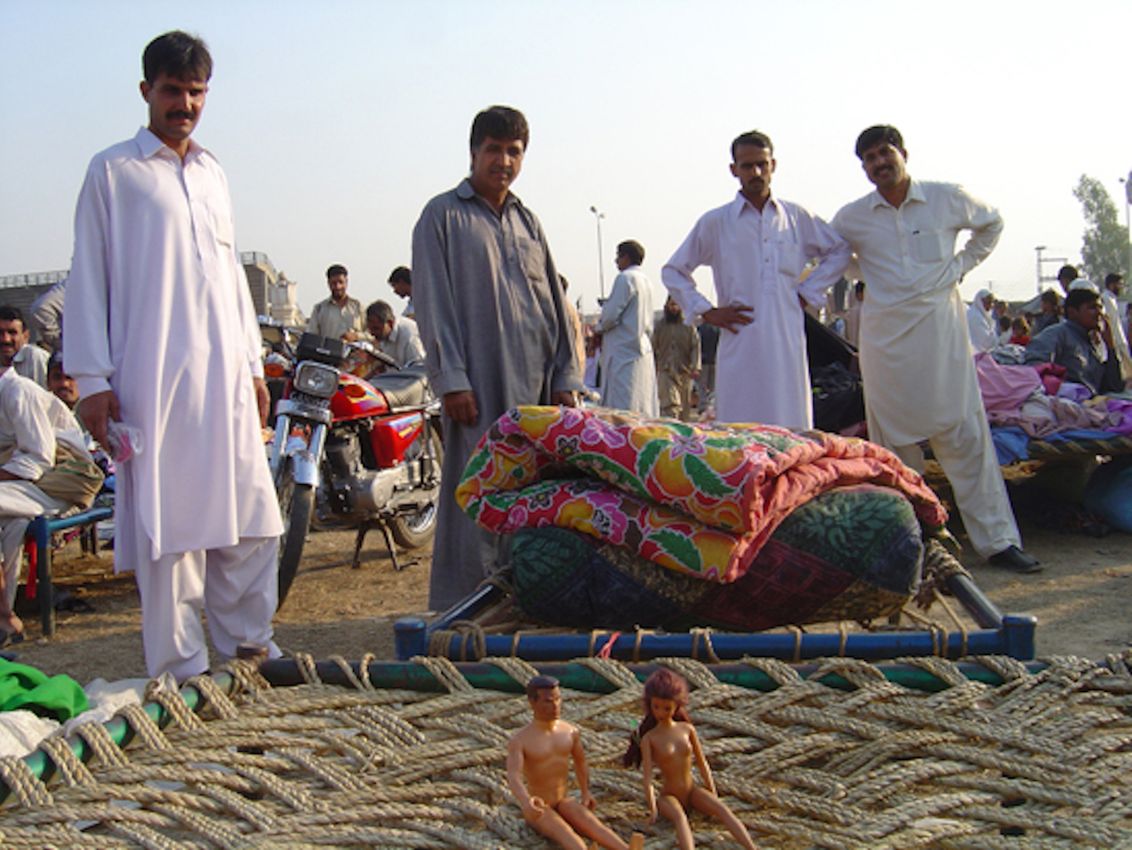
Thomas Erben is pleased to present Contemporary Art from Pakistan, a cohesive and nuanced look into the current Pakistani art scene that is beginning to garner wider international recognition. Composed of emerging, established and historical artists working in a full spectrum of media and intent, this exhibition makes legible the interconnectedness of the visual arts to the ‘real world’. This interdependence often eludes viewers when presented with domestic material, but is here made manifest in each piece by particularising it to the often misunderstood and misrepresented nature of the contemporary political and cultural climate of Pakistan. This collection of work shows a disregard for certain Western temperaments, most notably the prevalent influence of popular culture’s intent to garner attention through overt subject matter. Rather, this grouping conveys highly charged material in a poetic, complex and thought-provoking manner, refusing to offer viewers a complacent or cursory experience.
The miniature, a traditional Pakistani genre, with its concern for geometric unity, classical composition, detail-oriented technique and decorative style is renegotiated in the work of Zahoor Ul Akhlaq, Hamra Abbas and Muhammad Zeeshan while notably referenced in the work of Mahbub Shah.
Ul Akhlaq is a forerunner in the expansion of the miniaturist style with his exaggerated scale, importation of a variety of painterly methods, and a shift in focus to negative space thus imbuing the work with psychological tension dependant upon technique. Hamra Abbas, an emerging artist, having come after the first break in tradition, takes six classical examples of miniature portraits and places them squarely within a conceptual art context. First Lesson in a Foreign Country, based upon her experience as a foreign exchange student in Germany, expands the contemporary political situation of her own nation to include cultural questions of identity within a wider geography as well as concern for the place of the individual. Muhammad Zeeshan, while still showing an interest in the hyper-reality prevalent in the classical miniature, confounds the miniaturist style’s intent by looking to the American nude and other tropes of pop art and creating its antithesis through a subtext of sexual instability.
Though Mahbub Shah’s does not reference the miniature in any direct fashion, his collages still show a palpable relationship to geometry and aesthetics while questioning the very nature of visual literacy by converting legible codes into conceptually surrealist tools.
New genres of media originally captured the western art scene as primarily an opening up of possibilities in medium and later reached an ability to solidly connect to theoretics. On the other hand, new media in the contemporary Pakistani scene reveals a comfort level whereby the use film, industrial materials and photography are quite natural and thereby utilised in a more organic manner as visible in the work of photographer Huma Mulji, sculptor, mixed media artist Naiza Khan, film artist Bani Abidi and new media artist Rashid Rana.
Photographer Huma Mulji and sculptor/mixed media artist Naiza Khan both consider feminist themes with an innate ability to connect their work to their chosen material. Mulji takes up specifically American cliches in a collection of c-prints in which Ken and Barbie hide behind dumpsters, relax at the public market and hold hands in the park. However, this well loved American couple are not in fact the subject of the work, it is what they embody as fictional lovers and the reaction these scraps of plastic are able to illicit from a Pakistani public thatwill capture our concern. Khan, in a more aggressive stance, has developed her own vocabulary in her steel bodices, harness-like brassieres and contentious, violent drawings. The properties of what is ‘female’ is looked at with an eye to their dissolvent.
Film artist Bani Abidi presents Shan Pipe Band Learns the Star Spangles Banner, the only film on view in the exhibition, in which post-colonialism is shown for the awkward struggle it is with a sense of humor for it’s ultimate futility. Rashid Rana, an internationally acclaimed artist, represents a new branch of the fine arts which is able to fluidly move between an array of media, style and subjectivity and imbue each with the same sharp and astute manipulation of the visual. In Dead Bird Flying, Rana masterfully looks to the computer age and secures it with the timeless theme of mortality in this effervescent diptych.
Established in 1996, Thomas Erben Gallery focuses on rediscovering and introducing artworks that expand or deviate from the media usually associated with an artist.

A respected voice in contemporary art discourse.
Focusing on ambitious storytelling and insightful art-world commentary. Ocula Magazine publishes in-depth interviews, critical essays and timely analysis on the artists, exhibitions and ideas driving the global art world.
Learn more about Ocula Magazine
Showcasing the best of the art world.
Ocula partners with galleries from around the world to highlight their artists, artworks and exhibitions. Gallery membership is by application and invitation, with each member vetted by an independent panel.
Learn more about Ocula Membership

Specialises in the sale of major artworks.
Led by a team with deep ties to the world’s leading auction houses, galleries and collectors. Ocula’s advisory team offers bespoke services to high-net-worth clients from around the world who are looking to acquire the best of contemporary and modern art.
Learn more about our team and services
