Press Release

“Any woman worth her salt is a rebel.”

– Marcelle Hanselaar

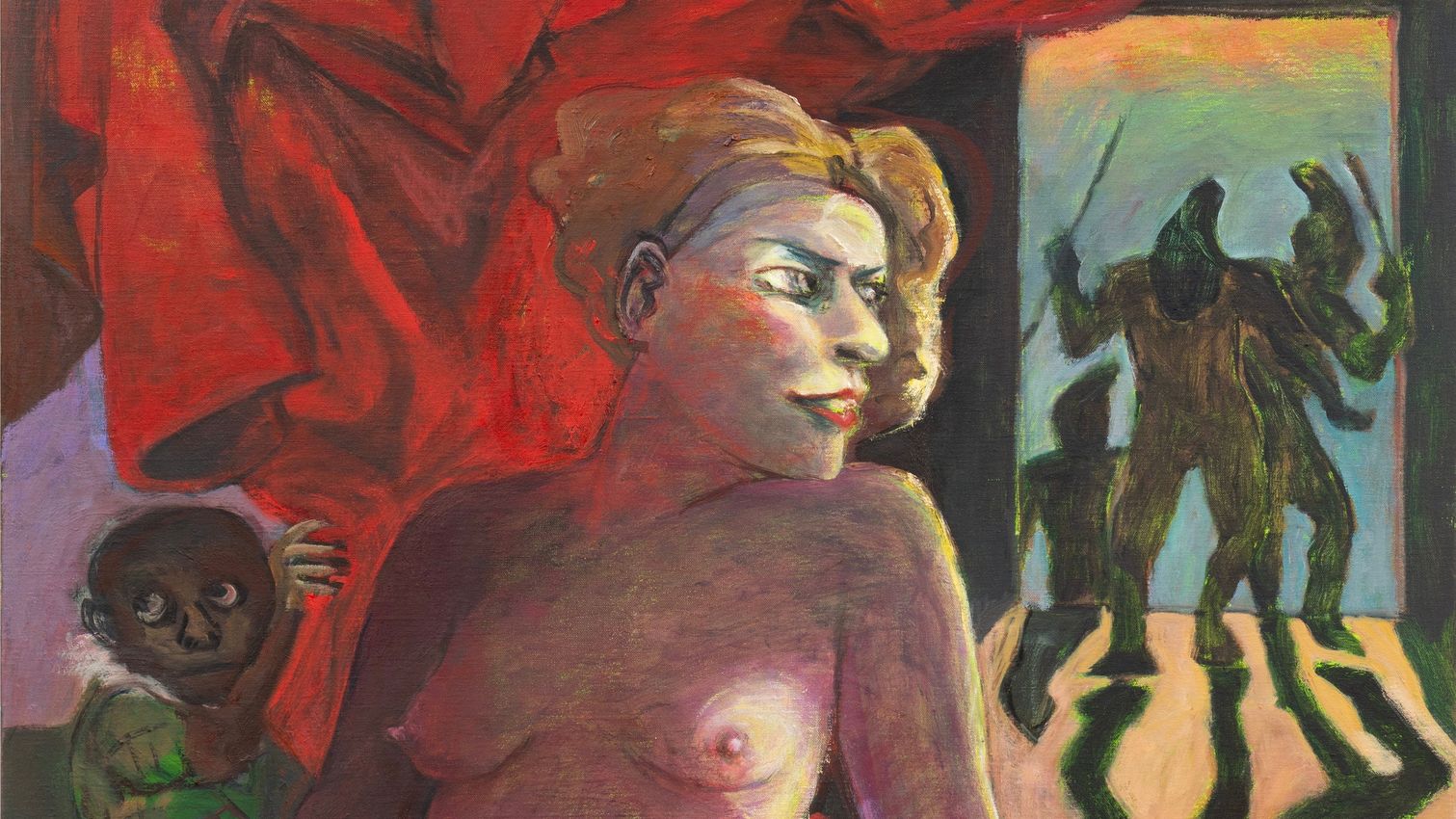
In Rebel Women, Marcelle Hanselaar resurrects the heroines of the Old Testament and the Apocrypha — the women who seduced, outwitted and destroyed men on their own terms, despite existing in worlds built entirely to contain them.

Developed from her celebrated print series Rebel Women from the Apocrypha – now held in the permanent collection of The Metropolitan Museum of Art, New York – this body of paintings draws on stories from biblical and apocryphal texts whose protagonists have captivated and unsettled audiences for millennia. Lilith, Delilah, Salome; these are not pious women. They are manipulators, seductresses and tricksters who make fools of powerful men, topple armies, and dance with severed heads. And yet they were also celebrated, even by the male scribes who first recorded their deeds, because they acted with a force of will that the patriarchal order could condemn but never fully suppress.

“Historically, some of these women actually existed and traces of their stories have become archetypes, which makes them interesting. They’re not particularly nice people, though. They manipulate, they kill, and they make fools out of men, which to me is both funny and courageous.”

“As an artist, I have to create something which has impact – a composition contained within the canvas in such a way people cannot take their eyes off it. Paintings don’t move, not like film or television which focuses attention. The action has to happen inside you. ”

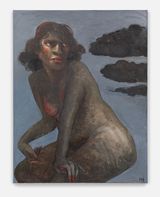
In the apocryphal Tales of Ben Sira, Lilith is Adam’s first wife, created from the same earth as him, not from his rib, and therefore his equal. When Adam demanded she lie beneath him, she refused, and for this disobedience was expelled from Paradise and transformed into a winged demon. Hanselaar’s Lilith sits coiled against a grey sky, dark clouds drifting behind her. Her body is rendered in deep, murky earth tones with flashes of red at her lips and fingertips with a cunning light behind her eyes.

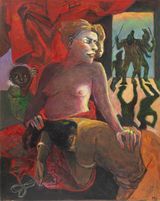
Everything about Delilah is enigmatic: historically we know little of her lineage, her status or her loyalties, other than she accepts a bribe from the Philistines to discover the secret of Samson’s strength, and once his hair is cut he is blinded and taken captive. In Rembrandt’s Blinding of Samson, Delilah’s eyes look back at him with pity. Here Hanselaar’s heroine keeps here eyes on the prize, rushing away from the scene. In a compressed vertical composition, her four legs give a comicbook impression of unstoppable speed.

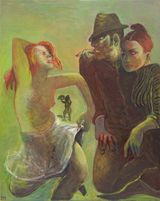
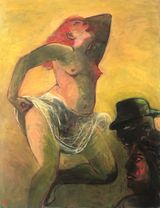
Hanselaar’s two Salome paintings stage the same scene from different temperatures. In the first, Salome dances in a sickly green light, her red hair loose, a ghostly veil barely covering her, while Herod and Herodias crowd the right side of the canvas — him leaning forward, her glowering behind. In the second, the palette shifts to a hot, sulfurous gold and the composition tightens: Salome arches back in something close to ecstasy, the veil swirling around her body, while Herod is reduced to a dark face in the corner, swallowed by shadow. He is no longer a king; he is an audience of one, entirely in her power.

“They’re very witty. Definitely ballsy, absolutely taking no prisoners, and being quite shameless about how to get their pound of flesh.”

Hanselaar has been direct about the contemporary impulse behind the series. While she fully supports the MeToo movement, she is impelled to resist a mode of victimhood that has entered parts of its discourse that she finds counterproductive. If men and women are to be equal in power, she argues, there should be no victimhood. To claim the status of victim is to cede the very power one is fighting for. Her Rebel Women are not role models in any sense, but none have gained the upper hand over their competitors by playing the victim or by ceding their agency.

They possess an energy that Hanselaar finds bracing and necessary, and humour is essential to this energy. She describes these women as feisty and witty, who take no prisoners and feel no shame about getting what they want. The paintings revel in the absurdity and audacity of their subjects, finding in their excesses a vitality that no amount of moralising can suppress. Hanselaar’s women have made men look absurd without ever managing to make themselves seem virtuous, remaining gloriously complex.

“If you look at early Baroque paintings, there’s definitely judgment in them. They use this subject to tell a moral story, mostly about how bad and devious women are. But since this subject matter has mostly been painted by men for generations, I gave it a different perspective.”

Read More
About the Gallery

Unit seeks to preserve the artist’s essential role as the flag-bearer of creativity in our future.

View Gallery Profile
Address
3 Hanover Square
London
United Kingdom
Opening Hours
Tuesday – Thursday
10am – 7pm
Friday
10am – 5pm
Saturday
10am – 6pm
(1)
London 3 Hanover Square
Unit
3 Hanover Square, London, United Kingdom
+44 (0) 20 7494 2035
http://www.unitlondon.com

Opening hours
Tuesday – Thursday
10am – 7pm
Friday
10am – 5pm
Saturday
10am – 6pm
The art world in focus