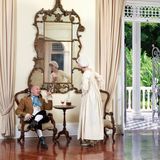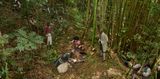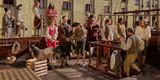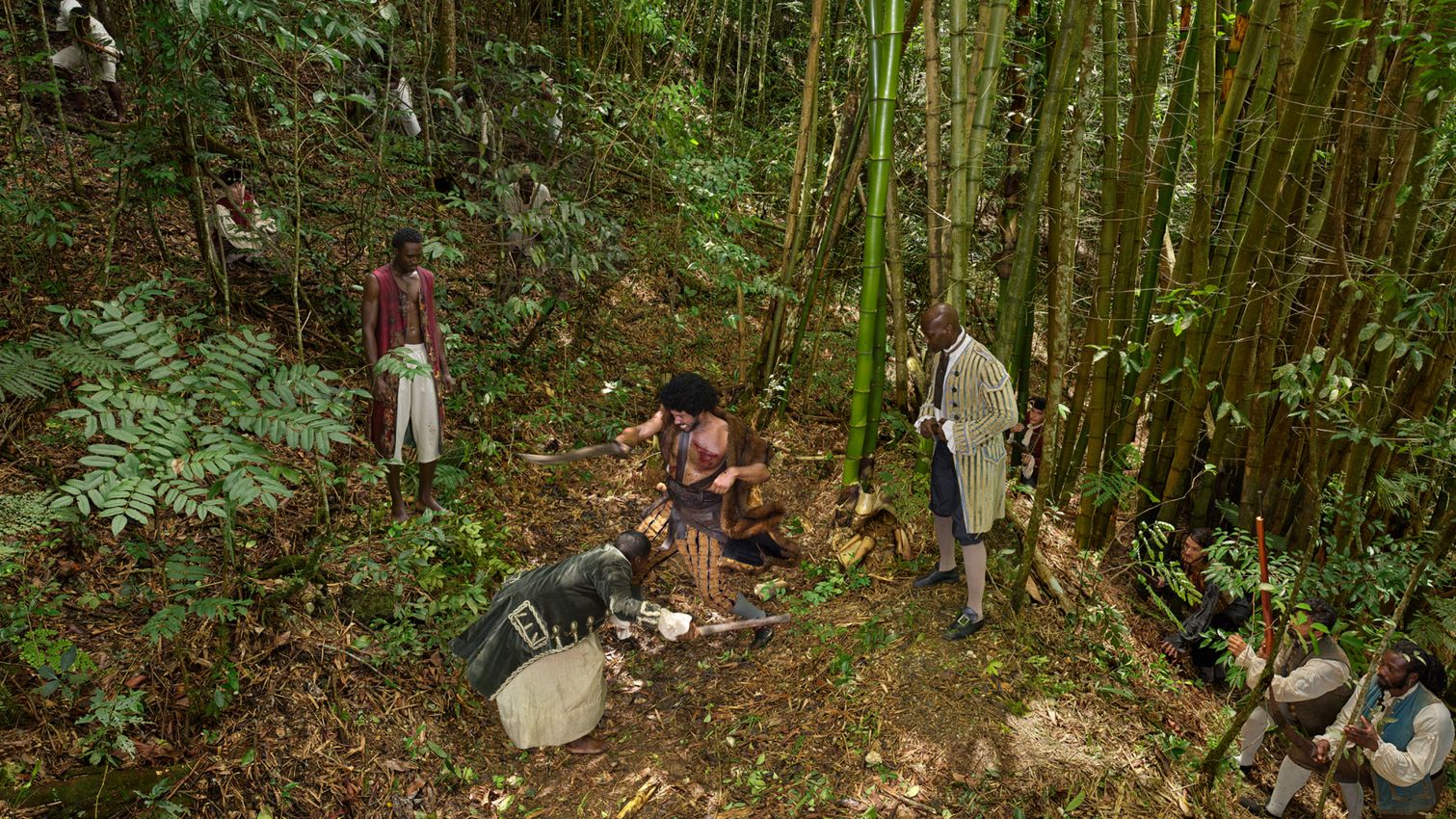
Victoria Miro is delighted to present Stan Douglas’ sixth solo exhibition with the gallery, which features the European premiere of the Canadian artist’s multi-channel video installation, Birth of a Nation, and works from a new photographic series, The Enemy of All Mankind: Nine Scenes from John Gay’s Polly.
Since the late-1980s, Stan Douglas has examined complex intersections of narrative, fact and fiction while simultaneously scrutinising the media he employs, technology’s role in image making and its influence on our understanding of reality. This exhibition marks the UK premiere of Birth of a Nation, Douglas’ new multi-channel video installation that confronts D.W. Griffith’s 1915 film The Birth of a Nation, a technically groundbreaking but deeply racist work that exalts white supremacy. Douglas’ video installation is shown together with photographs from The Enemy of All Mankind: Nine Scenes from John Gay’s Polly, a series in which Douglas stages scenes from the eighteenth-century comic opera Polly, written by English dramatist John Gay (1685–1732) and the sequel to his The Beggar’s Opera. Each of these works, although drawn from historic references, engages with a range of themes such as race, class and gender, that remain highly relevant today. Across the five screens of Birth of a Nation, Douglas focuses on one narrative strand of Griffith’s original, mirroring, altering and replaying scenes from multiple perspectives and with the introduction of new characters. In The Enemy of All Mankind the artist adapts scenes and modifies characters from Gay’s opera, enlisting a cast of actors to create large-scale photographs that position the viewer as a voyeuristic witness to the various narrative turns and dynamic shifts at play.
Through photography, film and installation the Canadian artist Stan Douglas has, since the late-1980s, examined complex intersections of narrative, fact and fiction while simultaneously scrutinising the media he employs and how it shapes our understanding of reality. Douglas’ work is often in the first instance an examination of place–Lisbon, Potsdam, Havana and Detroit have provided the impetus for, respectively, The Secret Agent, 2015, Der Sandmann, 1995, Inconsolable Memories, 2005 and Le Détroit, 1999 – but entangled with the detail of specific geographical and political circumstance is a diverse range of source material that has included the literary constructs of Franz Kafka, Joseph Conrad, Herman Melville, Samuel Beckett and ETA Hoffmann, and the films of Alfred Hitchcock and Orson Welles.


A respected voice in contemporary art discourse.
Focusing on ambitious storytelling and insightful art-world commentary. Ocula Magazine publishes in-depth interviews, critical essays and timely analysis on the artists, exhibitions and ideas driving the global art world.
Learn more about Ocula Magazine
Showcasing the best of the art world.
Ocula partners with galleries from around the world to highlight their artists, artworks and exhibitions. Gallery membership is by application and invitation, with each member vetted by an independent panel.
Learn more about Ocula Membership

Specialises in the sale of major artworks.
Led by a team with deep ties to the world’s leading auction houses, galleries and collectors. Ocula’s advisory team offers bespoke services to high-net-worth clients from around the world who are looking to acquire the best of contemporary and modern art.
Learn more about our team and services