



Press Release

Forms emerge from a still, shadowy void, looming through the vapoursto splay across an infinite surface. They stir like a mass of wet bitumen,leaving behind a residue of swirling scars. It is no pure blackness here,but a dense bleed of colours—cyan, orange, and sapphire—bruised withviolet and faintly shimmering with its own phosphorescence.

Ultimately, these forms reveal themselves as the “flower”, a word weimmediately suppress. To claim existence, a flower must keep itsdistance from everything around it. A flower is a flower; it is permittedto be nothing else. It certainly cannot be a towering drag queen, anindividual of excessive talent and taste, occupied with classical operaand sartorial design, chronically unloved, committed to the dailychanting of Buddhist sutras, only to end his own life in his prime.

Prior to the “flowers”, Xie Qi sought to monumentalise memory throughnude portraits of named acquaintances, a literal charting of storiesthrough rigorous resemblance. Paradoxically, this exactitude birtheda rebellion, as the painted forms sought to outrun their own likeness.The human eye was routinely erased, and through a deliberate abuse ofbrushstrokes, frames, and negative space, the bodily form was undone.

A disc of yellow eclipses the countenance in Untitled (2014), shearingthe image into a dialogue of top and bottom, proximity and distance.In Fermenting Unrest (2019), this violation becomes visceral: a woundopens in the middle of the torso, stretched taut by gripping fingers,threatening to lay bare the heart. Here, the flesh yields its boundaries,opening into a porous exchange with the outside. No longer a merecontainment of skin, bone, blood, and volition, the body dissolvesbeyond the property of individual anatomy.

Enmeshed with the universe, the “body” is a net that traps the world;what we call the physique is nothing but a provisional designation. Thesame holds for Xie’s “flower”, a naming of convenience we must notfixate upon. A portrait is tasked with capturing both the entity and theexpanse; her recent creations demand the coexistence of the literalflower and its spectral double.

The flower is hermaphroditic. Enclosed within the petals are the pistilsand stamens, organs that generate and receive pollen, with two spermcells housed inside each microscopic grain. At the base of thesereproductive structures lie nectaries, secreting a thick, saccharine fluidto indulge bees, butterflies, and hummingbirds; the petals themselveshave evolved vivid hues to seduce and guide them. Having feasted onform and flavour, these creatures perform the labour of pollination. Suchexchange has persisted for a hundred millennia, yet certain speciesrefuse this mutualism. Inherently vestigial, orchid seeds drop into thesoil to pilfer nutrients from fungi, yet the sprouted flora possess nometabolic capacity to secrete nectar. Instead, several orchid specieshave evolved a labellum that mimics female insect pollinators; the maleinsects pounce forward in an act of pseudocopulation, reaping neithernectar nor progeny, only to disperse the pollen smeared across theirbodies during their next desperate encounter.

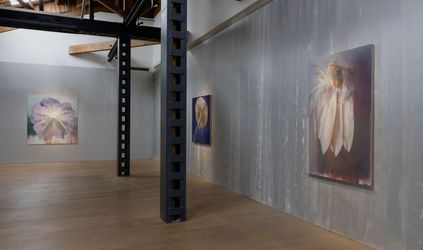
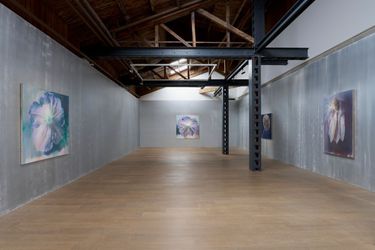
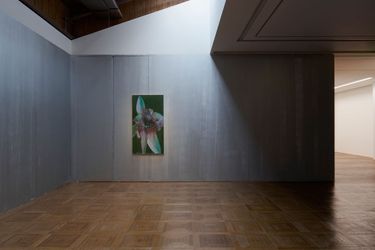
The beauty humans worship in flowers is an irrelevant byproduct, anecho a flower is impervious to; its voluptuousness and venom aremeant only for its insect accomplices. Gentle Nips (2026) is preciselysuch a blossom. Thrusting out from a murky, ash-green smog, itsfilaments tangle into a row of jagged teeth, shameless and aggressive,as if hurling an unspoken curse. Reaching back to the porous state ofFermenting Unrest, the petals fling themselves outward in contradictorydirections, foretelling a swift descent into decay and withering. Perhaps theflower senses a looming urgency: as spring slips away, and the cruelencroachment of heat and frost draws near, its evolutionary destinyremains unfulfilled.

Painting demands the distillation of a singular essence within a finiteperimeter. Xie’s realism is less about portraiture and more aboutcapturing the surge of vitality inherent in the plant’s literal form, renderingany stylistic overhaul redundant. (Her treatment of the body followssuit.) To render a flower as nothing but a flower requires audacity. Whenconfronted with such unadulterated lust, botanical though it may be,onlookers instinctively retreat into shame, branding it an alien anomalythat must be policed. They avert their eyes, banded in a consensus thatdomesticates it as “beauty”, speaking only of the decorative flower andthe flower as decoration. Yet, a flower is the genitalia of vegetation,engineered to harbour and release desire. Xie’s brush never flinches fromthis reality. Her blunt literalism carries a subtle, defiant sting.

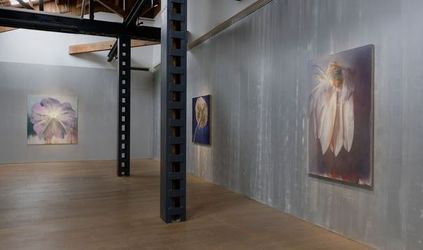
At times, she scatters a few stamens with a shorthand, almost playfulcarelessness (The Flattest Sea Star in the World, 2026); at others,she chronicles floral rot with a silent, elegant stasis evocative of askull (Popliteal Fossa and Pubis, 2025). Her canvases shift in scale,her maximum dimensions bounded only by the physical limits of herown reach. Measuring two metres square, Intimate Devouring (2026)extends slightly beyond the span of her arms, its two blossomsunfolding toward opposite margins. From the centre of the left flower, awash of red bleeds into white, a flushing of petals that betrays a delicatevulnerability. Fine white lines trace the flower’s venation and dissolveinto weeping streaks of white paint. The pleated petals form meanderingtrails of grey, an extension of a crisscrossing vascular labyrinth reminiscentof a midsummer nebula. Then, along the right flank of the flower, darkspecks begin to manifest. Tender youth, exuberant blossom, anddecay—this, too, is the ultimate scale a human life can sustain againsttime.

The flower thus mutates into the “flower”, a provisional designation. Thegravitational apparatus Xie constructs binds the canvas (the orchid) tothe spectators outside (the captivated “pollinators” of the image) in aperpetual, volatile interaction, a connection left arrestingly unresolved.The audience approaches expecting flowers, but attention dismantlestheir speech, forcing them to articulate the experience through barefragments of “this” and “that”, “such” and “thus”. Forcing the contentback into its floral cage unleashes an uncanny slippage, where theflower eludes its classification to become another image, allegory,or occurrence. Viewers are caught in something deeper than meretransformation: these rogue entities resonate with a theme threadbareas the flower, an entanglement to which they had long been blind. “Thename arises from the object; the designation issues from the self.” Theflower and its double collapse into a singularity of name and designationin Xie’s practice. The painting is an engine of desire cloaked as desire’sprey, a signifier that refuses a signified. Through this mechanics,desire leans (or rather, submits to an intangible tug) toward a far moreexpansive elsewhere.

Courtesy Perrotin

Read More
About the Artist

Caught between being and becoming, Xie Qi’s paintings read like half-forgotten memories. She uses densely packed yet ethereal brushstrokes barely defining her subjects.

View Artist Profile

Also Exhibiting at Perrotin

About the Gallery
Emmanuel Perrotin founded his first gallery in 1989 at the age of 21. He has opened since then over 17 different spaces, with the aim of continuing to offer increasingly vibrant and creative environments to experience artists work. He has worked closely with his roster of artists, some since more than 25 years, to help fulfil their ambitious dreams and projects. The gallery is now based in New York, Paris, Hong Kong, Seoul, Tokyo, and participates in all the significant worldwide art fairs each year (Art Basel (Hong Kong, Miami, Basel), Frieze (London, New York), FIAC (Paris), Dallas Art Fair, Art Cologne, Art Stage Jakarta, Expo Chicago, Art021 & West Bund Art & Design, Shanghai, Zona Maco Mexico, amongst others).
View Gallery Profile
Address
3/F, 27 Huqiu Road
Huangpu District
Shanghai
China
Opening Hours
Tuesday – Saturday
11am – 7pm
(1)
Shanghai 3/F, 27 Huqiu Road, Huangpu District
Perrotin
3/F, 27 Huqiu Road, Huangpu District, Shanghai, China
+86 216 321 1234
http://www.perrotin.com

Opening hours
Tuesday – Saturday
11am – 7pm
The art world in focus