






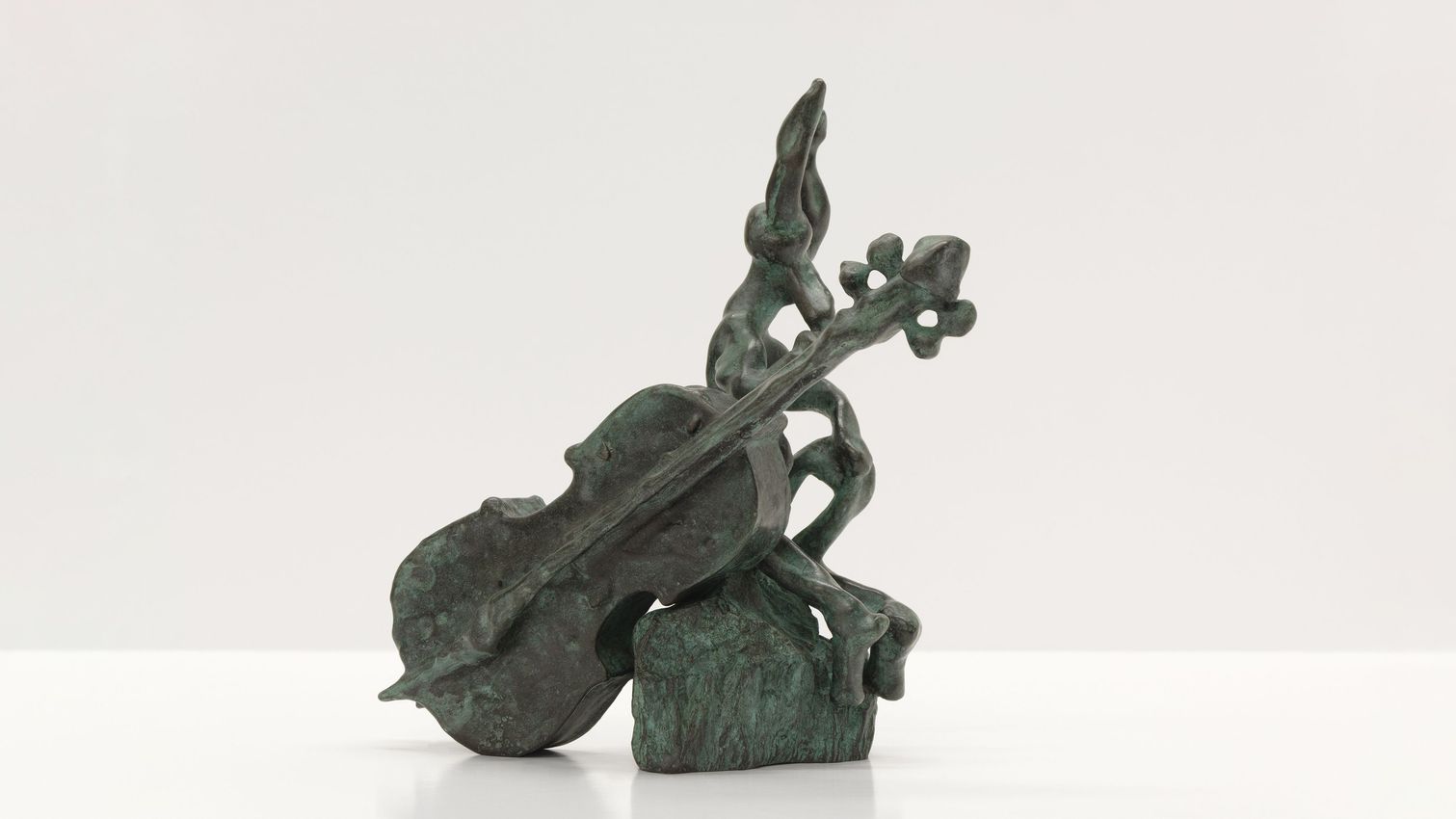
BARRY FLANAGAN
1941-2009, United KingdomBarry Flanagan was one of Britain’s most innovative and widely acclaimed sculptors, celebrated for his radical transformations in sculptural practice and his signature dynamic bronze hares. In 1982, he represented Britain at the Venice Biennale.
Early Years & Background
Born in Prestatyn, North Wales, Flanagan studied architecture at Birmingham College of Art and Crafts, then graduated from St Martin’s School of Art, London, with a Vocational Diploma in Sculpture in 1966. He taught at St Martin’s and the Central School of Arts and Crafts from 1967 to 1971, quickly establishing himself as a pivotal figure in Britain’s avant-garde community.
Barry Flanagan Artworks
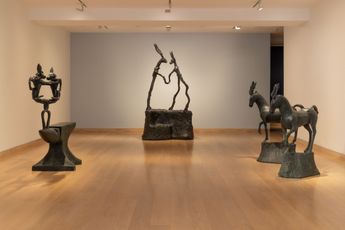
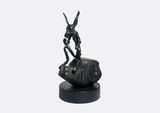
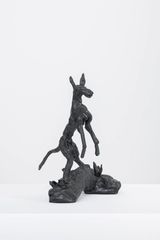
Flanagan’s early career was marked by experimental soft sculpture, concrete poetry, and installations that challenged the conventions of sculptural materials and form. Embracing Alfred Jarry’s ‘pataphysics’—the science of imaginary solutions—his playful, irreverent approach moved across rope, sand, stone, sheet metal, and, decisively, bronze. From the late 1970s, Flanagan revolutionised animal figuration, creating leaping, dancing, and anthropomorphic hares that subverted the heroic tradition of classical sculpture with wit and vitality.
Seminal Artworks and Developments
- 1965 — Soft sculpture aaing j gni aa exhibited at Better Books, London; acquired by Tate in 1969.
- 1979 — First bronze ‘Leaping Hare’, now iconic throughout major collections.
- 1985 — Nijinski Hare, a monumental sculpture, set an auction record at Christie’s in 2018.
- 1995—96 — Hares installed along Park Avenue, New York, and at Grant Park, Chicago.
- 2006 — Ten large-scale bronzes displayed across Dublin during his retrospective at Irish Museum of Modern Art.
- Other acclaimed works include stone, marble, and sheet metal pieces of the 1970s, and numerous public commissions of both animals and poetic forms.
Select Awards and Accolades
- OBE for services to art (1991).
- Elected to Royal Academy of Arts (1991).
- Represented Britain at 40th Venice Biennale (1982).
- Nine Young Artists Theodoron Award, MOMA (1969).
Barry Flanagan Exhibitions
Flanagan was the subject of major retrospectives and institutional solo exhibitions globally:
Solo Exhibitions at the following institutions
- 1993 — Fundación La Caixa, Madrid (toured to Musée des Beaux-Arts, Nantes, 1994).
- 2000 — Tate Liverpool.
- 2002—03 — Kunsthalle Recklinghausen, Germany; Musée d’Art Moderne et d’Art Contemporain, Nice.
- 2006 — Irish Museum of Modern Art, Dublin (with outdoor sculptures across the city).
- 2011—12 — Tate Britain, London (retrospective on early works).
- 2019 — IKON Gallery, Birmingham.
- 2025 — Ongoing global presentations of monumental hare sculptures, including Frieze Sculpture and ARTZUID Amsterdam.
Barry Flanagan FAQs
What is Barry Flanagan best known for?
Barry Flanagan is most celebrated for his whimsical and energetic bronze hare sculptures, which have become defining icons of contemporary British art.
How did Barry Flanagan revolutionise sculpture?
Barry Flanagan’s early use of unconventional materials and his playful approach questioned and expanded the possibilities of sculpture, moving from Arte Povera-like experiments to a witty subversion of classical bronze figuration.
Where can Barry Flanagan’s work be seen?
Major works by Barry Flanagan can be seen at the Museum of Modern Art (New York), Centre Pompidou (Paris), Tate (London), and can be found in public spaces and major.
Why did Barry Flanagan choose hares as his iconic subject?
Barry Flanagan selected hares over human figures to subvert the dominance of traditional portraiture, allowing for playful, mythic, and even unsettling representations that blend humour with a totemic aura.
What is ‘pataphysics’ and how does it influence Flanagan’s work?
Pataphysics—‘the science of imaginary solutions’—is central to Barry Flanagan’s practice, manifesting through his fascination with paradox, anarchism, and subversive, surreal forms that resist easy categorisation.
What materials and techniques did Barry Flanagan explore during his career?
Barry Flanagan is renowned for his inventive use of materials, starting with sand, cloth, rope, and concrete poetry in the 1960s, before shifting to stone, bronze, and marble in later years. His approach to materials often challenged sculptural tradition.
Are Barry Flanagan’s works publicly accessible?
Barry Flanagan’s monumental hare sculptures are installed in major cities worldwide—including London, New York, Dublin, and Chicago—and his works feature in the collections of Tate, Centre Pompidou, MoMA, and other major institutions.
Did Barry Flanagan make other kinds of art beyond sculpture?
Yes, Barry Flanagan’s practice included poetry, experimental film, performance, drawing, and printmaking, all informed by conceptual art, Arte Povera, and a continual interest in language and form.
Ocula | 2025

Works at Waddington Custot








Recently Exhibited



Exhibiting Elsewhere


Works Elsewhere


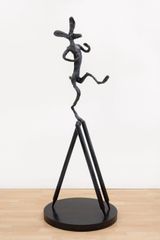
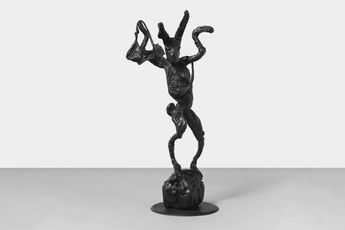
156.2 x 39.4 x 53.3 cm
Baldwin Contemporary more than GBP 250,000 Check Availability







Explore and Follow Artists Shaping Contemporary Art
A respected voice in contemporary art discourse.
Focusing on ambitious storytelling and insightful art-world commentary. Ocula Magazine publishes in-depth interviews, critical essays and timely analysis on the artists, exhibitions and ideas driving the global art world.
Learn more about Ocula Magazine
Showcasing the best of the art world.
Ocula partners with galleries from around the world to highlight their artists, artworks and exhibitions. Gallery membership is by application and invitation, with each member vetted by an independent panel.
Learn more about Ocula Membership
Specialises in the sale of major artworks.
Led by a team with deep ties to the world’s leading auction houses, galleries and collectors. Ocula’s advisory team offers bespoke services to high-net-worth clients from around the world who are looking to acquire the best of contemporary and modern art.
Learn more about our team and services