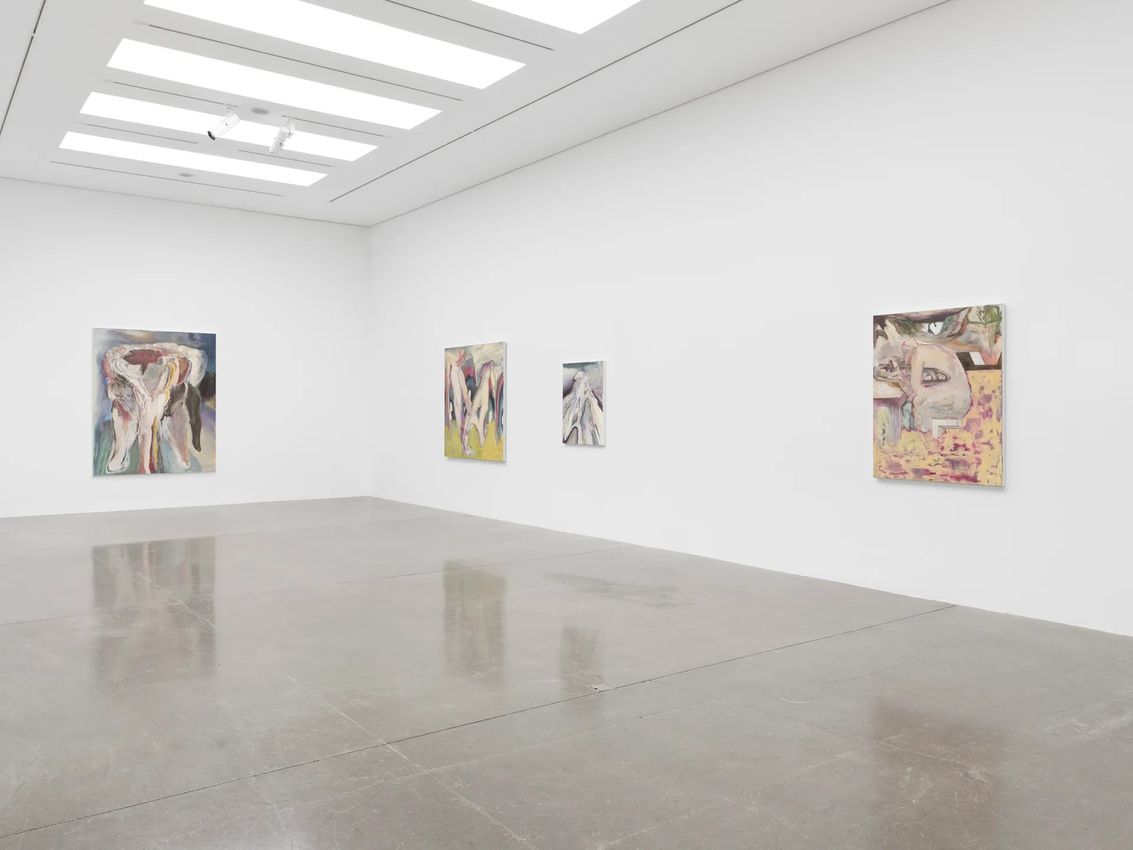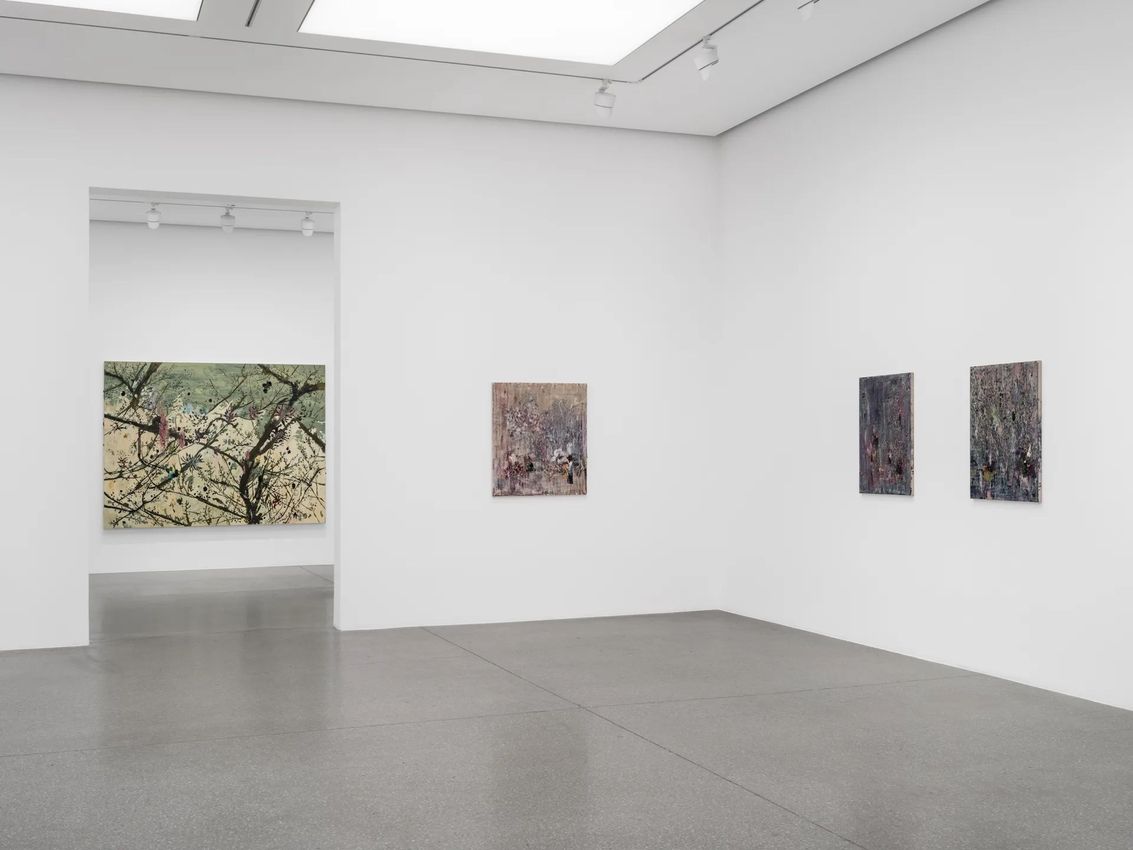




In her solo exhibition at White Cube Paris, London-based artist Mary Stephenson (b.1989) debuts a new series of paintings that act as ‘cathartic playgrounds’ for both artist and viewer. In her hypnagogic environments, architectonic planes sit alongside abstracted forms, evoking archetypal physical spaces and objects that invoke feelings and memories. For Stephenson, oil paint is a tool for navigating her unconscious, giving form and structure to emotions, ideas and the slippery nature of memory itself. Made over the course of a year, the paintings in ‘Mary! Go Round’ conjure liminal realms that exist somewhere between the internal and external world or, in her own words, ‘where the figurative shifts into abstract’.
In addition to the paronymic pun of the ‘merry-go-round’, the title of the exhibition refers to Stephenson’s use of oil paint to direct and route her internal dialogue. The artist’s introspective approach is mirrored in, and facilitated by, her attitude towards paint, which she treats not solely as a medium but as a collaborator or ‘wingman’. Speaking directly to ‘Mary!’, the title can be read as a demand on, or call to, the artist by the canvas, that marks the beginning of a synergistic exchange between artist and medium. The reference to a fairground carousel also speaks to the emotional oscillation and resurfacing engendered by her painting practice, a loop that involves the return to childhood memories, experiences and environments.
Often working with canvas primed with rabbit-skin glue, Stephenson builds up thin ‘veils’ of oil paint that seep into the surface at varying rates, creating a tension between control and surrender, between ‘feeding’ and receiving. As the artist has described: ‘a lot of the work happens in this push and pull. The paint asks questions, and the canvas gives answers’. Here, the highly transparent pigment zinc white plays a pivotal role, which Stephenson likens to ‘painting with glass’. Almost iridescent, it allows the artist to return to her imagery again and again, working layer upon layer. A sort of simultaneous veiling and unveiling through repetitive action occurs here, a process by which the artist can explore the unconscious aided by the sensory and emotive arousal of paint.
In these recent works, areas of throbbing, saturated colour seem to dissipate into sheer, stratified grounds – a diffuse application of paint that is tempered by the inclusion of ambiguous shapes and crisply rendered areas of compositional segmentation. In Delicate Structures, In A Sunflower Field (2024), rows of yellow spheres lead towards a collection of forms that variously recalls a Brutalist building, a makeshift cardboard den and a paper aeroplane. Evading any logical sense of scale or space, Stephenson’s scenes, much like childhood memories, afford even the most minute of gestures the status of monumentality.
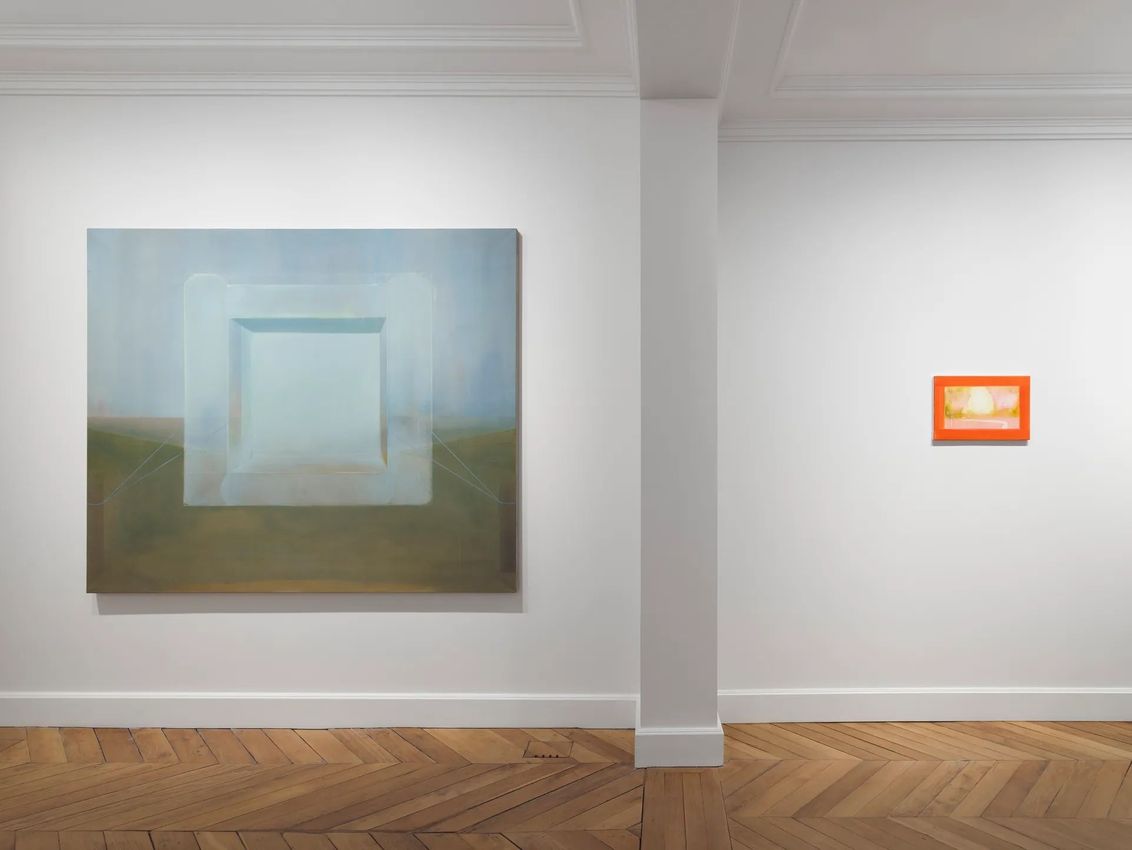
Although they are devoid of human figures, Stephenson describes these paintings as ‘kind of portraits’ of herself and her family. In_Inflatable Home_ (2024), a large, faceted semi-transparent square hovers over a barren landscape, tethered to two posts by exacting threads of blue paint. While the title references Stephenson’s childhood home, it also speaks of a dwelling that is not permanent, or even solid, but one that could be punctured or float away. Anchored to the ground, the inflatable behaves as a metaphor for the elusive nature of the past, and recollection as the inherent desire to impart stability to the ephemeral. In 5 Swings (2024), the titular objects representing Stephenson and her four siblings, are suspended from an unseen ceiling. The swings – some of which are traceable only by their ropes – are enclosed in a series of interconnected red walls or screens, which together resemble a stage set or a building that has been unfolded. Their outer edges taper into shards or sharp points, affording the otherwise playful scene a sense of foreboding or latent danger.
Red, And Yellow, And Blue (2024) offers a counterpoint to the more structured compositions and figurative formations. Created in one short sitting after suffering a personal loss, this visceral abstract scene of three coloured orbs carries an immediacy: ‘This raw experience of grief resolved into three primary colours on the canvas, the three colours that expand all other things. This, for me, represents grief in a very acute way.’ Indeed, colour operates as a kind of ‘locating device’ for Stephenson. ‘It’s not necessarily that the colour is what the memory looked like’, she explains, but is more of ‘a coordinate to get somewhere’. Painted on a non-absorbent gesso, which refuses the layering by which other works in the exhibition have been made, Red, And Yellow, And Blue is at once urgent and sobering: ‘it was almost like an exorcism’.
In ‘Mary! Go Round’, Stephenson uses colour, form and the materiality of paint as conduits to the intimate recesses of the mind. Through her particular approach to painting and its vicissitudes, the works come to stand as portals into a personal unconscious, as well as the raw material from which universal experiences and collective memories arise. Acting as umbilical cords between the internal and external, fantasy and reality, these ‘cathartic playgrounds’ are sites of the psyche that distil, for a moment, that which is fleeting and intangible.


Giving physical structure to memory, Mary Stephenson builds spaces that hold visual remnants of the unconscious mind. She approaches her canvases as fertile surfaces with the potential to recreate an emotion or bodily sensation. Stephenson applies thin layers of brightly coloured paint that seep and recede into her canvases before revealing a final image. Minute gestures—such as a small slit, a fine thread, or a sliver of light—provides entry points into these highly-saturated surfaces, inviting viewers to look closer.


An international art powerhouse, White Cube was established in 1993 in London by art dealer Jay Jopling. In its space on Duke Street, it served as the early exhibition venue for many now internationally acclaimed British artists, including Tracey Emin, Gilbert & George, Rachel Kneebone and Antony Gormley, who still show with the gallery today.

A respected voice in contemporary art discourse.
Focusing on ambitious storytelling and insightful art-world commentary. Ocula Magazine publishes in-depth interviews, critical essays and timely analysis on the artists, exhibitions and ideas driving the global art world.
Learn more about Ocula Magazine
Showcasing the best of the art world.
Ocula partners with galleries from around the world to highlight their artists, artworks and exhibitions. Gallery membership is by application and invitation, with each member vetted by an independent panel.
Learn more about Ocula Membership

Specialises in the sale of major artworks.
Led by a team with deep ties to the world’s leading auction houses, galleries and collectors. Ocula’s advisory team offers bespoke services to high-net-worth clients from around the world who are looking to acquire the best of contemporary and modern art.
Learn more about our team and services