Press Release

Xavier Hufkens is pleased to present Esther Kläs’ third exhibition at the gallery.
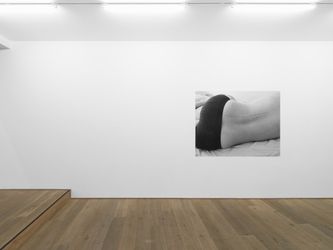
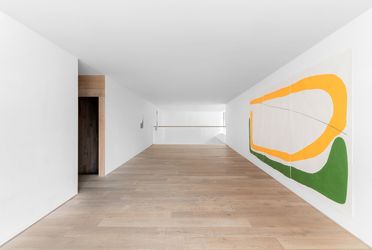
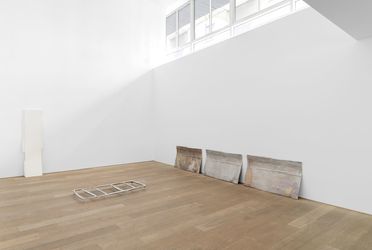
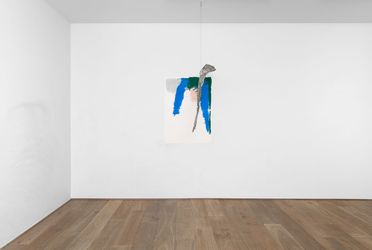
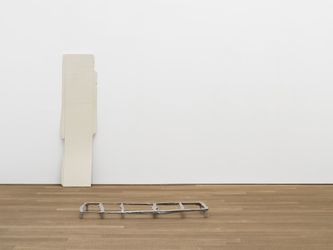
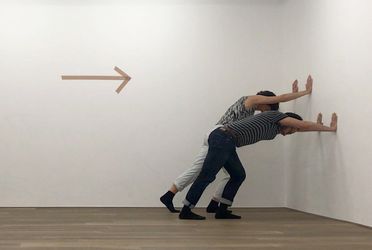
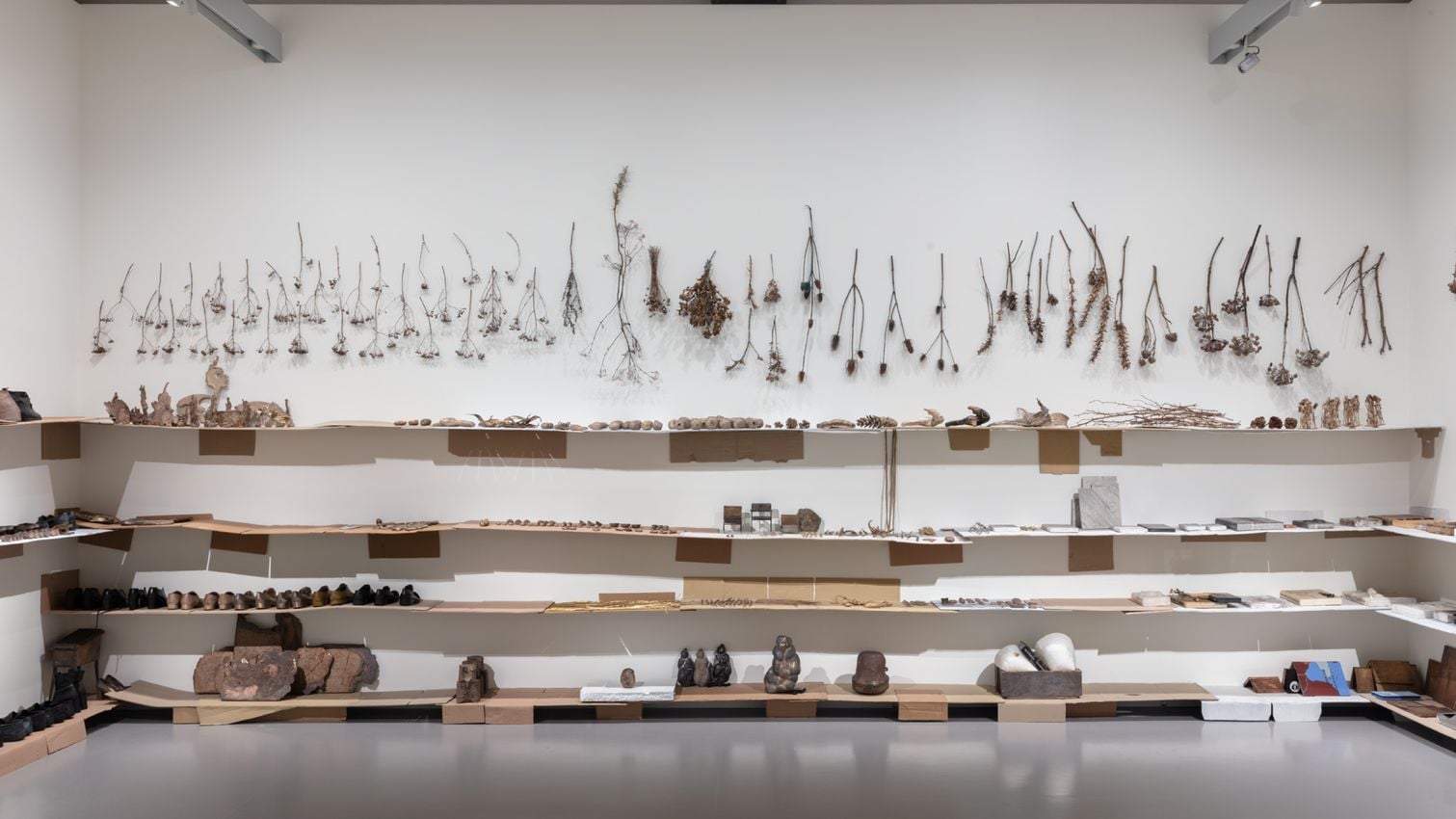
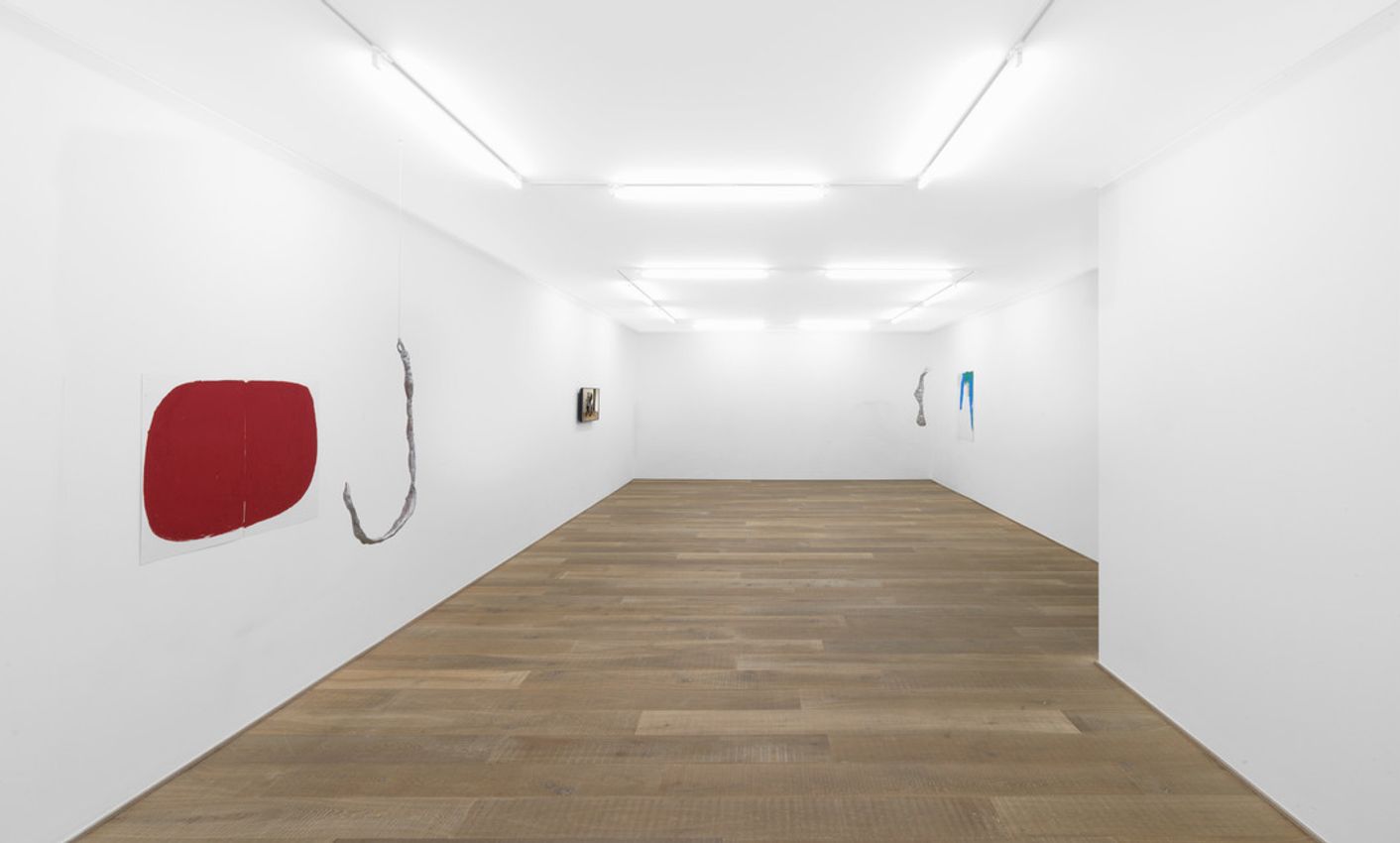
ll (elle elle) (long lines) continues the artist’s investigation of form, openness and presence through new works that span sculpture, photography, drawing and installation. Recently, Kläs began collaborating with choreographer and artist Gustavo Gomes. While mounting the exhibition, Kläs and Gomes produced new video works on site, dealing with joy, time and intimacy.

Falling, with no intention of hitting the ground. A space trick. Summer in the apartment is spent barefooted. In each room the floor tiles follow a different pattern. Paviment hidràulic, one by one handmade. They appeared in Catalonia in the 1850s and derive their durability from adding dehydrated Portland cement to coarser layers of sand. The pigment — hydraulically pressed into the surface — becomes part of the tile. Many of them are cracked. You feel them shuffling into place when you step on the carpet. I sit down, straighten my back and try to align my spine with the wall, push the lower vertebrae into the plaster. Let me try this. Three Tuareg men, cloaked in dry-dyed indigo, leave only hands, feet, eyes sticking out. The pigment of their tagelmusts leaches into their skin, becomes part of it. They carry their colour with them. Easy.

— Do you want me to sing? (sings) Blue are the people here...

The Tuareg are an oral society in which memory and speech perform all the functions which reading and writing would have otherwise. Their alphabet, the Tifinagh script, is primarily used for games and puzzles.

— (continues) Blue are the words I say.

I am looking at satellite images of dunes in the Laayoune-Sakia El Hamra region. Barchan dunes can measure up to 30 meters high and 370 meters wide. Desert winds mould their location and form. After a dune has migrated, a ghost shape is left behind.

And a blue Corvette...

Exactly! Do you remember when we visited Vall de Boí and its Romanesque churches? The frescoes depicted Christ with two halo’s: a small white one behind his head, and a larger (almond shaped) blue one which encapsulated the whole of his body. On our way we passed through Cavallers, one of few mountain ranges in Spain where you can climb on granite. Oldest rock on the block. Long narrow slits make it especially suited for crack climbing. To ascent these rigid lines, you need to familiarise yourself with ‘jamming’, a technique which allows climbers to force a body part into the crack and thus create the friction needed for their upward progress. Ideally you slide a flat hand into the split rock and then curl it into a fist, anchoring your arm in the wall. Once the hand is stuck, it can easily carry the full weight of the body. Climbing is not so much about strength, but about being able to control your motions very precisely. Slow-flowing movements. Stay as close to the wall as possible, carefully shift your balance from one foot to the other, while your fingers probe the surface for holds. The next day we walked down to the valley until we reached the lake, Estany de Cavallers. At the foot of the mountain lies a body of water. Ever heard of a nullah? You find them in the drier parts of India and Pakistan, literally an ‘arm of the sea’. A watercourse. Like the wadi of the Arabs, nullahs are characteristic of mountainous country with little rainfall. At twenty, my father sailed across the wrist of Panama. Clearly the world is shaped by the words of our body. These things go in every direction.

— (starts singing again) In the canyons of your mind, I will wander through your brain, To the ventricles of your heart, my dear, I’m in love with you again!

Esther Kläs (b. 1981, Mainz, Germany) lives and works in Barcelona. Her work is currently on view in The subtle interplay between the I and the me, a one year long exhibition at Kolumba in Cologne, Germany. Other recent exhibitions include Maybe it can be different, Fondazione Giuliani, Rome, Italy (2020), Start, CCA- Center for Contemporary Art Tel Aviv, Tel Aviv, Israel (2019), ola/wave, Proyecto AMIL, Lima, Peru (2017—2018); Our Reality, Fondazione Brodbeck, Catania, Italy (2015—2016); Whatness, Kunsthalle Bielefeld, Bielefeld, Germany (2015); Girare Con Te, Marino Marini Museum, Florence, Italy (2014) and Better Energy, MoMA PS1, NY, USA (2012).

Read More

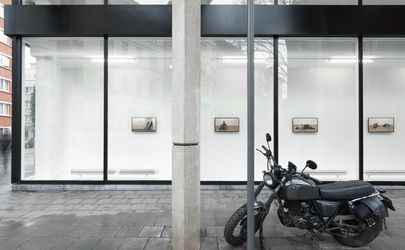
Installation Views

About the Artist

German-born Esther Kläs has developed a distinctive visual language that harks back to the great sculptural traditions of the twentieth century – including post-war abstraction and minimalism – while simultaneously challenging contemporary sculptural norms. Using malleable materials that can be worked by hand – cement, clay, plaster, Styrofoam and resin – Kläs is a process-based sculptor who maintains an intimate physical relationship with her work. Interested in the dynamics of group sculptures, Kläs often creates human-scale ensembles that seem governed by their own internal and external logic. Her practice frequently addresses stasis and movement, with her sculptures eliciting specific gestures and motions from viewers. Differing relations of scale, asymmetry, and the contrast between light and dark colours, also play a central role in her work.

View Artist Profile

Also Exhibiting at Xavier Hufkens

About the Gallery
Xavier Hufkens is one of Europe’s leading galleries for contemporary art. Located in Brussels, the gallery maintains a diverse exhibition programme with solo exhibitions of the gallery artists as well as group exhibitions and special projects. The gallery deals in a distinctive combination of painting, drawing, sculpture, photography, video and installation-based work.

The origins of the gallery date back to 1987, when Xavier Hufkens opened a gallery space in an un-refurbished warehouse in the neighbourhood of the South Station (Midi) in Brussels. During the early years, the focus of the gallery was upon mid-career and emerging artists and the gallery is known for having introduced some of the most influential contemporary artists to Brussels at a time when they were still relatively unknown. British sculptor Antony Gormley, who is still affiliated with the gallery, Felix Gonzalez-Torres and Rosemarie Trockel all showed in Belgium for the first time with Xavier Hufkens (Gormley in 1987; Gonzalez-Torres in 1991 and Trockel in 1993).

In 1992, the gallery moved to a 19th-century townhouse at 6 rue Saint-Georges, close to the Avenue Louise. Completely renovated by Belgian architects Paul Robbrecht, Hilde Daem and Marie-José Van Hee, the house quickly gained a reputation for being not just one of the most beautiful contemporary art spaces in the Belgian capital, but also one of the most interesting. The expanded exhibition programme coincided with the additional representation of a number of established artists from Belgium and abroad, including Richard Artschwager, Thierry De Cordier and Jan Vercruysse. In 1997, Hufkens expanded the gallery further by annexing the adjacent building and a number of new artists joined the gallery, including Louise Bourgeois, Roni Horn and Thomas Houseago.

A second space in the same street, at 107 rue Saint-Georges, opened in spring 2013. Located in the Galerie Rivoli, a mixed-use commercial development from the 1970s, the new gallery space was designed by Swiss architect Harry Gugger, who was previously in partnership with Herzog and De Meuron. Slegten & Toegemann, Brussels, managed the project.

An eclectic but very clear vision underpins all of the gallery’s activities: ‘The definition of the gallery was established from the start. The common thread, then and now, is quality over and above everything else, which I find more intellectually challenging than a forced definition. From the early days I juxtaposed established artists such as Michelangelo Pistoletto with someone like Felix Gonzalez-Torres when he was totally unknown. Today I still mix my work: I have no problem showing Malcolm Morley … alongside Robert Ryman, or Willem de Kooning.’ [Xavier Hufkens in The Art Newspaper, Issue 220, January 2011, published online: 20 January 2011]

Xavier Hufkens represents some thirty artists from different generations. He was part of the six-member selection committee for Art Basel during seven years and also participates in up to five international Arts Fairs annually. The gallery has partnerships with the estates of Louise Bourgeois, Willem de Kooning, Robert Mapplethorpe and Alice Neel.
View Gallery Profile
Address
107 rue St-Georges
St-Jorisstraat
Brussels
Belgium
Opening Hours
Tuesday – Saturday
11am – 6pm
(1)
Brussels 107 rue St-Georges
Xavier Hufkens
107 rue St-Georges, St-Jorisstraat, Brussels, Belgium

Opening hours
Tuesday – Saturday
11am – 6pm
The art world in focus