



Press Release

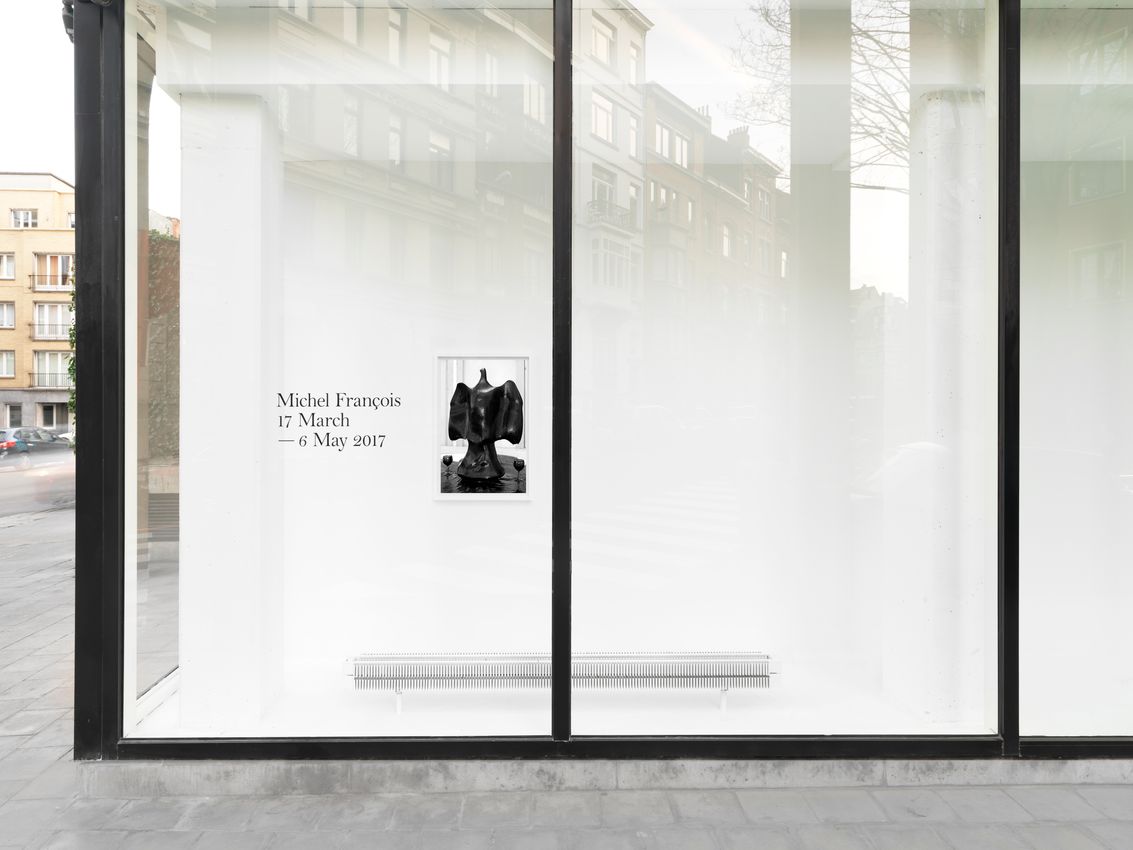
Xavier Hufkens is delighted to announce the opening of an exhibition of recent work by Michel François.

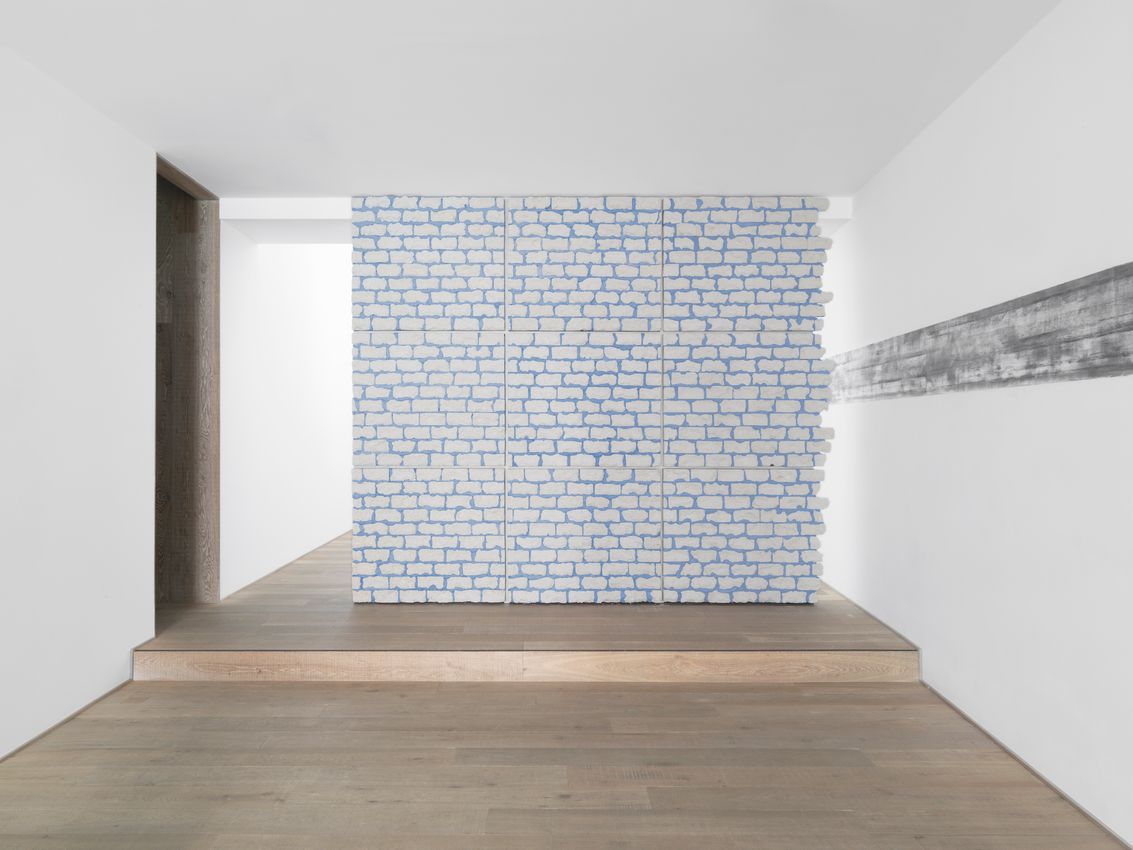
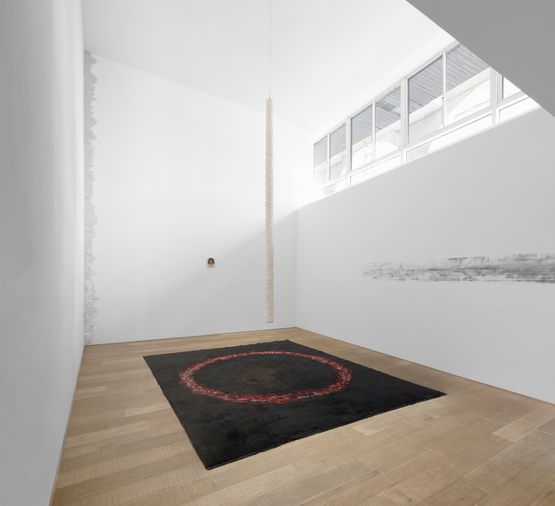
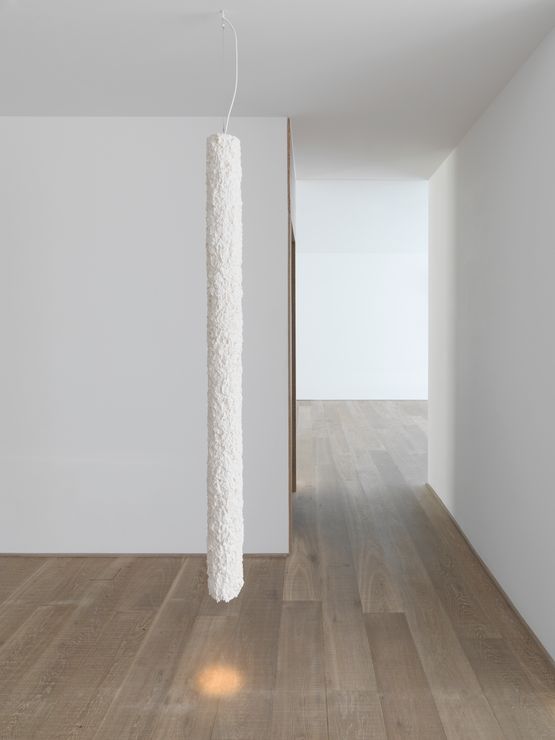
In a presentation that is as formally beautiful as it is intriguing, Michel François punctuates the gallery space with a series of sculptural works that depart from the rigid geometry of the line. Vertical and horizontal, suspended or freestanding, appearing in a masonry grid, defining a corner or marked across the wall: the linear trace is all pervasive.

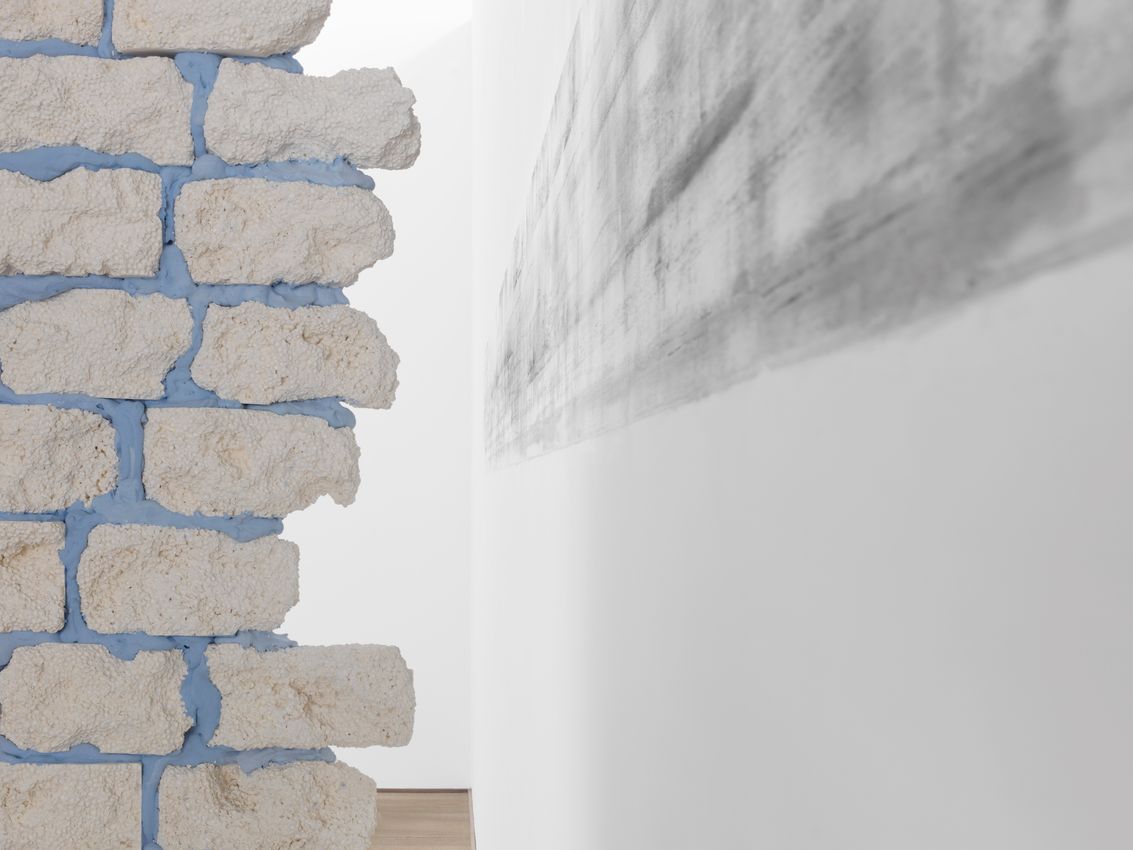
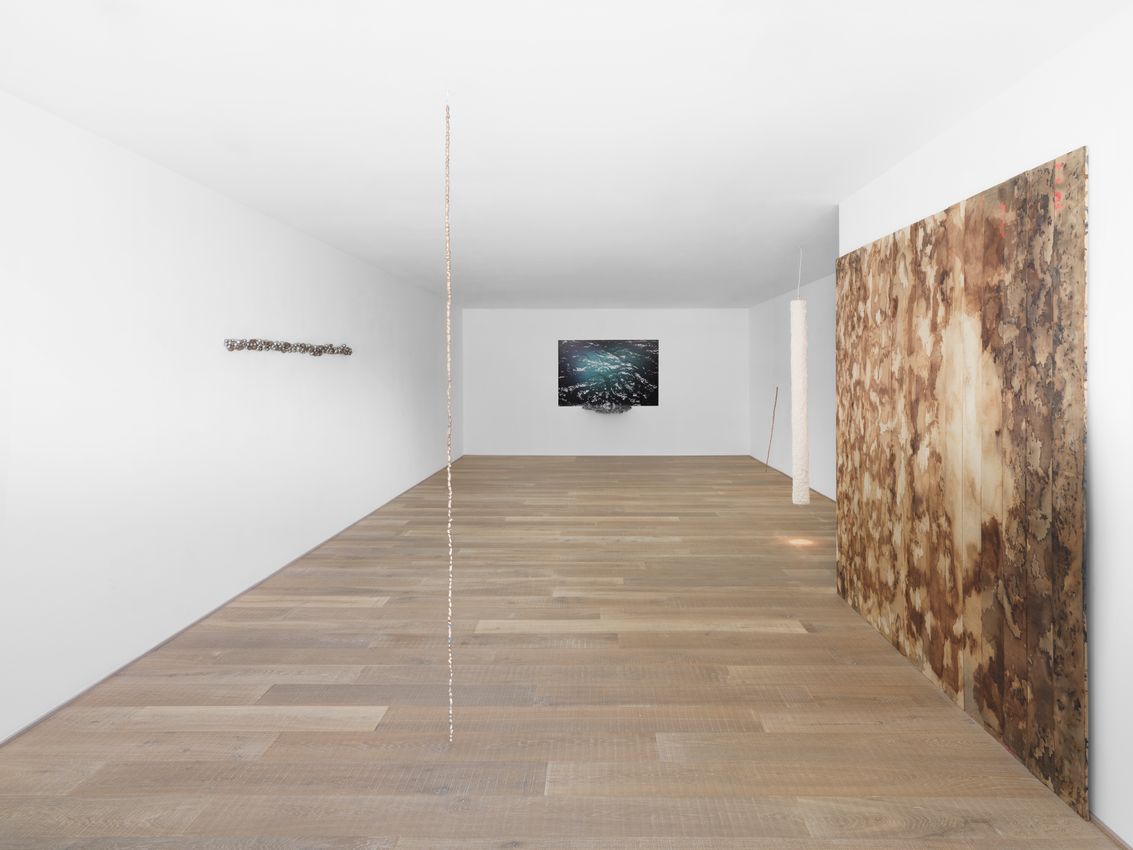
Yet each sharply defined edge, line, angle or plane also reveals its procedural antithesis: the organic, capricious and uncontrolled forms that arise during the making of the works. François’s practice is centred on what might be described as ‘controlled loss of control’ or, in other words, allowing the medium to do its will. These contradictions are particularly visible in Ruins of a Sky-Blue Wall, the major new work that confronts viewers upon entering the gallery. Constructed out of 1,200 hand-cast plaster bricks, this sculptural wall is as much an object of wonder as it is a barrier or impediment. On the one hand, it appears weightless, cartoon-like, tactile, surreal; yet it also represents painstaking labour, is heavy, solid and obstructing. To make the bricks, François poured plaster into moulds filled with tiny Styrofoam spheres; as the material hardened, it acquired a granular texture. Thanks to the friability of the plaster, each brick could be subsequently abraded, thereby creating imperfect forms with uniquely sponge-like textures. Plaster also ‘cements’ the bricks together, only this time coloured light-blue: an allusion to the sky, or the open space; the ‘cracks through which the light gets in’, but which, likewise, also holds the entire structure together. While the wall looks strong and forceful, closer inspection reveals an inherent tension and fragility.

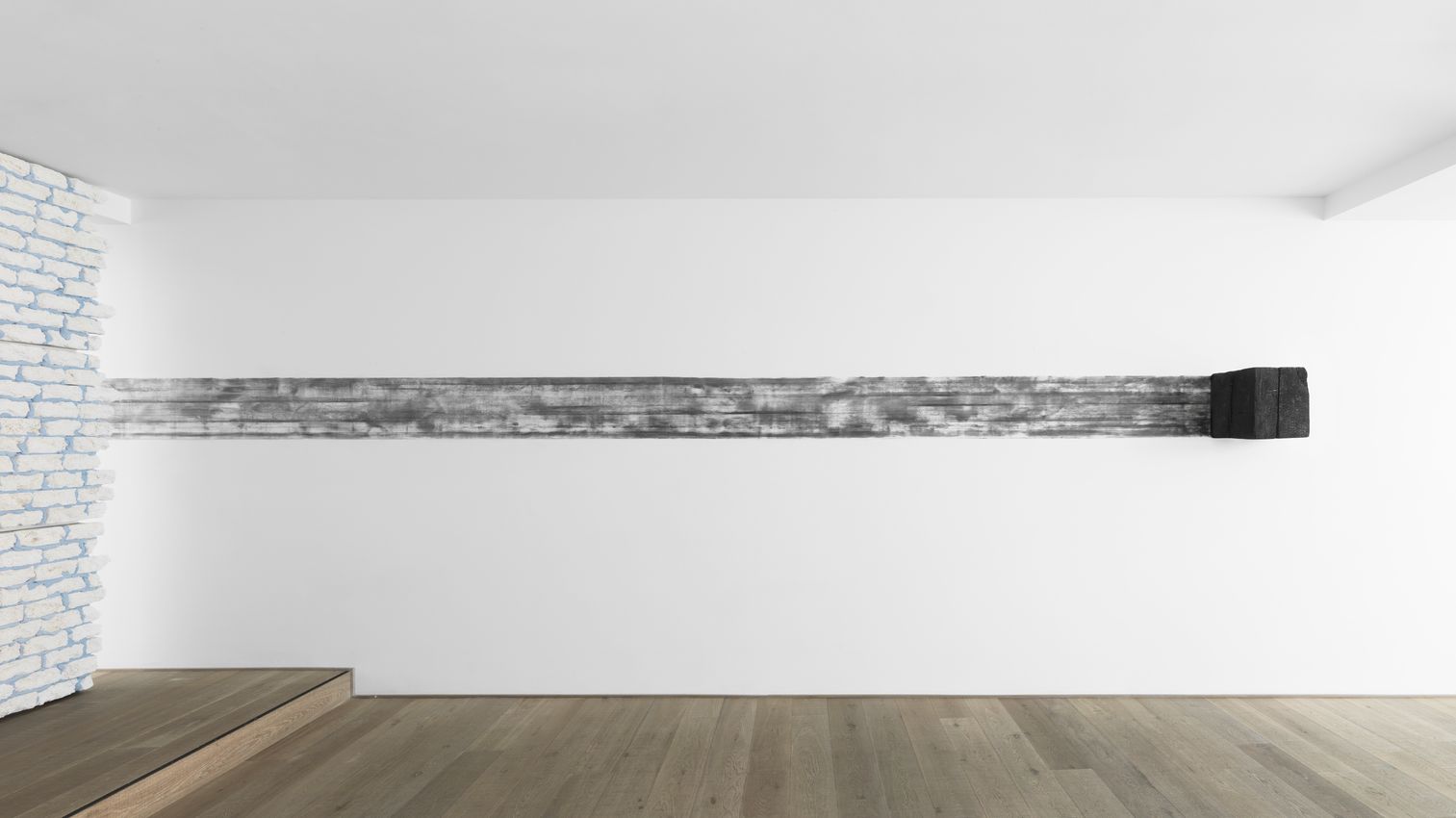
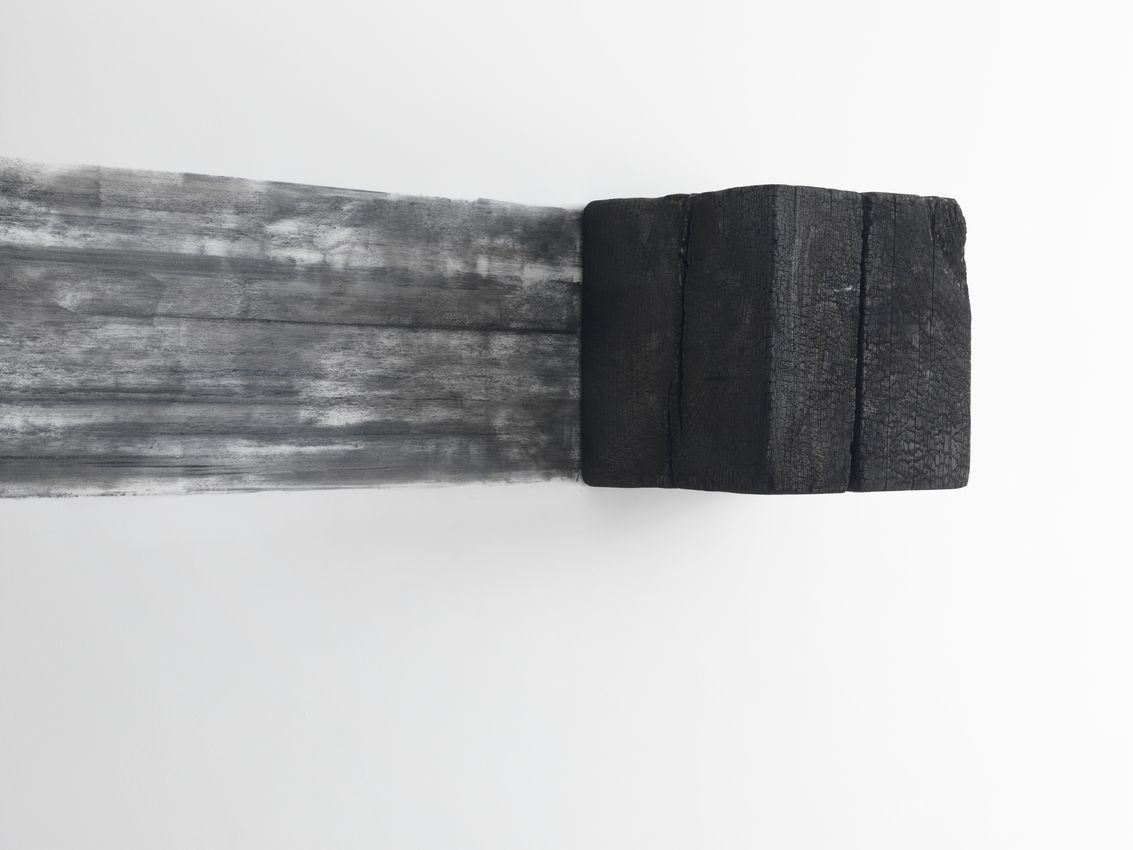
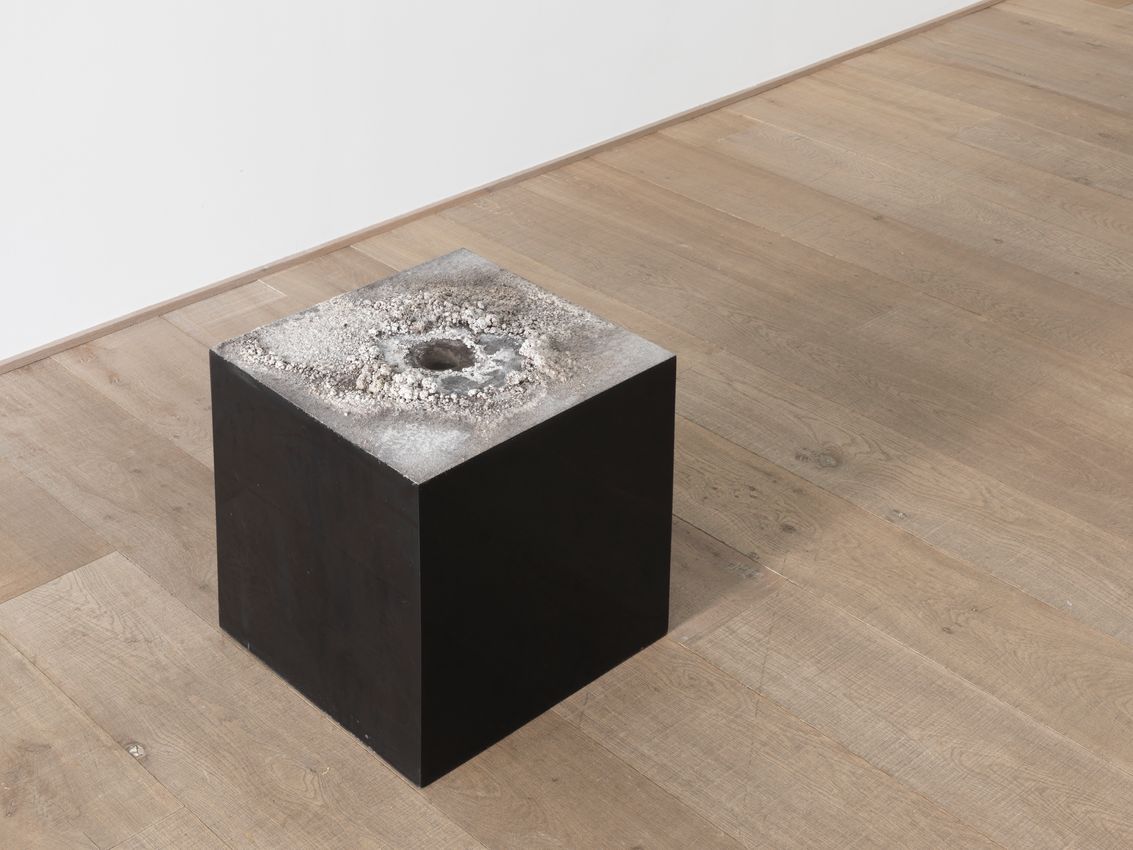
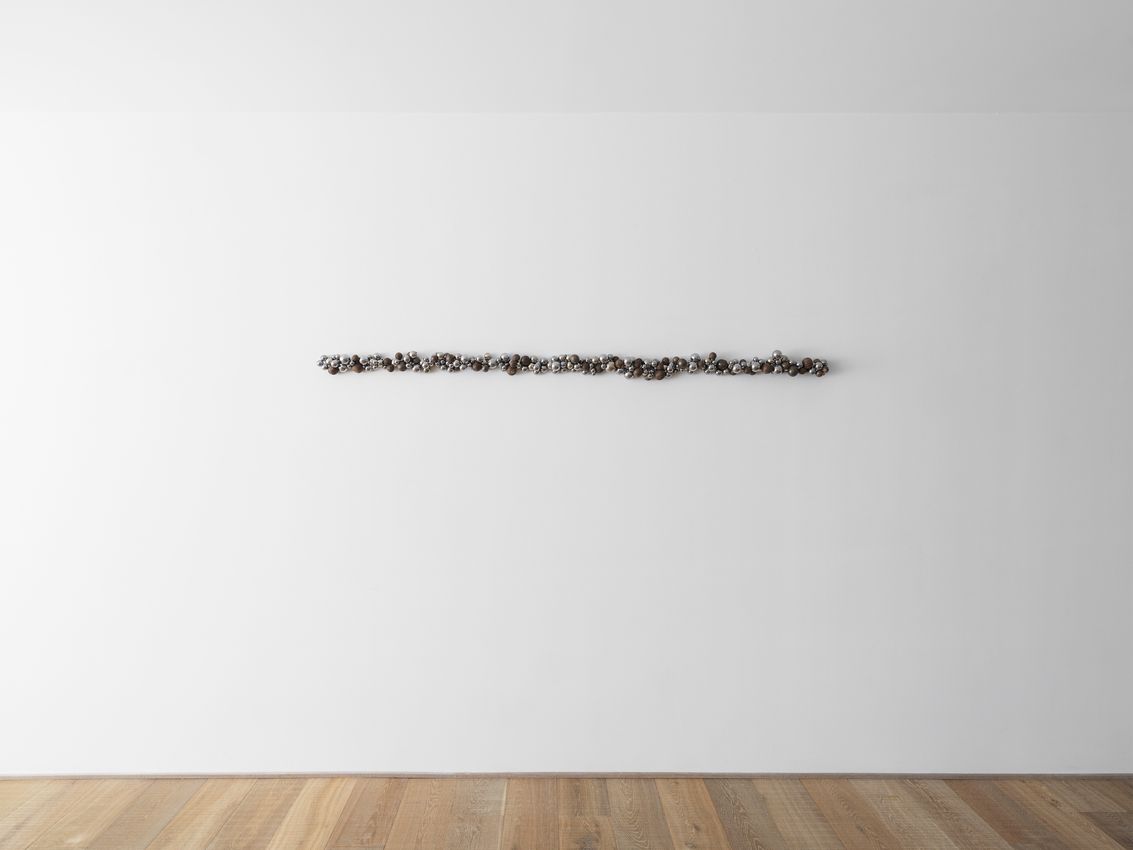
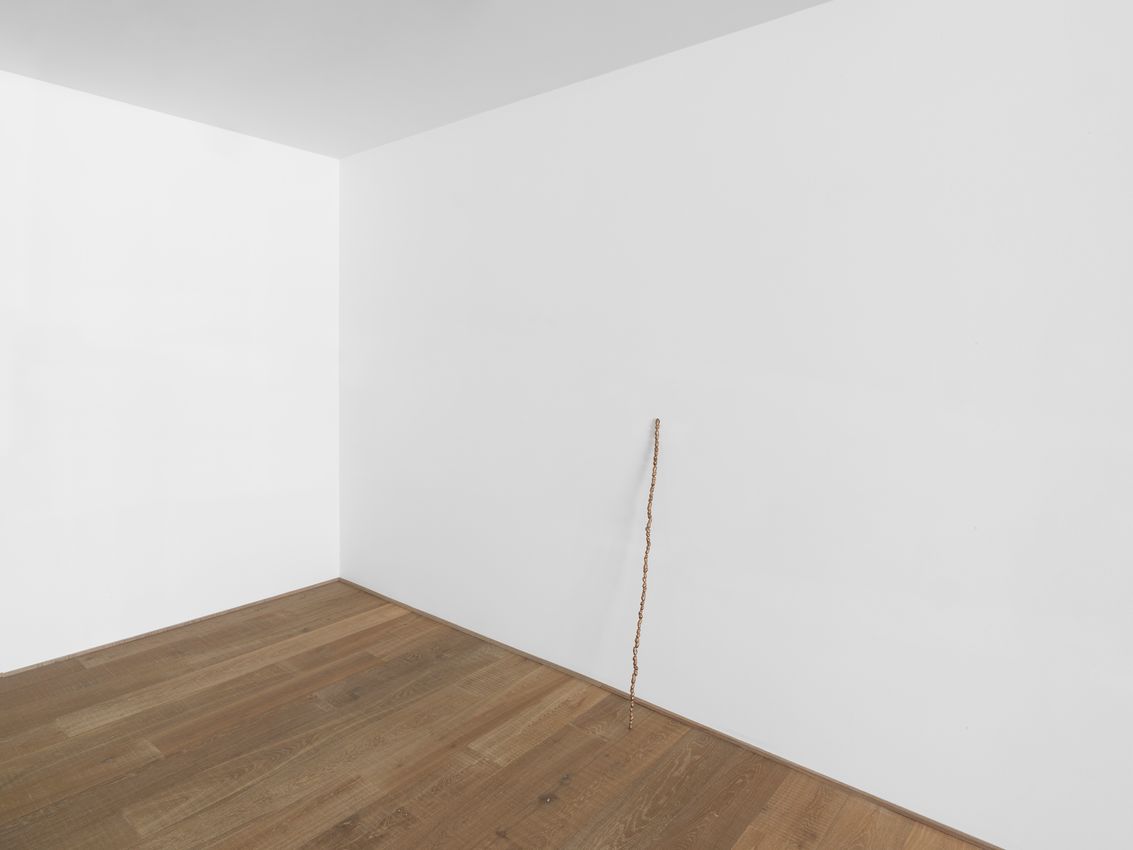
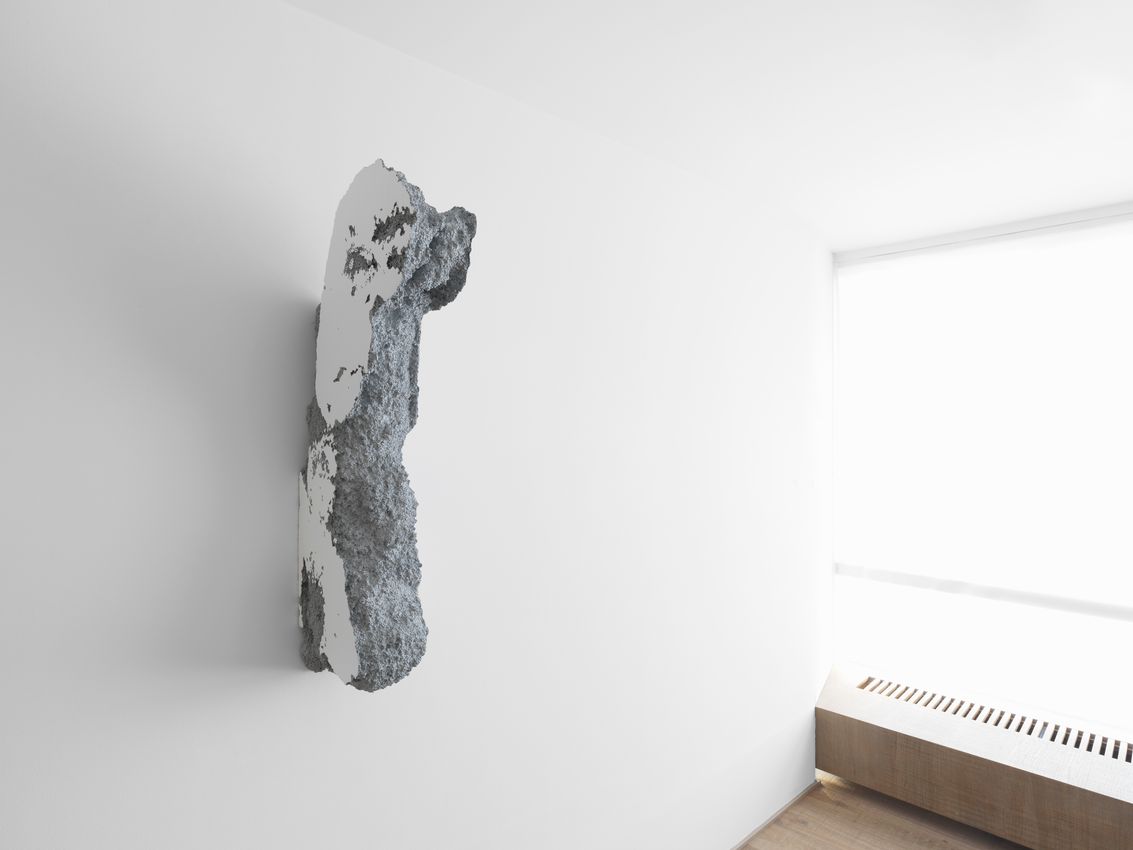
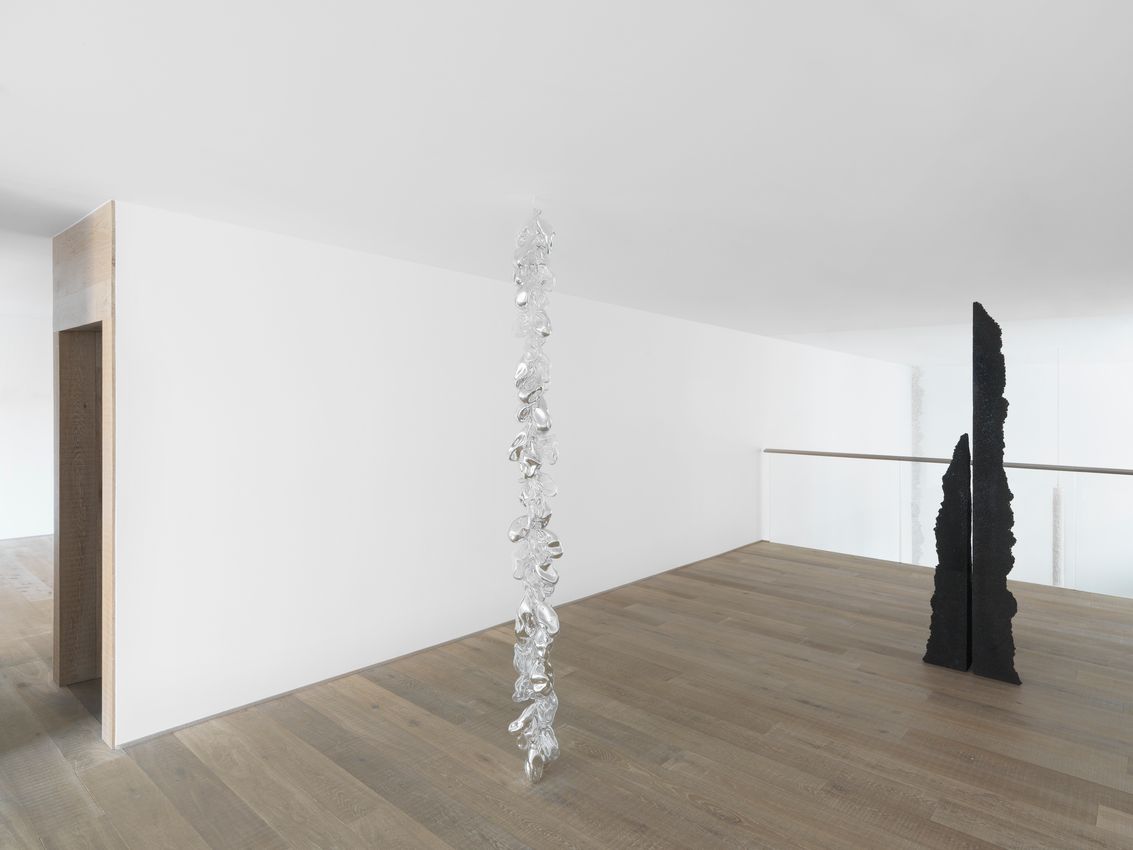
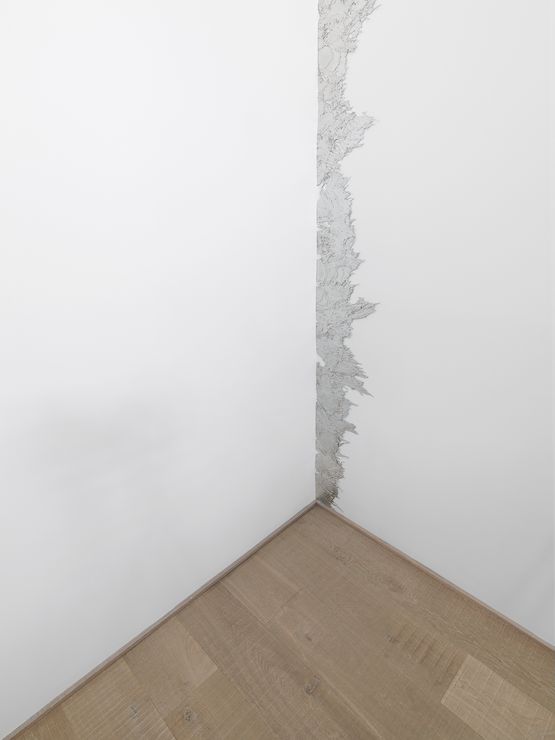
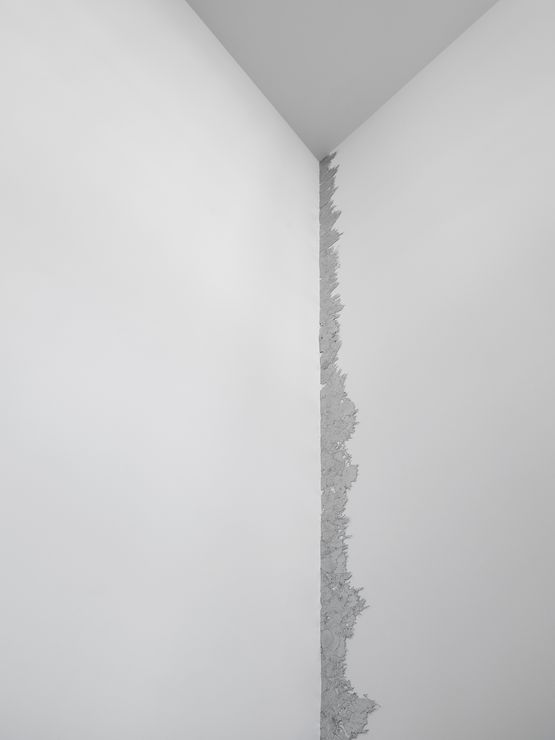
Shiny Corner materialises an equivalent transformation: to make this work, the artist hurled molten tin at the seam between his studio floor and wall. The hot metal hitting the cold surface caused it to solidify into globular rivulets, its motion and fluidity abruptly arrested. At the same time, this haphazard gesture also produced a perfect right angle that, now upended, completes the corner of the room. The same technique is used to opposite effect in the dark, matte, otherworldly sculptures made of asphalt, only here the works are dark, shadowy, light-absorbing, alien. Technical precision and chance are also evident in the artist’s Souffles perdus sculptures. In the work on display, a cluster of individually mouth-blown, silvered glass balloons are tethered to a taught, vertical line. And as if to counteract the luminosity of the limpid, natural forms — filled with the breath of life, but also strangely deflated — a solid geometric cube of carbonised wood leaves its dark and dusty trail across the pristine, white-washed walls.

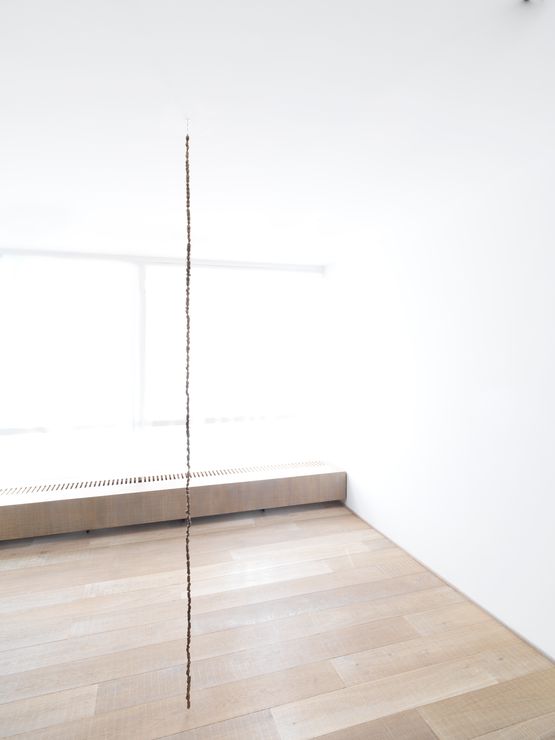
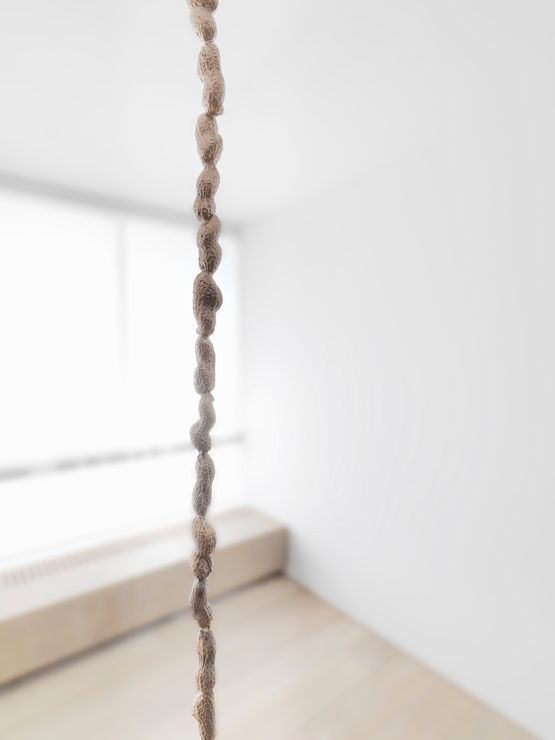
Francois’s works are, in a manner of speaking, ‘pieces of evidence’: the physical proofs of activities and events that have occurred elsewhere. They are action-based sculptures in the sense of being both the product and record of a controlled, but unpredictable, gesture: throwing (tin), blowing (glass), dragging (charcoal), stacking (belt buckles, peanuts), constructing (masonry) and pouring (plaster, aluminium, asphalt).

The line, as a leitmotiv, also possesses a conceptual significance. Lines divide, create borders, or establish thresholds. While this is immediately obvious when pure geometry gives way to organic form (or is it vice versa?), these junctures also call to mind other, more actual points of contact: the invisible barriers between seemingly different, contradictory and irreconcilable forces, peoples and cultures. But boundaries can also be permeable, as suggested by the sponge-like, porous textures of the bricks; soft as hinted at by the powdery charcoal; or fixed and impenetrable, like the unyielding metal.

In his subtle visual translations of these dualities – between control and ungovernability, conscious decision-making and random chance, and between materials and forms – Michel François alludes to the undertow of opposite and relative truths that, whether we are aware of them or not, define our very existence.

Michel François (b.1956, Saint-Trond) lives and works in Brussels. Recent solo exhibitions include: Nineteen thousand posters. 1994-2016, Frac île-de-France, le château, Rentilly, France (2016); Pieces of Evidence, Ikon Gallery, Birmingham, UK (2014); Pièces à conviction, CRAC Languedoc-Roussillon, Sète, France (2012); Michel François. Le Trait commun, Ecole nationale supérieure des Beaux-Arts, Paris, France (2012); 45.000 affiches. 1994-2011, MAC’s, Site du Grand Hornu, Belgium (2011); Plans d’évasion, IAC, Villeurbanne, France (2010); Plans d’évasion, SMAK, Ghent, Belgium (2009) and Hespérides I, Musée des Beaux-Arts, Lausanne, Switzerland (2009). His work has also been included in numerous group exhibitions such as Documenta IX (1992), the São Paolo Biennial XXII (1994), the 48th Venice Biennial (1999) and Sonsbeek 2008. Together with Ann Veronica Janssens he contributed to The Song (2009) by Anne Teresa De Keersmaeker. Other collaborations with De Keersmaeker include En Atendant (2010) and Partita 2 (2013).

Read More

Installation Views

Also Exhibiting at Xavier Hufkens

About the Gallery
Xavier Hufkens is one of Europe’s leading galleries for contemporary art. Located in Brussels, the gallery maintains a diverse exhibition programme with solo exhibitions of the gallery artists as well as group exhibitions and special projects. The gallery deals in a distinctive combination of painting, drawing, sculpture, photography, video and installation-based work.

The origins of the gallery date back to 1987, when Xavier Hufkens opened a gallery space in an un-refurbished warehouse in the neighbourhood of the South Station (Midi) in Brussels. During the early years, the focus of the gallery was upon mid-career and emerging artists and the gallery is known for having introduced some of the most influential contemporary artists to Brussels at a time when they were still relatively unknown. British sculptor Antony Gormley, who is still affiliated with the gallery, Felix Gonzalez-Torres and Rosemarie Trockel all showed in Belgium for the first time with Xavier Hufkens (Gormley in 1987; Gonzalez-Torres in 1991 and Trockel in 1993).

In 1992, the gallery moved to a 19th-century townhouse at 6 rue Saint-Georges, close to the Avenue Louise. Completely renovated by Belgian architects Paul Robbrecht, Hilde Daem and Marie-José Van Hee, the house quickly gained a reputation for being not just one of the most beautiful contemporary art spaces in the Belgian capital, but also one of the most interesting. The expanded exhibition programme coincided with the additional representation of a number of established artists from Belgium and abroad, including Richard Artschwager, Thierry De Cordier and Jan Vercruysse. In 1997, Hufkens expanded the gallery further by annexing the adjacent building and a number of new artists joined the gallery, including Louise Bourgeois, Roni Horn and Thomas Houseago.

A second space in the same street, at 107 rue Saint-Georges, opened in spring 2013. Located in the Galerie Rivoli, a mixed-use commercial development from the 1970s, the new gallery space was designed by Swiss architect Harry Gugger, who was previously in partnership with Herzog and De Meuron. Slegten & Toegemann, Brussels, managed the project.

An eclectic but very clear vision underpins all of the gallery’s activities: ‘The definition of the gallery was established from the start. The common thread, then and now, is quality over and above everything else, which I find more intellectually challenging than a forced definition. From the early days I juxtaposed established artists such as Michelangelo Pistoletto with someone like Felix Gonzalez-Torres when he was totally unknown. Today I still mix my work: I have no problem showing Malcolm Morley … alongside Robert Ryman, or Willem de Kooning.’ [Xavier Hufkens in The Art Newspaper, Issue 220, January 2011, published online: 20 January 2011]

Xavier Hufkens represents some thirty artists from different generations. He was part of the six-member selection committee for Art Basel during seven years and also participates in up to five international Arts Fairs annually. The gallery has partnerships with the estates of Louise Bourgeois, Willem de Kooning, Robert Mapplethorpe and Alice Neel.
View Gallery Profile
Address
107 rue St-Georges
St-Jorisstraat
Brussels
Belgium
Opening Hours
Tuesday – Saturday
11am – 6pm
(1)
Brussels 107 rue St-Georges
Xavier Hufkens
107 rue St-Georges, St-Jorisstraat, Brussels, Belgium

Opening hours
Tuesday – Saturday
11am – 6pm
The art world in focus
