





Press Release

In his new exhibition, Paul McCarthy presents a diverse body of work around the theme of CSSC The Dogs The Attack, a pivotal and hitherto unseen filmfrom his on-going stagecoach project CSSC (Coach Stage Stage Coach) (2016) and DADDA (Donald and Daisy Duck Adventure) (2018). The new video is accompanied by works on paper, recent paintings and a group of sculptures, including three unique works from the film. The selection not only showcases the full extent of McCarthy’s wide-ranging practice but also its dynamic and regenerative nature, whereby ideas cross-fertilise and permeate each other to create a complex web of interconnected links and allusions.

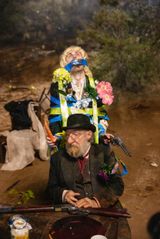
Paul McCarthy’s latest film instalment, CSSC The Dogs The Attack (2023), made in conjunction with his son Damon, revisits a disparate group of passengers as they travel through the American Midwest in a stagecoach. They are familiar, in shifting guises, from the previous films. Edited from the footage of these productions, CSSC, The Dogs The Attack chronicles the group’s encounter with a gang of Bonanza-like cowboys in pristine white outfits, referred to as ‘the dogs’. Four is a significant Biblical number: are these the Four Horsemen of the Apocalypse or four depraved Evangelists? Regardless, they go berserk and launch a devastating attack on the passengers, one of whom is a character named Ronald Raygun, in turn modelled on the banker J. P. Morgan (1837-1913), played by McCarthy himself. Central to McCarthy’s stagecoach films is a pointed focus on escalating violence: from malevolent bullying to fierce but organised brutality and, finally, a no-holds- barred descent into anarchic annihilation. And as per the prior instalments, CSSC, The Dogs The Attack also treads a fine line between authenticity and artifice: the fake silicone bodies are as lifelike on screen as the flashlights and plastic buckets are anachronistic. As an ensemble, the films can be read as parables of violence, whether in the historical or contemporary socio-political realm, or as tropes through which to consider the origins of barbarity and all its ramifications.

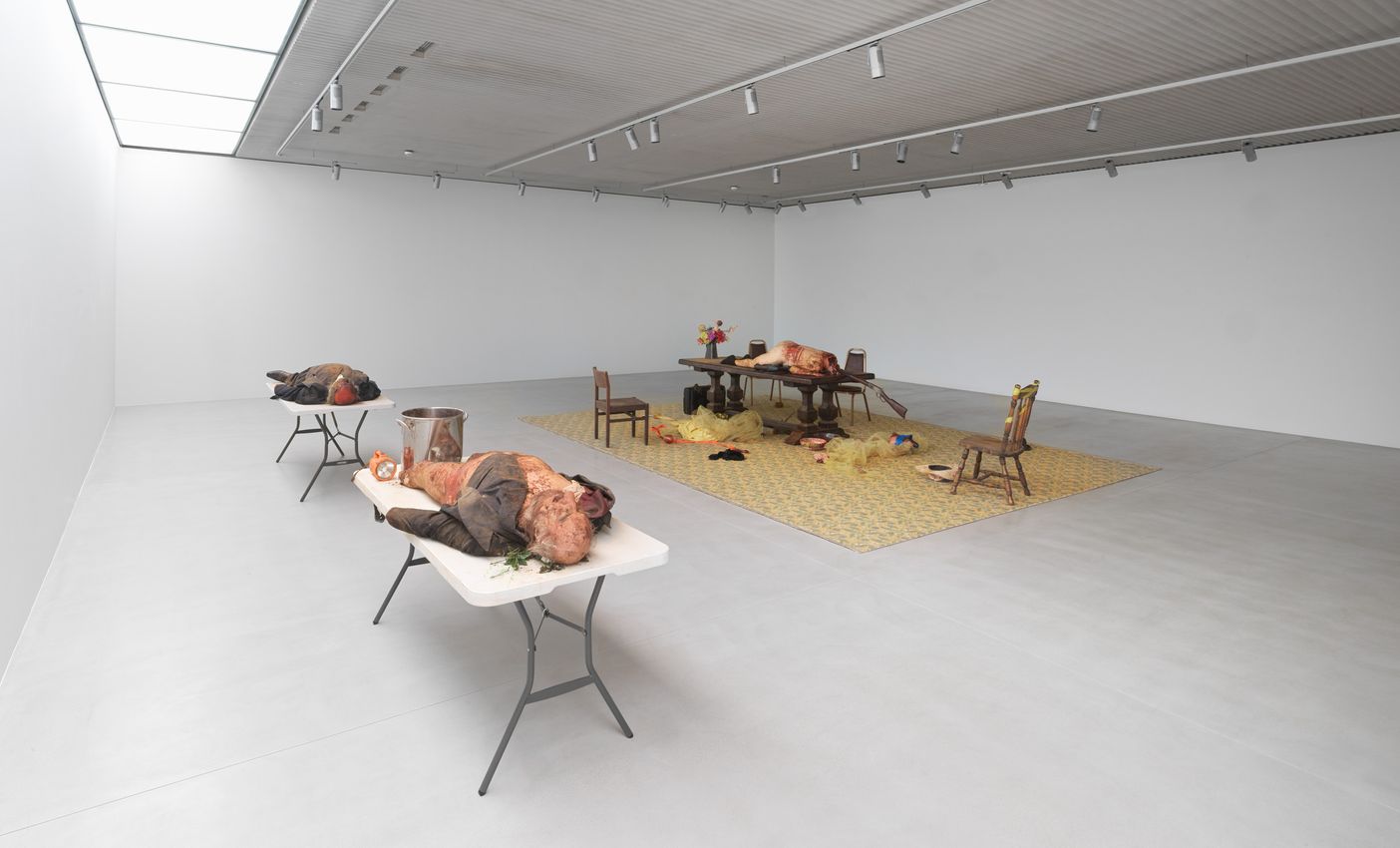
Three sculptures of McCarthy’s Ronald / J. P. Morgan character, which belong to the film, are exhibited in all their meticulously rendered detail. From an exhumed but intact, fully-clothed body to a semi-naked and half-butchered figure, the triptych concludes with a desecrated corpse that is mainly identifiable from the head on the floor. Seen in isolation from the film, the CSSC Banker sculptures raise more questions than they answer: what has led to this violence? What happened and why? The answers, of a sort, can be found on screen. As ‘relics’ of the cinematic process, so to speak, they also highlight the gap between image and reality. McCarthy presents the works twice: once in the film, during which they are passed off as ‘real’, but also in the gallery, which allows us to view them up-close, for longer, and in all their lifelike ‘unreality’. The intangible (cinematic image) and tangible (sculptures) coexist in the same space. Moreover, in every key respect, they are exact replicas of the artist, created from casts of his own body. Is thisthe death of a character, and everything he represents, or the death of the artist/ director? This dichotomy is particularly resonant in CSSC Banker, Ronald, Table, and Flowers (2016), which is shown in an identical arrangement to the film. Three figures, instead of one, imply that the Ronald / J. P. Morgan character has died multiple times and invariably returned to life, both as a nod to the surreal nature of the film and the mantra that Hollywood stars never die: they can perish endlessly on screen but will always live to make another movie, ad nauseum (John Wayne ‘died’ in at least eight films). On another level, the sculptures touch upon existential questions around death, mortality and identity, more specifically the cross-over points between role-playing and selfhood.

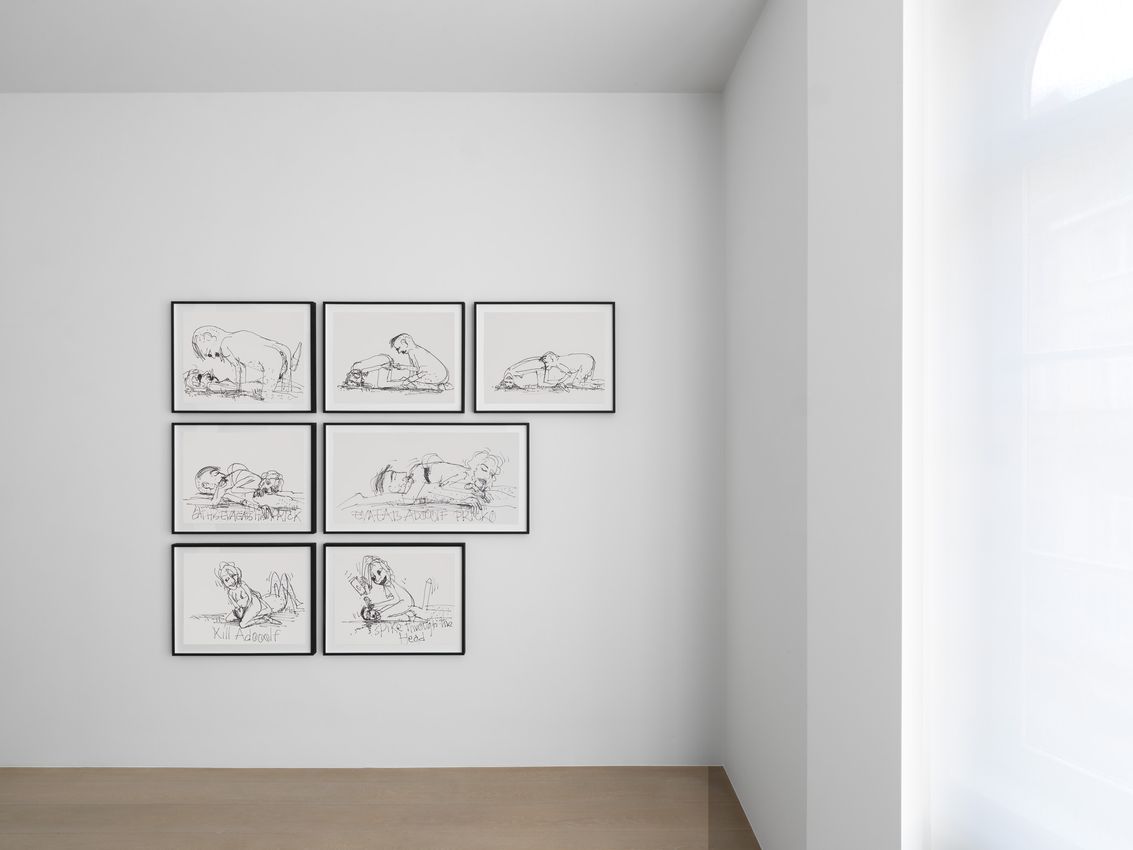
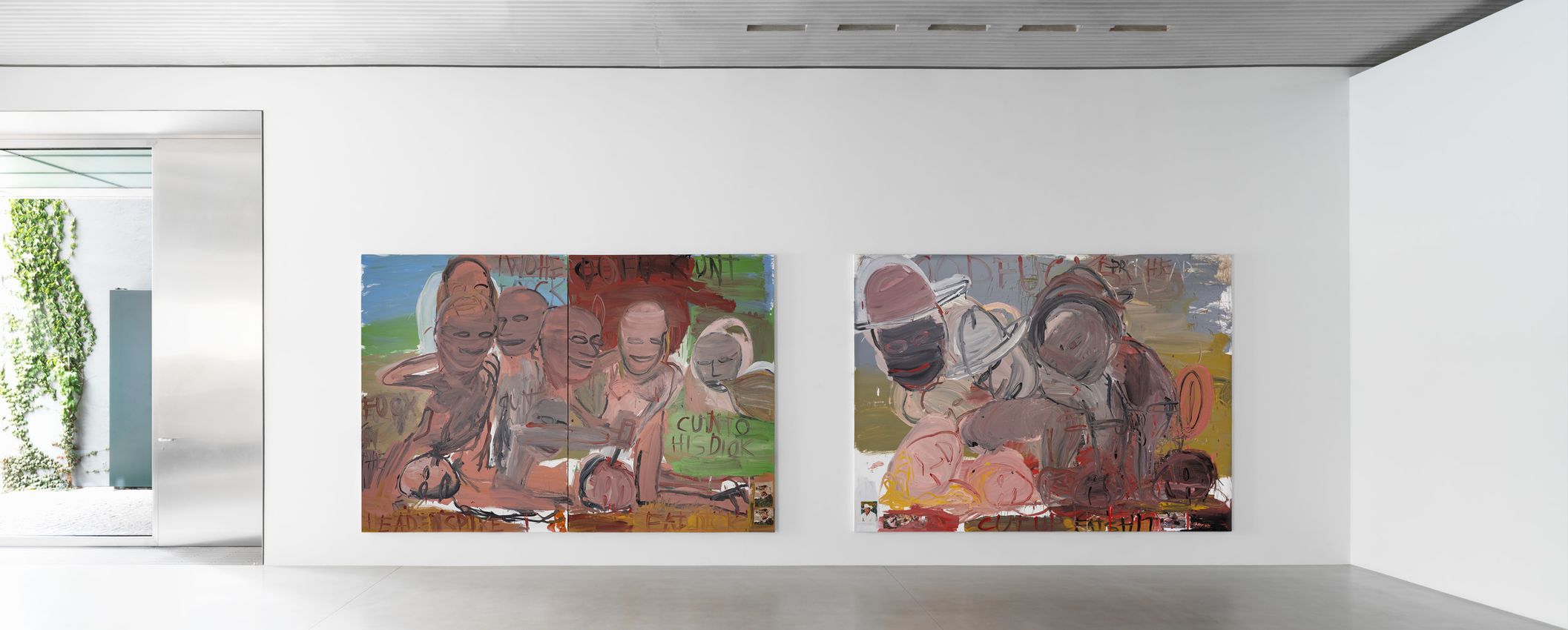
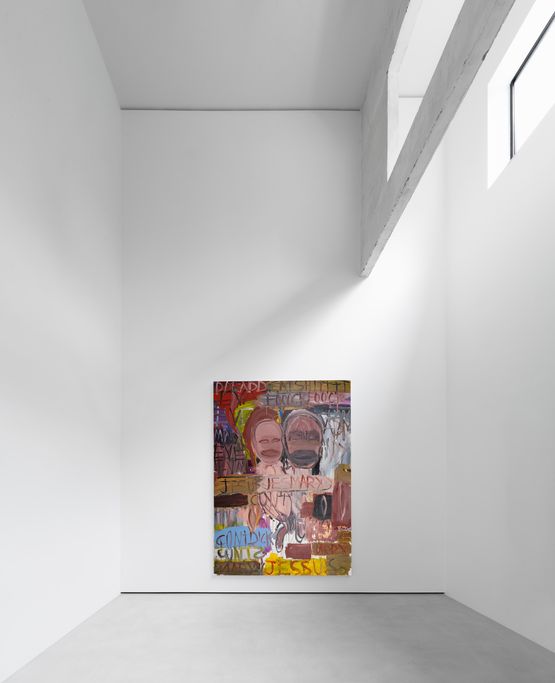
CSSC The Dogs The Attack and related sculptures are bookended by groups of pencil drawings and oil paintings. The former predate the CSSC and DADDA films and are akin to visual scripts and storyboards, whereas the latter were created this year. While certain paintings reimagine specific scenarios from the live-action sequences – the J. P. Morgan character on the table is clearly visible, for example, in CSSC DOG GOD and CSSC GOD COD – others venture into uncharted territory. In A&E EVAEAT CANNIBAL and A&E HEAD SPIKE, for instance, characters from another performance-based work, namely Adolf and Eva/Adam and Eve (from the A&E corpus), join forces with the bloodthirsty ‘dogs’. These latter paintings, in which the CSSC and A&E characters are conflated across time and space into new propositions, reveal the porous ‘boundaries’ between McCarthy’s varied worlds.

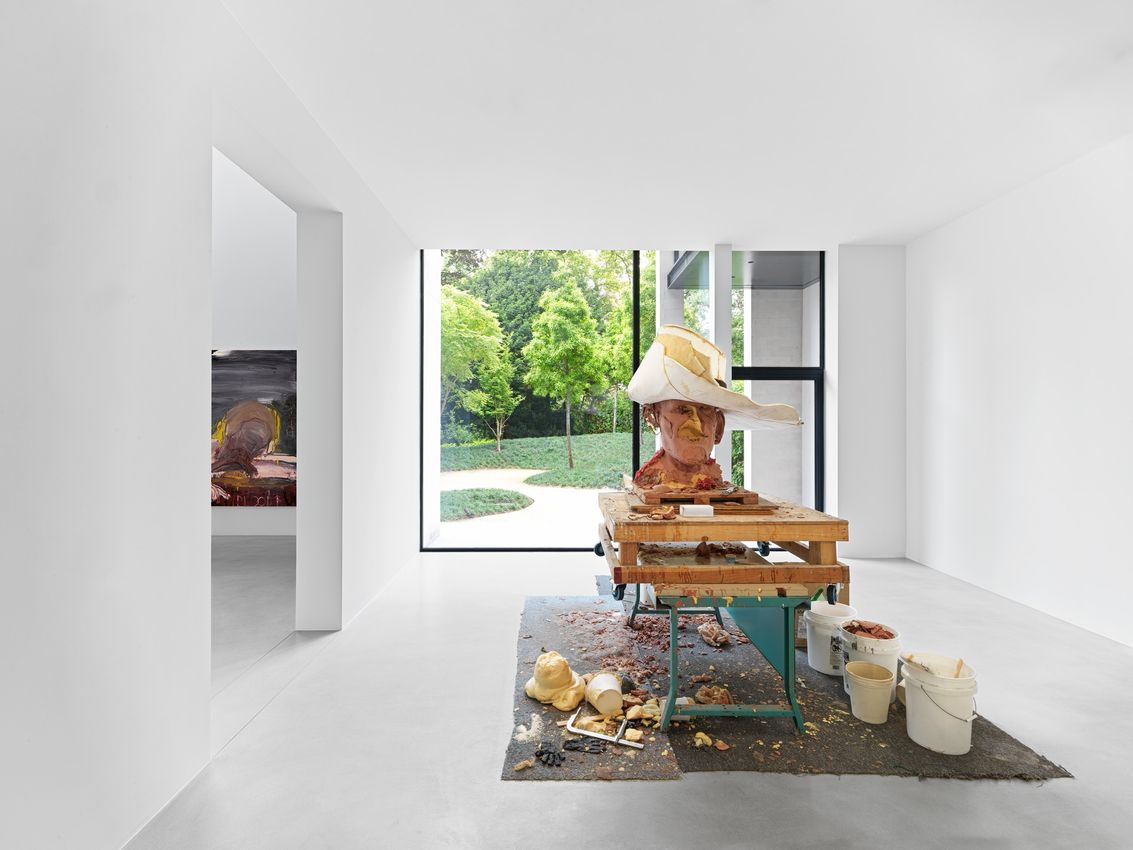
Complementing the exhibition is a large sculpture of John Wayne which relates to the overarching CSSC project. To a large extent, the artist’s films reference classic Westerns such as Stagecoach (1939), starring the aforementioned actor. When Wayne dramatically races his carriage across the desert, the wind catches the brim of his Stetson: the hat in McCarthy’s sculpture is bent at exactly the same angle.

In contrast to the hyper-realistic CSSC Banker series, the exposed armatures and amalgam of model-making materials are evocative of old-school, theatrical prop- making techniques. The figure is larger than life, devoid of realistic features, yet eminently recognisable as John Wayne due to the powerful iconography. McCarthy has said of the original Stagecoach film: “It is a prime example of Hollywood westerns creating a myth about the West. A fucked-up myth. The colonialism, the imperialism of America. The atrocity of the American Indians... just the atrocity of the Americas. All of that hidden and camouflaged in racism within Hollywood of the 30s, 40s, 50s.”

Paul McCarthy (b. 1945, Salt Lake City) lives and works in Los Angeles, California. Solo exhibitions were held at KODE, Bergen (2021); Hammer Museum, Los Angeles (2020) Museum of Fine Arts Leipzig (2018); M Woods, Beijing (2018); Faurschou Foundation in Venice, Venice (2017); Fundació Gaspar, Barcelona (2017); Kulturzentrum Lokremise, St.Gallen (2016); The Renaissance Society, Chicago (2015); Monnaie de Paris, France (2014); Neue Nationalgalerie, Berlin (2012); Whitney Museum, New York (2008); SMAK, Ghent (2007); Moderna Museet, Stockholm (2006); and Haus der Kunst, Munich (2005). He has also participated in many international events, including the Berlin Biennial (2006); the Whitney Biennial (1995, 1997, 2004); and the Venice Biennale (1993, 1999, 2001).

Read More

Installation Views

About the Artist

American artist Paul McCarthy is known for his wide-ranging and often provocative and disturbing oeuvre, which encompasses performance, photography, film, multimedia installations, sculpture, drawing and painting. Messy, antagonistic, sexually explicit and politically charged, McCarthy’s output takes aim at consumerism, popular culture and our innermost fears and neuroses, such as sex, bodily fluids and human orifices. While he regularly appropriates icons of popular culture and childhood, including gnomes, Santa Claus, Barbie, Snow White and Heidi in his work, McCarthy inevitably recasts his characters as violent, malicious and depraved. His imagery, which can be both explicit and brutal, is often shocking, and he delights in sensory overload, frequently producing work that is either difficult to watch, or is deliberately intended to elicit feelings of discomfort and disgust. In a career spanning some five decades, McCarthy has come to be recognised as one of the greatest chroniclers, and transgressors, of contemporary social norms and taboos. Mercilessly ridiculing authority and the so-called rules of polite society, his anarchic oeuvre mixes both high and low culture, and provokes an analysis of our most fundamental and sacrosanct beliefs.

View Artist Profile

Also Exhibiting at Xavier Hufkens

About the Gallery
Xavier Hufkens is one of Europe’s leading galleries for contemporary art. Located in Brussels, the gallery maintains a diverse exhibition programme with solo exhibitions of the gallery artists as well as group exhibitions and special projects. The gallery deals in a distinctive combination of painting, drawing, sculpture, photography, video and installation-based work.

The origins of the gallery date back to 1987, when Xavier Hufkens opened a gallery space in an un-refurbished warehouse in the neighbourhood of the South Station (Midi) in Brussels. During the early years, the focus of the gallery was upon mid-career and emerging artists and the gallery is known for having introduced some of the most influential contemporary artists to Brussels at a time when they were still relatively unknown. British sculptor Antony Gormley, who is still affiliated with the gallery, Felix Gonzalez-Torres and Rosemarie Trockel all showed in Belgium for the first time with Xavier Hufkens (Gormley in 1987; Gonzalez-Torres in 1991 and Trockel in 1993).

In 1992, the gallery moved to a 19th-century townhouse at 6 rue Saint-Georges, close to the Avenue Louise. Completely renovated by Belgian architects Paul Robbrecht, Hilde Daem and Marie-José Van Hee, the house quickly gained a reputation for being not just one of the most beautiful contemporary art spaces in the Belgian capital, but also one of the most interesting. The expanded exhibition programme coincided with the additional representation of a number of established artists from Belgium and abroad, including Richard Artschwager, Thierry De Cordier and Jan Vercruysse. In 1997, Hufkens expanded the gallery further by annexing the adjacent building and a number of new artists joined the gallery, including Louise Bourgeois, Roni Horn and Thomas Houseago.

A second space in the same street, at 107 rue Saint-Georges, opened in spring 2013. Located in the Galerie Rivoli, a mixed-use commercial development from the 1970s, the new gallery space was designed by Swiss architect Harry Gugger, who was previously in partnership with Herzog and De Meuron. Slegten & Toegemann, Brussels, managed the project. A third space opened in spring 2020, located at 44 Rue Van Eyck, designed by architect Bernard Dubois.

An eclectic but very clear vision underpins all of the gallery’s activities: ‘The definition of the gallery was established from the start. The common thread, then and now, is quality over and above everything else, which I find more intellectually challenging than a forced definition. From the early days I juxtaposed established artists such as Michelangelo Pistoletto with someone like Felix Gonzalez-Torres when he was totally unknown. Today I still mix my work: I have no problem showing Malcolm Morley … alongside Robert Ryman, or Willem de Kooning.’ [Xavier Hufkens in The Art Newspaper, Issue 220, January 2011, published online: 20 January 2011]

Xavier Hufkens represents some thirty artists from different generations. He was part of the six-member selection committee for Art Basel during seven years and also participates in up to five international Arts Fairs annually. The gallery has partnerships with the estates of Louise Bourgeois, Willem de Kooning, Robert Mapplethorpe and Alice Neel.
View Gallery Profile
Address
6 rue St-Georges
St-Jorisstraat
Brussels
Belgium
Opening Hours
Tuesday – Saturday
11am – 6pm
(1)
Brussels 6 rue St-Georges
Xavier Hufkens
6 rue St-Georges, St-Jorisstraat, Brussels, Belgium

Opening hours
Tuesday – Saturday
11am – 6pm
The art world in focus
