Press Release
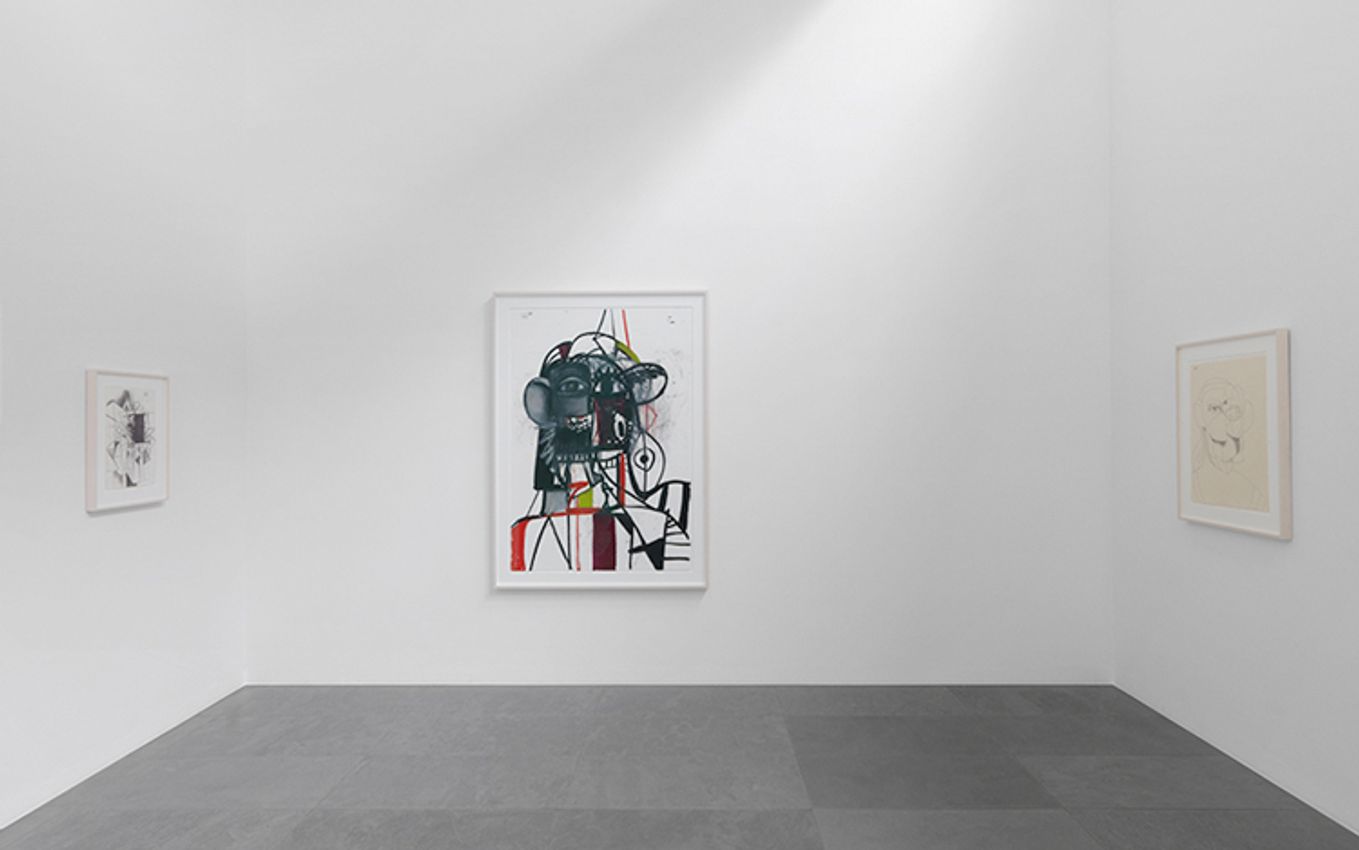
Xavier Hufkens is pleased to announce an exhibition of works on paper by George Condo at 6 rue St-Georges.

The works in this exhibition underscore the fundamental importance of drawing within George Condo’s practice. Ranging from bold, large-scale works in oil-stick, through to ink and pencil compositions of varying degrees of complexity, the drawings bear witness to the artist’s virtuoso handling of different scales, formats and media. While he rose to prominence as a painter, Condo is a consummate draftsman who does not believe in the traditional art-historical hierarchy that privileges oil painting over works on paper. Says Condo: ‘I want to reverse that, to stand up for drawing.’

His compositions are imaginary constructs that, on the one hand, open a window onto an inner world. On the other hand, they also reveal an objective, outward-looking dialogue with art history and popular culture. It is a conversation that has provided him with a rich wellspring of inspiration throughout his thirty-year career, not only with regard to subject matter, but also in terms of approach and technique. Condo’s interaction with the work of his predecessors is the leitmotiv that runs throughout his highly diverse and idiosyncratic oeuvre, one that has seen him ‘borrow’ freely from the art-historical canon in order to express complex and conflicting emotional states, or to expose contemporary political, cultural and social mores. While the works in this exhibition share many similarities with his paintings – figuration, portraiture, fragmentation, caricature – they nevertheless betray a shift, and mark a resurgence of Condo’s engagement with the work of Picasso. At the same time, they are also informed by his abiding interest in popular American culture, including Playboy magazine, comics and cartoons.

The formal correspondences between Condo’s drawings and Picasso’s cubist period are self-evident, although Condo prefers to define his own art as ‘psychological cubism’. He has said: ‘Picasso painted a violin from four different perspectives at one moment. I do the same with psychological states. Four of them can occur simultaneously… hysteria, joy, sadness, and desperation. If you could see these things at once that would be like what I’m trying to make you see in my art.’

Condo’s drawings portray a grotesque reality that is characterized by nudity and sex, and which often exudes visceral emotions such as rage, insanity, hysteria, violence, loneliness and alienation. The figures are human, but often distorted and hybrid, depicted with multiple eyes and mouths. Condo aficionados will recognise familiar characters from earlier paintings, such as the butler Jean Louis, while one drawing is executed upon a blank orchestral score, a reminder of Condo’s musical abilities. The sense of distress that emanates from a number of works is linked to the artist’s profound reflection on the human condition: ‘If you can paint the anguish of everyday life and give some dignity to everyday despair… or some of the emotions that regular people have, their feelings or thoughts become worthy of an artistic endeavour. There’s something beautiful about recognizing those kinds of things in life and saying something about them… If you think about people’s feelings and emotions, or unimportant and insignificant thoughts, and shine a light on them, you get a kind of cinematic moment, like what happens before the first word on a page in a novel.’

George Condo (b. 1957) lives and works in New York. Solo exhibitions include Mental States, New Museum, New York (travelling exhibition, 2012-2011) and La Civilisation Perdue, Musée Maillol, Paris (2009). His works feature prominently in important public and private collections, including The Museum of Modern Art, New York; The Metropolitan Museum of Art, New York; The Solomon R. Guggenheim Museum, New York; The Whitney Museum of American Art, New York; Museu d’Art Contemporani de Barcelona, Barcelona; Astrup Fearnley Museet, Oslo; and the Fonds National d’Art Contemporain, Paris.
About the Artist

George Condo is recognised as being one of America’s most influential living artists. In a career spanning more than three decades, Condo’s highly original and distinctive body of work has consistently drawn upon art historical traditions and genres, the portrait particularly, in order to hold a mirror up to contemporary social mores. Condo first started exhibiting his startling, hybrid style paintings – that daringly fused the sensibilities of European Old Master painting with references to popular American culture, including Playboy magazine, comics and cartoons – in the 1980s. Condo coined the term ‘Artificial Realism’, to describe his approach or, in other words, ‘the realistic representation of that which is artificial’. Between 1985 and 1995, Condo worked in both Paris and New York, and spent a considerable amount of time in the French capital where he met writer William S. Burroughs (with whom he has collaborated on many paintings and sculptures) and the philosopher Felix Guattari, who has written extensively on his work. Throughout his career, Condo has never deviated from his personal vision. His unique pictorial inventions, imaginary portraits (which also include a bizarre cast of pinhead figures known as Antipodes) and often grotesque but classically executed paintings continue to surprise and, at times, horrify.

View Artist Profile

Also Exhibiting at Xavier Hufkens

About the Gallery
Xavier Hufkens is one of Europe’s leading galleries for contemporary art. Located in Brussels, the gallery maintains a diverse exhibition programme with solo exhibitions of the gallery artists as well as group exhibitions and special projects. The gallery deals in a distinctive combination of painting, drawing, sculpture, photography, video and installation-based work.

The origins of the gallery date back to 1987, when Xavier Hufkens opened a gallery space in an un-refurbished warehouse in the neighbourhood of the South Station (Midi) in Brussels. During the early years, the focus of the gallery was upon mid-career and emerging artists and the gallery is known for having introduced some of the most influential contemporary artists to Brussels at a time when they were still relatively unknown. British sculptor Antony Gormley, who is still affiliated with the gallery, Felix Gonzalez-Torres and Rosemarie Trockel all showed in Belgium for the first time with Xavier Hufkens (Gormley in 1987; Gonzalez-Torres in 1991 and Trockel in 1993).

In 1992, the gallery moved to a 19th-century townhouse at 6 rue Saint-Georges, close to the Avenue Louise. Completely renovated by Belgian architects Paul Robbrecht, Hilde Daem and Marie-José Van Hee, the house quickly gained a reputation for being not just one of the most beautiful contemporary art spaces in the Belgian capital, but also one of the most interesting. The expanded exhibition programme coincided with the additional representation of a number of established artists from Belgium and abroad, including Richard Artschwager, Thierry De Cordier and Jan Vercruysse. In 1997, Hufkens expanded the gallery further by annexing the adjacent building and a number of new artists joined the gallery, including Louise Bourgeois, Roni Horn and Thomas Houseago.

A second space in the same street, at 107 rue Saint-Georges, opened in spring 2013. Located in the Galerie Rivoli, a mixed-use commercial development from the 1970s, the new gallery space was designed by Swiss architect Harry Gugger, who was previously in partnership with Herzog and De Meuron. Slegten & Toegemann, Brussels, managed the project. A third space opened in spring 2020, located at 44 Rue Van Eyck, designed by architect Bernard Dubois.

An eclectic but very clear vision underpins all of the gallery’s activities: ‘The definition of the gallery was established from the start. The common thread, then and now, is quality over and above everything else, which I find more intellectually challenging than a forced definition. From the early days I juxtaposed established artists such as Michelangelo Pistoletto with someone like Felix Gonzalez-Torres when he was totally unknown. Today I still mix my work: I have no problem showing Malcolm Morley … alongside Robert Ryman, or Willem de Kooning.’ [Xavier Hufkens in The Art Newspaper, Issue 220, January 2011, published online: 20 January 2011]

Xavier Hufkens represents some thirty artists from different generations. He was part of the six-member selection committee for Art Basel during seven years and also participates in up to five international Arts Fairs annually. The gallery has partnerships with the estates of Louise Bourgeois, Willem de Kooning, Robert Mapplethorpe and Alice Neel.
View Gallery Profile
Address
6 rue St-Georges
St-Jorisstraat
Brussels
Belgium
Opening Hours
Tuesday – Saturday
11am – 6pm
(1)
Brussels 6 rue St-Georges
Xavier Hufkens
6 rue St-Georges, St-Jorisstraat, Brussels, Belgium

Opening hours
Tuesday – Saturday
11am – 6pm
The art world in focus