


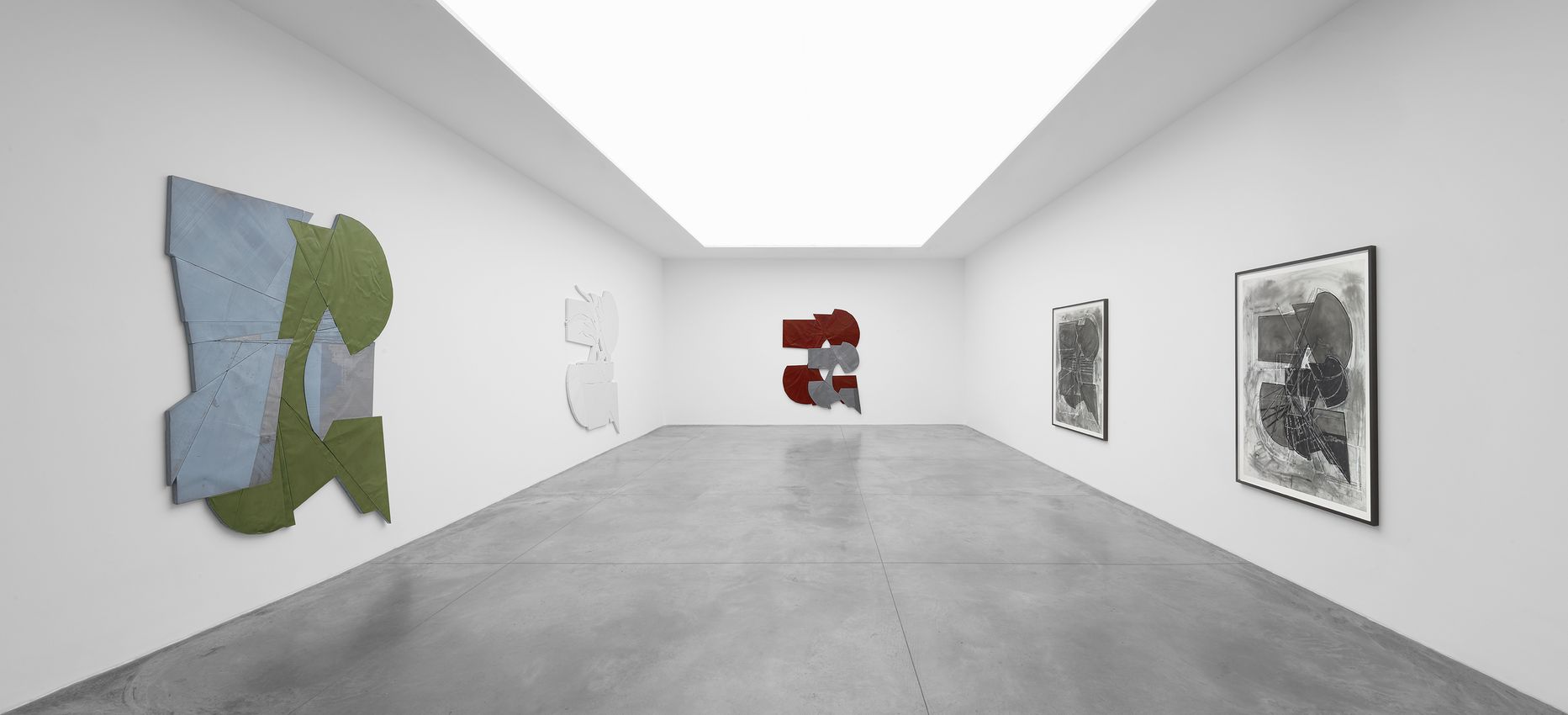
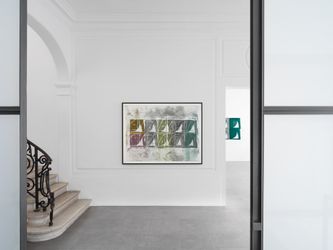
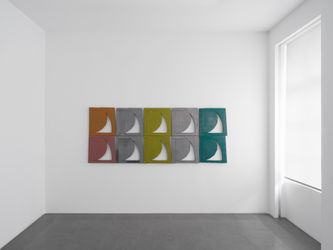
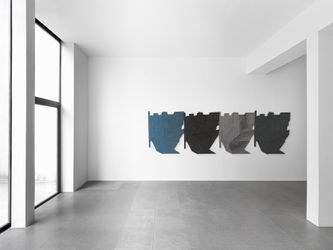
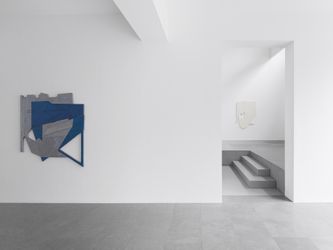
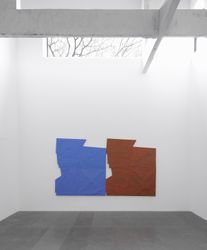
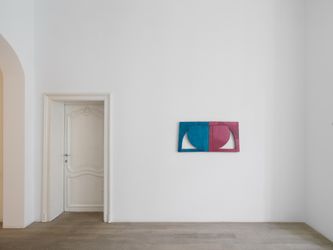
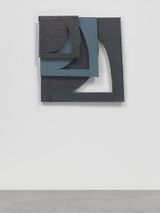
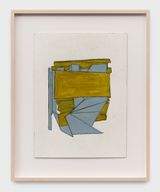
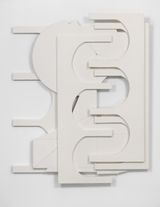
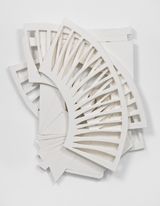
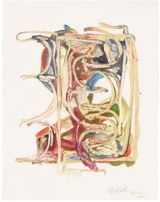
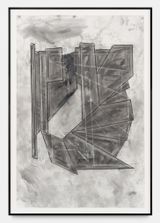
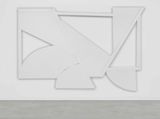

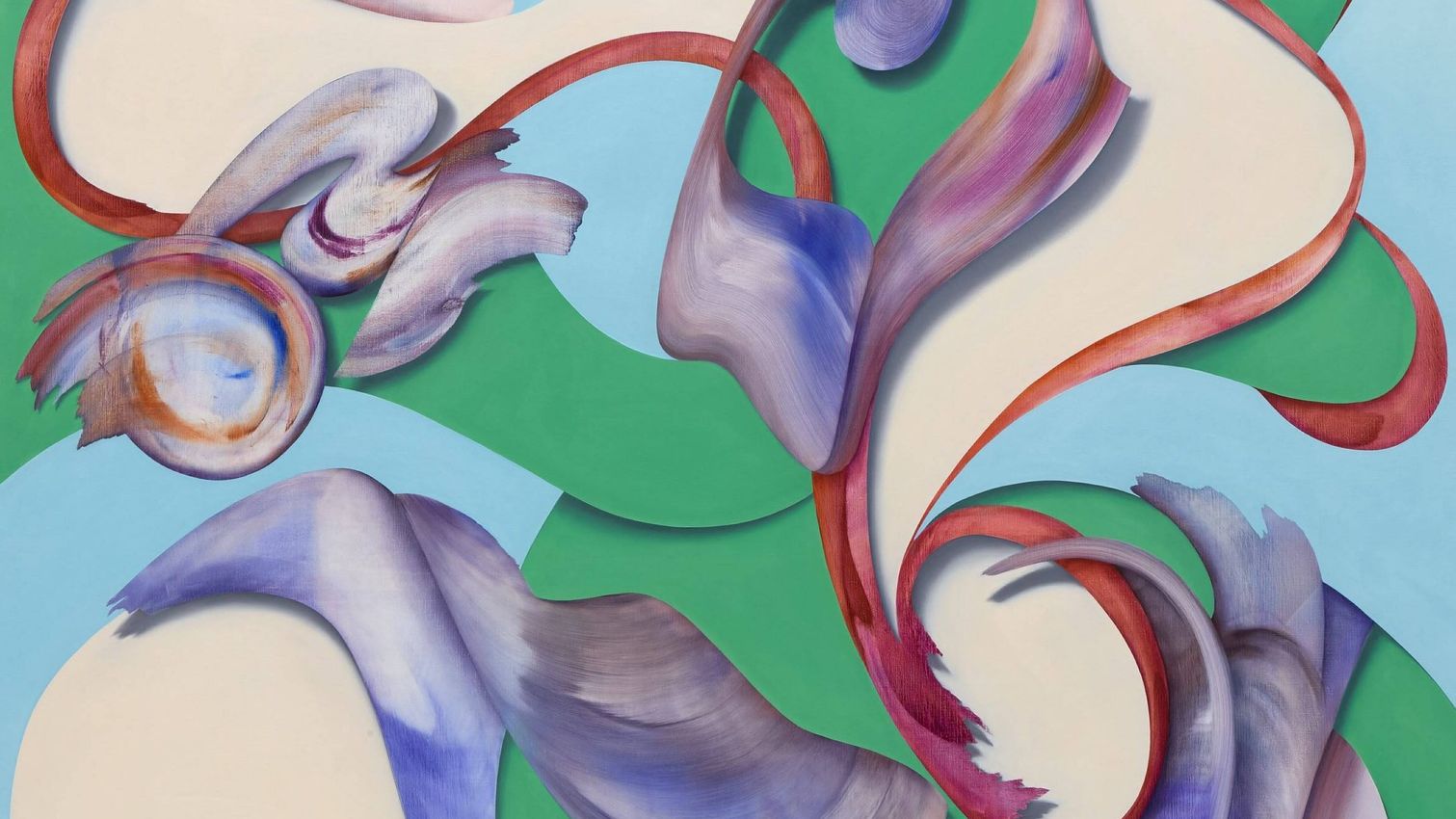
Xavier Hufkens is delighted to announce the opening of American artist Wyatt Kahn’s second exhibition with the gallery. The presentation focuses on a new series of works in milled lead and oil-based pigment, which are shown alongside compositions in natural canvas and a group of related drawings. This not only gives an overview of the interrelated nature of Kahn’s practice but also highlights new developments in his on-going exploration of the dialogue between painting and sculpture.
At first glance, Wyatt Kahn’s works in lead and oil stick form a striking visual contrast to the canvas constructions with which he established his reputation. Yet despite the obvious material and chromatic differences, the two bodies of work are closely related. They are even constructed in an identical fashion: shaped wooden frames are wrapped in pliable materials, be it canvas or lead. In terms of their manufacture and wall-mounted installation, the works resemble paintings. Yet the gaps between the panels—the negative spaces that pull the surroundings into the assemblages—lend the works a pronounced sculptural quality. It is precisely this ambiguity that makes us confront, and question, the parallels between painting and sculpture. In so doing, Kahn is following in the footsteps of a long line of artists who have sought to destabilise and transgress these boundaries. Yet his own work, while acknowledging these precursors, turns more towards what these distinctions might still mean in contemporary terms and how they can be revitalised.
The lead and pigment works are based on four abstract forms that are replicated, transposed or otherwise adapted. This is clearly evident in the series Untitled (Roma Spectrum), Bits (Gray, Black and Blue) and Untitled (Red/Blue). Similarly, the composition repeated four times in Untitled (Grayscale/City Paintings) is reprised, with variations, in both Untitled (Blue) and Untitled (Gold). Various structures are conflated: Untitled (Green) is a blend of Coti/Cosi and Family, for example. The canvas works, on the other hand, are where abstraction and representation meet: Adolescence, in which one sees the outline of a houseplant, is spliced with the form of Coti/Cosi. And in a clever sleight of hand, Kahn adapts and subtracts from Family to create Drifting, a mise en abyme that resembles a shattering mirror.
This natural symbiosis establishes an intriguing visual discourse within the exhibition and encourages active and attentive looking. Although all of Kahn’s compositions are autonomous works in their own right, they are also enmeshed within an intricate network of mutually reinforcing ‘familial’ relationships. In a process of self-renewal and cross-fertilisation, one form triggers another although—crucially—no two works are ever the same. In the case of this exhibition, the four essential forms in the lead works can be traced back to earlier compositions in canvas: Bad Girl (2015), Whem (2012), Bit (2014) and Drifter (2011). Each later iteration, however, represents a physical, material and psychological shift—be it subtle or pronounced—that opens up new sets of conditions and ideas, as well as additional links between painting, sculpture and the wider history of art. The lead works are thus akin to a form of ‘rebuilding’, or ‘reactivation’, whereby the surfaces—previously executed in canvas—are transformed through the contrast between the lead and oil-rich pigment. As a result, they become mutable, responsive and dynamic. Of the colours, Kahn says: ‘Every generation has a spectrum of colour that is representative of the cultural, political, and social climate of that moment in history. The colours I use are within the spectrum for our current time. They are weathered, but still maintain the inherent hope that only colour can provide. These are colours of transference.‘The resonant juxtaposition of lead and colour, coupled with the dextrous way that Wyatt Kahn reformulates compositional approaches, reveal the extent to which the artist’s practice has evolved. His formal investigations into the push and pull between painting, sculpture and drawing have gathered momentum and entered a new realm, one in which the intimate sphere of human experience plays a central role.
Wyatt Kahn (b. 1983) lives and works in New York. Recent solo exhibitions were held at Museo di Arte Moderna e Contemporanea di Trento e Rovereto, Trento (2016) and at the Contemporary Art Museum, St. Louis, MO (2015). The artist was also included in the exhibition Jay DeFeo: The Ripple Effect at Le Consortium in Dijon, which travelled to the Aspen Art Museum (29 June-28 October 2018). His work is included in the collections of the Museum of Modern Art, NY; the Whitney Museum of American Art, NY; Centre Georges Pompidou, Paris; MOCA, Los Angeles; Dallas Museum of Art; MCA, Chicago; CCS Bard Hessel Museum of Art, NY; and Albright-Knox Art Gallery, Buffalo.


Wyatt Kahn is primarily known for his investigations into the visual and spatial relationship between painting and sculpture. Using unprimed canvases stretched over wooden frames, Kahn assembles complex wall-mounted works in which the gaps between the individual canvases give rise to abstractor pictorial compositions. Rather than tracing the lines and shapes directly onto the canvas itself, he turns them into physical components of the artwork. Referencing the tradition of minimalist abstraction, Wyatt Kahn’s monochrome multi-panel ‘paintings’ are informed by a desire to explore non-illusory forms of representation. In essence, their subject becomes the interplay between two and three dimensions, as experienced via shifts in surface, structure and depth. In Kahn’s work, the wall upon which the work is hung becomes an integral part of the composition. Interested in a painting’s potential to function as the very embodiment of the object it depicts, Kahn has also developed works in which the shaped stretchers combine to create the form of an actual object, while a synthesis of hand-drawn motifs and words epitomize its essential qualities.


A respected voice in contemporary art discourse.
Focusing on ambitious storytelling and insightful art-world commentary. Ocula Magazine publishes in-depth interviews, critical essays and timely analysis on the artists, exhibitions and ideas driving the global art world.
Learn more about Ocula Magazine
Showcasing the best of the art world.
Ocula partners with galleries from around the world to highlight their artists, artworks and exhibitions. Gallery membership is by application and invitation, with each member vetted by an independent panel.
Learn more about Ocula Membership

Specialises in the sale of major artworks.
Led by a team with deep ties to the world’s leading auction houses, galleries and collectors. Ocula’s advisory team offers bespoke services to high-net-worth clients from around the world who are looking to acquire the best of contemporary and modern art.
Learn more about our team and services