

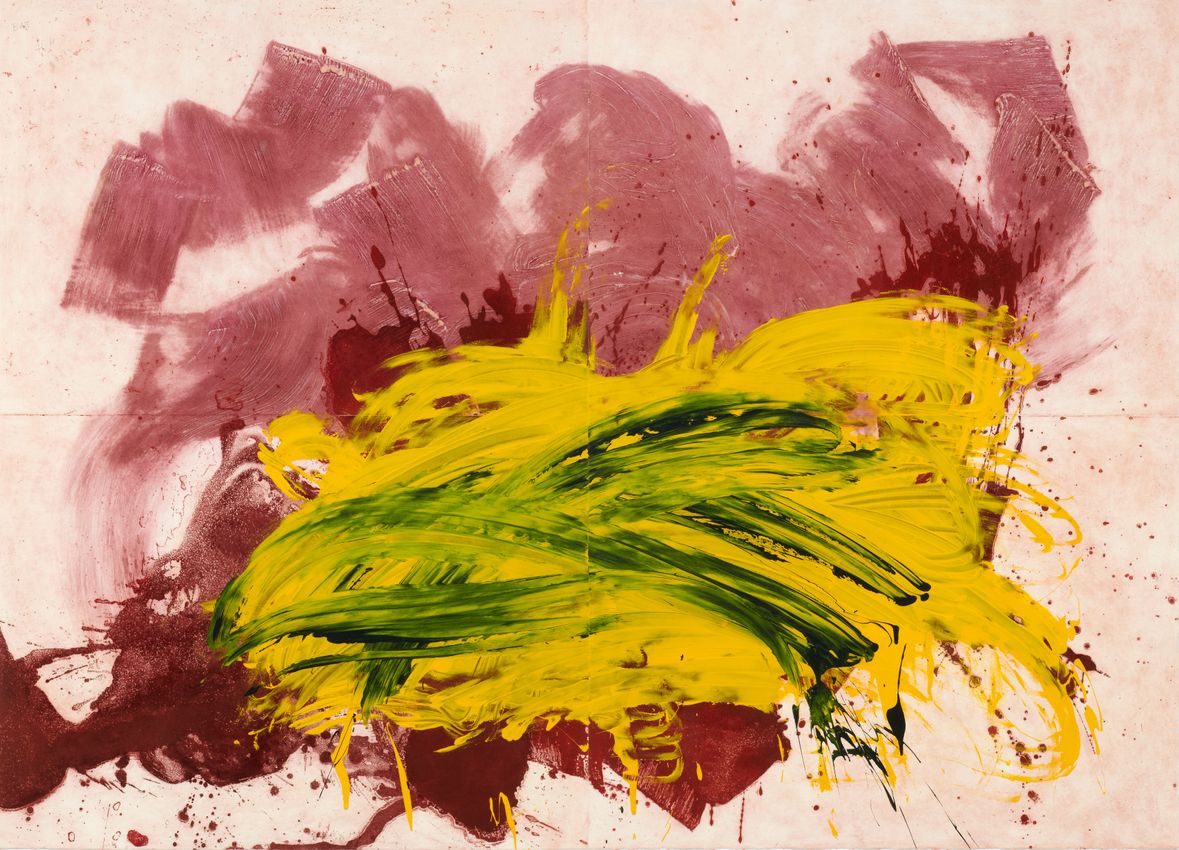
HOWARD HODGKIN
1932-2017, United KingdomHoward Hodgkin (1932—2017) was a highly respected British painter, whose abstract works were characterised by their vibrant, emotionally rich use of colour. As well as creating oil paintings on board, he had a parallel printmaking practice.
Early Years
Gordon Howard Eliot Hodgkin was born in London in August 1932. He wanted to be an artist at a young age—between 1940—1943 he lived in Long Island with his mother and older sister and was further inspired by seeing works by Picasso and Matisse at MoMA. Back in England, Hodgkin was sent to Eton College but ran away twice, then Bryanston School, but ran away again. In 1949 he painted Memories, which depicts an aunt lying on the couch in the Long Island house. He attended Camberwell School of Arts and Crafts (1949—1950) and Bath Academy of Art, Corsham (1950—1954), where he later taught.
Howard Hodgkin: Artworks
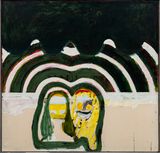
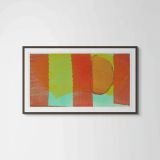
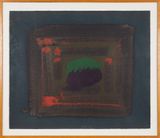
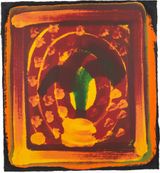
Howard Hodgkin was celebrated for his use of colour and gesture. Using board rather than canvas—“A firm surface won’t answer back,” he told the Guardian in 2016—, he painted right to the edge, often covering the frame. His artworks were rooted in memory, past experience and time—he is often quoted as having said: “I paint representational pictures of emotional situations.” The feeling with which his art was imbued is not rendered figuratively; it appears to the viewer through intense colours and sweeping or stabbing brushstrokes. His pictures often took years to complete.
- Acquainted with the Night (1953) was Howard Hodgkin’s first print, inspired by Robert Frost’s poem and made for a group portfolio called Poetry at Night while he was at Corsham. However, he didn’t keep a copy. In 2012, he revisited the poem and made a series of prints—the collection was titled Acquainted with the Night. In 2026, the original print was found (thanks to the heirs of a principal of Corsham) and acquired by the Howard Hodgkin Legacy Trust.
- Blackmail (2006—2015) is an example of a work that took Hodgkin a long time to complete. The large-scale oil-on-board piece is a window of disordered reds and orange, with hints of green, framed by a reddy brown.
- Howard Hodgkin became interested in collecting Indian miniatures while he was at Eton and first visited India in 1964, returning almost every year subsequently. In 1978, he worked in Ahmedabad using hand-made paper on which he painted while it was still wet (artworks he made that year include Tree, Little Lotus, Snake and Rest House). Other works, characterised by warmth and colour, include Bombay Sunset (1972_1973),_ Out of the Window, Bombay (2012—2014) and Hello, Bombay_ (2016).
Howard Hodgkin: Select Awards
- Commander of the Order of the British Empire (1977)
- Turner Prize (1985)
- Knighthood, New Year’s Honours (1992)
- Honorary Fellowship, London Institute (1999)
- Honorary DLitt, University of Oxford (2000)
- Member of the Order of the Companions of Honour, New Year’s Honours (2003)
Howard Hodgkin: Select Exhibitions
Select Solo Exhibitions
- Howard Hodgkin: In a Public Garden, Pitzhanger Manor and Gallery, London (2025)
- Howard Hodgkin: Absent Friends, National Portrait Gallery, London (2017)
- Howard Hodgkin: Painting India, The Hepworth Wakefield, Wakefield (2017)
- Howard Hodgkin: From Memory, Gagosian, New York City (2016)
- Howard Hodgkin: Indian Waves, Gagosian, London (2014)
- Howard Hodgkin: As Time Goes By, Alan Cristea Gallery, London (2009)
- Howard Hodgkin: Paintings 1992—2007, Yale Centre for British Art, New Haven (2007) (and touring)
- Howard Hodgkin, Dulwich Picture Gallery, London (2001)
- Howard Hodgkin, Alan Cristea Gallery, London (2001)
- Howard Hodgkin: Paintings 1975—1995, Metropolitan Museum of Art, New York City (1995)
- Howard Hodgkin: Small Paintings, Musée des Beaux Arts, Nantes (1990) (and touring)
- Howard Hodgkin: Forty Paintings, British Pavilion, Venice Biennale (1984)
- Indian Leaves, Tate Gallery, London (1982)
- Howard Hodgkin, Forty-Five Paintings: 1949—1975, Museum of Modern Art, Oxford (1976) (and touring)
- Howard Hodgkin: New Paintings, Kasmin Gallery, London (1969)
- Arthur Tooth and Sons, London (1962)
Select Group Exhibitions
- Kettle’s Yard Handpicked: Painting Flowers from 1900 to today, Kettle’s Yard, Cambridge (2026)
- Size Doesn’t Matter, Michael Fuchs Galerie, Berlin (2025)
- Memories: Etel Adnan and Howard Hodgkin, Cristea Roberts Gallery, London (2023)
- The Solace of Amnesia, Hall Art Foundation, Reading (2018)
- Watercolour, Tate Britain, London (2011)
- The Galleries Show, Royal Academy of Arts, London (2002)
- The 1980s: Prints from the Collection of Joshua P Smith, National Gallery of Art, Washington, DC (1989)
- Aspects of British Art Today, Tokyo Metropolitan Art Museum (1982) (and touring)
- The Human Clay, Hayward Gallery, London (1976) (and touring)
- Contemporary Prints, Ulster Museum, Belfast (1972)
Further Reading
- Howard Hodgkin’s official website
- Article about Hodgkin from Christie’s (2026)
- Interview in the Guardian (2016)
- Interview in The Times (2008)
- Artist profile page at Gagosian
Howard Hodgkin FAQs
What did Howard Hodgkin do for the Olympics?
Howard Hodgkin created prints for the 1984 Winter Olympics, the 2012 summer games in London and for Team GB for the 2016 Olympics. Welcome (also called Winter Sports) was commissioned for the official art portfolio for the Sarajevo games in 1984 and features a green tree/arrow motif on an orange background. Swimming (2012) was made with hand-pulled silkscreens in shades of blue, while The Road to Rio (2016) brought the blue, yellow and green of the Brazilian flag to life using 22 separate layers of colour.
Was Howard Hodgkin married?
Yes, Hodgkin married Julia Lane in 1955 and they had two sons. However, during the 1970s he came out as gay, and met his long-term partner Anthony Peattie in 1984.
Was Howard Hodgkin part of any specific art movement?
No, although his contemporaries were part of the Euston Road School and the Pop Art movement. Hodgkin remained independent, and his work moved from figurative (he painted portraits of his fellow artists in his early career) to abstract.
Who were Howard Hodgkin’s famous relatives?
Howard Hodgkin’s father worked for ICI and was a keen amateur horticulturalist; his mother was a botanical illustrator. But members of his wider family were well-known: his great, great-grandfather’s brother, Thomas Hodgkin, discovered Hodgkin’s lymphoma; his cousin Dorothy won the Nobel Prize for chemistry in 1964 and two other cousins were Margery Fry, the prison reformer, and Roger Fry, the painter and art critic.
Ocula











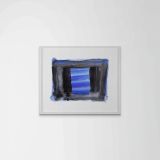

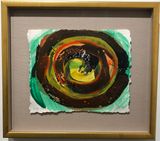
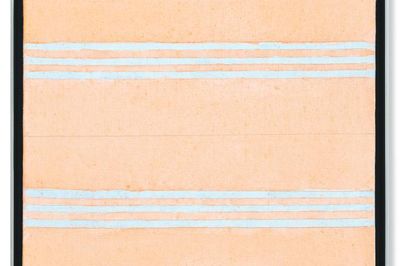
23.4 x 28 cm
31.4 x 36 cm (incl frame)
Dellasposa Gallery Request Price & Availability
Explore Howard Hodgkin's Exhibitions






Explore and Follow Artists Shaping Contemporary Art
A respected voice in contemporary art discourse.
Focusing on ambitious storytelling and insightful art-world commentary. Ocula Magazine publishes in-depth interviews, critical essays and timely analysis on the artists, exhibitions and ideas driving the global art world.
Learn more about Ocula Magazine
Showcasing the best of the art world.
Ocula partners with galleries from around the world to highlight their artists, artworks and exhibitions. Gallery membership is by application and invitation, with each member vetted by an independent panel.
Learn more about Ocula Membership
Specialises in the sale of major artworks.
Led by a team with deep ties to the world’s leading auction houses, galleries and collectors. Ocula’s advisory team offers bespoke services to high-net-worth clients from around the world who are looking to acquire the best of contemporary and modern art.
Learn more about our team and services