






ALEX KATZ
b. 1927, United StatesAlex Katz’s bright, crisp portraits of American life may have emerged as a counterpoint to Abstract Expressionism, but the artist’s work—characterised by flat planes, solid lines and confident colour—not only anticipated Pop Art but outlived it.
Early Years
Alex Katz was born in Brooklyn in 1927 and raised in Queens by his Russian-immigrant parents in a style that may today have been called “free-range parenting”. He attended Woodrow Wilson Vocational High School because it gave him the chance to study art every afternoon (the school also gave him an education in music, fashion and dance). In 1946 he applied for Cooper Union, the New York City art school that offered free tuition. He spent his time wandering the city drawing people. On a scholarship to Skowhegan School of Painting and Sculpture in Maine, he painted landscapes outdoors for the first time, developing a faster painting style.
Alex Katz: Artworks
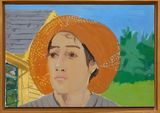
Alex Katz captures modern American life through his figurative portraits, landscapes, cut-out sculptures and large-scale public artworks. Flat planes of colour, an economy of line and carefully thought-out brushstrokes characterise his practice.
- Katz has painted hundreds of portraits of his wife, Ada—one of the most well-known examples is Blue Umbrella I (1972), in which Ada is cropped closely, with her umbrella touching the edges of the picture. The painting features Katz’s trademark precise detailing, notably in Ada’s clothes. It sold for £3.4 million in 2019.
- Springtime (2009) is a huge canvas featuring six female figures in summer clothes against a pale green background. However, a closer look reveals that there are only two women in the picture—they are each painted from three different angles (an example of his fondness for repeated patterns).
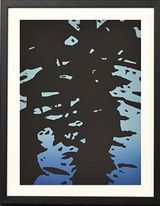
- Katz’s 2024 show in Venice, Claire, Grass and Water, focused on three of Katz’s favourite subjects: fashion (outfits designed by Claire McCardell during the 1940s), landscapes (tall yellow and green grass) and turbulent, dark waters.
Alex Katz: Select Public Commissions
- Times Square, New York City (1977)
- Silvio V Mollo Building, Foley Square, New York City (1980)
- Harlem Station, Chicago (1984)
- Give Me Tomorrow, New York City (2005)
- Art Adds, New York City Taxis (2010)
- Metropolitan Faces, 57th Street and Sixth Avenue Subway, New York City (2019)
- Bill 2, La Jolla, San Diego (2019)
- Park Avenue Departure, New York City (2019)
Alex Katz: Select Exhibitions
- Studies, Thaddaeus Ropac, Seoul (2026)
- Alex Katz: Dancing With Reality, Kunsthalle Tübingen (2026)
- Alex Katz: Theatre and Dance, Museum of Contemporary Art San Diego, San Diego (2025)
- Alex Katz: Four Seasons, Scai The Bathhouse, Tokyo (2025)
- Alex Katz: Seasons, MoMA, New York City (2024)
- Alex Katz: Portraits and Landscapes, Museum Brandhorst, Munich (2024)
- Alex Katz: Claire, Grass and Water, Fondazione Giorgio Cini, Venice (2024)
- Alex Katz: Purple Splits, Thaddaeus Ropac, Paris (2023)
- Alex Katz, Museum Voorlinden, Wassenaar (2023)
- Alex Katz: Sunrise, Schindler House, West Hollywood (2023)
- Alex Katz: Cool Painting, Albertina, Vienna (2023)
- Alex Katz: Gathering, Solomon R Guggenheim Museum, New York City (2022)
- Alex Katz: Flowers, Richard Gray Gallery, Chicago (2019)
- Alex Katz: Quick Light, Serpentine Galleries, London (2016)
- Katz x Katz, Yale School of Art, New Haven (2013)
- Alex Katz: Cut-outs, Galeria Javier Lopez, Madrid (2007)
- Alex Katz: Small Paintings, Addison Gallery of American Art, Phillips Academy, Andover (2002) (and touring)
- Alex Katz Under the Stars: Landscapes 1951-1995, Baltimore Museum of Art (1996) (and touring)
- Retrospective Exhibition, Whitney Museum of American Art, New York City (1986)
- Alex Katz: Drawings, 1944–1981, Marlborough Gallery, New York City (1982)
- Alex Katz Prints, Whitney Museum of American Art, New York City (1974) (and touring)
- Alex Katz: Cut-outs 1955–1965, Fischbach Gallery, New York City (1965)
- Alex Katz: Flat Statues, Tanager Gallery, New York City (1962)
- Alex Katz: Paintings, Roko Gallery, New York City (1954)
Select Group Exhibitions
- Sea, Pop and Sun, Fondation Carmignac, Île de Porquerolles (2026)
- 360° Why We Paint?, By Art Matters, Hangzhou (2025)
- Drawn into the Present: Portraits on Paper, Thaddaeus Ropac, London (2023)
- Slab City Rendevous, Farnsworth Art Museum, Rockland (2019)
- The Shell, Almine Rech Gallery, Paris (2015)
- Essential Painting, National Museum of Art, Osaka (2006)
- Couples, Cheim and Read, New York City (2000)
- Face to Face, Victoria Miro Gallery, London (1996)
- 1991 Biennial Exhibition, Whitney Museum of American Art, New York City (1991)
- International Masters of Contemporary Figuration, Marlborough Fine Art, Tokyo (1984)
- 16 Realists of New York, Centro Colombo-Americano, Bogotá (1979)
- American Drawings 1963–1973, Whitney Museum of American Art, New York City (1973)
- Recent Landscapes by Eight Americans, The Museum of Modern Art, New York City (1964)
Further Reading
- Alex Katz’s official website
- CBS Sunday Morning profile from 2025
- 2024 interview from the Financial Times
- 2024 interview with MoMA 2
- 022 profile in The New York Times
- 2009 article from Smithsonian magazine
Alex Katz FAQs
Who are Alex Katz’s influences?
Katz was inspired by his figurative painting contemporaries, such as Fairfield Porter and Larry Rivers, as well as Modern artists including Henri Matisse, Henri Rousseau and Edward Hopper and 18th-century Japanese artist Kitagawa Utamaro. However, he also took inspiration from his social circle, notably poets Frank O’Hara, Edwin Denby and John Ashbery from the New York School.
Does Alex Katz buy paintings by other artists?
Yes, he regularly buys work by emerging artists and donates them to institutions via his foundation. He has gifted more than 700 paintings, particularly to museums and galleries in Maine. Speaking in 2024, he said: “I had a horrible time coming up. The years from 25 to 35 are hard. So I thought: give someone encouragement. Take a painting and give it to a museum that’ll show it.”
Why did Alex Katz start making cut-outs?
Katz’s cut-outs began by chance: in 1959, he wanted to remove a background he wasn’t keen on, so cut out the central figure from the painting and mounted it on plywood, which he hung on the wall. His practice evolved into making freestanding pieces, painted directly on to metal and with a distinct front and back.
Why does Alex Katz paint on a large scale?
Katz emerged on to the art scene when Abstract Expressionism was fashionable; his figurative depictions of people and real-world objects bucked the trend, but he also took inspiration from the scale of billboards and Cinemascope movies to increase the size of his paintings. “It was an open door,” he said in 2009. “No one was doing representational painting on a large scale.”
How does Alex Katz make his huge paintings? What is “pouncing”?
Katz begins with a small oil sketch of a subject, which he paints on to high-density fibreboard (“masonite board” in the USA). He then makes a small, detailed charcoal or pencil drawing, which he blows up into a “cartoon” and pricks tiny perforations in it. He transfers this to the large canvas using a technique called “pouncing”, where powdered pigment is pushed through the perforations. He pre-mixes his colours and then paints, sometimes in single sessions so that wet mixes with wet, which gives the blended paints a luminous quality.
Ocula

Works at Gladstone




Recently Exhibited



Exhibiting Elsewhere

Works Elsewhere















Alex Katz in Ocula Magazine









Explore and Follow Artists Shaping Contemporary Art
A respected voice in contemporary art discourse.
Focusing on ambitious storytelling and insightful art-world commentary. Ocula Magazine publishes in-depth interviews, critical essays and timely analysis on the artists, exhibitions and ideas driving the global art world.
Learn more about Ocula Magazine
Showcasing the best of the art world.
Ocula partners with galleries from around the world to highlight their artists, artworks and exhibitions. Gallery membership is by application and invitation, with each member vetted by an independent panel.
Learn more about Ocula Membership
Specialises in the sale of major artworks.
Led by a team with deep ties to the world’s leading auction houses, galleries and collectors. Ocula’s advisory team offers bespoke services to high-net-worth clients from around the world who are looking to acquire the best of contemporary and modern art.
Learn more about our team and services