






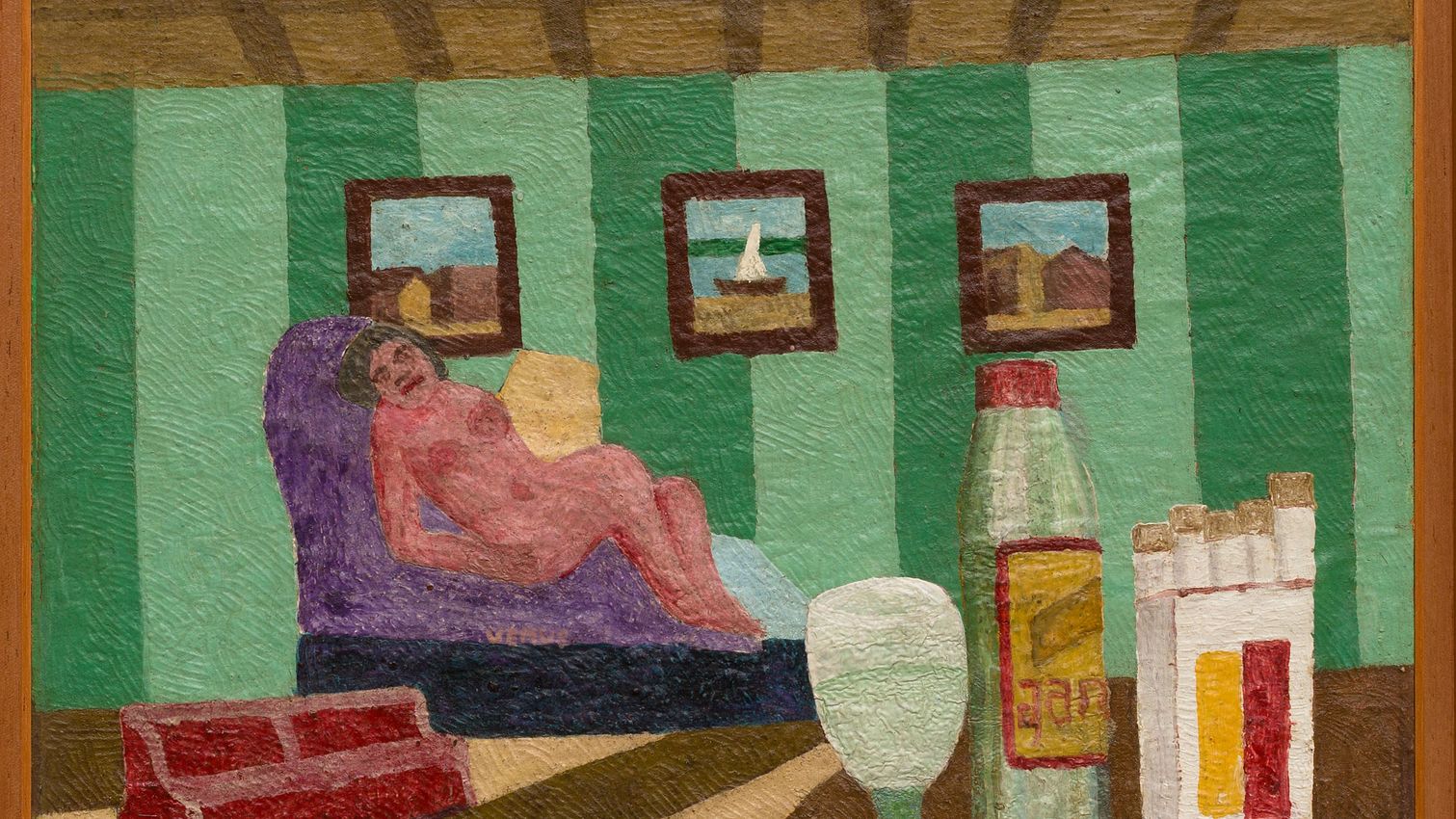
AMADEO LUCIANO LORENZATO
1900-1995, BrazilConsidered the seminal artist of his generation, Amadeo Luciano Lorenzato was drawn to the natural world and symbols of daily life. Largely a self-taught painter, Lorenzato developed a singular body of paintings centred on his fastidious observations of the everyday subjects he encountered in his hometown of Belo Horizonte, Brazil; depicting landscapes, still lives, and scenes from his neighbourhood His aim was not to replicate his environment, but rather to translate it through a simplified vision of reduced geometric forms utilising rich, handmade pigments and defined brush strokes. Lorenzato considered painting an everyday activity, a natural extension of himself, and ‘a form of spiritual survival.’
Born in 1900 to Italian parents who immigrated to Brazil in the last decade of the nineteenth century, Lorenzato began working as a painter’s assistant in 1910. With the epidemic of Spanish influenza, which hit the capital in the late 1920s, Lorenzato’s family returned to Asiero, Italy, where the young émigré became a wall painter in the reconstruction of the town.
In 1925, Lorenzato enrolled at the Real Accademia delle Arti in Vicenza to develop his artistic practice. Eager to visit other parts of Europe, Lorenzato left the academy the following year and embarked on a year-long cycling trip across Europe with the Dutch Painter, Cornelius Keesman. This trip was of particular significance for Lorenzato, not only in that it enabled Lorenzato to absorb European culture and architecture, but also provided him with the opportunity to explore museums, encountering works by artists such as Matisse, Picasso, and Gauguin. Following the trip, Lorenzato moved back to Italy for a short time before returning to Brazil in 1948 to start work in the construction trade in his native Belo Horizonte. After sustaining an injury to his leg in 1956, Lorenzato decided to commit himself to painting full time, until his death in 1995.
Though appreciated during his lifetime by his contemporaries, Lorenzato was long considered a regional artist, with his work remaining largely unknown outside of Brazil. The recent attention on Lorenzato’s work has led to an overdue re-examination of the artist, his place within the broader context of Brazilian modernism and international art history.
His work has been presented in numerous solo and group shows, including a large retrospective exhibition at the Museu de Arte da Pampulha, Belo Horizonte, in 1995. His most recent shows include S|2 Gallery, London (2019); David Zwirner, London (2019); Mendes Wood DM, New York (2019); Galeria Estação, São Paulo (2014), and Lorenzato: And You Can Not Even Imagine That I Am Epaminondas, Bergamin & Gomide, São Paulo (2014). His work is also in a number of public collections, such as Fundação Clóvis Salgado, Belo Horizonte; Museu de Arte da Pampulha, Belo Horizonte; Museu de Arte de São Paulo (MASP); Nouveau Musée National de Monaco; Pinacoteca de São Paulo, and Universidade Federal de Viçosa.
Courtesy Mendes Wood DM

Recently Exhibited




Exhibiting Elsewhere

Works Elsewhere



















Explore and Follow Artists Shaping Contemporary Art
A respected voice in contemporary art discourse.
Focusing on ambitious storytelling and insightful art-world commentary. Ocula Magazine publishes in-depth interviews, critical essays and timely analysis on the artists, exhibitions and ideas driving the global art world.
Learn more about Ocula Magazine
Showcasing the best of the art world.
Ocula partners with galleries from around the world to highlight their artists, artworks and exhibitions. Gallery membership is by application and invitation, with each member vetted by an independent panel.
Learn more about Ocula Membership
Specialises in the sale of major artworks.
Led by a team with deep ties to the world’s leading auction houses, galleries and collectors. Ocula’s advisory team offers bespoke services to high-net-worth clients from around the world who are looking to acquire the best of contemporary and modern art.
Learn more about our team and services