






AYAKO ROKKAKU
b. 1982, JapanAkayo Rokkaku creates the visual language of her kawaii-adjacent paintings without prior design, resulting in a performative, ebullient practice. Her part abstract, part figurative canvases are full of bright colours and cute characters, which she has also realised in sculpture and fabric installations.
Early Years
Akayo Rokkaku was born in Chiba, Japan, in 1982. As a child, she liked drawing and especially colouring. She is a self-taught artist and considers children’s drawing when making artwork, striving to create an idea of child-like freedom in her finished pieces. When Rokkaku was 24, Takashi Murakami invited her to join his Kaika Kiki booth at the Volta art fair in Basel. His backing and advice helped her to choose to continue with art as a career.
Akayo Rokkaku: Artworks
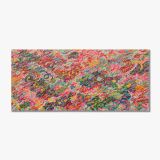
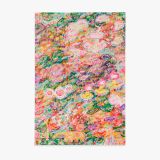
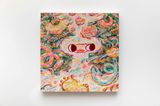
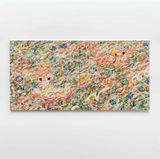
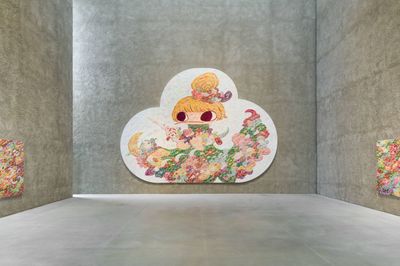
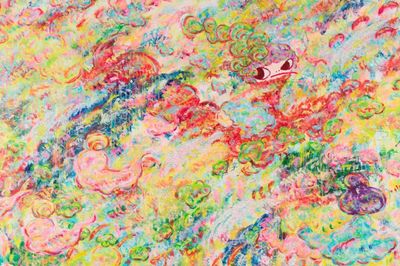
Blending ideas from abstract expressionism and traditional Japanese aesthetics, Akayo Rokkaku applies her bold acrylic colours directly with her hands, and this physical engagement allows her to express emotion and create texture. Her works frequently include big-eyed characters, which act as a point of entry to the paintings for viewers. Her compositions are cute, but not to the point of being cloying—she mixes in grotesque elements. The physicality of her painting process means she has also staged live performances in which she creates artworks.
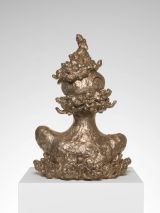
Moving into sculpture was partially inspired by working with a traditional Japanese woodworker on some painted vases. Her bronzes lack the colour of her canvases and glass works, but this gives her the chance to focus on form.
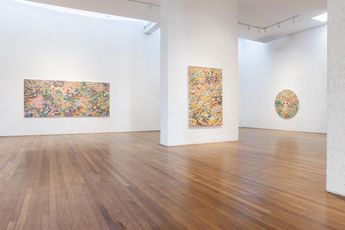
- Inspired by the Mallorcan mountains, the centrepiece of Rokkaku’s 2025 exhibition Mountains of Nameless Emotions used fabrics and wool to create a huge, organic, tactile piece where small and large creatures co-exist, and that reflects her own emotional flux.
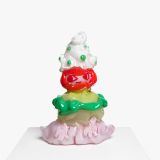
- Akayo Rokkaku created 11 glass sculptures early in 2025 at the Berengo Studio in Murano. She worked with glass masters to create effects similar to her artistic style, mixing transparent and opaque elements.
- Rokkaku used her experience making glass to create new paintings—for example, 2025’s Untitled, a triptych that allows her to explore ideas of connection and disconnection and include a character on each canvas.
- Rokkaku’s Hong Kong debut was inspired by Onigashima “demon island” from Japanese folklore. Her six-metre-high fabric tunnel sculpture in bright pinks and reds encouraged viewers to touch and feel it, and even go inside to see paintings and sculptures.
Akayo Rokkaku: Select Exhibitions
Select Solo Exhibitions
- Playful, Stormy, Continuing, Baró, São Paulo (2026)
- Trails of Life in the Air, CICA Vancouver (2026)
- Scenery in the Process of Being Formed, König Galerie, Berlin (2026)
- The Island—Onigashima, Landmark, Hong Kong (2026)
- Breathing with Chaos, Total Museum, Seoul (2025)
- Close to Your Treasure, Long Museum, Chongqing (2025)
- Detour for an Ice Cream Fairy, Palazzo Corner Mocenigo, Venice (2024)
- Surreal Surroundings, König Mexico City (2024)
- Cute. Weird. Free, König Galerie, Berlin (2023)
- Imagination for Flying Adventure, König London (2022)
- Born in the fluffy journey, König Galerie, Berlin (2021)
- Magic Hand, Chiba Prefectural Museum of Art (2020)
- Fumble in Colours, Tiny Discoveries, Museum Jan van der Togt, Amsterdam (2019)
- Sealed Reminiscence, Gallery Delaive, Amsterdam (2016)
- Lumpy Fluffy Splatter, Gallery Trax, Yamanashi (2015)
- Where the Smell Comes From, Danubiana Meulensteen Art Museum, Bratislava (2012)
- About Us, Vacant, Tokyo (2010) (and touring)
- girl in moment, Guy Peters Gallery, Knokke-Heist (2009)
- Rokkaku Ayako Exhibition, Galerie Teo, Tokyo (2007)
Select Group Exhibitions
- Inner Spaces, König Galerie, Seoul (2024)
- Oketa Collection—A New Decade, Spiral Garden, Tokyo (2020)
- 25th Anniversary in Gallery Trax vol I, Gallery Trax, Yamanashi (2018)
- Perpetual Colours, Phillips X, Hong Kong (2018)
- Cat Love. Nine lives in the art, Kunsthal Rotterdam (2017)
- Swatch Faces 2015 at 56th Venice Biennale, Arsenale (2015),
- Full House, Gallery Target, Tokyo (2015)
Further Reading
- Akayo Rokkaku’s official website
- Akayo Rokkaku’s Instagram
- Studio video from 2026
- Artist profile page at König Galerie
Ayako Rokkaku FAQs
Why does Akayo Rokkaku paint with her fingers?
Akayo Rokkaku applies colour directly from her hand, drawing, pressing and dripping the paint, applying one colour at a time and thinking about the next colour while touching the canvas. Speaking in 2026, she explained that she once got paint on her hand and wiped it on to a piece of cardboard, which gave her the idea to see how it dried.
Where does Akayo Rokkaku find inspiration?
Rokkaku has said that she takes inspiration from nature—for example, when she walks near the ocean or sees leaves moving in the wind. Her inclusion of cute, big-eyed characters also nods to kawaii culture.
What materials and techniques does Akayo Rokkaku use?
When Akayo Rokkaku is painting, colours and shapes are realised first, before adding character. She paints with her hands and fingers rather than brushes and begins a canvas by randomly applying a single colour. She doesn’t make preliminary drawings, preferring to create organically through the process of painting. When making bronzes, Rokkaku also uses touch, frequently feeling the clay as its shape changes. However, she cannot shape glass using touch, so instead draws sketches while concentrating on the way heated glass expands and trying to imagine where colours and the smoothness of the glass will converge.
Ocula

View Ayako Rokkaku's Artworks











Explore Ayako Rokkaku's Exhibitions













Explore and Follow Artists Shaping Contemporary Art
A respected voice in contemporary art discourse.
Focusing on ambitious storytelling and insightful art-world commentary. Ocula Magazine publishes in-depth interviews, critical essays and timely analysis on the artists, exhibitions and ideas driving the global art world.
Learn more about Ocula Magazine
Showcasing the best of the art world.
Ocula partners with galleries from around the world to highlight their artists, artworks and exhibitions. Gallery membership is by application and invitation, with each member vetted by an independent panel.
Learn more about Ocula Membership
Specialises in the sale of major artworks.
Led by a team with deep ties to the world’s leading auction houses, galleries and collectors. Ocula’s advisory team offers bespoke services to high-net-worth clients from around the world who are looking to acquire the best of contemporary and modern art.
Learn more about our team and services