Callum Morton’s works often incorporate narratives from everyday life, books, and film, altering reimagined structures using scale, material, location, and sound and blending historical references with popular culture to distort familiar settings and create dystopian scenes.
International Style (1999)
Morton’s satirical works recover fragments of existing or once-existing buildings scaled down, as in International Style (1999), which replicated the entirely glass-walled, modern country retreat for which architect Mies van der Rohe was sued due to its ‘unsuitability for living’. The structure was parodied by the artist, who through party lights and sounds of laughter and chatting introduced a party inside that ended with gunshots and screams.
Gas and Fuel (2002)
Gas and Fuel (2002) offered a 1:34-scale model of the Gas and Fuel Building once located on Melbourne‘s Federation Square, with the addition of an audio recording pleading, ‘Help me, please help me!’, from the soundtrack in The Fly (1958), alluding to help that will never come.
Habitat (2003)
Habitat (2003) replicated a 1:50 model of a communal housing project by architect Moshe Safdie conceived for Expo1967 in Montreal, a project Morton’s father helped realise around the time of Morton’s birth.
The artist’s re-conception of the modern living space represented a day in the life at the complex, using a looped sequence of sound and lights to compress 24 hours within 28 minutes, blending public and private spaces while addressing the mundanity of recurrence.
Babylonia (2005)
Babylonia (2005) showed a scaled-up model that could be entered, at two-thirds of human size, replicating the interiors of an international hotel with a line of doors that cannot be opened. The work is at once familiar yet claustrophobic, a tomb with no exit, recalling tragedies of modernity.
Monument #28: Vortex (2011)
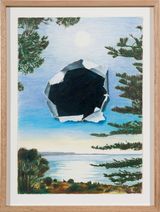
Monument #28: Vortex (2011) punctured a massive hole across gallery walls, replicating a shop front post-disaster. The installation, which originally opened into the Heide Museum‘s back gardens, alluded to the 19th-century break with landscape representation in art.
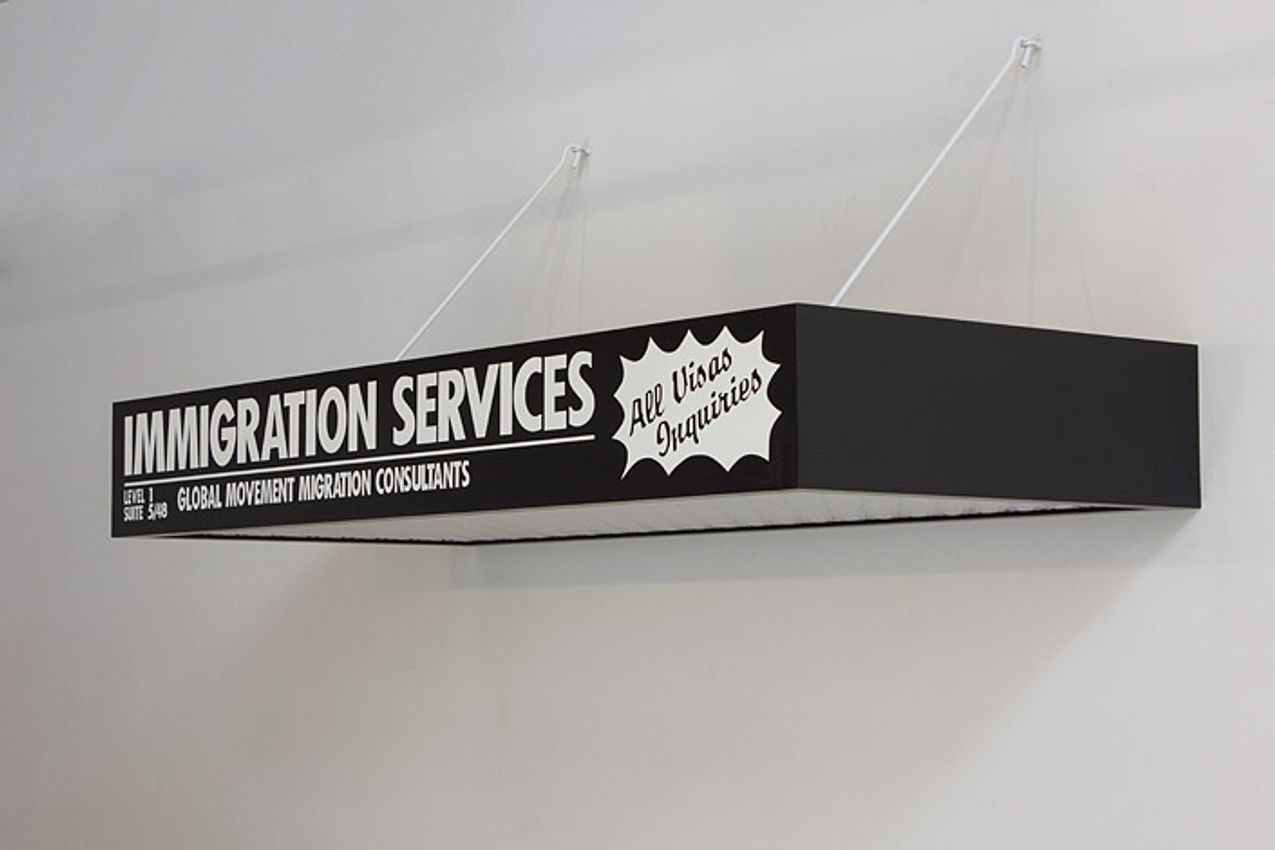
The installation echoed and marked a continuation from early works like Been There (1997—1998), commercial outlets awnings suspended from the walls, and The Heights (2005), a scaled-down balcony placed at eye level.