






CARMEN HERRERA
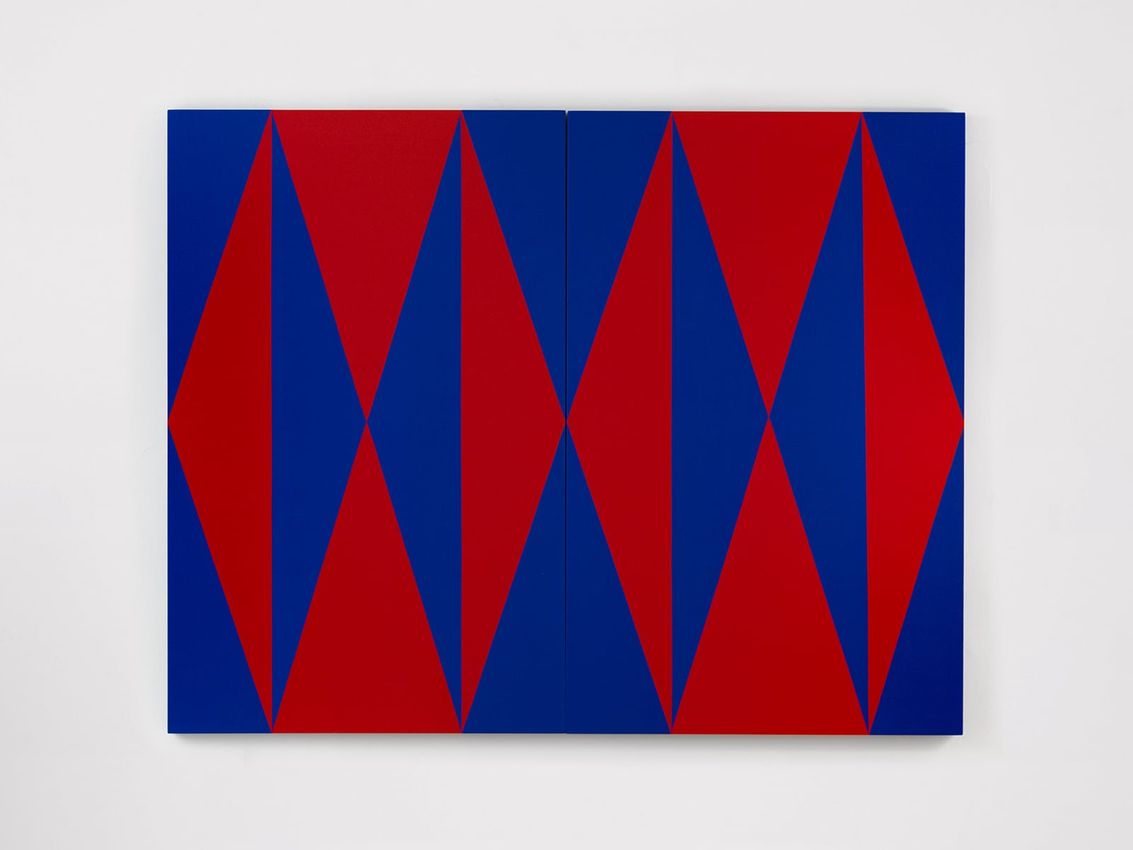
b. 1915, CubaAfter going unnoticed for decades, the crisp, Minimalist geometric abstractions of pioneering Cuban-American painter Carmen Herrera have gained increasing recognition as a meeting-point of the approaches of a range of Latin American, European, and North American 20th-century movements.
Herrera was born in Havana, Cuba, in 1915, and grew up amidst socio-political unrest. Her early education was carried out between Cuba and Paris, first in art and then in architecture. After marrying an American teacher, Jesse Loewenthal, Herrera moved to New York in 1939. Retaining her passion for art, she studied at The Art Students League from 1942 to 1943.
Between 1948 and 1953, Carmen Herrera lived in Paris. In these formative years as an artist, she moved in the circles of Simone de Beauvoir, Jean-Paul Sartre, and the various international regulars exhibiting at the Salon des Réalités Nouvelles, among them Theo van Doesburg, Kazimir Malevich, and the early Russian Suprematists.
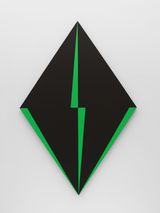
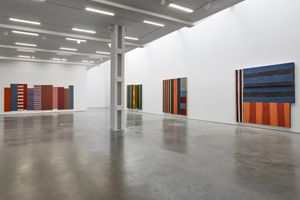
In Paris, Herrera refined a style of pure, hard-edged geometric abstraction in which ovals, triangles, rectangles, and semi-circles overlap and interlock. These strict, disciplined, highly architectural compositions, with a palette limited to two or three colours, anticipated the Minimalism trend that was to emerge a decade later.
After returning to New York with her husband, Carmen Herrera continued to develop an increasingly Minimalist style in which crisp lines glide along planes of contrasting colour. While her exploration of colour was in tune with contemporaneous American artists like Leon Polk Smith, it also found harmony with Latin American groups such as the Brazilian Concretists and the Venezuelan Los Disidentes.
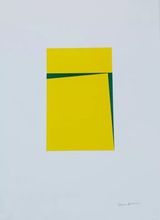
A seminal series for Carmen Herrera, ‘Blanco y Verde’ (1959–1971), reflects the artist’s quest for what she calls ‘the simplest of pictorial resolutions’. Each of the 14 works in the series generates a tension in which the points of thin coloured triangles meet against a white backdrop. The paintings demonstrate a fascination with line and colour that Herrera has sustained in her work for the better part of a century.
Unlike celebrated male contemporaries of geometric abstraction such as Barnett Newman and Ellsworth Kelly, Herrera worked for decades with little recognition. As she intimated in an interview for the Guardian in 2016, navigating the complex male-dominated artworld as a female avantgardist proved difficult, and broad commercial and institutional acceptance proved elusive. Herrera did not sell her first paintings until 2004.
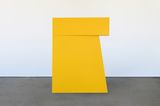
Carmen Herrera’s paintings, drawings, and sculptures found increasing acclaim in the 21st century, however, and are now located in major public collections including The Museum of Modern Art, New York, and Museum Pfalzgalerie Kaiserslautern, Germany. The artist continues to paint in New York with the aid of an assistant. The 2015 Carmen Herrera documentary, The 100 Years Show, offered further attention to the artist’s long and until more recently, under appreciated career.
Carmen Herrera Solo Exhibitions include:
Structuring Surfaces, The Museum of Fine Arts, Houston (2020); Lines of Sight, Whitney Museum of American Art, New York (2016); Carmen Herrera, Ikon, Birmingham, United Kingdom (2009); The Forms of Silence: Carmen Herrera Abstract Works 1948–1976, Miami Art Central (2005); The Black and White Paintings, 1951–1959, El Museo del Barrio, New York (1998); Carmen Herrera: A Retrospective 1951–1984, The Alternative Museum, New York (1984).
Carmen Herrera Group Exhibitions include:
Spilling Over: Painting Color in the 1960s, Whitney Museum of American Art, New York (2019); Epic Abstraction, The Metropolitan Museum of Art, New York (2018); Southern Geometries, from Mexico to Patagonia, Fondation Cartier pour l’art contemporain, Paris (2018); Our America: The Latino Presence in American Art, Smithsonian American Art Museum, Washington, D.C. (2014); New Perspectives in Latin American Art, 1930–2006, The Museum of Modern Art, New York (2007).
Michael Irwin | Ocula | 2020














Explore and Follow Artists Shaping Contemporary Art
A respected voice in contemporary art discourse.
Focusing on ambitious storytelling and insightful art-world commentary. Ocula Magazine publishes in-depth interviews, critical essays and timely analysis on the artists, exhibitions and ideas driving the global art world.
Learn more about Ocula Magazine
Showcasing the best of the art world.
Ocula partners with galleries from around the world to highlight their artists, artworks and exhibitions. Gallery membership is by application and invitation, with each member vetted by an independent panel.
Learn more about Ocula Membership
Specialises in the sale of major artworks.
Led by a team with deep ties to the world’s leading auction houses, galleries and collectors. Ocula’s advisory team offers bespoke services to high-net-worth clients from around the world who are looking to acquire the best of contemporary and modern art.
Learn more about our team and services