






CAROLINE WALKER
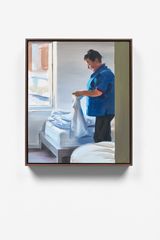
b. 1982, United KingdomCaroline Walker stands out as a leading figurative painter whose evocative, cinematic depictions of women in both public and private spaces have reinvigorated the genre of contemporary realism. Walker’s large-scale canvases and intimate panels, painted in luminous oils, offer unique, voyeuristic glimpses into the overlooked worlds of women’s everyday labour and leisure. By shining a light on subjects ranging from contract cleaners to midwives and mothers, Walker elevates mundane yet profound acts of care and work, challenging and expanding the canon of the female experience within art.
Practice
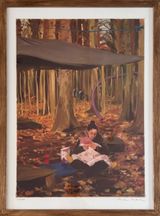
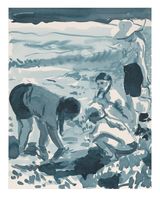
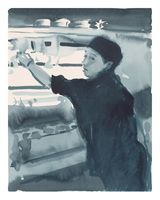
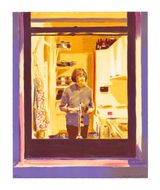
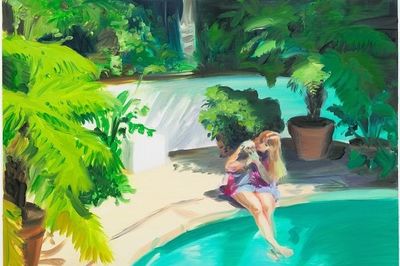
Walker’s paintings primarily explore the multifaceted roles and environments occupied by women today, blending observation and empathy without sentimentality. Drawing from her own photographs taken in diverse locations—including London, Los Angeles, Palm Springs, and her native Scotland—she presents anonymous women engaged in tasks like housekeeping, beauty care, and retail work. Her compositions often frame subjects through windows, doorways, or at oblique angles, evoking a sense of proximity and distance that invites viewers to reexamine the boundaries of privacy and public observation. Influences from Dutch Golden Age interiors, Edouard Manet, and Mary Cassatt are evident in her attention to light, colour, and domestic intimacy.
Walker’s shift towards a documentary approach in 2016, portraying real women encountered in her neighbourhood, led to a body of work noted for its authenticity and psychological insight. Series such as Painted Ladies and Home (commissioned by Kettle’s Yard) document not only the physical settings but the social and economic diversity of female experience, touching on themes of migration, care, class, and community.
Based in London, Walker has built an international reputation for examining the lives of women with an unflinching yet compassionate gaze, and her work has been widely collected by major institutions including Tate (UK), Pérez Art Museum Miami, National Galleries of Scotland, the British Museum, and the Institute of Contemporary Art, Miami. In 2025, the Hepworth Wakefield in Yorkshire, England presented Caroline Walker: Mothering, bringing together works made over the previous five years with new paintings exploring themes of motherhood and early-years care. An illustrated monograph accompanied the opening of the show.
Background
An avid drawing and painting enthusiast from a young age, Caroline Walker was influenced by the likes of Thomas Gainsborough, Henry Raeburn, and The Glasgow Boys. This influence is evident in the naturalistic realism with which she renders her subjects. She studied painting at the Glasgow School of Art, graduating with a BA in 2004, then completed an MA in Painting at the Royal College of Art, London, in 2009.
Artistic Practice
Initially, Walker hired models and staged them for photographs in carefully designed domestic scenes. Around 2016, though, she switched to a more documentary approach, taking to the city streets to find her anonymous subjects in their natural environment.
Caroline Walker’s anonymous women, who have been consistent subjects in her work, come from far and wide. They are housewives, tailors, shop assistants, waitresses, hairdressers, hotel housekeepers, nail salon beauty technicians, and more. Between works, there is a diversity of socio-economic status, ranging from individuals living in mansions on the hills above Los Angeles to refugee women living in London in very basic accommodation.
Walker uses different colour palettes in each painting to create a sense of light and atmosphere indicative of a specific time of day and place, whether that is Palm Springs early on a summer’s evening, or inside a suburban English home in the middle of the afternoon. The narrative is never fully and overtly told in these scenes, aside from the occasional sense of discord between the subject and her surroundings.
In Caroline Walker’s paintings, the viewer sees only enigmatic moments of pause and contemplation, the context of which they are never party to. Just like the subjects in Edward Hopper‘s New York window scenes, they catch a small frozen snapshot of the lives of these women—a glimpse through an open window or doorway, or across the room in a public space.
Any understanding of personal narratives in Caroline Walker’s scenes is subordinate to the greater project of exploring contemporary femininity by presenting snapshots of women carrying out their ordinary lives in female-dominated professions that rarely receive recognition.
Exhibitions and Representation
Significant solo exhibitions include:
- Mothering, Hepworth Wakefield, West Yorkshire (England), touring to Pallant House Gallery, Chichester (2025–2026)
- The Holiday Park, GRIMM, New York (2025)
- Janet, Ingleby Gallery, Edinburgh (2020)
- A Woman Sewing, GRIMM, Amsterdam (2019)
- Painted Ladies, Space K, Gwacheon (2017)
- Home, Kettle’s Yard, Cambridge (UK)
- Bathhouse, Space K, Seoul (2015)
- Vantage Point, Ana Cristea Gallery, New York (2011)
Caroline Walker FAQs
Where can I see Caroline Walker’s work?
Walker’s paintings are held in major public and private collections globally, including Tate (London), the British Museum (London), Pérez Art Museum (Miami), Institute of Contemporary Art Miami, The Hepworth Wakefield (West Yorkshire), Dallas Museum of Art, Kunstmuseum Den Haag (Netherlands), and the National Museum of Wales.
Her current and upcoming exhibitions are regularly updated on representing galleries’ websites and on her Ocula artist page.
What medium and techniques does Caroline Walker use?
Walker primarily works in oil on canvas, using her own original photography as source material to compose highly detailed, atmospheric scenes. She is recognised for her adept use of light, colour, and composition to create psychological depth and narrative ambiguity.
What are the core themes of Walker’s work?
Walker’s art examines themes of women’s work, motherhood, domesticity, migration, class, and community. By portraying ordinary everyday actions, she invites a reconsideration of what constitutes valuable labour and experience in contemporary society.
Has Caroline Walker’s work received institutional recognition?
Walker’s practice has been the focus of major institutional exhibitions, including Mothering at the Hepworth Wakefield and Pallant House Gallery. Her work is included in public collections across Europe, the UK, the US, and Asia, and she is regarded as a significant voice in the contemporary feminist art movement.
Are Walker’s scenes based on real people?
Yes. While early works involved staged models, since 2016 Walker’s process has become primarily documentary, involving observation and engagement with real women in their daily environments. Subjects range from close family members, such as her mother, to anonymous women encountered in public spaces.
What makes Caroline Walker’s viewpoint distinctive?
Walker reclaims the female gaze by depicting women through the eyes of a woman artist, often referencing art history’s predominantly male perspective. Her compositions encourage viewers to reflect on issues of visibility, privacy, and agency, making her work both timely and timeless.
Ocula | 2025








Explore Caroline Walker's Exhibitions










Explore and Follow Artists Shaping Contemporary Art
A respected voice in contemporary art discourse.
Focusing on ambitious storytelling and insightful art-world commentary. Ocula Magazine publishes in-depth interviews, critical essays and timely analysis on the artists, exhibitions and ideas driving the global art world.
Learn more about Ocula Magazine
Showcasing the best of the art world.
Ocula partners with galleries from around the world to highlight their artists, artworks and exhibitions. Gallery membership is by application and invitation, with each member vetted by an independent panel.
Learn more about Ocula Membership
Specialises in the sale of major artworks.
Led by a team with deep ties to the world’s leading auction houses, galleries and collectors. Ocula’s advisory team offers bespoke services to high-net-worth clients from around the world who are looking to acquire the best of contemporary and modern art.
Learn more about our team and services