





ERNST CARAMELLE
b. 1952, AustriaBorn 1952 in Hall in Tyrol, Austria, lives and works in Frankfurt/Main and New York City.
Ernst Caramelle studied at the Universität für angewandte Kunst (University of Applied Arts) Vienna. In 1974, he was a research fellow at the Massachusetts Institute of Technology, Boston. He was a guest professor at the Städelschule in Frankfurt am Main 1981–1983, followed by the University of Applied Arts Vienna 1986–1990. In 1994 he became a professor at the Staatliche Akademie der Bildendenden Künste (Academy of Fine Arts) in Karlsruhe, where he has been rector from 2012 to 2018.
What is reality, how can we believe what we see, and what are the conditions of art have been recurring questions in Ernst Caramelle’s work since he first began exhibiting in the mid-seventies. ‘Art is a fake’ has been his creed ever since. In his conceptually based oeuvre that spans many different media–from drawing, painting, photography, video, and wall painting, to virtually immaterial works with sunlight on paper–he explores the status of original and fake, production and reproduction, the perception of art and the context of art reception.
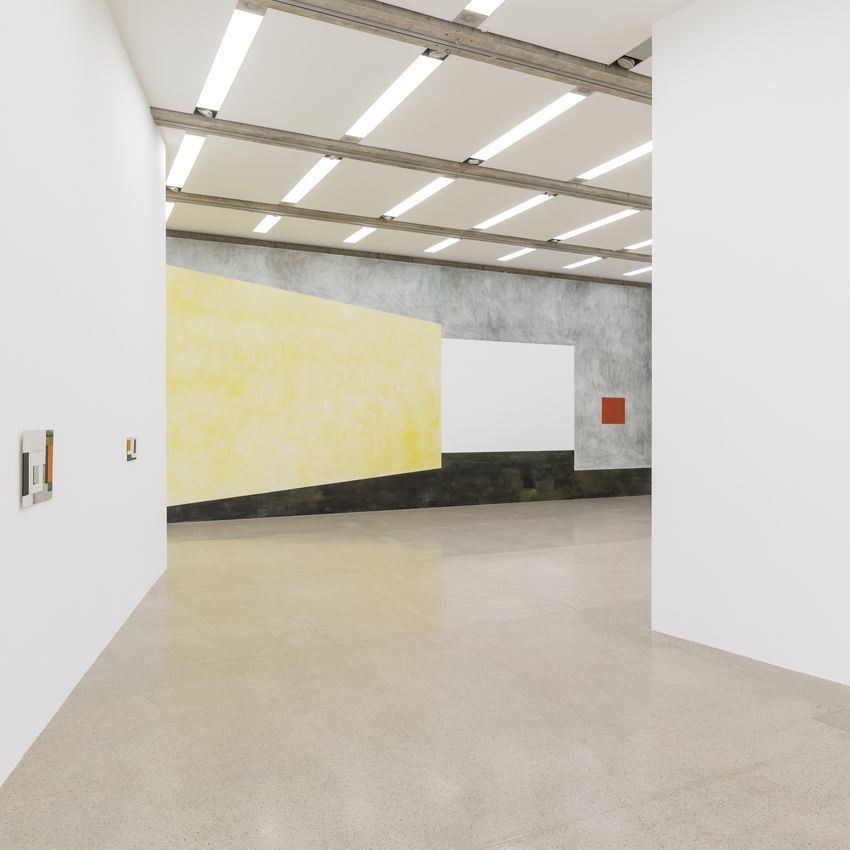
Caramelle’s paintings–whether on gesso ground, wood, cardboard, or directly on a wall’s surface–exhibit views refracted by different perspectives. Coloured, sometimes washed-out shapes formally refer to spatial and geometrical elements, to architectural found footage. In this system of doubles, mirror images, and juxtapositions, the wall itself is transformed into a picture. One spatial illusion follows another, while perspective views mutate into physiognomies. Beholding is reversed into being beheld, and what is visible questions its own status.
Ernst Caramelle participated in the Biennale of Sydney in 1990 and the Documenta IX in Kassel in 1992.
Selected solo exhibitions: 2018 Museum moderner Kunst Stiftung Ludwig, Vienna; Marta Herford, Herford, Germany; 2017 Galerie der Stadt Schwaz, Austria; 2016 Bonnefantenmuseum Maastricht, The Netherlands; 2012 Wexner Center for the Arts, Columbus, Ohio; 2010 Bloomberg Space, London; 2008 Galerie im Taxispalais, Innsbruck, Austria; 2006 Badischer Kunstverein, Karlsruhe, Germany; 2005 Museu Serralves, Porto, Spain; 2001 BAWAG Foundation, Vienna; 1998 Städtische Galerie, Nordhorn, Germany; 1993 Wiener Secession, Vienna; 1993 Portikus, Frankfurt/Main, Germany; 1990 Museum Haus Lange, Krefeld, Germany; 1990 Nationalgalerie, Berlin; 1989 Musée départemental de Rochechouart, France; 1986 Kunsthalle Bern, Switzerland; 1982 Kunsthalle Basel, Switzerland; 1981 Frankfurter Kunstverein, Frankfurt/Main.
Selected museum collections: Albertina, Vienna; Generali Foundation, Salzburg, Austria; Krefelder Kunstmuseum, Krefeld, Germany; Kunsthaus Bregenz, Austria; Kunstmuseum Liechtenstein, Vaduz, Liechtenstein; MUMOK Museum Moderner Kunst, Vienna; Neue Galerie am Landesmuseum Joanneum, Graz, Austria; The Museum of Modern Art, New York; Whitney Museum, New York.
Text courtesy Galerie nächst St. Stephan Rosemarie Schwarzwälder.


Explore and Follow Artists Shaping Contemporary Art
A respected voice in contemporary art discourse.
Focusing on ambitious storytelling and insightful art-world commentary. Ocula Magazine publishes in-depth interviews, critical essays and timely analysis on the artists, exhibitions and ideas driving the global art world.
Learn more about Ocula Magazine
Showcasing the best of the art world.
Ocula partners with galleries from around the world to highlight their artists, artworks and exhibitions. Gallery membership is by application and invitation, with each member vetted by an independent panel.
Learn more about Ocula Membership
Specialises in the sale of major artworks.
Led by a team with deep ties to the world’s leading auction houses, galleries and collectors. Ocula’s advisory team offers bespoke services to high-net-worth clients from around the world who are looking to acquire the best of contemporary and modern art.
Learn more about our team and services