





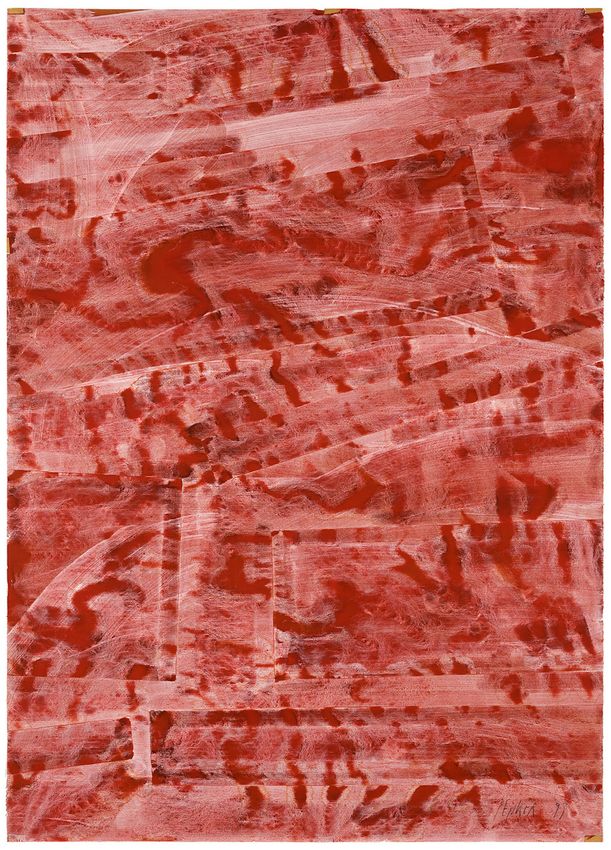
FERDINAND PENKER
1950-2014, AustriaBorn 1950 in Klagenfurt, Austria, died 2014 in Farrach in Carinthia, Austria.
Ferdinand Penker studied medicine and art history at the University of Graz from 1968 to 1972. In 1971, he got to know Josef Albers, and he lived in the USA as a professor at the University of California, Davis, from 1977 to 1987. In 1986, he travelled to Japan for the first time, and he later lived and worked in Tokyo for half a year in 2008.
In the 1970s, Ferdinand Penker began building up an oeuvre influenced by Constructivist and Concrete art, American Colour Field painting, and Minimal art. Throughout his career, he explored and continued to develop the means, possibilities, and conditions of painting. Ferdinand Penker’s work is characterised by an analytic quality and consistency that has earned him a singular position within Austrian painting.
Also in the 1970s, he developed a distinct vocabulary and methodology, which he continued to vary and intensify in his work. Due to his fascination with space and architecture, his artistic endeavours began to concentrate on the line. He used the serial repetition of identical lines to produce two-dimensional structures as examples of abstract composition and formal results of a method of a specific scriptural application of paint. In the 1990s, this often minimalistic, monochrome, and radically decelerated painting acquired a sense of spatiality through which the picture as an autonomous unit dissolved, thus expanding the range of his engagement.
Selected solo exhibitions: Schloss Wolfsberg, Austria (2016); Museum der Wahrnehmung, Graz, Austria (2014); Museum Moderner Kunst Kärnten, Klagenfurt, Austria (2010); Yamanote, Sclater Street Platform, London, United Kingdom (2010); 45 Views of a Square, Machiya Bunka Center, Tokyo, Japan (2008); NOSPACE, Casa Amarilla, San Jose, Costa Rica (2006); 97-99 Sclater Street, London, United Kingdom (2000); Kärntner Landesgalerie, Klagenfurt, Austria (1999); Forum Stadtpark, Graz, Austria (1995); Neue Galerie am Landesmuseum Joanneum, Graz, Austria (1994); KALA Institute, Berkeley, California (1984); Wiener Secession, Vienna, Austria (1981)
Text courtesy Galerie nächst St. Stephan Rosemarie Schwarzwälder.



Explore and Follow Artists Shaping Contemporary Art
A respected voice in contemporary art discourse.
Focusing on ambitious storytelling and insightful art-world commentary. Ocula Magazine publishes in-depth interviews, critical essays and timely analysis on the artists, exhibitions and ideas driving the global art world.
Learn more about Ocula Magazine
Showcasing the best of the art world.
Ocula partners with galleries from around the world to highlight their artists, artworks and exhibitions. Gallery membership is by application and invitation, with each member vetted by an independent panel.
Learn more about Ocula Membership
Specialises in the sale of major artworks.
Led by a team with deep ties to the world’s leading auction houses, galleries and collectors. Ocula’s advisory team offers bespoke services to high-net-worth clients from around the world who are looking to acquire the best of contemporary and modern art.
Learn more about our team and services