






GÜNTHER FÖRG
1952-2013, GermanyA key figure in postwar European contemporary art, Günther Förg is celebrated for his rigorous, genre-defying practice that bridged painting, photography, sculpture, and installation with a bold interrogation of modernist aesthetics.
Early Years
Günther Förg was born in the Bavarian town of Füssen in 1952. He studied at the Akademie der Bildenden Künste in Munich under Karl Fred Dahmen, graduating in the late 1970s—a period marked by Germany’s postwar reckoning and the resurgence of painting in contemporary art. From the outset, Förg developed a critical engagement with modernism, at once reverential and iconoclastic.
He spent much of his life in Germany and Italy, and his travels profoundly influenced his architectural photography. Förg later became a professor at the Akademie der Bildenden Künste in Munich, where he also maintained his studio practice until his death in 2013.
Artworks
Combining painterly experimentation with architectural inquiry, Günther Förg’s art practice explored material, structure and space in a continually evolving investigation of modernist legacies in contemporary art.
Wall Paintings and Lead Works (1978–1989)
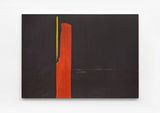
Förg’s early monochrome wall paintings of the late 1970s and early 1980s—such as his untitled grey murals at Galerie Max Hetzler (1981)—offered a stark critique of modernist purity. These gave way to his signature lead paintings, begun in 1984, where thin acrylic was brushed across sheets of lead mounted on wood. Works like Untitled (1987) exemplify this tactile dialogue between industrial weight and painterly gesture. At once minimal and expressive, these artworks destabilised the heroic aura of American abstraction while confronting the material and historical density of postwar German art.
Photography and Architectural Series (1988–1995)
Förg’s photographic works from the late 1980s and 1990s captured iconic yet ideologically fraught modernist architecture across Europe and beyond. In his Buildings series (1988–1995), Förg documented Bauhaus sites in Dessau, fascist Italian architecture in Como, and sanatoriums by Alvar Aalto and Le Corbusier. These large-format black-and-white prints—like Sanatorium Zonnestraal, Hilversum, 1990—reveal the tension between utopian design and historical disillusionment. Exhibited at the Stedelijk Museum (2018), Förg’s photographs highlight his conceptual concern with space, ideology, and surface, positioning architectural documentation as a form of painterly inquiry.
Grid Paintings and Gitterbilder (1992–2006)
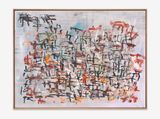
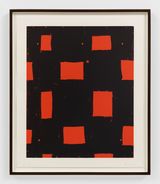
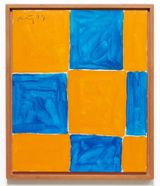
In the 1990s, Förg reinvigorated geometric abstraction with his vibrant, loose-limbed grid paintings, or Gitterbilder. Works such as Untitled (1995) feature rapidly applied, painterly lattices rendered in vivid colours, often on canvas or wood panel. These compositions quote the formal logic of Constructivism and Colour Field painting, but with visible brushstrokes that introduce spontaneity and imperfection. Förg’s grid works, shown at Greene Naftali and Galerie Max Hetzler, push against the rationalist order of modernism while embracing its visual vocabulary, establishing a dialogue between formal constraint and expressive freedom.
Late Works on Paper and Canvas (2008–2013)
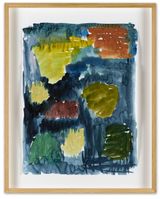
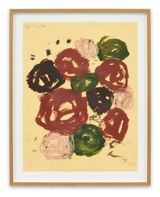
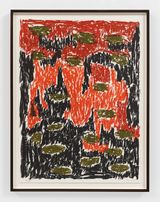
After suffering a stroke in 2008, Förg’s visual language became increasingly lyrical and gestural. In his late watercolours and acrylics, such as Untitled (2011), he painted looping, calligraphic marks and ribbon-like forms on soft backgrounds, often recalling musical scores or proto-writing. These works retain the architectural structure seen throughout his career but shift toward vulnerability and introspection. Shown posthumously in exhibitions like Back and Forth at Fondation Beyeler (2009), these final paintings mark a poignant coda to his practice, balancing fragility with formal clarity.
Public Commissions
- Mural installation at the Museum für Moderne Kunst, Frankfurt
- Large-scale wall paintings at the Museum Brandhorst, Munich
- Site-specific works at the Austrian Parliament, Vienna
Exhibitions
Günther Förg has been the subject of both solo exhibitions and group exhibitions at important institutions. A selection of important exhibitions is provided below.
Solo Exhibitions
- Günther Förg, Long Museum, Shanghai (2023)
- A Fragile Beauty, Stedelijk Museum, Amsterdam. Travelled to Dallas Museum of Art, Dallas (2018)
- Günther Förg in Rome, A modern city, Museo Carlo Bilotti, Rome (2013)
- Günther Förg, Fondatio Beyeler, Basel (2009)
- Gunther Forg / Bernhard Frize, Kunstmuseum Basel, Basel (2006)
- Günther Förg, Guggenheim Foundation, Deutsche Guggenheim, Berlin (2000)
Group Exhibitions
- Abstraction: Aspects of Contemporary Art, The National Museum of Art, Osaka (2019)
- Art of Two Germanys/Cold War Cultures, Los Angeles County Museum of Art, Los Angeles (2009)
- Minimalismos. Un signo de los tiempos, Museo Nacional Centro de Arte Reina Sofía, Madrid (2001)
- New York: a new generation, San Francisco Museum of Modern Art, San Francisco (1990)
- Psychological Abstraction, The Deste Foundation for Contemporary Art, Athens (1989)
- Carnegie International, Carnegie Museum of Art, Pittsburgh (1988)
Critical Reception
Günther Förg’s work has been widely covered in leading art publications including Artnet News, ARTnews, and The New York Times.
Günther Förg FAQs
What is Günther Förg best known for?
Günther Förg is best known for his multidisciplinary approach that challenged the formal and ideological boundaries of modern art. His lead paintings, architectural photography, and expressive grid works reflect a persistent interrogation of modernist ideals. Often working in series, Förg combined industrial materials with painterly gestures, creating artworks that are both conceptually rigorous and visually compelling. His ability to synthesise painting, photography, and architecture into a cohesive practice has made him a central figure in postwar European contemporary art.
How did architecture influence Günther Förg’s art?
Architecture profoundly shaped Günther Förg’s practice, both thematically and formally. His large-scale photographic series captured the aesthetics of 20th-century modernist buildings—from Bauhaus constructions in Germany to Fascist-era structures in Italy—often highlighting the ideological contradictions embedded in their design. These architectural forms also informed his painting: the grid systems, material surfaces, and structural rhythms in his artworks echo built environments. Förg used architecture not only as subject matter, but as a conceptual framework for exploring order, memory, and cultural identity.
How has Günther Förg influenced contemporary art?
Günther Förg has had a lasting influence on contemporary art through his defiant, cross-disciplinary exploration of modernism’s legacy. His irreverent use of canonical styles—Minimalism, Abstract Expressionism, Bauhaus design—opened space for a more critical and fluid engagement with historical forms. Förg’s work encouraged later generations of artists to embrace hybridity, embrace imperfection, and question purity in art. His legacy is evident in the practices of contemporary artists who fuse architecture, photography, and abstraction to rethink the aesthetics and politics of space.
Ocula | 2025

Works at Galerie Max Hetzler

Recently Exhibited




Works Elsewhere

















Explore and Follow Artists Shaping Contemporary Art
A respected voice in contemporary art discourse.
Focusing on ambitious storytelling and insightful art-world commentary. Ocula Magazine publishes in-depth interviews, critical essays and timely analysis on the artists, exhibitions and ideas driving the global art world.
Learn more about Ocula Magazine
Showcasing the best of the art world.
Ocula partners with galleries from around the world to highlight their artists, artworks and exhibitions. Gallery membership is by application and invitation, with each member vetted by an independent panel.
Learn more about Ocula Membership
Specialises in the sale of major artworks.
Led by a team with deep ties to the world’s leading auction houses, galleries and collectors. Ocula’s advisory team offers bespoke services to high-net-worth clients from around the world who are looking to acquire the best of contemporary and modern art.
Learn more about our team and services