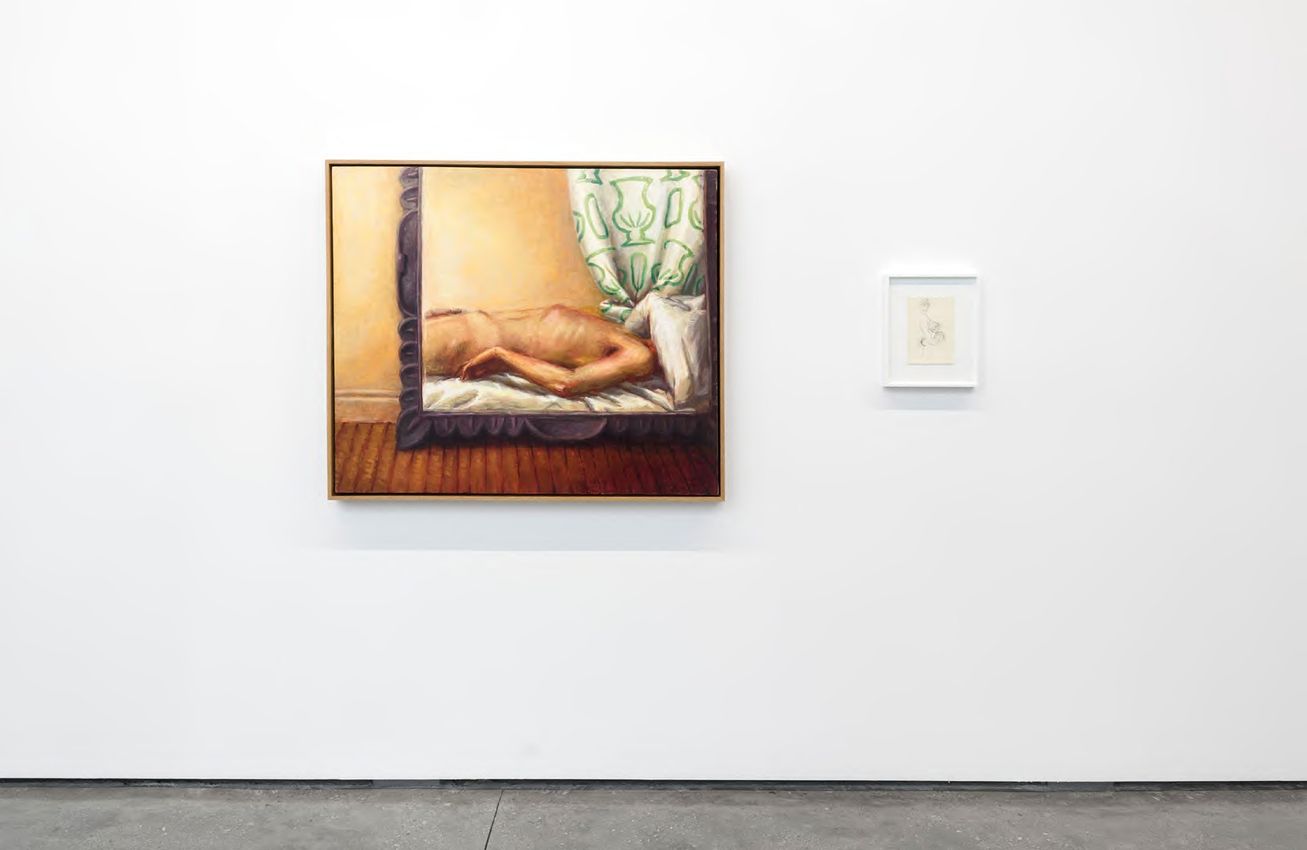
Hugh Steers was an American figurative painter who described his work as ‘allegorical realism’. His paintings and works on paper are a reflection of 1990s AIDS-era queer America, combining the visual language of French Masters such as Pierre Bonnard and Renaissance religious art with a bleak sense of lived intimacy and humour.
Steers was born in Washington, D.C. into a well-connected political family that included Gore Vidal and the Kennedys. Developing an interest in painting at an early age, he attended the Hotchkiss School in Lakeville, Connecticut, where his paintings and anatomical studies lined the school corridors. Steers went on to study painting at Yale University, and in 1983 travelled to France and Italy through the Parsons School of Art and Design study abroad programme.
Steers graduated cum laude from Yale in 1985 and moved to New York the following day, becoming entranced by the nightlife and drag scene. His work drew critical acclaim very quickly and was shown in The Drawing Center and Midtown Galleries by 1988, despite the overwhelming sway against figurative painting at the time. He was awarded a summer residency at the Skowhegan School of Painting and Sculpture in Maine in 1991, which was a turning point for his treatment of light and colour, briefly moving his figures from the interior into the bucolic landscape that surrounded him.
Steers was diagnosed with HIV in 1987 at the age of 25. From then on, his male nudes in bleak apartment interiors became tinged with a personal grappling with the disease that eventually claimed his life. Steers died at 32 from AIDS-related complications in 1995.
Hugh Steers’ practice utilises the visual language of the Old Masters of Western art to draw the viewer in, then quickly confront them with the challenging reality of his subject matter. Exploring queer identity and the devastation of the AIDS crisis, he completed many of his larger paintings propped on an easel in his kitchen, giving them an almost trademark warped perspective that heightens their emotional intensity.
Alexander Gray Associate’s 2015 exhibition Day Light presented a collection of Steers’ works produced between 1990 and 1992 that examined his artistic process and treatment of light. Positioning his 1991 residency at Skowhegan as a turning point for his technique, the exhibition contrasted many of Steers’ earlier interior works with paintings and studies completed during his residency. Maroon Shed (1991) displays two men embracing in the Maine farmland from the same oblique viewpoint as Edward Hopper, bathed in golden summer light and high contrasting shadows.
In 2021, Alexander Gray Associates presented Strange State of Being, an exhibition of late-career works for which Steers became known, drawing particular attention to his enigmatic figures as ‘constant companions’. The title of the show was taken from a 1994 quote from the artist after his diagnosis, reflecting the poignancy of Steers’ paintings in exposing the intricacies of AIDs treatment from his experience and those around him. Two Men and a Woman (1992) depicts a nude man in a shadowed bathtub being nursed by two other figures. Steers’ friend Julie Heffernan explained that these figures expressed a desire for companionship and the artist’s own loneliness throughout his struggle with the illness.
As part of the exhibition series More Life—a group of solo shows held by David Zwirner that mark the 40th anniversary of the ongoing HIV/AIDs crisis—Russell Tovey curated Hugh Steers: Blue Towel, Red Tank in 2021. The show traversed Steers’ entire career as a celebration of his unflinching authenticity in his figurative style. The title painting Blue Towel, Red Tank (1988) depicts a nude man spread across a bathroom floor as another man appears to give him CPR, the ‘blue towel’ draped across the chair by the bathtub. The intimacy of this scene is heightened by the bathroom tiles beneath, which curve around the figures in their wake.

In 1989, Steers was awarded a Pollock-Krasner Foundation Fellowship.
Hugh Steers has been the subject of both solo exhibition and group exhibitions.
Solo exhibitions include Hugh Steers: Blue Towel, Red Tank, David Zwirner Gallery, Paris (2021); Hugh Steers: Strange State of Being, Alexander Gray Associates, New York (2021); Hugh Steers: The Nullities of Life, Alexander Gray Associates, New York (2018); Day Light, Alexander Gray Associates, New York (2015); That Soft Glow of Brutality: The Art of Hugh Steers, Visual AIDS, New York (2009).
Group exhibitions include Every Moment Counts—AIDS and its Feelings, Henie Onstad Kunstsenter, Høvikodden (2022); We Are Family, New York Academy of Art, New York (2022); Any distance between us, RISD Museum, Providence (2021); Intimate Companions, Mary Heaton Vorse House, Provincetown (2020); You Tell Me, Foley Gallery, New York (2018).
Annie Curtis | Ocula | 2022

A respected voice in contemporary art discourse.
Focusing on ambitious storytelling and insightful art-world commentary. Ocula Magazine publishes in-depth interviews, critical essays and timely analysis on the artists, exhibitions and ideas driving the global art world.
Learn more about Ocula Magazine
Showcasing the best of the art world.
Ocula partners with galleries from around the world to highlight their artists, artworks and exhibitions. Gallery membership is by application and invitation, with each member vetted by an independent panel.
Learn more about Ocula Membership
Specialises in the sale of major artworks.
Led by a team with deep ties to the world’s leading auction houses, galleries and collectors. Ocula’s advisory team offers bespoke services to high-net-worth clients from around the world who are looking to acquire the best of contemporary and modern art.
Learn more about our team and services