





IDELLE WEBER
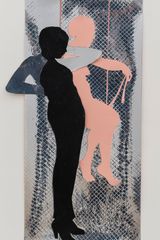
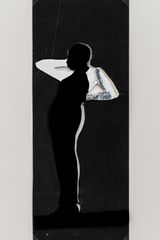
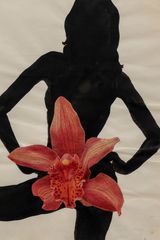
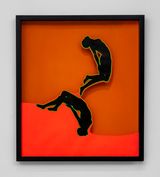
In the late 1950s, Idelle Weber created the first iteration of the silhouette paintings that would become central to her work of the next decade. In 1958, she studied at the Art Students League with Theodoros Stamos and Ralph Humphries, and her first silhouettes developed from her work there. By the early 1960s, she was firmly involved with New York’s progressive art world, and she was represented by Bertha Schaefer. During this period, Weber began creating hard-edged silhouettes of people, placed over backgrounds that were by turns planes of color or, more frequently, patterned with flat grids or other designs.
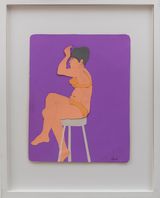
The silhouettes depict types—businessmen, office workers, couples, brides, families—in quotidian activities. By rendering the figures anonymous, the artist makes them universal: a viewer could occupy any of these roles. At the same time, the archetypal quality of the forms suggests standardization or commercialization, an implication underscored by the crisp outlines and broad forms that resemble advertisements. In these silhouette paintings, the artist leaves her intentions ambiguous. Whether critique or celebration of American culture, they offer a graphic appeal that reflects her Pop milieu.
A Chicago native, Weber was raised there and in Beverly Hills. As a teenager, she won a Scholastic Art Award, among other regional competitions, and she pursued art while a student at Scripps College and UCLA; her instructors included Millard Sheets and Stanton Macdonald-Wright. Weber taught briefly in Los Angeles before moving to New York in 1957 at age 25. That year, a drawing was included in the Museum of Modern Art’s “Recent Drawings U.S.A.”—Gertrude Mellon bought the piece from the show.
By the early 1960s, her work was exhibited widely at venues including the Pennsylvania Academy of the Fine Arts, the American Federation of Arts, and the Dwan Gallery. Schaefer began showing her silhouette paintings in 1962, and the following year, the Albright-Knox Art Gallery purchased a piece. Later in the 1960s, Weber began working with Plexiglass to create wall sculptures in three dimensions.
In the 1970s, she shifted her focus to include representational paintings of New York City fruit stands and litter, finding inspiration in detritus. Drawing from everyday subjects shifted direction in the following decade; Weber worked on images of foliage, flowers, pebbles, and other natural subjects. Her work is included in public collections including the Metropolitan Museum of Art, the Art Institute of Chicago, the Harvard Art Museums, and the Brooklyn Museums, among many others. Weber passed away on March 23, 2020 at the age of 88.
















Explore and Follow Artists Shaping Contemporary Art
A respected voice in contemporary art discourse.
Focusing on ambitious storytelling and insightful art-world commentary. Ocula Magazine publishes in-depth interviews, critical essays and timely analysis on the artists, exhibitions and ideas driving the global art world.
Learn more about Ocula Magazine
Showcasing the best of the art world.
Ocula partners with galleries from around the world to highlight their artists, artworks and exhibitions. Gallery membership is by application and invitation, with each member vetted by an independent panel.
Learn more about Ocula Membership
Specialises in the sale of major artworks.
Led by a team with deep ties to the world’s leading auction houses, galleries and collectors. Ocula’s advisory team offers bespoke services to high-net-worth clients from around the world who are looking to acquire the best of contemporary and modern art.
Learn more about our team and services