

MIKA TAJIMA
b. 1975, United StatesMika Tajima is fascinated by the ways scientific discovery can help us to see versions of ourselves. Her artistic practice considers how capitalism has affected the evolution of human behaviour and how the complexity of identity is shaped by economics and the environment.
Early Years
Mika Tajima was born in Los Angeles in 1975 to Japanese parents who were both scientists. She recalls How Art Changed Me her earliest memory of art as trying to draw a cat when she was aged three or four, and being frustrated with how it was turning out. She wanted to go to art school, but her parents wanted her to have a liberal arts education, so she studied at Bryn Mawr College, majoring in fine art and East Asian studies, graduating in 1997 and interning at the Institute of Contemporary Art and a printmaking gallery in Philadelphia. She gained her MFA from Columbia University School of the Arts in 2003 and became a post-graduate apprentice at The Fabric Workshop and Museum in Philadelphia.
Mika Tajima: Artworks
In a practice spanning painting, sculpture, installation and technology, Mika Tajima creates artworks that explore how humanity interacts with its environment via the architecture of design and the invisible infrastructure created by technology. She considers how capitalist structures and development inform both productivity and leisure, and how this in turn influences freedom, control, our emotions and behaviour.
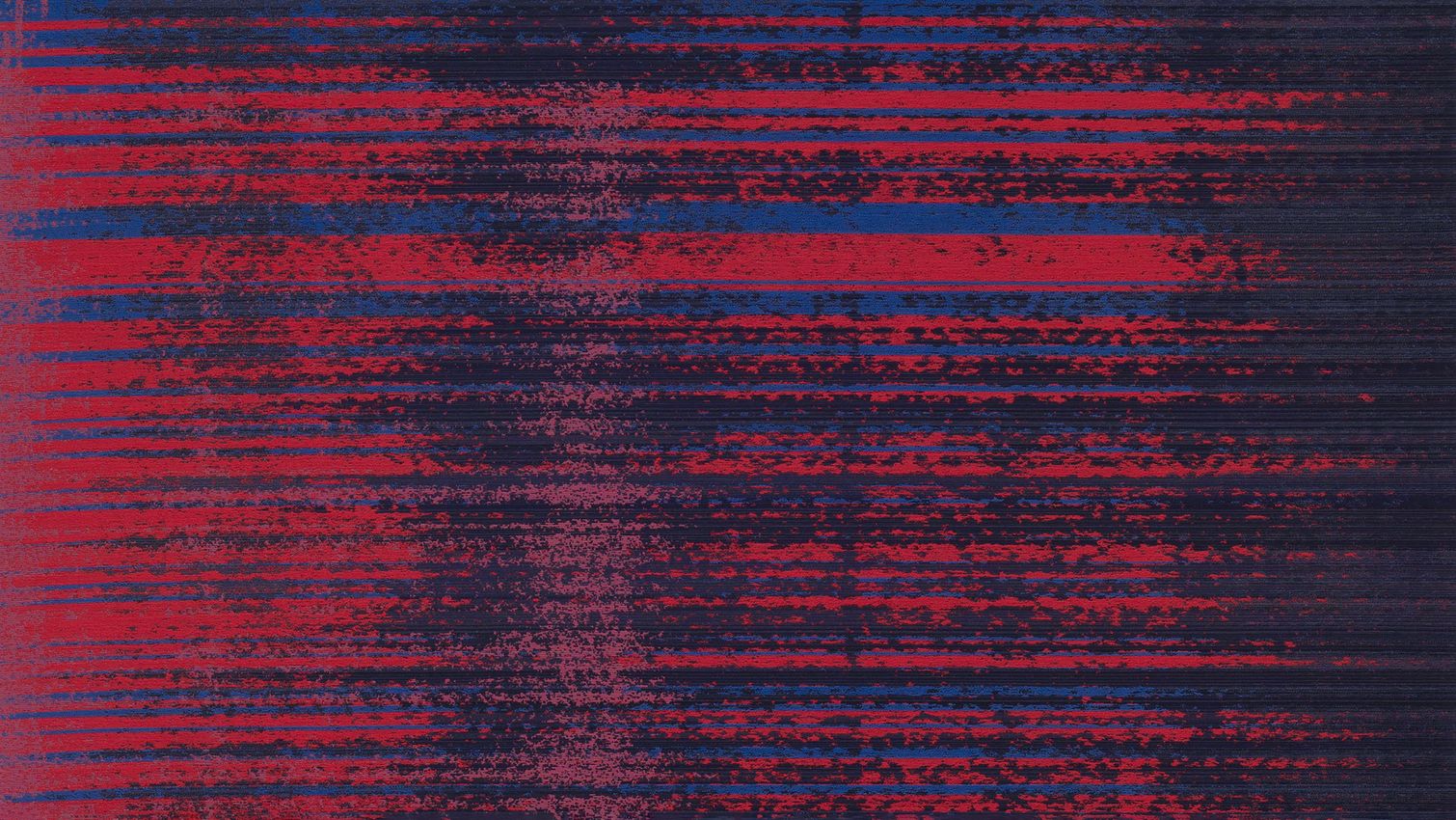
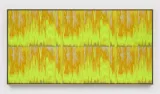
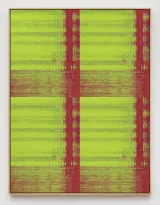
- Mika Tajima began her Negative Entropy series while she was artist-in-residence at The Fabric Workshop and Museum in Philadelphia in 2003. The original iteration of her large-scale woven acoustic portrait series (which she later expanded, notably during the Covid-19 pandemic) comprised six woven acoustic portraits using sound from local industries in Pennsylvania, which were then transmuted into spectrogram images, to which Tajima assigned colours. She recorded sound from traditional and modern practices, from textile looms to data centres.
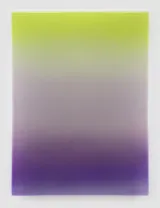
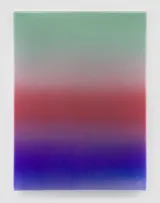
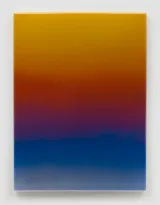
- Tajima’s Arts d’Ameublement series (2011—) references Erik Satie’s repetitive Furniture Music compositions, designed as background or aural décor. She coats transparent acrylic shells with airborne paint particles which not only creates colour gradients and a “soft, blurry reflection” but also prevents viewers looking inside the shell. She has said that viewers have the chance to see themselves in the context of something that’s completely abstract, “enter the space of the painting”.
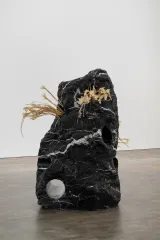
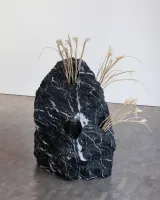
- Negentropia (2025) examined how the ongoing evolution of humankind is closely linked to materials and minerals, which of course are used extensively in technology. Negentropia comprised a series of marble objects—marble representing geologic time—containing biologically altered flowers (Tajima delayed their entropy) that had been given a transfusion of fluorescence. “I wanted to play with the notion of the earth’s power and the power of man—these two kinds of powers at play,” she said, talking about the work in an article in Ocula.
Mika Tajima: Select Exhibitions
Select Solo Exhibitions
- Mika Tajima: 37 Dimensions, Pace Gallery, Los Angeles (2026)
- Mika Tajima: Anthesis, Pace Gallery, London (2025)
- Mika Tajima: Penumbra, Pace Gallery, Hong Kong (2024)
- Mika Tajima: Super Natural, Hill Art Foundation, New York City (2024)
- Mika Tajima: Energetics, Pace Gallery, New York City (2024)
- Mika Tajima: Air Max, Pace Gallery, Geneva (2022)
- Mika Tajima: Spectral, Taro Nasu Gallery, Tokyo (2022)
- Mika Tajima: Appear, Dazaifu Tenmangu, Fukuoka (2022)
- Mika Tajima: You Must Be Free, Kayne Griffin, Los Angeles (2022)
- Mika Tajima: Regulation, Simon Lee Gallery, London (2021)
- Mika Tajima: Psycho Graphics, Art Production Fund, Los Angeles (2019)
- Mika Tajima: Ulterior, Francesca Minini, Milan (2018)
- Mika Tajima: Aether, Borusan Contemporary, Istanbul (2018)
- Mika Tajima: Touchless, Taro Nasu, Tokyo (2017)
- Mika Tajima: Air, Raster Gallery, Warsaw (2017)
- Mika Tajima: Meridian (Gold), Sculpture Centre, New York City (2016)
- Mika Tajima: Human Synth, Taro Nasu, Tokyo (2015)
- Mika Tajima: Total Body Conditioning, Art in General, New York City (2014)
- Mika Tajima: Pineapples and Pyramids, Aspen Art Museum (2012)
- Mika Tajima: The Architect’s Garden, UT Visual Arts Centre, Austin (2011)
- Mika Tajima: The Double, Bass Museum, Miami (2010)
- Mika Tajima: The Extras, X Initiative, New York City (2009)
- Mika Tajima: The Double, The Kitchen, New York City (2008) (and touring)
- Mika Tajima: Thin Line, Circuit, Lausanne (2007)
- Mika Tajima: New Humans: Disassociate, Elizabeth Dee Gallery, New York City (2007)
- Mika Tajima: Echoplex, Swiss Institute Contemporary Art, New York City (2005)
Select Group Exhibitions
- You Stretched Diagonally Across It: Contemporary Tapestry, The Fabric Workshop and Museum, Philadelphia (2026)
- Of Anarchy in Music: More Journeys in Sound, National Taiwan Museum of Fine Arts (2025)
- Inner Cosmos, Outer Universe, Pace Gallery, Geneva (2024)
- Tropic of Cancer, Pace Gallery, Palm Beach (2023)
- Hawaii Triennial 2022
- Painting, Kayne Griffin Corcoran, Los Angeles (2020) *If the Snake, Okayama Art Summit (2019)
- Programmed: Rules, Codes and Choreographies in Art 1965—2018, Whitney Museum of American Art, New York City (2018)
- Sea Sick in Paradise, Depart Foundation, Los Angeles (2017)
- 11th Gwangju Biennial (2016)
- Office Space, Yerba Buena Centre for the Arts, San Francisco (2015)
- Pier 54, High Line Art, New York City (2014)
- Paint Things: Beyond the Stretcher, Decordova Museum and Sculpture Park, Lincoln (2013)
- Stage Presence: Theatricality in Art and Media, San Francisco Museum of Modern Art (2012)
- Transaction Abstraite, New Galerie, Paris (2011)
- Interference, Moderna Museet, Stockholm (2010)
- Second Look (at the Surface), Künstlerhaus Bregenz (2009)
- Whitney Biennial 2008, Whitney Museum of American Art, New York City (2008)
- Sympathy for the Devil Rock and Roll in Art_, Museum of Contemporary Art in Chicago (2007) (and touring)
- One Way or Another: Asian American Art Now, Asia Society, New York City (2006) (and touring)
- Uncertain States of America—American Art in the Third Millennium, Astrup Fearnley Museum of Modern Art, Oslo (2005) (and touring)
- New Humans: Grass Grows Forever in Every Possible Direction, Swiss Institute, New York City (2004)
- Club in the Shadow, Kenny Schachter Contemporary, New York City (2003)
- Comfort Zone, Fabric Workshop and Museum, Philadelphia (2002)
- A Complement to Love, Vox Populi, Philadelphia (2000)
Further Reading
- Mika Tajima’s website Mika Tajima’s Instagram
- Artist profile page at Pace Gallery
- How Art Changed Me video from 2025
- Video about the 37 Dimensions exhibition (2026)
- 2024 interview in Observer
Mika Tajima FAQs
What kind of art did Mika Tajima make during the Covid-19 pandemic?
During the lockdowns, Tajima further explored her Negative Entropy series. She considered the idea that we communicated almost-exclusively online during that period, and that this was the only connection we had with other people. She compared the isolation and “fragility of physicality” we experienced, feeling “small” in a world of big data, and took this further by weaving small pieces of brain activity energy into these super-large woven artworks.
Did Mika Najima make art out of Tweets?
Yes, for Sense Object (2024), Mika Najima collected all the Twitter posts from US users on 1 January 2023 and stored them on a memory crystal, a very small piece of technology that encodes data. In her 37 Dimensions exhibition in Los Angeles in 2026, she balanced the crystal on top of a rose quartz, known for its healing energy.
Did Mika Tajima use hot tubs in her art?
Yes, as part of her 2014 exhibition Total Body Conditioning in New York City, Mika Tajima cast “hot tub” shapes from acrylic sheets, which she then reverse-spray-enamelled in gradients of colours and hung on the gallery walls. The spa bath sculptures explored ideas of how we articulate our bodies in relation to objects (hot tubs are designed around the human form). In her 2014 installation, Tajima used the hot tubs as containers for both the body and paint—a mix of figuration and abstraction.
Ocula

Works at Pace Gallery








Recently Exhibited









Explore and Follow Artists Shaping Contemporary Art
A respected voice in contemporary art discourse.
Focusing on ambitious storytelling and insightful art-world commentary. Ocula Magazine publishes in-depth interviews, critical essays and timely analysis on the artists, exhibitions and ideas driving the global art world.
Learn more about Ocula Magazine
Showcasing the best of the art world.
Ocula partners with galleries from around the world to highlight their artists, artworks and exhibitions. Gallery membership is by application and invitation, with each member vetted by an independent panel.
Learn more about Ocula Membership
Specialises in the sale of major artworks.
Led by a team with deep ties to the world’s leading auction houses, galleries and collectors. Ocula’s advisory team offers bespoke services to high-net-worth clients from around the world who are looking to acquire the best of contemporary and modern art.
Learn more about our team and services