





MINJEONG AN
Minjeong An’s detailed, intricate diagrams use scientific and mathematical principles to deconstruct experiences, feelings and memories. Viewers are drawn into each work via hundreds of tiny details and the huge contrast between her diagrammatic style and the emotions examined in her practice.
Early Years
Born in Chorwon in 1981 and now living and working in Seoul, Minjeong An achieved her BFA in 2005 and her MFA in 2008 (both in Fine Arts) from the Seoul National University of Technology. A core childhood memory inspired an early work, The Power of a Kiss (2008)—she writes on her website that she found it hard to walk to primary school on her own, but held on to the feeling of the goodbye kiss from her mother. “When I was tired to walk on the way to school, I recharged the power of mom’s kiss saved on my face,” she says. She also references childhood in Detailed Map of my House (2015), which features the small room where she lived alongside her parents, siblings and grandmother between 1981–1990.
Minjeong An: Artworks
Minjeong An’s detailed diagrammatic artworks “visualise invisible things” by using trusted, recognisable mathematical and scientific symbols to unravel complex human emotions. She utilises the language and formulas of science to create factual answers to questions raised about personal relationships and feelings, and concentrates on visualising and quantifying abstract concepts and energies.
She values the beauty of lines and labelling as carriers of information and was inspired by an architectural blueprint she found while working as a web designer, in which she could see that every element of the drawing had its own meaning. For her first Self-Portrait (2007) she measured her body parts, detailing scars and moles as well as length and angle. She has also explained that drawing halo-like curves around her figure’s head was a way of quantifying her aura. “It would be fun to draw a blueprint with my face,” Minjeong An said in a 2018 interview. “Make my teeth as stairs, and nostrils as doorways.”
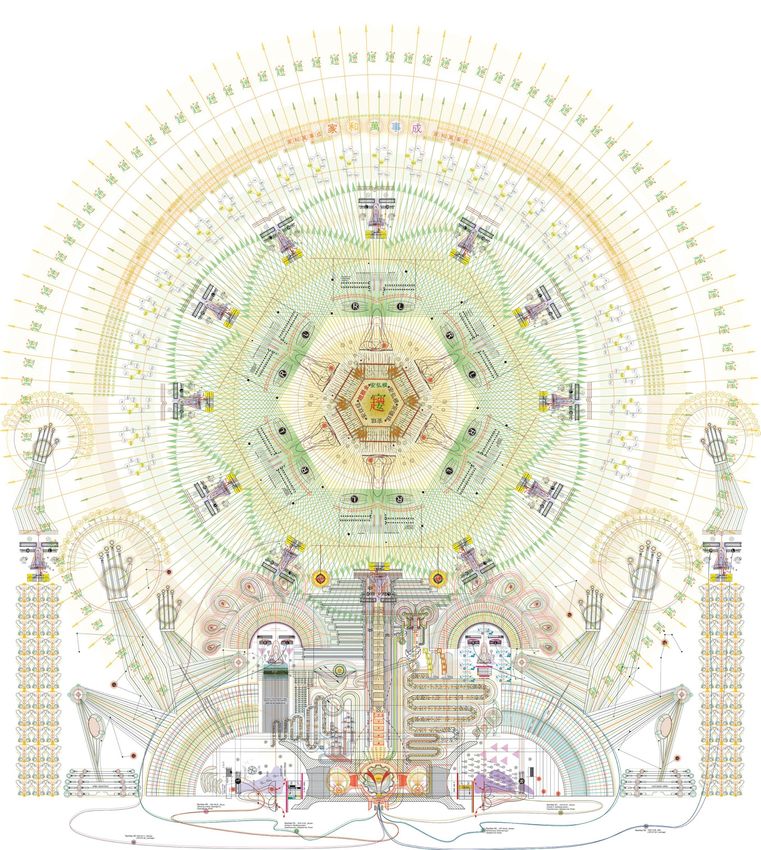
- Six-Membered Family Portrait: All Goes Well (2008) interprets a Korean family motto (When one’s home is harmonious, all goes well) via concentric circles underneath which all the family members are connected as one single human body.
- The Study on Mother’s Hand and Wind of Healing (2013/2025) was originally created in 2013 and zones in on love, relationships and emotions through a semicircular diagram featuring hands holding hands. The work was newly presented at the 2025 Seoul Mediacity Biennale.
- Rachaph (Self-Portrait) (2024) is the story of Minjeong An herself, featuring scars from childhood bee stings and even her underwear size. She says on her website: “This piece is a work made by imagining what I would look like if I were to redraw myself and transfer it into a diagram.”
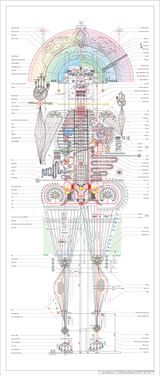
- Minjeong An reproduces a large-scale human body rich in diagrammatic detail in Postpartum Care Centre Detailed Diagram (2026), a moving, brutally honest work about the period after the birth of her second child, depicting the physical and physiological changes she underwent
Minjeong An: Exhibitions
Select Solo Exhibitions
- Private Pictograph, Staniar Gallery, Washington and Lee University, Virginia (2025)
- Engineering of memories, The gallery D, Hongcheon, (2018)
Select Group Exhibitions
- Unapologetic, p21, Seoul (2026)
- Flesh and Bones: the Art of Anatomy, ArtScience Museum, Singapore (2026)
- Exoskeleton, p21, Seoul (2024)
Further reading
- Minjeong An’s website
- Washington and Lee University’s page about the Private Pictograph exhibition in 2025
- Minjeong An’s Instagram
- A 2012 profile from Huffpost
Minjeong An FAQs
How has Minjeong An depicted motherhood and birth in her artworks?
Postpartum Care Centre Detailed Diagram is a large-scale (112cm x 228cm) detail-rich diagram resembling a human body that recalls Minjeong An’s time in a postpartum care centre (common practice for Korean mothers) during the Covid-19 pandemic, including her daily weeping (visitors were barred), the stretching and swelling of her nipples and the obsession that she “must recover perfectly”. She described the centre as “both a heaven and a prison”. Rachaph (Self-Portrait) (2024) also explores the emotional and physical changes she experienced after childbirth. This is now part of MoMA’s permanent collection.
What are the main themes in Minjeong An’s work?
Minjeong An’s diagrammatic artworks use mathematical and scientific symbols and language to visualise emotion and family relationships. Her presentation quantifies life experiences, inherited traditions and feelings of intimacy and love, showcasing them in the style of empirical research.
What materials and techniques does Minjeong An use?
Minjeong An works at a computer; the former web designer uses software in the creation of her large-scale, richly detailed diagrams. In her self-portraits, she has also taken measurements of parts of her own body, as well as documenting scars and blemishes.
Ocula






Explore Minjeong An's Exhibitions



Explore and Follow Artists Shaping Contemporary Art
A respected voice in contemporary art discourse.
Focusing on ambitious storytelling and insightful art-world commentary. Ocula Magazine publishes in-depth interviews, critical essays and timely analysis on the artists, exhibitions and ideas driving the global art world.
Learn more about Ocula Magazine
Showcasing the best of the art world.
Ocula partners with galleries from around the world to highlight their artists, artworks and exhibitions. Gallery membership is by application and invitation, with each member vetted by an independent panel.
Learn more about Ocula Membership
Specialises in the sale of major artworks.
Led by a team with deep ties to the world’s leading auction houses, galleries and collectors. Ocula’s advisory team offers bespoke services to high-net-worth clients from around the world who are looking to acquire the best of contemporary and modern art.
Learn more about our team and services