






PAT STEIR
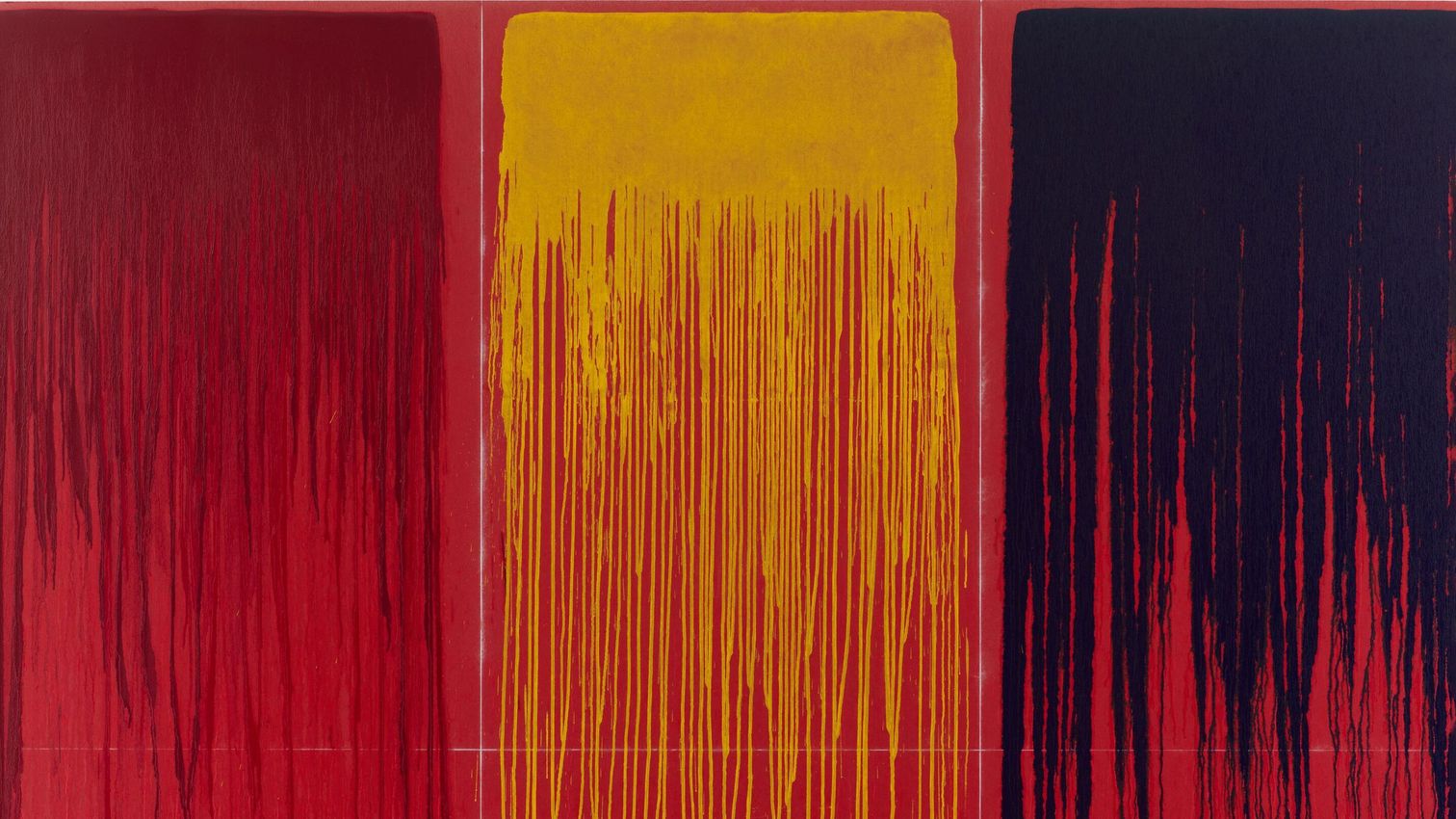
1938-2026, United StatesPat Steir was an American painter and printmaker best known for her monumental ‘Waterfall’ paintings, in which poured paint, gravity, and gesture combine to form luminous, immersive canvases. Drawing on art history, Eastern philosophy, and a deep interest in chance, she developed a distinctive approach to abstraction that has shaped the evolution of painting since the 1970s.
Over a six‑decade career, Steir exhibited widely at institutions including the Whitney Museum of American Art, The Museum of Modern Art in New York, the Barnes Foundation in Philadelphia, and the Hirshhorn Museum and Sculpture Garden in Washington, DC. Following her death in 2026, obituaries underscored her role as a pioneering woman artist whose work bridged Conceptual art, Minimalism, and a renewed, process‑driven painterly language.
Early life and education
Born in Newark, New Jersey, Steir studied at Pratt Institute in New York from 1956 to 1958, taking painting classes with Richard Lindner and Philip Guston. She continued at Boston University College of Fine Arts from 1958 to 1960, focusing on art and philosophy, before returning to Pratt to complete her BFA in 1962. During these years, she became acquainted with figures linked to Conceptual and Minimal art, including Sol LeWitt, Brice Marden, and Lawrence Weiner, encounters that helped shape her scepticism about fixed images and her interest in systems and language
Shortly after graduating, Steir’s work appeared in group exhibitions at the High Museum in Atlanta, the Philadelphia Museum of Art, and MoMA in New York, positioning her among the first generation of women to gain visibility in a predominantly male art world. In the mid‑1960s she supported herself as a freelance illustrator before becoming art director at Harper & Row in New York, and later taught at Parsons School of Design and the California Institute of the Arts, where her students included Ross Bleckner and David Salle. She also played an important role in artist‑run publishing, serving as an editor for Semiotext(e) and as a founding board member of both Printed Matter and the feminist journal Heresies.
Works and themes
Steir’s art is defined by an ongoing exploration of process, material, and the balance between control and chance. Working across painting, installation, and printmaking, she drew on both Western and East Asian traditions, aligning her practice with literati landscape painting and Zen concepts of non‑intention as much as with Abstract Expressionism.
In the mid‑1970s she gained critical attention for a series of rose paintings in which she crossed out the image, effectively cancelling it while leaving its trace visible. These works, along with early wall drawings and room‑sized installations, challenged the boundary between figuration and abstraction and began to treat painting as an environment that viewers could enter..
The ‘Waterfall’ paintings
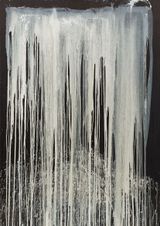
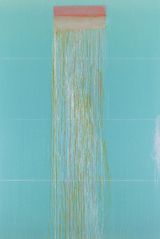
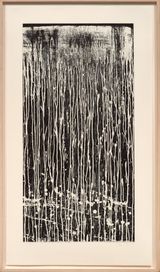
By the late 1980s, Steir had developed her signature ‘Waterfall’ technique, pouring and flinging thinned paint from the top of the canvas so that gravity, time, and chance determined the final image. Informed by her study of Japanese woodblock prints and Chinese landscape painting, these works evoke cascades, mist, and rain without depicting specific sites, what she has described as ‘chance within limitations’. Her friendship with composer John Cage reinforced her embrace of non‑intention, even as she carefully planned color, scale, and the sequence of pours.
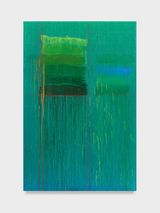
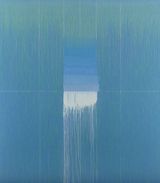
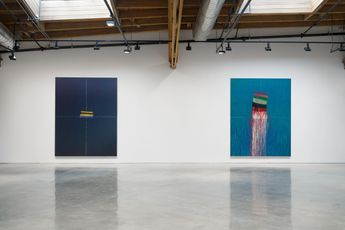
Major series such as ‘Sixteen Waterfalls of Dreams, Memories, and Sentiment’ (1990) and later installations at the Barnes Foundation and the Hirshhorn Museum have become touchstones of late‑20th‑ and early‑21st‑century abstraction. In her final years, Steir continued to innovate within this language, notably in a ‘blue period’ of closely modulated blue ‘Waterfalls and rivers’ that critics have linked to her heightened sensitivity to that color.
Exhibitions
Since the 1970s, Pat Steir has been featured in solo and group exhibitions at major museums including the Brooklyn Museum, Whitney Museum of American Art, The Metropolitan Museum of Art, The Museum of Modern Art, and Centre Pompidou, as well as recent solo shows with Hauser & Wirth in New York, Los Angeles, and Zurich. Below is a selection of important exhibitions.
Solo Exhibitions
- Pat Steir: Color Wheel, Hirshhorn Museum and Sculpture Garden, Washington DC, 2019
- Silent Secret Waterfalls: The Barnes Series, Barnes Foundation, Philadelphia, 2019
- Pat Steir: Drawing Out of Line, The Drawing Center, New York, 2010
- Pat Steir, Whitney Museum of American Art, New York, 2011
- Pat Steir, Brooklyn Museum, New York, 1984
Group Exhibitions
- Women in Abstraction, Centre Pompidou, Paris, 2021
- Epic Abstraction: Pollock to Herrera, The Metropolitan Museum of Art, New York, 2018
- The Forever Now: Contemporary Painting in an Atemporal World, Museum of Modern Art, New York, 2014
- Whitney Biennial, Whitney Museum of American Art, New York, 1973
Pat Steir FAQs
Who was Pat Steir and why is she important?
Pat Steir (c1938–2026) was an American painter and printmaker best known for her large‑scale abstract ‘Waterfall’ paintings that use poured paint and gravity to create cascading veils of color. She is considered a major figure in contemporary art for bridging Conceptual art, Minimalism, and lyrical abstraction, and for sustaining an influential career across more than five decades.
What is Pat Steir best known for?
Pat Steir is best known for her ‘Waterfall’ paintings, a long‑running series that began in the late 1980s. In these works she pours and flings thinned paint from the top of large canvases, allowing gravity, time, and chance to form vertical streams and mists that evoke waterfalls, rain, and atmospheric landscapes without depicting specific sites.
Has Pat Steir received any major awards?
Pat Steir has been recognised as a pioneering figure in contemporary art, with her work included in major museum exhibitions since the 1960s and her advocacy for artist-led initiatives such as Printed Matter and Heresies.
What are the key themes in Pat Steir’s art?
The main themes in Pat Steir’s art include the relationship between control and chance, the passage of time, and the limits of representation in painting. Her work is also shaped by Eastern philosophy and East Asian painting traditions, as well as a sustained engagement with Western art history, especially Abstract Expressionism and postwar abstraction.
Where can I see Pat Steir’s paintings and installations?
Pat Steir’s paintings and prints are held in major museum collections, including The Museum of Modern Art in New York, the Whitney Museum of American Art, the Metropolitan Museum of Art, and the Philadelphia Museum of Art. Her work has also been the focus of important solo exhibitions at institutions such as the Brooklyn Museum, the Hirshhorn Museum and Sculpture Garden, and the Barnes Foundation.
How did Pat Steir make her ‘Waterfall’ paintings?
Pat Steir made her ‘Waterfall’ paintings by working on large canvases tacked vertically to the wall and pouring heavily diluted paint from the top edge so that it streamed down under the force of gravity. She often layered multiple pours and splashes, carefully planning color and sequence while allowing chance effects, a method she described as ‘chance within limitations’ and linked to her friendship with composer John Cage.
Ocula | 2026












Explore Pat Steir's Exhibitions







Explore and Follow Artists Shaping Contemporary Art
A respected voice in contemporary art discourse.
Focusing on ambitious storytelling and insightful art-world commentary. Ocula Magazine publishes in-depth interviews, critical essays and timely analysis on the artists, exhibitions and ideas driving the global art world.
Learn more about Ocula Magazine
Showcasing the best of the art world.
Ocula partners with galleries from around the world to highlight their artists, artworks and exhibitions. Gallery membership is by application and invitation, with each member vetted by an independent panel.
Learn more about Ocula Membership
Specialises in the sale of major artworks.
Led by a team with deep ties to the world’s leading auction houses, galleries and collectors. Ocula’s advisory team offers bespoke services to high-net-worth clients from around the world who are looking to acquire the best of contemporary and modern art.
Learn more about our team and services