




PATRICIA PICCININI
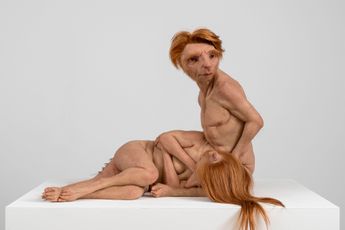
b. 1965, AustraliaArtist Patricia Piccinini is most recognised for her hyper-realistic human-animal hybrid sculptures rendered in fibreglass, silicone, and sometimes hair. Her art has found an audience across Australia and well beyond.
Early Years
Born in Sierra Leone and raised in Australia, Piccinini first attained a BA in Economic History at The Australian National University in 1988, and later a BA in Painting at the Victorian College of the Arts in 1991.
Piccinini began her sculpture career in the late 1990s by creating machine-like forms that examine the naturalisation of technology in the contemporary world.
Patricia Piccinini Artworks
Though startling at first, a sense of tenderness and humour inhabit Patricia Piccinini’s artworks. While her practice encompasses photography, sculpture, diorama, and large-scale installation, Piccinini works with a team of experts in her Melbourne studio to actualise her drawings, through everything from traditional hand-sculpting to 3D printing.
Protein Lattice
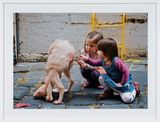
Piccinini’s long-standing interest in relationships is apparent in her early works, which drew their inspiration from scientific—particularly genetic—experiments of the day. In the photographic series ‘Protein Lattice’ (1997), young models pose alongside mice with what resembles a human ear on their backs. The hybrid animal—computer-generated in the images—is derived from the Vacanti mouse, named after the American researcher who famously grew ear-shaped cartilage on it in 1997. The artist’s images show the women and mice close together, unperturbed by each other’s presence, suggesting that, with the advancement of technology, humans and non-human beings are no longer as distant as previously considered.
Truck Babies
Truck Babies (1999) is a pair of pink and blue transporting vehicles made from fibreglass and automotive paint with large lights and high rotund back ends. Bringing together themes around the naturalisation of objects, the work manifests the artist’s vision of the offspring of trucks that she saw during a road trip in the United States.
Sculpture in the 2000s
Piccinini elaborated her concern with relational dynamics in a 2018 interview with Ocula Magazine as ‘Relationships between beings, relationships within families and relationships between species, but also the boundary between the artificial and the natural.’ Many of her creatures appear in groups, portraying familial relations.
Examples include babies suckling from their mother’s teat in the artist’s The Young Family (2002) or an aged bonobo-like couple embracing in Sanctuary (2018). Even when they are physically alone, however, the artist’s creations are never psychologically isolated, forging a relationship with the audience by compelling them to contemplate their own social differences and similarities.
The Lovers
Another sculptural work, The Lovers (2011) shows two scooters leaning against each other, their forms made softer to suggest those of animals tenderly nuzzling. When speaking to Victoria Lynn for Ocula Magazine, the artist said of the work that ‘we see machines imagined as wild—rather than domesticated animals—and this suggests an anxiety about technology escaping our control.’
Skywhales
In 2013, Piccinini broadened her media to include hot-air balloons with Skywhale, a massive hot-air balloon of a turtle-cetacean with 10 teats, commissioned by the city of Canberra for its centenary.
Patricia Piccinini’s Skywhalepapa (2020), a male companion to Skywhale, was launched in January 2021 for a tour around Australia. As Piccinini told Ocula News, the father turtle-cetacean offers an example of tender paternal care that is absent in much of popular culture.
Exhibitions
Patricia Piccinini has been the subject of both solo exhibitions and group exhibitions.
Patricia Piccinini solo exhibitions include Between the Shadow and the Soul, Helsinki Taidehalli, Finland (2020); Chromatic Balances, Tolarno Galleries, Melbourne (2019); En Kaerlig Verden, Arken Museum, Copenhagen (2019); Curious Affection, Gallery of Modern Art, Brisbane (2019); Curious Imaginings, Vancouver Biennale at the Patricia Hotel (2018); The Struggle and the Dawn, Roslyn Oxley9 Gallery, Sydney (2017); Piccinini at Hosfelt, Artinternational, Istanbul (2015); Structure and Support, Canberra Museum and Gallery (2013).
The artist’s group exhibitions include: Future and the Arts, Mori Art Museum, Tokyo (2019); Cars: Accelerating the Modern World, Victoria and Albert Museum, London (2019); The Coming World, Garage Museum of Contemporary Art, Moscow (2019); Adelaide Biennial of Australian Art: Divided Words, Art Gallery of South Australia, Adelaide (2018); Hyper Real, National Gallery of Australia, Canberra (2017); New Romance Art and the posthuman, Museum of Contemporary Art, Sydney (2016); In the Flesh: Experiencing the New Real, National Portrait Gallery of Australia, Canberra (2014).
Website and Instagram
Patricia Piccinini’s website can be found here and her Instagram can be found here.
Sherry Paik | Ocula | 2022

Works at Ames Yavuz



Recently Exhibited


Works Elsewhere










Patricia Piccinini in Ocula Magazine







Explore and Follow Artists Shaping Contemporary Art
A respected voice in contemporary art discourse.
Focusing on ambitious storytelling and insightful art-world commentary. Ocula Magazine publishes in-depth interviews, critical essays and timely analysis on the artists, exhibitions and ideas driving the global art world.
Learn more about Ocula Magazine
Showcasing the best of the art world.
Ocula partners with galleries from around the world to highlight their artists, artworks and exhibitions. Gallery membership is by application and invitation, with each member vetted by an independent panel.
Learn more about Ocula Membership
Specialises in the sale of major artworks.
Led by a team with deep ties to the world’s leading auction houses, galleries and collectors. Ocula’s advisory team offers bespoke services to high-net-worth clients from around the world who are looking to acquire the best of contemporary and modern art.
Learn more about our team and services