

QIU XIAOFEI
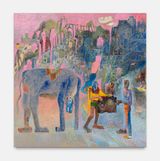
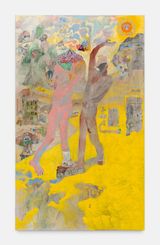
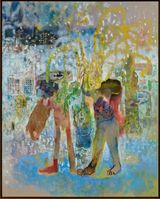
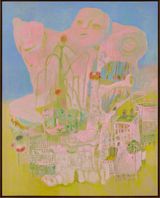
b. 1977, ChinaQiu Xiaofei draws on both Eastern and Western artistic aesthetics in the creation of his colourful, resonant paintings that often include temporal layers and an idea of infinite space. Inspired by family, history, memory and religion, his dreamlike abstract-meets-figurative compositions combine past, present and future, threaded together by the idea that time is a spiral.
Early Years
Qiu Xiaofei was born in Harbin in 1977 and raised in a household that combined the influences of government with those of arts and literature. His maternal grandfather studied in the Soviet Union and became a leader of the Chinese Communist Party, moving his mother and her family from Beijing to Harbin when he was branded a Trotskyite. His paternal grandfather, by contrast, was a playwright and Qiu’s father worked for his troupe. Qiu graduated from the Central Academy of Fine Arts in Beijing in 2002 and rose to prominence during the early 2000s as part of a new generation of Chinese contemporary artists.
Qiu Xiaofei: Artworks
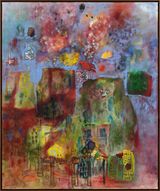
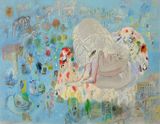
Qiu Xiaofei’s style has evolved over time: before 2010, his realistic paintings were mostly inspired by his own memories and what he described in 2022 as “self-therapy”. He moved towards abstraction, but then combined this with figuration. Qiu’s artistic practice examines the idea of the past, present and future co-existing, supported by the concept of time moving in a spiral. He considers the present by blending ideas from the past (from Russian political figures to Sampul tapestry) with elements of illusion, fiction and allegory. Whether the painting engages with history or the present, Qiu said in 2026 that “what reaches the canvas is ultimately a trace of human consciousness”.
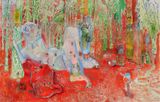
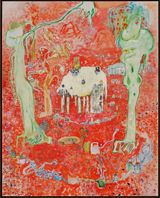
- Created during the Covid-19 pandemic, Red (2020) sees Qiu use multiple shades of red as his background, with a man with a broken arm in the foreground. This person first appeared in A Still Indigo (2010) but also references Qiu’s emotions and feelings surrounding the death of his father.
- In Belovezhskaya Forest (2019–2021), family memories merged with deconstructed historical figures (Trotsky’s in there) in a dreamlike composition that Qiu says he “spent years immersed in”. It went on display at MoMA in New York City in September 2025.
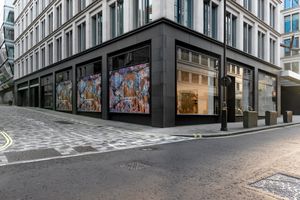
- Qiu’s 2026 exhibition at Hauser & Wirth in New York City, The Theatre of Whither and Thrive, came about following the artist’s discovery of some undeveloped rolls of camera film among his late father’s belongings. The film contained images of Qiu’s childhood, and he said rediscovering them felt like “pushing open a door that had long been shut”. The pictures Qiu created depicted the decline and renewal of the world, with images and figures from the films scattered through the backgrounds of the artworks.
Qiu Xiaofei: Select Exhibitions
Select Solo Exhibitions
- The Theatre of Wither and Thrive, Hauser & Wirth, New York City (2026)
- BARE, Xavier Hufkens, Brussels (2024)
- Divination, Pace Gallery, New York City (2021)
- An Artist’s Case-study Exhibition Part II: Trotsky Grew into a Tree, New Century Art Foundation, Beijing (2020)
- An Artist’s Case-study Exhibition Part I: RED, New Century Art Foundation, Beijing (2020)
- Fade Out, Pace Gallery, Seoul (2018)
- Pine or Willow, Pace Gallery, Hong Kong (2017)
- Double Pendulum, Pace Gallery, New York City (2016)
- Apollo Bangs Dionysus, Pace Gallery, Beijing (2014)
- Rauschenberg Said, “The Walking Stick is Longer than the Maulstick, after All”, Beijing Commune (2013)
- Qiu Xiaofei: Repetition, Minsheng Art Museum, Shanghai (2013)
- Point of No Return, Boers-Li Gallery, Beijing (2010)
- Invisible Journeys, Doosan Art Centre, Seoul (2009)
- Pagoda of the Discarded, Art and Public Gallery, Geneva (2008)
- House of Recollected Fragments, Boers-Li Gallery, Beijing (2008)
- Recent Works, Galerie Loft, Paris (2006)
- Heilongjiang Box, Art Museum of Central Academy of Fine Arts, Beijing (2006)
Select Group Exhibitions
- Love Unknown, G Museum, Nanjing (2025)
- Chine, une nouvelle génération d’artistes, Pompidou Centre, Paris (2024)
- M+ Sigg Collection: Another Story, M+, Hong Kong (2023)
- ON|OFF2021: Carousel of Progress, He Art Museum, Foshan (2022)
- Signs, Pace Gallery, Hong Kong (2021)
- The Logic of Painting, Shijiazhuang Art Museum, Shijiazhuan (2020)
- Symbiosis: The Intertextuality of Art and Poetry, OCAT, Shenzhen (2019)
- Surface Work, Victoria Miro, London (2018)
- Summer Days (and Summer Nights), Pace Gallery, New York City (2017)
- Self, Massimo De Carlo, London (2016)
- Full of Peril and Weirdness, M Woods, Beijing (2015)
- My Generation: Young Chinese Artists, Tampa Museum of Art (2014) (and touring)
- Beijing Voice: Relations, Pace Gallery, Beijing (2013)
- Art Berlin Contemporary (2012)
- MengLong-Darkness: Collateral Events of the 54th International Art Exhibition, Venice Biennale (2011)
- Negotiation: the Second Today’s Documents, Today Art Museum, Beijing (2010)
- The 10th Havana Biennial (2009)
- New World Order: Contemporary Installation Art and Photography from China, Groninger Museum (2008)
- The Real Thing: Contemporary Art from China, Tate Liverpool (2007)
- N12–No 4, C5 Art Centre, Beijing (2006)
- Mahjong: Contemporary Chinese Art from the Sigg Collection, Kunstmuseum, Berne (2005)
- Painting, TaiKang Top Space, Beijing (2004)
- N12, Art Museum of the Central Academy of Fine Arts Beijing (2003)
- Back, Beijing Contemporary Art Museum, Beijing (2001)
- The Second Factory Time, YunFeng Gallery, Beijing (2000)
Further Reading
- Qiu Xiaofei’s Instagram
- Artist profile page at Hauser & Wirth
- Artist profile page at Xavier Hufkens
- Interview with Art Asia Pacific (2022)
- Qiu Xiaofei: In the Studio (2026)
Qiu Xiaofei FAQs
How is the spiral important to Qiu Xiaofei?
The motif of the spiral is a huge and recurring part of Qiu’s artistic practice—it’s a way of expressing the concept of past, present and future overlapping. He has said: “All my paintings point to the same origin, forming an upward-moving spiral. Every new attempt to include experiences of greater complexity incorporates past solutions.” He has also related the evolution of his artistic practice to going up a spiral staircase, with every step having “a direct bearing on the next one”.
Why doesn’t Qiu Xiaofei take part in art world events?
Speaking in 2022, Qiu Xiaofei explained that he didn’t find social events fun, although he did enjoy small gatherings of like-minded artist friends. “I have no interest in dining, drinking, and partying,” he said. “I like serious, uninterrupted, spiritual communication. As soon as I feel bored, I leave. But I am certainly no recluse; I simply do not want to spend my mental energy on things that I have already judged to be worthless to me.”
What techniques and materials does Qiu Xiaofei use?
In an [interview][6] with Ocula in 2016, during a period when he was bringing representational elements back alongside his abstractions using shapes and figures next to impasto brushstrokes, he explained that his creative process was “improvisational and very spontaneous”, adding layers to each canvas to create different ideas of space as well as multiple dimensions.
[6}: https://ocula.com/magazine/spotlight/qiu-xiaofei-at-pace-new-york/
Ocula

Works at Xavier Hufkens





Recently Exhibited


Works Elsewhere












Explore and Follow Artists Shaping Contemporary Art
A respected voice in contemporary art discourse.
Focusing on ambitious storytelling and insightful art-world commentary. Ocula Magazine publishes in-depth interviews, critical essays and timely analysis on the artists, exhibitions and ideas driving the global art world.
Learn more about Ocula Magazine
Showcasing the best of the art world.
Ocula partners with galleries from around the world to highlight their artists, artworks and exhibitions. Gallery membership is by application and invitation, with each member vetted by an independent panel.
Learn more about Ocula Membership
Specialises in the sale of major artworks.
Led by a team with deep ties to the world’s leading auction houses, galleries and collectors. Ocula’s advisory team offers bespoke services to high-net-worth clients from around the world who are looking to acquire the best of contemporary and modern art.
Learn more about our team and services