





ROBERT RAUSCHENBERG
1925-2008, United StatesOver 60 years, Robert Rauschenberg pushed the boundaries of art, working in a huge range of mediums including painting, print, photography, performance and sculpture. His work became known during the height of Abstract Expressionism, and he challenged this movement’s dominance.
Early Years
Milton Ernest Rauschenberg was born on 22 October 1925 in Port Arthur, Texas into a family that lived frugally—a “make do and mend” practice that may have inspired his later use of found objects. He studied pharmacology at the University of Texas but was drafted into the US Navy during the Second World War. However, as a pacifist, he worked as a psychiatric technician in a naval hospital. He worked briefly as a newspaper illustrator in Los Angeles before the “GI Bill” allowed him to study art in Paris in 1948. He then studied at Black Mountain College in North Carolina under Josef Albers, as well as the Art Students League in New York City.
Robert Rauschenberg: Artworks
Rauschenberg’s artistic practice was rooted in experimentation with techniques and materials, paving the way for post-Abstract-Expressionism art including the 1970s Conceptual movement. He also advocated for the wider art community, including Change Inc, a non-profit to help artists with emergency expenses, and the Rauschenberg Overseas Culture Interchange (ROCI), that used art to inspire cross-cultural dialogue between 1984 and 1991.
- The White Paintings of 1951 were multi-panel pieces featuring entirely white, smooth-surfaced canvases that reacted to the light and shadows in their surroundings. John Cage has said that these paintings were the inspiration for his silent music piece 4’33” (1952).
- Between 1951 and 1953, Rauschenberg created his Black Paintings, featuring matte or glossy black painted on to canvas or paper, often including newsprint.
- The Red Paintings (1953–1954) saw red paint applied via impasto, brushstrokes, drips and squeezed out of the tube on to newspaper and fabric attached to the canvas. Later paintings in the series included found objects.
- Rauschenberg’s Combines (1954–1964) blended painting, sculpture and found objects, contextualising his found treasures in terms of art. Monogram (1955–1959) features a stuffed goat inside a tyre, on a platform. 1957’s Hazard features a bird’s wing mounted on wood, alongside printed paper. Bed (1955) vertically mounted a pillow and quilt, which were then covered in paint.
- During the period 1958–1960, Rauschenberg created a series of transfer drawings illustrating the 34 cantos of Dante’s Inferno. He used his own watercolours and drawings, combined with images reproduced from magazines which he transferred using solvent and pencil on to the paper.
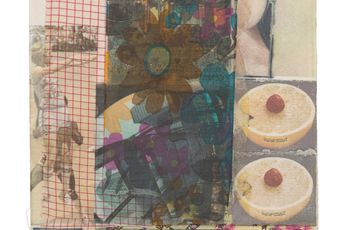
- Inspired by Andy Warhol, Rauschenberg created silkscreen paintings between 1962 and 1964, sourcing images from magazines and his own photographs, completing each work with gestural use of oil paint. He continued to use screenprinting techniques in later works.
Robert Rauschenberg: Select Awards
- International Grand Prize in Painting, 32nd Venice Biennale (1964)
- Medal of Honour for Visual Arts, National Arts Club, New York City (1989)
- Lifetime Achievement Award in Contemporary Sculpture, International Sculpture Centre, Washington, DC (1996)
- Gold Medal for Painting, American Academy of Arts and Letters, New York City (1999)
- Julio González International Prize, Conseil de la Generalitat Valenciana and Institut Valencià d’Art Modern, Spain (2005)
Robert Rauschenberg: Select Exhibitions
Select Solo Exhibitions
- Robert Rauschenberg: Important Early Works from the Cy Twombly Foundation, Gagosian, New York City (2026)
- Robert Rauschenberg’s New York: Pictures from the Real World, Museum of the City of New York (2025)
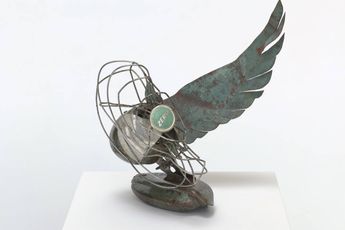
- Sympathy for Abandoned Objects, Gladstone Gallery, New York City (2025)
- Arcanums, Gladstone Gallery, New York City (2024)
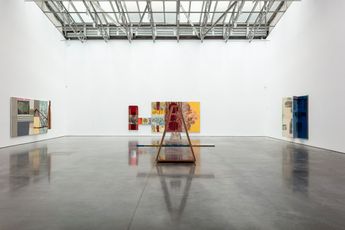
- Spreads and Scales, Gladstone Gallery, New York City (2023)
- Robert Rauschenberg: Spreads and Scales, Gladstone Gallery, New York City (2023)
- Robert Rauschenberg: Exceptional Works, 1971–1999, Mnuchin Gallery, New York City (2022)
- Venetians and Early Egyptians 1972–1974, Gladstone Gallery, New York City (2022)
- Metal, Ink and Dye: Late Works from Captiva, Galerie Bastian, London (2021)
- Night Shades and Phantoms, Thaddeus Ropac, Paris (2020) (and touring)
- Paintings Objects Collages, Galerie Bastian, Berlin (2018)
- Robert Rauschenberg, Tate Modern, London (2016) (and touring)
- Rauschenberg: Posters, Los Angeles County Museum of Art (2005)
- Robert Rauschenberg: A Retrospective, Solomon R Guggenheim Museum, New York City (1997) (and touring)
- Robert Rauschenberg: The Silkscreen Paintings, 1962–1964, Whitney Museum of American Art, New York City (1990)
- Rauschenberg Overseas Culture Interchange: ROCI JAPAN, Setagaya Museum of Art, Tokyo (1986)
- Robert Rauschenberg: A Portfolio of Twelve Photographs, Galerie Watari, Tokyo (1981)
- Stoned Moon Series, Hirshhorn Museum and Sculpture Garden, Washington DC (1976)
- Rauschenberg: Soundings, MoMA, New York City (1968)
- Rauschenberg: Illustrations for Dante’s Inferno, Whitechapel Gallery, London (1964) (and touring)
- Robert Rauschenberg, Galerie Daniel Cordier, Paris (1961)
- Paintings by Bob Rauschenberg, Betty Parsons Gallery, New York City (1951)
Select Group Exhibitions
- Five Friends, Museum Brandhorst and Museum Ludwig (2025)
- Just Above Midtown: Changing Spaces, MoMA, New York City (2022)
- Apollo’s Muse: The Moon in the Age of Photography, Metropolitan Museum of Art, New York City (2019)
- Dancing around the Bride: Cage, Cunningham, Johns, Rauschenberg, and Duchamp, Philadelphia Museum of Art (2012)
- Singular Forms (Sometimes Repeated): Art from 1951 to the Present, Solomon R Guggenheim Museum, New York City (2004)
- Marcel Duchamp and the Avant Garde Since 1950, Ludwig Museum, Cologne (1988)
- American Pop Art, Whitney Museum of American Art, New York City (1974)
- Art Since 1950, American and International, World’s Fair, Seattle (1962)
- Artists of the New York School: Second Generation, The Jewish Museum, New York City (1957)
Further Reading
- The Robert Rauschenberg Foundation
- The Robert Rauschenberg Foundation’s Instagram
- Obituary in the Guardian
- Obituary in The New York Times
- Artist profile page at Baldwin Contemporary
- Artist profile page at Gladstone
Robert Rauschenberg FAQs
Did Robert Rauschenberg choreograph dance?
Yes, although his first choreographed performance came about because of a printing error. Rauschenberg created set designs, lighting and costumers for the choreographer Paul Taylor and the Merce Cunningham Dance Company during the 1950s and 1960s but was a not a choreographer himself. However, when he was accidentally listed as a choreographer in publicity materials for a 1963 performance by the Judson Dance Theatre he took on the challenge and choreographed Pelican, which he performed on rollerskates with a parachute on his back.
Did Robert Rauschenberg own an island?
No, but he was the biggest residential landowner on the Gulf Coast island of Captiva, owning almost nine hectares (22 acres) of land including his studio, several houses and beach front. In April 2026, his estate sold the land to the adjacent resort.
Were Robert Rauschenberg and Cy Twombly lovers?
Although Rauschenberg was married to the artist Susan Weill for two years (they had a son, Christopher, in 1951) he and Cy Twombly became lovers during the early 1950s. Shortly after this, Rauschenberg met Jasper Johns and they moved in together in 1955, a romantic and artistic partnership.
Ocula
Works at Gladstone

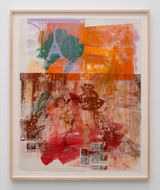

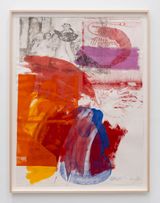

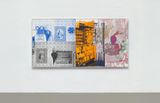
Recently Exhibited



Exhibiting Elsewhere

Works Elsewhere








Robert Rauschenberg in Ocula Magazine







Explore and Follow Artists Shaping Contemporary Art
A respected voice in contemporary art discourse.
Focusing on ambitious storytelling and insightful art-world commentary. Ocula Magazine publishes in-depth interviews, critical essays and timely analysis on the artists, exhibitions and ideas driving the global art world.
Learn more about Ocula Magazine
Showcasing the best of the art world.
Ocula partners with galleries from around the world to highlight their artists, artworks and exhibitions. Gallery membership is by application and invitation, with each member vetted by an independent panel.
Learn more about Ocula Membership
Specialises in the sale of major artworks.
Led by a team with deep ties to the world’s leading auction houses, galleries and collectors. Ocula’s advisory team offers bespoke services to high-net-worth clients from around the world who are looking to acquire the best of contemporary and modern art.
Learn more about our team and services