





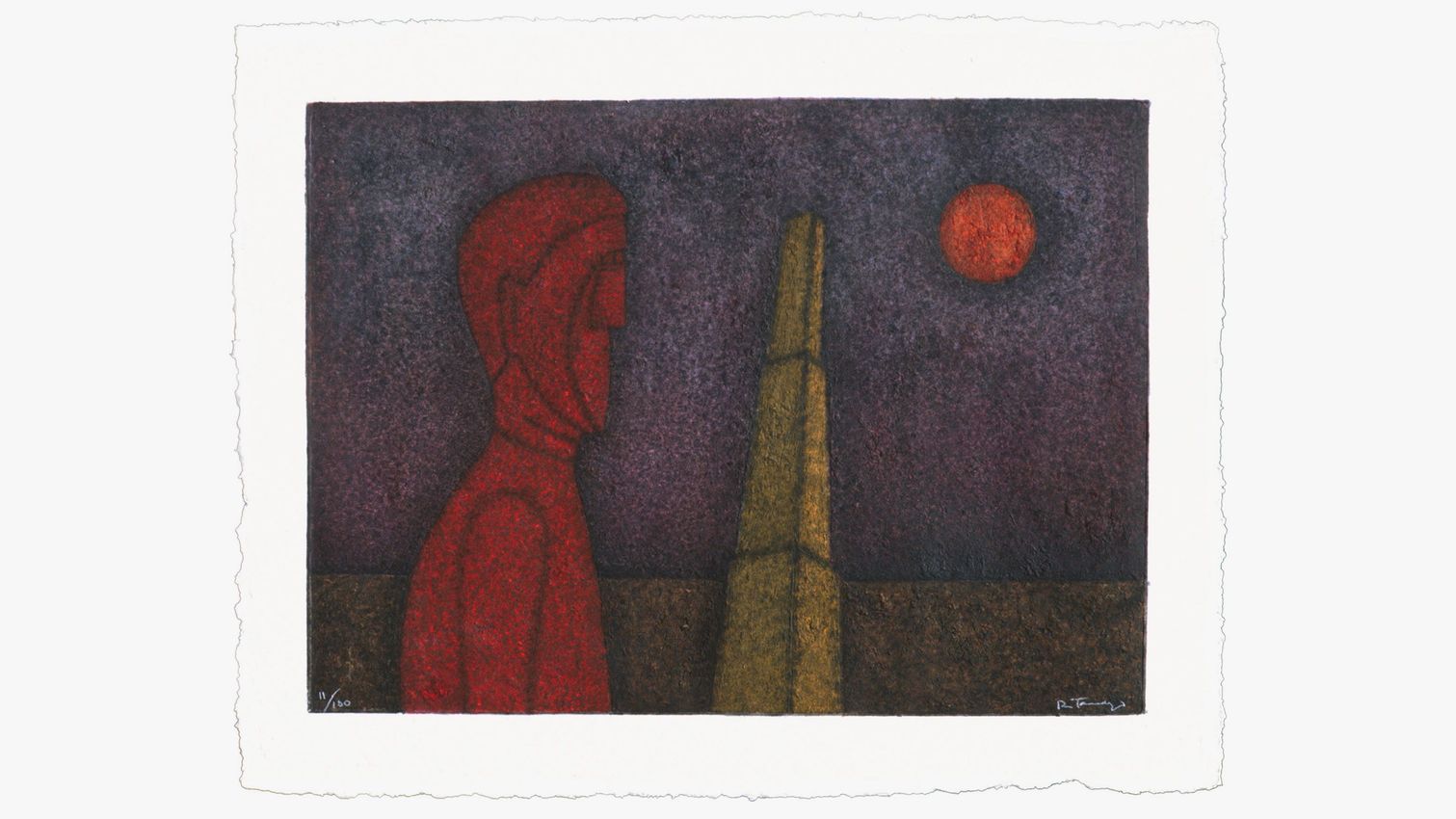
RUFINO TAMAYO
1899-1991, MexicoRufino Tamayo was a Mexican modernist painter and printmaker whose vivid colour, textured surfaces, and synthesis of European avant-garde painting with Indigenous Mexican motifs reshaped 20th-century art in Latin America and beyond.
Working across easel painting, murals, sculpture, and groundbreaking print techniques, Tamayo balanced universal human themes with a strong sense of Mexican identity while often avoiding overt political narratives that defined many of his contemporaries.
Born in Oaxaca and long based between Mexico City, New York, and Paris, he achieved major institutional recognition from the mid-20th century, including retrospectives, international biennials, and two museums in Mexico dedicated to his own collections.
Early life and education of Rufino Tamayo
Rufino Tamayo was born on 26 August 1899 in Oaxaca, in southern Mexico, and was orphaned at a young age before moving to Mexico City to live with relatives. Between 1917 and 1921 he studied at the Escuela Nacional de Bellas Artes (School of Fine Arts) in Mexico City but soon rejected its academicism, continuing his training independently while supporting himself through work.
From 1921 to 1926 Tamayo headed the department of ethnographic drawing at the National Museum of Archaeology in Mexico City, where close study of pre-Columbian artefacts profoundly shaped his visual language. Throughout the 1920s and 1930s he divided his time between Mexico and the United States, eventually spending extended periods in New York and later Paris before resettling permanently in Mexico in the mid-1960s.
Rufino Tamayo artworks and style
Rufino Tamayo artworks are known for their saturated colour, simplified figures, and integration of Indigenous Mexican symbolism with modernist abstraction, making him a key figure for collectors and contemporary art galleries worldwide.
Tamayo rejected the explicitly revolutionary narratives of Mexican muralism, favouring instead a more personal exploration of myth, cosmic imagery, and everyday subjects such as animals, fruit, and musicians. Drawing on Cubism and Surrealism, he fractured forms into planes and silhouettes, yet maintained a strong sense of human presence and emotion, often using rough textures and glowing colour contrasts to heighten drama.
From the 1950s he developed a restrained palette in many works, arguing that limiting the number of colours increased expressive power, a principle visible in paintings such as Three Singers and late canvases that juxtapose sun, moon, and night.
Early works and developments, 1920s—1940s
In the 1920s Tamayo produced paintings and murals that already blended traditional Mexican themes with lessons from European modernism, distancing himself from more didactic mural programs.
During extended stays in New York from the late 1920s through the 1940s he absorbed contemporary developments in abstraction, exhibited widely, and created key works like Dog Howling at the Moon that combined urban anxiety with mythic resonance.
Mature practice and key series, 1950s—1970s
Tamayo’s international reputation consolidated in the 1950s when he showed at the Venice Biennale and won the painting prize at the São Paulo Biennial, events that positioned him as a leading Mexican modernist.
He executed major murals including Birth of Nationality and Mexico Today for the Palacio de Bellas Artes in Mexico City, and Prometheus Bringing Fire to Man for UNESCO in Paris, works that translate his distinct figural style into monumental public space.
Alongside painting, he produced bronze and iron sculpture and an extensive graphic oeuvre that explored the human figure, animals, and celestial bodies through increasingly abstracted forms.
Prints, Mixografia, and late work, 1960s—1990s
Tamayo was an exceptionally prolific printmaker, creating woodcuts, lithographs, etchings, and portfolios that extended his imagery into more experimental, textured formats.
In collaboration with printer Luis Remba in Mexico City he co-developed the Mixografia process, a high-relief printing technique that allows three-dimensional textures and deep embossing, significantly expanding possibilities for fine-art printmaking.
Late paintings from the 1970s to the early 1990s emphasise pared-back compositions featuring suns, moons, and solitary figures, reflecting on mortality and cosmic cycles while maintaining his signature luminous colour.
The Museo Tamayo Arte Contemporáneo in Mexico City
The Museo Tamayo Arte Contemporáneo in Mexico City is a public museum in Chapultepec Park that presents major modern and contemporary art from Mexico and abroad alongside a significant collection of works by its founder, Rufino Tamayo. Opened in 1981 and housed in a celebrated modernist building by Teodoro González de León and Abraham Zabludovsky, the museum shows Tamayo’s paintings, sculptures, and prints in dialogue with international figures such as Picasso, Miró, Magritte, Rothko, and de Kooning. Through rotating exhibitions and its permanent holdings, the Museo Tamayo highlights Tamayo’s legacy while acting as a dynamic platform for cutting-edge contemporary art in Mexico City.
Public commissions by Rufino Tamayo
- 1952—53 — Birth of Nationality, mural, Palacio de Bellas Artes, Mexico City, Mexico.
- 1952—53 — Mexico Today, mural, Palacio de Bellas Artes, Mexico City, Mexico.
- 1958 — Prometheus Bringing Fire to Man, mural, UNESCO headquarters, Paris, France.
Awards and honours of Rufino Tamayo
- 1989 — Grand Officer of the Order of Merit of the Italian Republic, Italy.
- 1988 — Belisario Domínguez Medal of Honour, Mexican Senate, Mexico.
- 1985 — Gold Medal of Merit in the Fine Arts, Spain.
- 1985 — Honorary Doctor of Fine Arts, University of Southern California, Los Angeles, USA.
- 1978 — Honorary Doctor, National Autonomous University of Mexico, Mexico City, Mexico.
- 1964 — National Prize for Arts and Sciences in Fine Arts, Mexico.
Exhibitions of Rufino Tamayo
Rufino Tamayo has been the subject of major solo exhibitions and numerous group shows across Mexico, the United States, Europe, and Latin America, ensuring his artworks remain visible in museums and contemporary art galleries worldwide.
Select solo exhibitions
- 2024—2025 — Rufino Tamayo: Innovation and Experimentation, Los Angeles County Museum of Art (travelling exhibition collection), presented at the Amon Carter Museum of American Art, Fort Worth, USA.
- 2017—2018 — Tamayo: The New York Years, Smithsonian American Art Museum, Washington, DC, USA.
- 1990 — Rufino Tamayo, Museo Rufino Tamayo, Mexico City, Mexico.
- 1974 — Rufino Tamayo, Museo de Arte Prehispánico Rufino Tamayo, Oaxaca, Mexico.
- 1948 — Rufino Tamayo Retrospective, Palacio de Bellas Artes, Mexico City, Mexico.
Select group exhibitions
- 1953 — São Paulo Biennial (First Prize in Painting), São Paulo, Brazil.
- 1950 — Venice Biennale (Tamayo Room), Venice, Italy.
- 1942 — Masters of Art from 1790 to 1950, Los Angeles County Fair, including Dog Howling at the Moon, Los Angeles, USA.
- 1930s—1940s — Various exhibitions in New York and Paris that helped establish Mexican modern art internationally.
Website, Instagram, and further reading
Key institutional overviews of Rufino Tamayo’s life and artworks can be found through the Museo Tamayo in Mexico City and the Museo de Arte Prehispánico Rufino Tamayo in Oaxaca, whose sites offer collection highlights and archival material.
Further biographical and critical essays on Rufino Tamayo are available via the Art Institute of Chicago, LACMA, and the Smithsonian American Art Museum.
Readers can also explore auction histories and artworks by Rufino Tamayo through major contemporary art platforms and galleries that handle his prints and paintings.
About this profile
This profile on Rufino Tamayo was prepared in line with Ocula‘s editorial guidelines, using information from verified museum, institutional, and gallery sources. It is intended as an accessible overview of Rufino Tamayo’s life, artworks, and exhibitions for audiences interested in modern and contemporary art.
Rufino Tamayo FAQs
Who is Rufino Tamayo?
Rufino Tamayo is a Mexican modernist painter and printmaker known for vivid colour, textured surfaces, and for merging European avant-garde painting with Indigenous Mexican motifs across easel works, murals, and prints. Born in Oaxaca in 1899 and active through much of the 20th century, he became one of Mexico’s most internationally recognised artists, with museums in Mexico City and Oaxaca dedicated to his legacy.
What type of art does Rufino Tamayo make?
Rufino Tamayo makes modernist artworks that combine simplified, often abstracted figures with saturated colour, Indigenous symbols, and cosmic imagery in paintings, murals, sculpture, and graphic prints. His work stands apart from politically charged Mexican muralism through its focus on universal human emotions, myth, and everyday motifs such as animals, fruit, and musicians.
What is Rufino Tamayo’s artistic style?
Rufino Tamayo’s style blends elements of Cubism, Surrealism, and abstraction with Mexican folk and pre-Columbian art, resulting in flattened figures, bold outlines, and glowing, carefully limited palettes. He often used textured surfaces and high-contrast colours—reds, purples, deep blues—to create atmospheric scenes that evoke night skies, celebrations, or existential drama.
Where was Rufino Tamayo born, and where did he work?
Rufino Tamayo was born in Oaxaca, Mexico, and developed his career between Mexico City, New York, and Paris before eventually resettling in Mexico. Time spent in New York and Paris connected him to international avant-garde movements, while his ongoing engagement with Mexican culture anchored his imagery in Indigenous and folk traditions.
What is Mixografia, and how did Rufino Tamayo use it?
Mixografia is a specialised printmaking technique co-developed by Rufino Tamayo and printer Luis Remba that produces richly textured, three-dimensional prints using handmade paper and deep relief plates. Tamayo used Mixografia from the 1970s onwards to translate his characteristic figures, animals, and celestial forms into sculptural graphic works that blur boundaries between print and low relief sculpture.
What are some famous artworks by Rufino Tamayo?
Famous Rufino Tamayo artworks include paintings such as Dog Howling at the Moon (1942), Nacimiento de nuestra nacionalidad (early 1950s), and late works like Luna y Sol (1990), as well as numerous untitled figure and fruit compositions. His major public murals—Birth of Nationality (1952—53), Mexico Today (1952—53), and Prometheus Bringing Fire to Man (1958)—are widely cited examples of his synthesis of modern form with Mexican and universal symbolism.
Where can I see work by Rufino Tamayo?
You can see work by Rufino Tamayo in Mexican institutions such as the Museo Tamayo Arte Contemporáneo in Mexico City and the Museo de Arte Prehispánico Rufino Tamayo in Oaxaca, which house his donations and key paintings. Significant holdings are also found in international museums including the Art Institute of Chicago, LACMA, and the Smithsonian American Art Museum, as well as in private collections and on the secondary market.
Ocula | 2026


Representative Artworks
View exhibition
Explore and Follow Artists Shaping Contemporary Art
A respected voice in contemporary art discourse.
Focusing on ambitious storytelling and insightful art-world commentary. Ocula Magazine publishes in-depth interviews, critical essays and timely analysis on the artists, exhibitions and ideas driving the global art world.
Learn more about Ocula Magazine
Showcasing the best of the art world.
Ocula partners with galleries from around the world to highlight their artists, artworks and exhibitions. Gallery membership is by application and invitation, with each member vetted by an independent panel.
Learn more about Ocula Membership
Specialises in the sale of major artworks.
Led by a team with deep ties to the world’s leading auction houses, galleries and collectors. Ocula’s advisory team offers bespoke services to high-net-worth clients from around the world who are looking to acquire the best of contemporary and modern art.
Learn more about our team and services