






TEAMLAB
b. 2001, JapanteamLab is a Tokyo‑based international art collective founded in 2001 that creates immersive digital environments where art, science, technology, and the natural world intersect. Best known for museums such as teamLab Borderless and teamLab Planets in Tokyo, the group uses projection, responsive sound, and real‑time computation to transform exhibition spaces into fluid, interactive worlds visited by millions each year.
Founded by Toshiyuki Inoko with collaborators including Daisuke Sakai, Tetsuya Tamura, Joe Yoshimura, and Shunsuke Aoki, teamLab has grown into a several‑hundred‑strong “ultra‑technologist” collective spanning artists, programmers, engineers, CG animators, architects, and mathematicians. Their installations dissolve boundaries between viewer and artwork, encouraging movement and touch so that space and image continually change in response to bodies while engaging questions of perception and nature.
The collective has established dedicated museums and permanent spaces—including teamLab Borderless (Tokyo and Shanghai), teamLab Planets in Tokyo, teamLab SuperNature Macao, and major projects in Abu Dhabi—alongside touring installations worldwide. Works have entered public collections such as the Museum of Contemporary Art, Los Angeles; National Gallery of Victoria, Melbourne; Art Gallery of New South Wales, Sydney; and Amos Rex, Helsinki.
Development and Approach
Inoko established teamLab after studying engineering at the University of Tokyo, envisaging a studio where software engineers, designers, and artists collaborate without rigid hierarchies. Initially closer to a digital production company, the group developed interactive and commercial projects that honed the real‑time graphics and interface design later central to its art. Exhibitions linked to Takashi Murakami in the late 2000s and early 2010s helped shift teamLab from the tech sector into the international contemporary art field.
Projects are developed by interdisciplinary teams that combine coding, spatial design, animation, sound, and hardware engineering over long periods. In an interview with Ocula, Inoko has underscored that authorship is genuinely shared and that teamLab’s aim is to produce experiences no single discipline or “author” could achieve alone. This emphasis on co‑creation, both internally and with audiences, underpins their view of digital technology as a social and perceptual medium rather than a neutral tool.
Works, Methods, and Themes
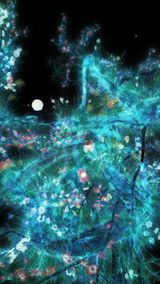
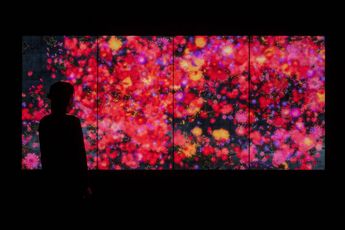
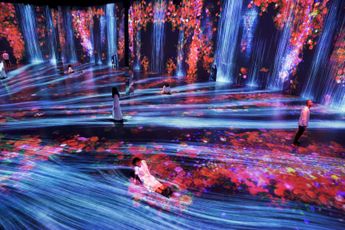
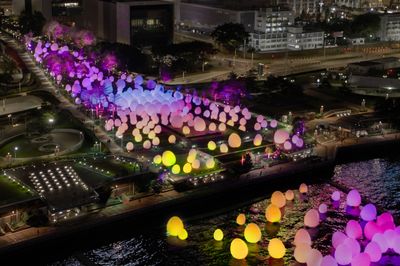
teamLab is best known for immersive projection environments in which moving images of flowers, waterfalls, animals, or calligraphic marks flow across walls, floors, and sometimes water, responding in real time to visitors’ presence. Many works are software‑driven ecosystems rather than loops: digital flowers grow and wither according to algorithmic rules, or schools of fish scatter when touched and regroup elsewhere. LED, laser projection, multi‑channel sound, and mirrored or water‑filled architecture create enveloping spaces in which viewers lose a clear sense of the room’s boundaries.
A central concept is “borderlessness”—the erasure of fixed separations between artworks, spaces, and people. In museum‑scale projects such as teamLab Borderless, imagery migrates between rooms rather than staying within discrete works, while at teamLab Planets visitors walk barefoot through mirrored spaces and shallow pools so that flowers or koi seem to swirl around their legs. Parallel initiatives like “Future Park” focus on interactive installations for children and families, using drawing and play to introduce ideas of co‑creation and systems.
Thematically, the collective explores the relationship between self and world, and between humans and nature, in a technologised society. Inoko links their sensibility to pre‑modern East Asian cosmologies in which humans are part of nature, a view reflected in responsive depictions of flowers, water, and animals that register human touch without idealising untouched landscapes. teamLab argues that modernity has encouraged sharply bounded views of self and environment, while their installations seek to cultivate a sense of continuity and interdependence.
Exhibitions, Museums, and Recognition
teamLab’s installations have been presented globally in institutions and venues across North America, Europe, the Middle East, and Asia. Their expanding network of dedicated spaces includes teamLab Planets in Tokyo, teamLab Borderless in Tokyo and Shanghai, teamLab SuperNature Macao, and Phenomena, a vast digital art museum in Abu Dhabi that opened in 2025. Sam Gaskin covered the collective’s ambitions extensively in an article for Ocula in 2023.
Works are held in collections including the National Gallery of Victoria, Melbourne; Art Gallery of New South Wales and Art Gallery of South Australia; the National Gallery of Australia, Canberra; Amos Rex, Helsinki; Museum of Contemporary Art, Los Angeles; Asian Art Museum, San Francisco; Asia Society Museum, New York; and Borusan Contemporary, Istanbul.
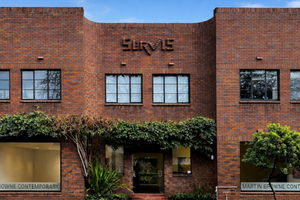
Represented by galleries such as Pace and Martin Browne Contemporary, teamLab is frequently cited in discussions of digital art’s institutionalisation and the rise of immersive, experience‑driven museums.art.
teamLab FAQs
What is teamLab best known for?
teamLab is best known for large‑scale immersive digital installations and dedicated museums such as teamLab Borderless and teamLab Planets in Tokyo, where projected imagery and sound respond in real time to visitors. These environments blur distinctions between artwork, architecture, and audience, creating “borderless” experiences that have attracted millions of visitors.
What themes does teamLab explore in its work?
The teamLab collective’s work explores relationships between self and world, and between humans and nature, focusing on how perception is shaped by technology and cultural frameworks. Their installations aim to dissolve boundaries between people, artworks, and environments, proposing a continuous field of interconnected phenomena.
How does teamLab use technology in its installations?
teamLab develops custom software systems that generate imagery and sound in real time, allowing environments to change in response to visitors rather than loop as fixed sequences. Using projection, LED, sensors, sound, and sometimes water or mirrored architecture, they create interactive spaces in which viewers’ actions become part of the work.
Where can I see teamLab’s art?
teamLab operates dedicated venues including teamLab Planets in Tokyo, teamLab Borderless in Tokyo and Shanghai, teamLab SuperNature Macao, and Phenomena in Abu Dhabi. Their works also feature in museum collections such as the Museum of Contemporary Art, Los Angeles; National Gallery of Victoria, Melbourne; and Amos Rex, Helsinki.
Why has teamLab become so popular?
The teamLab’s collective’s popularity stems from the accessibility and visual impact of its installations, which operate as immersive environments and social spaces inviting collective participation. Coverage in outlets such as The New York Times has highlighted record‑breaking visitor numbers and positioned teamLab at the centre of debates about spectacle, experience, and contemporary art.
Anna Dickie | Ocula | 2026

Works at Martin Browne Contemporary





Recently Exhibited




Exhibiting Elsewhere

Works Elsewhere


teamLab in Ocula Magazine










Explore and Follow Artists Shaping Contemporary Art
A respected voice in contemporary art discourse.
Focusing on ambitious storytelling and insightful art-world commentary. Ocula Magazine publishes in-depth interviews, critical essays and timely analysis on the artists, exhibitions and ideas driving the global art world.
Learn more about Ocula Magazine
Showcasing the best of the art world.
Ocula partners with galleries from around the world to highlight their artists, artworks and exhibitions. Gallery membership is by application and invitation, with each member vetted by an independent panel.
Learn more about Ocula Membership
Specialises in the sale of major artworks.
Led by a team with deep ties to the world’s leading auction houses, galleries and collectors. Ocula’s advisory team offers bespoke services to high-net-worth clients from around the world who are looking to acquire the best of contemporary and modern art.
Learn more about our team and services