





Toshiyuki Inoko on teamLab, Digital Art, and Ultra Subjective Space


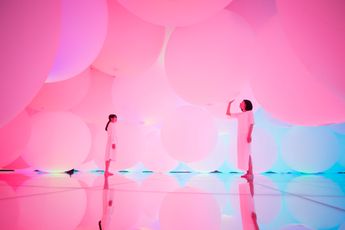
At the 2013 Singapore Biennale, one work in particular seemed to rewire how viewers understood both space and spectatorship: teamLab’s immersive installation Peace can be Realised Even Without Order (2013).
Concealed behind a controlled-access door at the Singapore Art Museum, the work unfolded in a completely darkened room as an interactive, animated diorama of a seemingly endless army of dancers in traditional Japanese costume. The dancers appeared as holographic figures, and as viewers navigated horizontally and vertically through their ranks, motion sensors triggered waves of movement and sound, so that each person could imagine themselves absorbed into the troupe—a witness, participant, and even the putative subject of some ancient rite.
In the following conversation between Toshiyuki Inoko and Anna Dickie, the teamLab founder unpacks the ideas that underpin the collective’s art, from this early biennial project to the theories of perception and digital space that continue to shape their work.
“I loved the idea of technology changing the world and art changing peoples’ minds.”
AD: In 2001 and while you were at university, you set up teamLab Inc. How did you arrive at this idea?
TI:
I became very interested in the internet before (or perhaps it was just after), I entered university. I found it very exciting. Before the internet came along information was controlled. People weren’t free to access information so easily. And I believed the internet would create a whole new society.
I loved the idea of technology changing the world and art changing peoples’ minds. So I committed myself to digital technology, which was a new field and decided to create art based on digital ideas.
I also knew that I wouldn’t be accepted by conventional society. I don’t wake up early in the morning, reply to emails promptly, or answer phones, nor remember what I am told to do or generally otherwise conform to a social norm. Without my team complementing each person’s weakness and strength, I guess I couldn’t achieve what I wanted or participate in society as I wish. Moreover, I wanted to be with my friends. I wanted to create new values with them. That is also why I started teamLab.
AD: What were the aspirations for teamLab when it began?
TI: We wanted to create digital artworks that were innovative, and changed people’s minds and values.
I believe that, because they didn’t conform to society, there are intellectual or cultural ideas and knowledge that have been abandoned over time. Using them through our work, we want to provide an insight into these ideas and knowledge and suggest an alternative way to live in contemporary society.
“Digital expression is undervalued compared to art created by using physical materials and we want to change that.”
AD: In your recent exhibition at Pace, in New York, you raise a theory you have termed ‘Ultra Subjective Space’. Perhaps you can discuss this theory and how it relates to a work, such as Crows are chased and the chasing crows are destined to be chased as well — Division in Perspective, Light in Dark, which appears in the Pace exhibition?
TI:


In this work, we visualised three-dimensional space using a traditional Japanese way of spatial recognition — what we call “Ultra Subjective Space”. Japanese traditional painting is often described as flat because it lacks western perspective. However, we propose that people in Japan at that time may have actually seen the world as they chose to depict it in Japanese painting. People of today have a perception of space that is based on the perspective they see in photos and paintings, but is it not possible that people of old saw and were able to feel space in the art work they looked at? Is it not possible that the “flatness” of Japanese art was based on a different logic and understanding of space than that of perspective? At teamLab, we have decided to call that logical construction of space “Ultra Subjective space”.
Flat 2D screen images based on Ultra Subjective Space have different features compared with images created using Western perspective - especially when you physically separate the screen. For example, if you use Ultra Subjective Space and then separate or bend the 2D screen, it won’t make the view uncomfortable since there is no one specific viewpoint. Ultra Subjective - 2D is easy to reconstruct in a physical sense. Using this feature, we set up seven screens in the exhibition space for the Crow work, separating the movie (as such). The viewer can still enjoy the work from any point of view.
AD: The work Yatagarasu also uses Ultra Subjective Space in a similar way?
TI:


In the work, Yatagarasu (a mythic crow with 3 legs that leads spirits) flies around the space, leaving bright lines of movement behind it.
To create this work, we referred to the work of Ichiro Itano, an anime artist. Itano is renowned for the so-called “Itano Circus” — a style of action scene - which he established and used in the anime television series, Space Runway Ideon (1980-1982) and The Super Dimension Fortress Macross (2009). His work depicted missiles flying around, but rather than presenting them from one specific point of view, he exaggerated the movements such that it appears as if a high-speed camera is moving around the space with the missiles. This expression successfully allowed people to feel the dynamic energy emanating from the screen.
So we tried to realise this expression in a three-dimensional space. I wanted to experience how it would be to stand in that space. We reconstructed a real space liberated from any specific perspectives.
AD: You discuss teamLab’s concept of ‘Ultra Subjective Space’ being related to Japanese animation and manga games. Perhaps you could describe the connection in more detail?
TI: I think Japan and also other East Asian countries (since Japan has been influenced by East Asia) always retained some inherent knowledge of ‘Ultra Subjective Space’ enough that it has influenced our contemporary culture. Although it seems that we lost it on the surface level of our modernisation, I believe that it was still sub-consciously in our culture psyche and this has been reflected in new forms of expression, such as that found in animation, manga and computer games.
The big hit game ‘Super Mario Brothers’ was born in Kyoto. It successfully depicted a landscape in flat expression (very differently from a landscape represented using western perspective). You need to scroll horizontally to move to the next stage. This flat 2D Super Mario game is perfectly designed with layers to express spatial background - it reflects the Japanese approach to physical space because in Japan our domestic spaces have been, and still are designed with layers, and we also need to move left or right to move to another room.
For example, in reality bridges exist horizontally against the ground and ladders exist vertically. But imagine when you walk across a bridge and when you climb up a ladder - in both situations, the bridge and the ladder subjectively look similar (in rectangle shape). So, for example, if you look at the video game “Dragon Quest”, both objects (ladders and bridges) are subjectively depicted in a flat position. Now compare that to how a ladder and a bridge would be presented in a single scene using traditional Western perspective - the scene would be depicted objectively from one point of view, therefore bridge and the ladder cannot be expressed the same way. What I mean by “Japanese spatial recognition” (or Ultra Subjective Space) is that you can set yourself in one character, and you can observe the entire scene at the same time. You are not limited by one perspective.
Through creating the Crow work, we wanted to explore and express how anime artists have recognised the concept of Ultra Subjective Space, and how this is something inherited from their ancestors. The anime artist’s approach to space and perspective is similar to traditional Japanese spatial recognition. Culture is reborn in the trajectory of a long history - non-verbally and unconsciously.
“We want to show that digital technology can provide a new possibility for art.”
AD: The Pace exhibition includes a work entitled_, Flower and Corpse Glitch, set of 12_ —Can you please explain why you included the word ‘glitch’ in the title?
TI: At a first glance, Flower and Corpse Glitch, set of 12 appears to be an artwork referring to a traditional Japanese painting. But it is actually created by depicting a 3D space in a computer using the motifs you see in the work, which are then transformed into a flat expression by applying our Japanese spatial theory. The reference to glitch is to draw attention to that process and how the flatness is created by peeling off the surface. We used the same ‘glitch’ affect in another work in the exhibition called Cold Life. It is a way of showing the digital technology behind the analog surface.
AD: What do you want viewers to experience from these works?
TI: We want to show that digital technology can provide a new possibility for art. Videotape appears to be finite but we can transform video work into an endless form using technology. In terms of the works’ relationship with the viewer - viewers can influence the work and vice versa, and this can continue forever. We want people to experience the “futuristic something” which already exists.
Digital expression is undervalued compared to art created by using physical materials and we want to change that. We want to free peoples’ mindsets and enable them to feel more optimistic and peaceful.
AD: I had the pleasure of seeing your work at the Singapore Biennale — Peace can be Realised Even Without Order — an extraordinary work, with a very utopian sounding title. In general the works created by teamLab seem to present a very positive view about the potential of humankind.
TI: Yes, absolutely. That reflects our thinking.
The internet has enhanced the ability of people to be connected with each other. The world is now pretty much connected and we are highly influenced by these connections. When I joined a traditional dance festival, I came up with an idea to express it in an artwork. In the new era, we can create peace using a different approach. That’s what I felt.
The internet allows us to notice hidden or unrecognised problems more easily than ever. Living in this era, we want to provide a positive message for humanity through art.
We hope that we can create more works with greater impact. Overall, I hope to continue this great team forever. I hope that we can contribute to society by changing the future to be an even more exciting place - even just a tiny bit. We can make it happen by changing values in the world and liberating human beings from a concern with physical matters.
AD: teamLab will be showing their work soon at the Japan Society in New York for the group exhibition Garden of Unearthly Delights (along with Manabu Ikeda and Hisashi Tenmyouya). Could you please share what the group will be showing in that exhibition?
TI: We will show four or five works including one new interactive work at that exhibition. In the new work, thousands of flowers will be projected on walls and floors. When a viewer gets closer, something will happen. I hope many people will come and experience our work!






A respected voice in contemporary art discourse.
Focusing on ambitious storytelling and insightful art-world commentary. Ocula Magazine publishes in-depth interviews, critical essays and timely analysis on the artists, exhibitions and ideas driving the global art world.
Learn more about Ocula Magazine
Showcasing the best of the art world.
Ocula partners with galleries from around the world to highlight their artists, artworks and exhibitions. Gallery membership is by application and invitation, with each member vetted by an independent panel.
Learn more about Ocula Membership
Specialises in the sale of major artworks.
Led by a team with deep ties to the world’s leading auction houses, galleries and collectors. Ocula’s advisory team offers bespoke services to high-net-worth clients from around the world who are looking to acquire the best of contemporary and modern art.
Learn more about our team and services