Press Release

The Seoul Museum of Art (SeMA) is pleased to announce Lynn Hershman Leeson: First Person Plural, a solo exhibition by American media artist and filmmaker Lynn Hershman Leeson (b. 1941), from October 21, 2026, to February 21, 2027, across the second and third floors of SeMA’s Seosomun Main Branch. The exhibition marks the artist’s first museum solo exhibition in Asia.

Featuring approximately 200 works encompassing paintings, photographs, sculptures, media installations, films, and archival materials, the exhibition offers a comprehensive survey of the artist’s practice spanning more than six decades, from her earliest works of the 1960s to her most recent projects. Throughout her career, Hershman Leeson has consistently experimented with emerging technologies, from video, laserdiscs, and the internet to artificial intelligence (AI) and genetic engineering. Centered on the question, “Who am I, and where do I end?”, the exhibition traces the ways in which human identity has expanded alongside technological developments.

Lynn Hershman Leeson is a pioneer of media art whose practice has explored the intersections of technology, identity, the body, and feminism. In the 1970s, she assumed the identity of a fictional persona, Roberta Breitmore, inhabiting her life over several years. Between 1979 and 1984, she created Lorna, an interactive laserdisc-based work that allowed viewers to determine the course of the narrative using a remote control. Her major exhibitions include the retrospective Civic Radar at ZKM (Germany, 2014), the solo exhibition Twisted (United States, 2021), and The Milk of Dreams, the 59th International Art Exhibition of La Biennale di Venezia (Italy, 2022). In Korea, her work has previously been presented at the inaugural Seoul Mediacity Biennale (2000), organized by the Seoul Museum of Art, and the 13th Gwangju Biennale (2021).

Hershman Leeson has often been characterized as either a “pioneer of technology” or a “feminist artist.” Moving beyond these established descriptions, the exhibition foregrounds her sustained investigation of identity, examining how this inquiry has evolved over more than six decades. From early in her career, the artist has tested through her own life the proposition that “I may have been born ‘me,’ but there is no reason I have to live as ‘me’ alone.” Through fictional personas, machines, and data, she has continuously constructed multiple versions of the “self.” The exhibition title, First Person Plural, likewise refers to this multiplicity of selves. Borrowed from the third installment of The Electronic Diaries, a series of video diaries the artist began in 1984, the title invokes the grammatical term “first person plural” (“we”), suggesting that the “I” is not a fixed, autonomous individual but an entity that expands through relationships with others.

This multiplicity of selves, which Hershman Leeson began exploring decades ago, resonates closely with contemporary life. Today, we navigate multiple social roles, manage our identities on social media, and engage in conversations with personalized AI systems.

Spanning the second and third floors of the Seosomun Main Branch, the exhibition unfolds across six sections, tracing how these multiple selves are constructed and expanded. Beginning with questions of identity rooted in childhood memories and early artistic experiments, the exhibition follows the self as it enters social relationships through fictional personas, transcends bodily boundaries through its integration with machines, and connects with others through screens, data, and artificial intelligence. Ultimately, it arrives at the stage where human identity itself becomes subject to biological modification through genetic engineering.

Confessions of a Chameleon: This section presents approximately 40 early paintings, drawings, and sculptures from the 1960s and 1970s. In 1966, while pregnant, Hershman Leeson was hospitalized for approximately a month in an oxygen tent due to a heart condition. In this enclosed environment, where the only sound she could hear was her own breathing, she began molding facial forms in wax. By incorporating recordings of her own voice into these forms, she developed the interactive sculptural series Breathing Machines.

Investigating a Persona: Centered on the artist’s seminal work Roberta Breitmore (1973-78), this section examines the formation and expression of identity within social relationships. Hershman Leeson developed the fictional persona’s appearance and manner of speaking, opened an actual bank account, obtained a driver’s license, and placed newspaper advertisements seeking a roommate, performing and documenting Roberta’s life over several years. Also featured are Pseudonymous Three Art Critics, in which the artist, as a means of intervening in the male-dominated art world, created the characters of three fictional critics who published criticism of women artists; the work is accompanied by Hero Sandwich, a series exploring celebrity images constructed by the media.

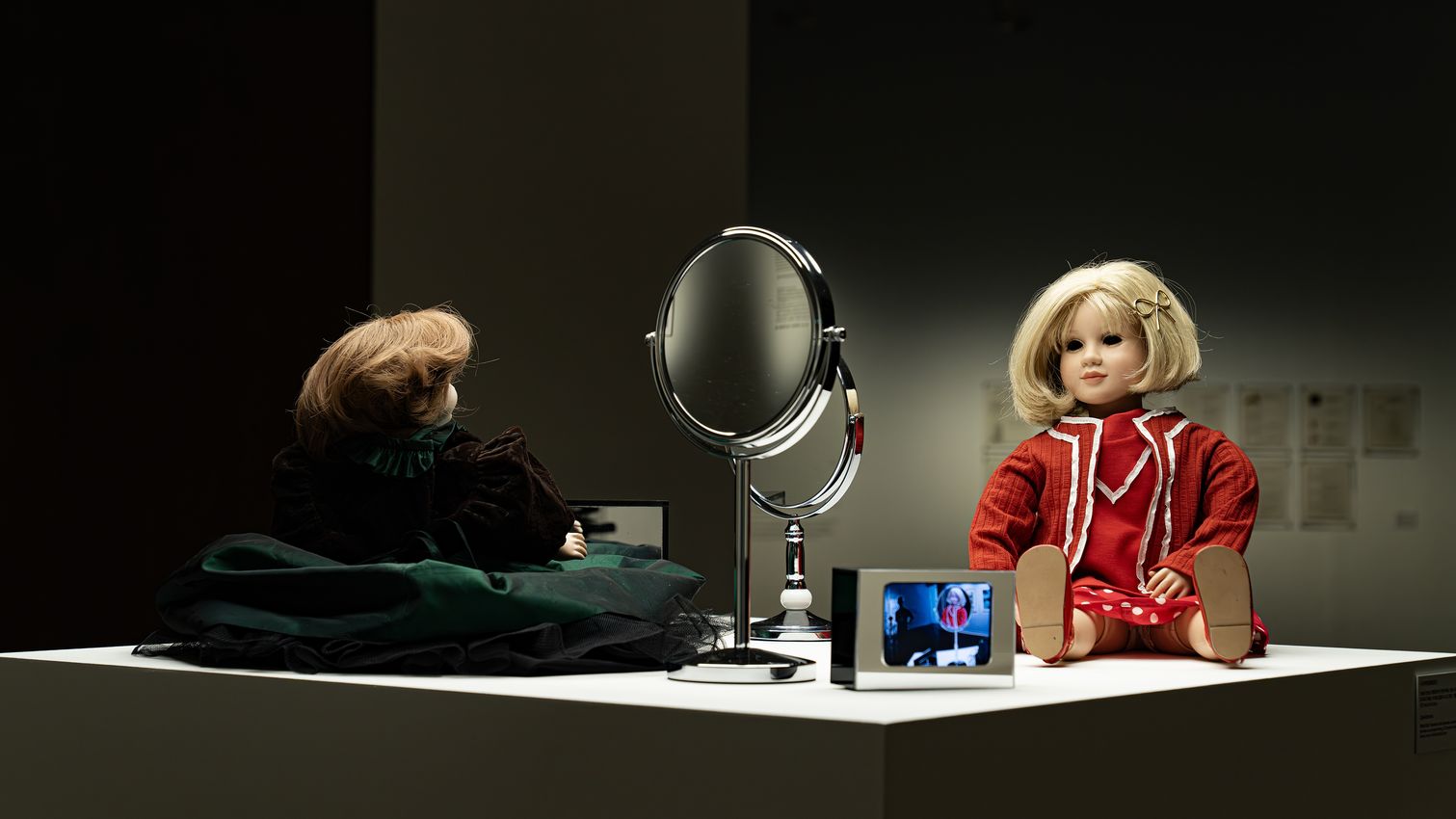
Flesh and Machine: This section presents the Phantom Limb series of photographic collages, which combine images of women’s bodies with cameras and television screens; the Cyborg series, depicting women who are part human and part robot; and the telerobotic dolls Tillie (1995) and CyberRoberta (1996/2026). Together, these works question how far the boundaries of the human body can be extended through technology, and how the technologically mediated body becomes subject to representation and surveillance.

Screen, Responding: Bringing together works that respond to viewers’ choices and participation, this section highlights Lorna (1979-1984), in which viewers use a remote control to navigate the story of a protagonist suffering from agoraphobia; Deep Contact (1984), which connects viewers’ bodies to the artwork through a touchscreen interface; and The Electronic Diaries (1984-), a series in which the artist documents herself through video.

When Data Becomes Love: This section explores how technology enters the realm of human emotions and relationships. Featured works include Agent Ruby (1998-2002), an early AI chatbot in the collection of the San Francisco Museum of Modern Art; DiNA (2004), a voice-based chatbot developed as an extension of Agent Ruby; and Logic Paralyzes the Heart (2022), which examines the history of AI and warfare as well as algorithmic surveillance. Awarded a Special Mention by the jury of the Biennale Arte 2022, Logic Paralyzes the Heart features a script co-written by the artist and AI.

Edited Future: This section examines Hershman Leeson’s expanding engagement with biotechnology and genetic engineering since 2010. In Room #8 (2010-2019), the artist presents the LYNNHERSHMAN Antibody, developed in collaboration with the Swiss pharmaceutical company Novartis. Created by arranging amino acids corresponding to the letters of the artist’s name, the antibody extends her investigation of identity into the biological realm. Also on view is the Infinity Engine series, which likens humans who aim to extend their lifespans and continually renew themselves through genetic engineering, to perpetual motion machines.

Meanwhile, Korean-language versions of three interactive works originally developed in English—Lorna, Deep Contact, and Agent Ruby—will be presented for the first time at this exhibition. In collaboration with the media artist collective Seoul Express and the artist’s studio, Korean subtitles and Korean-language interactive features have been developed to make these works more accessible to local audiences.

The exhibition also sheds light on Lynn Hershman Leeson’s practice as a filmmaker. In collaboration with Seoul Art Cinema, a nonprofit cinematheque based in Seoul, SeMA will present Women Behind the Scenes, a feature-film screening program running from November 2026 through January 2027. The program will feature a total of 12 screenings of three feature-length films.

Conceiving Ada (1997): A film in which a contemporary computer scientist communicates through technology with Ada Lovelace, a nineteenth-century mathematician. The film marks the artist’s first collaboration with actress Tilda Swinton.

Teknolust (2002): A science-fiction film about a biotechnologist who creates three clones using her own DNA. Tilda Swinton plays four roles, portraying both the scientist and her three clones.

!Women Art Revolution: A Secret History (2012): A documentary chronicling the feminist art movement since the 1960s. The film draws on interviews with artists, curators, critics, and historians, as well as archival footage collected by Hershman Leeson over more than four decades.

Choi Eunju, General Director of the Seoul Museum of Art, stated, “At a time when AI and digital technologies are transforming the meanings of everyday life, relationships, and identity, Lynn Hershman Leeson’s work invites us to reconsider the question, ‘Who am I, and where do I end?’” She added, “I hope this exhibition will offer an opportunity to reflect on the relationship between technology and humanity, and to discover the multiple selves and possibilities within each of us.”

Read More

Also Exhibiting at Seoul Museum of Art | SeMA

Address
61, Deoksugung-gil
Jung-Gu
Seoul
South Korea
Opening Hours
Tuesday – Friday
10am – 8pm

Weekends and National Holidays
March – October
10am – 7pm

November – February
10am – 6pm

Last admission 1 hour before closing.
Closed on Monday and New Year's Day. Open if Monday is a national holiday.
(1)
Seoul 61, Deoksugung-gil, Jung-Gu
Seoul Museum of Art | SeMA
61, Deoksugung-gil, Jung-Gu, Seoul, South Korea
+82 2 2124 8800
http://sema.seoul.go.kr

Opening hours
Tuesday – Friday
10am – 8pm

Weekends and National Holidays
March – October
10am – 7pm

November – February
10am – 6pm

Last admission 1 hour before closing.
Closed on Monday and New Year's Day. Open if Monday is a national holiday.
The art world in focus