





Inside the Goldfish Bowl
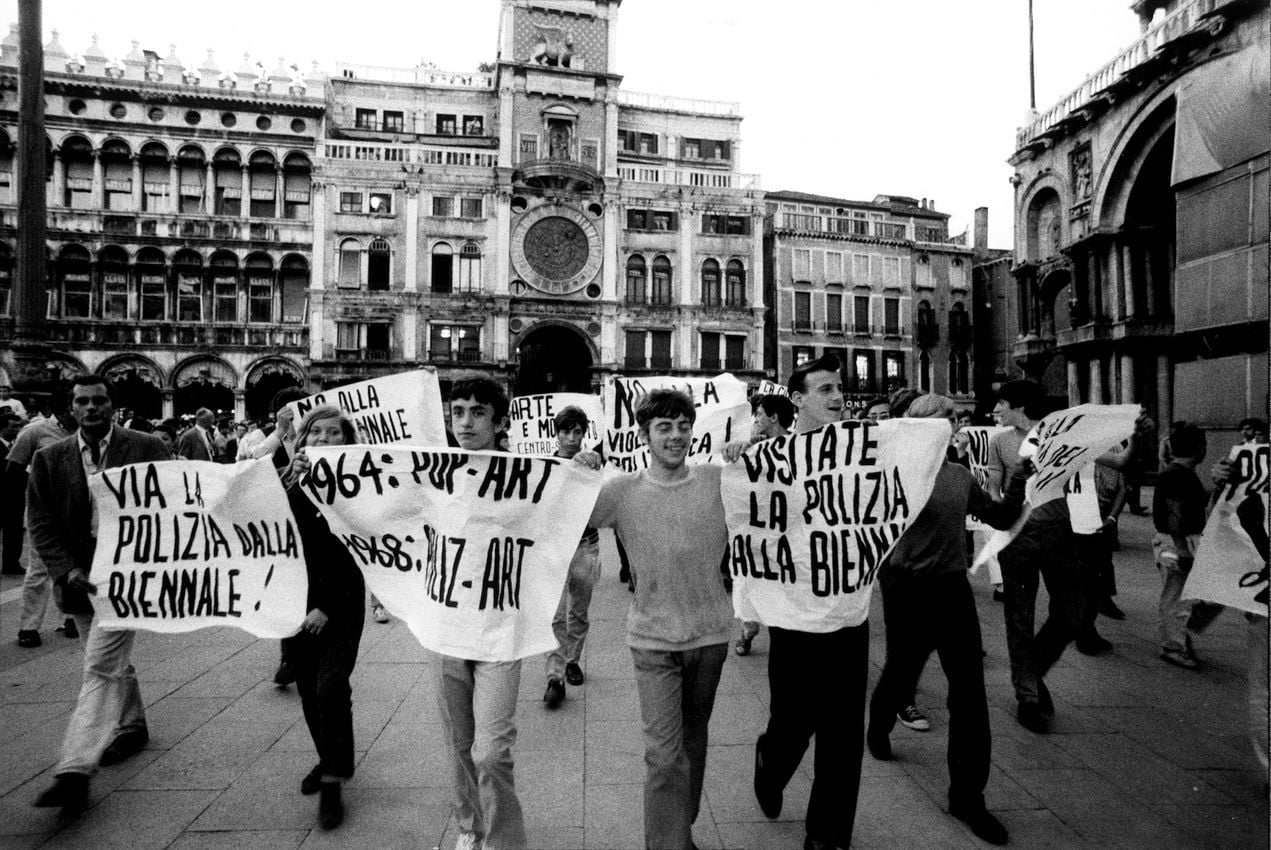
Political activity at the Venice Biennale isn’t a new phenomenon. But will this year’s protests have the same long‑term impact as those that took place in 1968? Save to My OculaIn June 1968, artists, journalists and art world professionals arrived at the vernissage of the 34th Venice Art Biennale to find the oldest and most prestigious exhibition in the world under siege. Newspapers had reported that local art students planned to occupy the Giardini della Biennale (the park that serves as the event’s central venue) and Venetian police had requested more than 1,000 additional armed troops in response. Galvanised by the recent wave of revolutionary foment that had spread across Europe, a few hundred demonstrators seized upon the biennale as a symbol of bourgeois power and the capitalist commodification of culture. After standing outside the gates of the Giardini during the opening—and shouting at officers—they marched around Venice and were charged at, beaten and arrested by law enforcement. This violent alteration was captured by photojournalists—some of the images from that day are as shocking as those that had immortalised the mood of the previous month’s civil unrest on the streets of Paris.
The clash between protestors and police also struck a nerve with exhibiting artists from several countries, many of whom withdrew their work from view. This solidarity sought to link tangibly what was happening inside the walls of the Biennale with what was happening outside. Activists continued to demonstrate throughout the public opening, holding up placards that decried the “Police Biennial” and the “art of the elites [padroni]”. Gastone Novelli, an Italian artist who was invited to present work at that edition’s international pavilion, turned his canvases against the wall in response. He wrote on the reverse of one: The Biennale is fascist.”
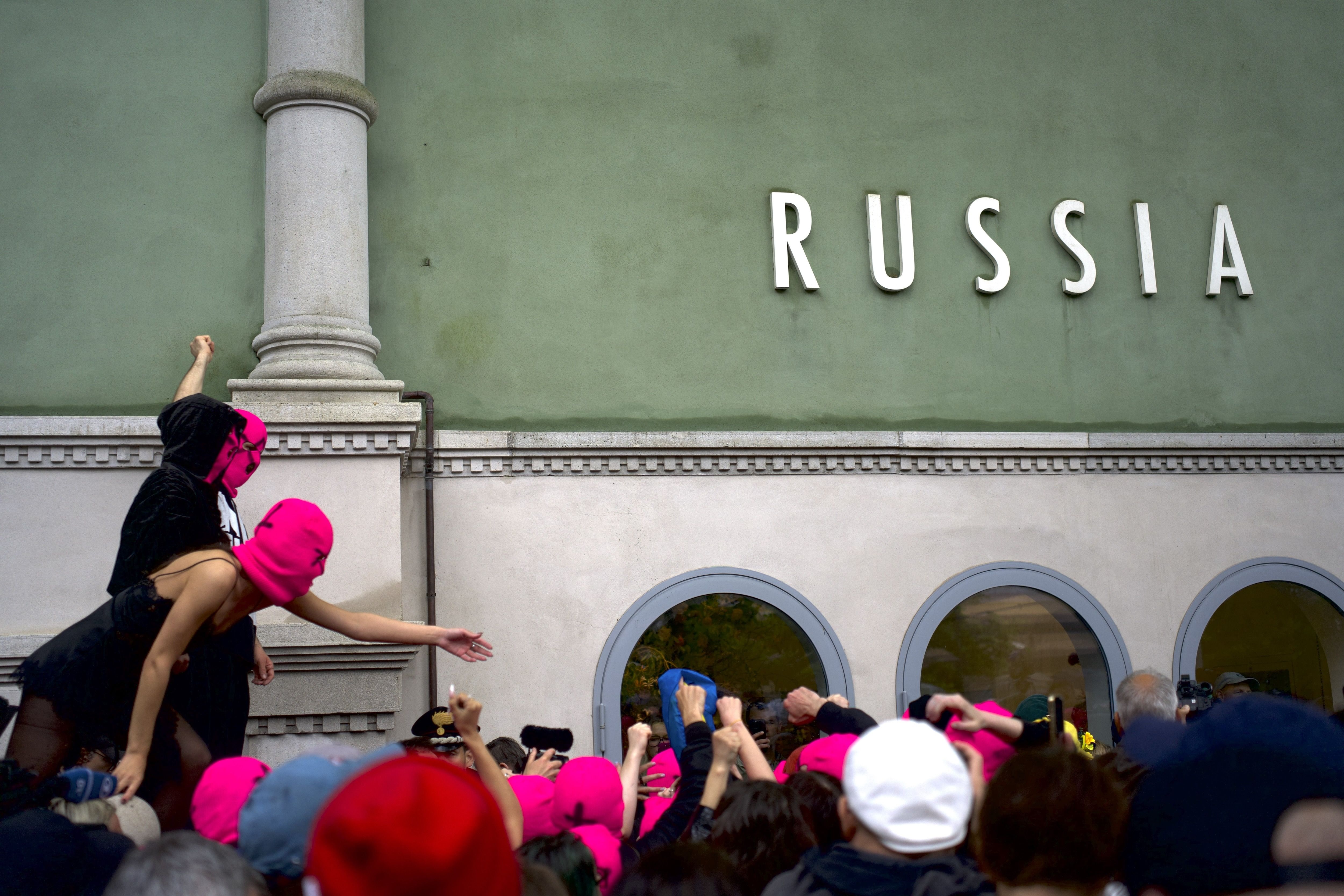
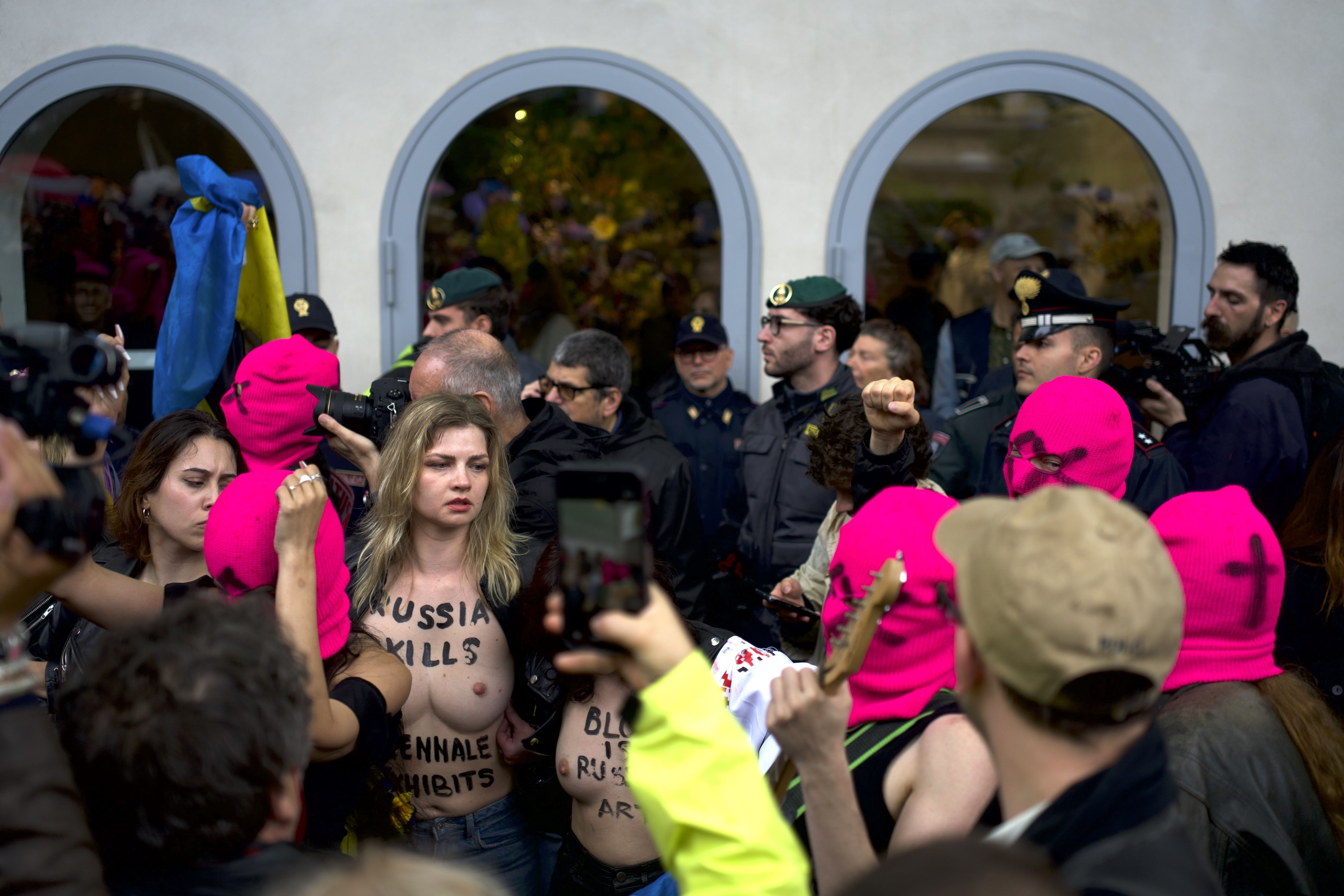
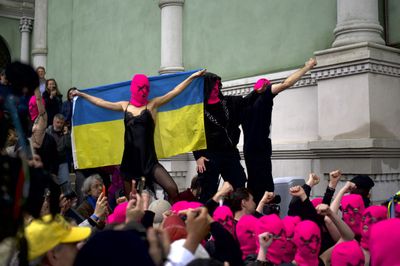
Over a half-century later, the protests which interrupted the opening of the 61st Venice Biennale have revived the tactics of 1968. During the preview days, activist groups including Art Not Genocide Alliance (ANGA), Pussy Riot and Femen held large demonstrations outside the Russia and Israel pavilions in objection to the countries’ participation, while artists and cultural workers at the Biennale staged a 24-hour strike on 8 May against Israel’s inclusion in the event. And across Venice, around 60 artists from the international exhibition, Minor Keys, have presented the Solidarity Drone Chorus, a daily collective performance of drone sounds intended to bring the realities of Gaza into the space of the biennale.
Of course, the biennale had always been a political affair. From its origins, it has functioned as an arena of soft power, and it now involves dozens of nation-states presenting work that reflects, and often reflects upon, the political and social conditions of our world. This was acknowledged not just by the 1968 protestors but also in the first historical account of the exhibition, which was published that same year by the English (but US-based) critic and curator Lawrence Alloway. In The Venice Biennale, 1895–1968: From Salon to Goldfish Bowl, Alloway periodised the event’s history into three major phases.
“The 1968 demonstrations marked a seismic shift in the biennale’s orientation and activities”
During the first stage, between 1895–1914, the biennale primarily took the form of what Alloway called a “super-salon” within a central building in the Giardini, realised in the spirit of the colonial era’s international exhibitions. Between 1920–1942, soon after a proliferation of European national pavilions constructed just outside the main exhibition, the biennale was shaped by a time of increasing fascism in the region and became an instrument of cultural propaganda for Benito Mussolini’s regime.
The final phrase, from 1948–1968, saw the biennale’s discovery of modern art, which was manifested by a slew of exhibitions and prizes honouring contemporary artists. As a result, Alloway claimed that the Biennale put “the avant-garde in a goldfish bowl”: the rest of the world began to descend upon Venice to scrutinise the trends and tendencies of a new generation of artists in the wake of Italy’s liberation from fascism.
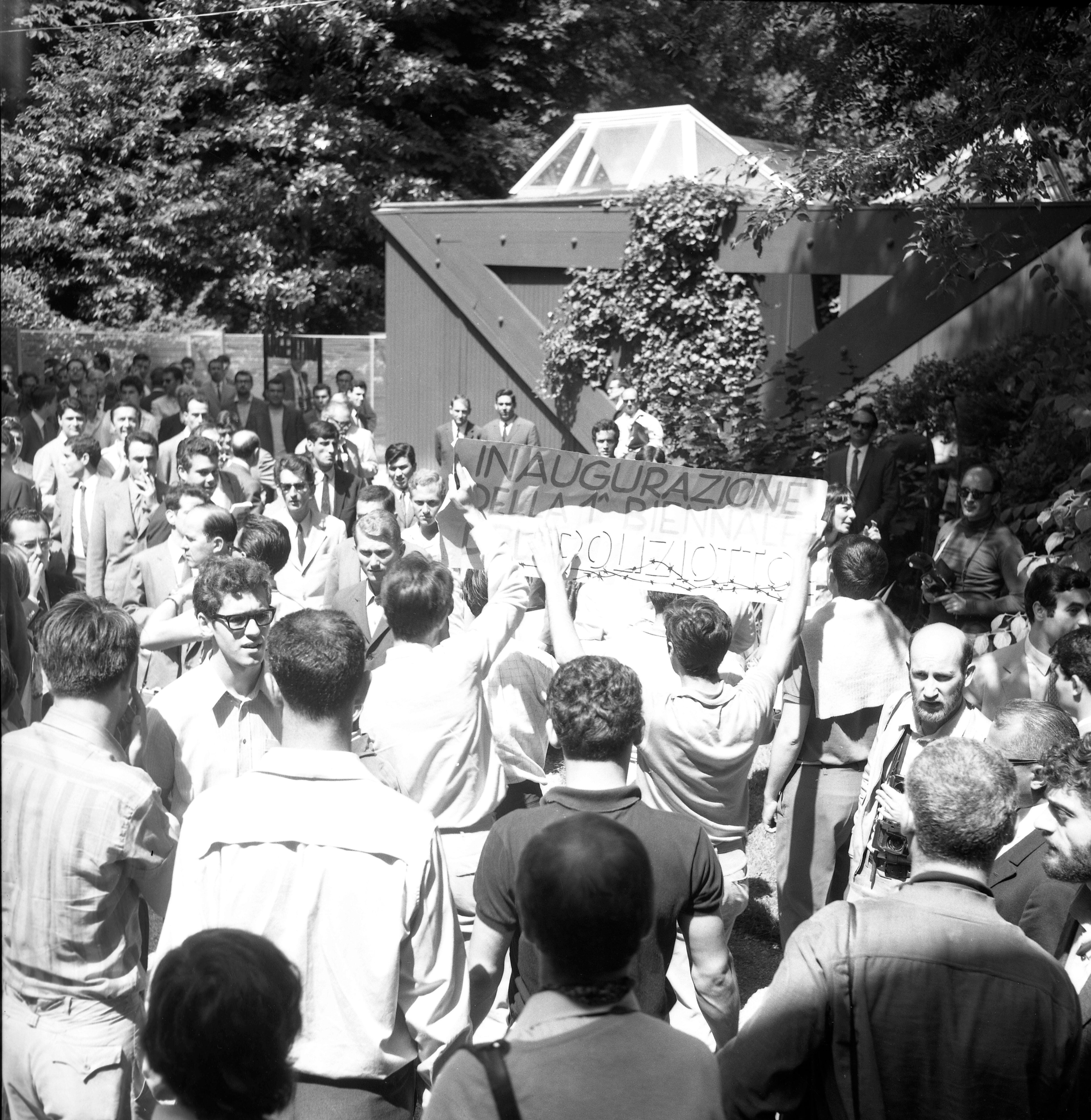
This final stage has endured. Alloway predicted that the avant-garde would remain in the goldfish bowl, only to attract a bigger and bigger audience. The protests outside the 1968 edition “pointlessly interrupted” the biennale’s activities and resulted from the demonstrators’ failures to recognise what he perceived to be a key function of the biennale: to remove art from the hands of the elites and bring it into those of the masses. Alloway believed that these protests would be of little consequence—an anomalous blip in the exhibition’s history.
He was correct that the biennale would continue to be regarded as a litmus test for the contemporary art world. But his prediction that the 1968 protests would not indelibly affect the event’s future was misguided. In fact, these demonstrations marked a seismic shift in the biennale’s orientation and activities. Their greatest contribution was in explicitly identifying the biennale as the dominant art institution during the beginning of practices that we now group under the label “institutional critique”.
“The contemporary Venice Biennale model has given the event the illusion of being a microcosm of the world”
Although small, the 1968 protests were influential in a few ways. First, they pressured organisers to abolish prizes and enact a prohibition on artwork sales to ameliorate criticisms of commercialism. Second, they successfully pushed for a ban on South Africa’s participation in the biennale in opposition to the apartheid regime—an exclusion from the art world stage that lasted until 1993. Cultural boycotts like this have since become a prominent form of protest at the biennale, exemplified by calls for the exclusion of the Russian, Israeli and US pavilions from the 2026 edition.
Finally, the demonstrations precipitated drastic changes in the organisation and curatorial direction of the biennale. Their demands for an autonomous body to oversee the biennale came to fulfilment in 1973, when Italian parliament overturned a 1938 fascist-era statute that had placed the event under government control. This allowed for the adoption of a robust and politically engaged curatorial agenda and established the Venice Biennale as a centre of cultural debate.
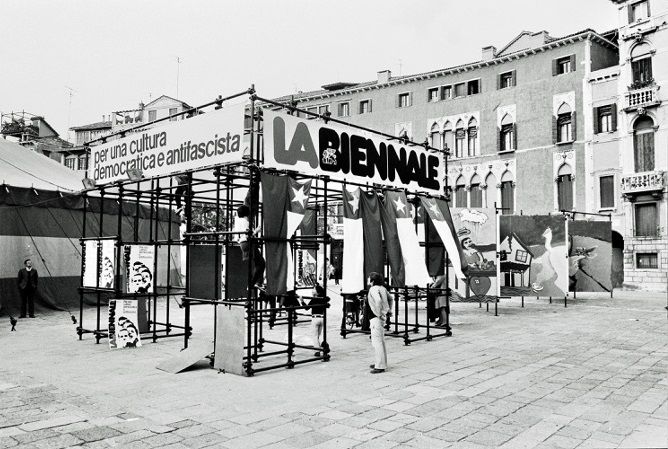
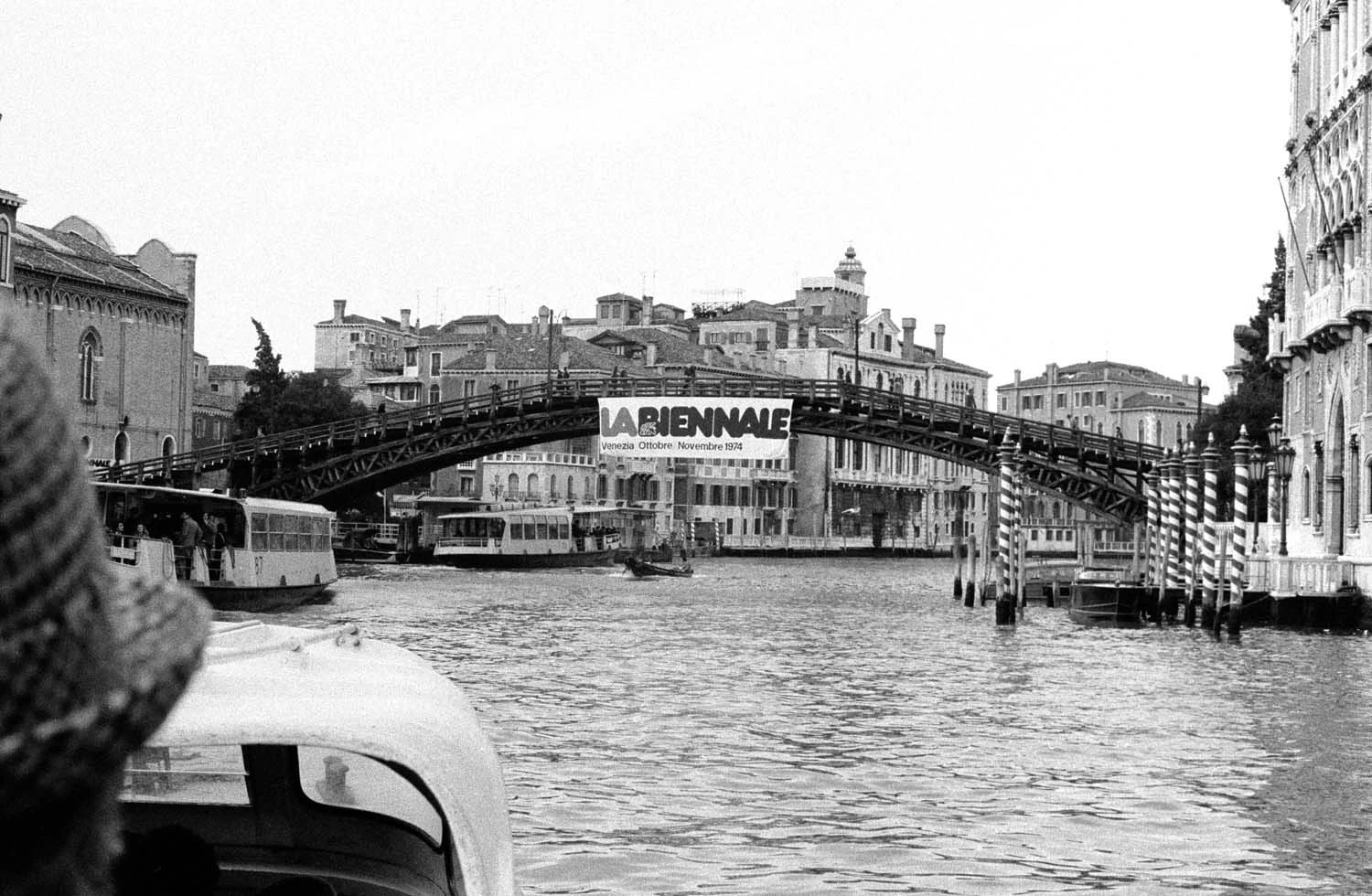
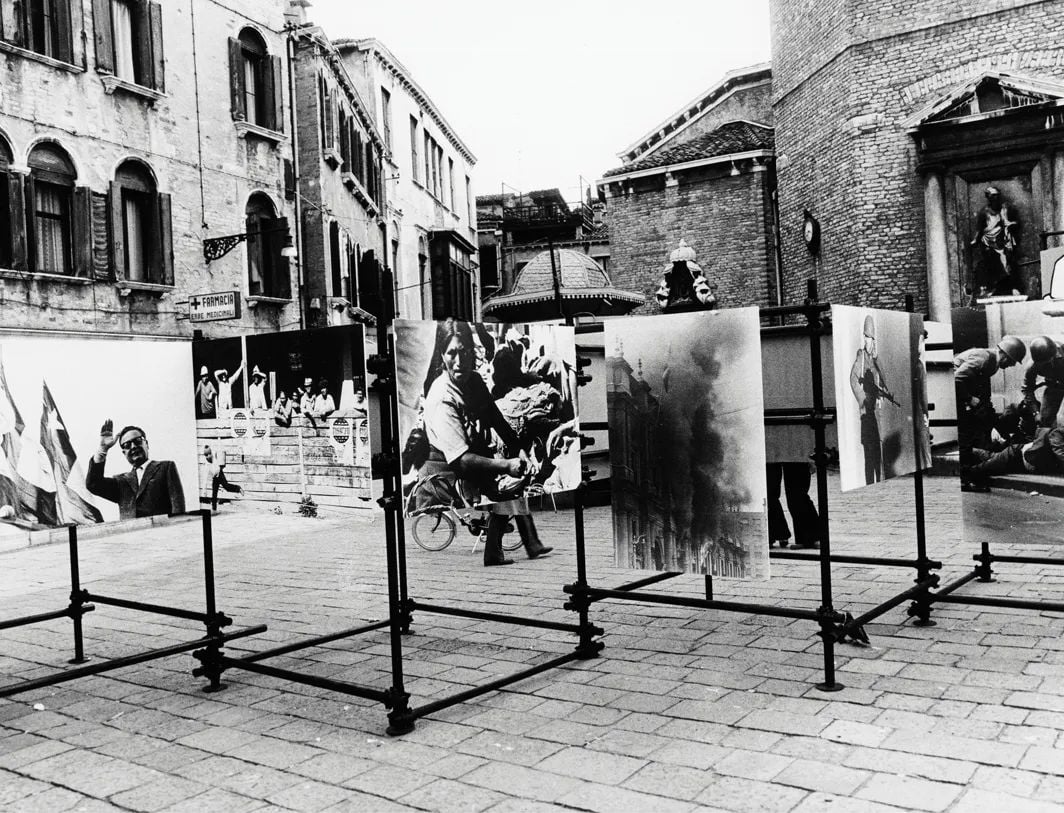
The radical restructuring of the art event led to a complete overhaul of its programme between 1973–1977, which reflected the progressive ambitions of the biennale’s new president. Carlo Ripa di Meana, then a member of the Italian Socialist Party, flipped the event on its head, pausing its biannual sequencing and the Giardini circuit. Instead, murals, photography exhibitions, as well as music and theatrical events, were found throughout the boroughs of Venice, with anti-capitalist and anti-imperialist imagery entered the streets of local neighbourhoods. Called Biennale per una cultura democratica e antifascista [Biennial for a democratic and anti-fascist culture], Ripa di Meana’s editions were committed to the global struggle for liberation and asked: could the Venice Biennale itself function as a form of political protest?
The first of these, in 1974, was a condemnation of Augusto Pinochet’s military dictatorship in Chile, which overthrew the democratically elected President Salvador Allende with support from the US government. The second, in 1976, was positioned as an “Homage to Democratic Spain,” foregrounding resistance to the long rule of General Franco. The following year, Ripa di Meana’s planned “Biennale of Dissent”—dedicated to unofficial Soviet art—provoked fierce condemnation from the Russian government and intensified political tensions within Italy, placing his curatorial programme under scrutiny.
“These protests positioned national pavilions as stand-ins for state power”
By 1978, Ripa di Meana’s biennale experiment came to a close with his resignation, and the exhibition settled into the structure we are familiar with today. Alongside a large-scale, central international exhibition curated by an individual elected by the biennale’s board, the national pavilions are independently organised by the countries themselves. In 1986, the prizes (which had been suspended after the 1968 protests) were reintroduced, including the Golden and Silver Lion awards, now presented to outstanding national participants and to artists featured in the central exhibition. (In a gesture that echoes earlier moments of institutional rupture, the jury of the 2026 Venice Biennale has resigned amid mounting political pressure and will not issue awards for this year’s edition, leaving it to be judged instead by public vote.) This format has endured, and the event increasingly came to propel contemporary art into the age of globalisation.
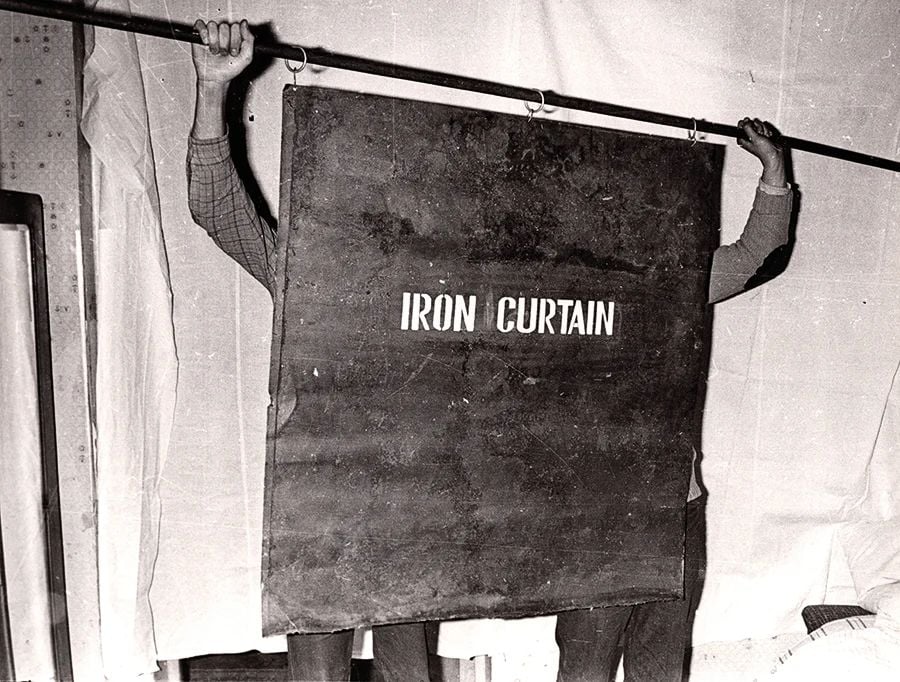
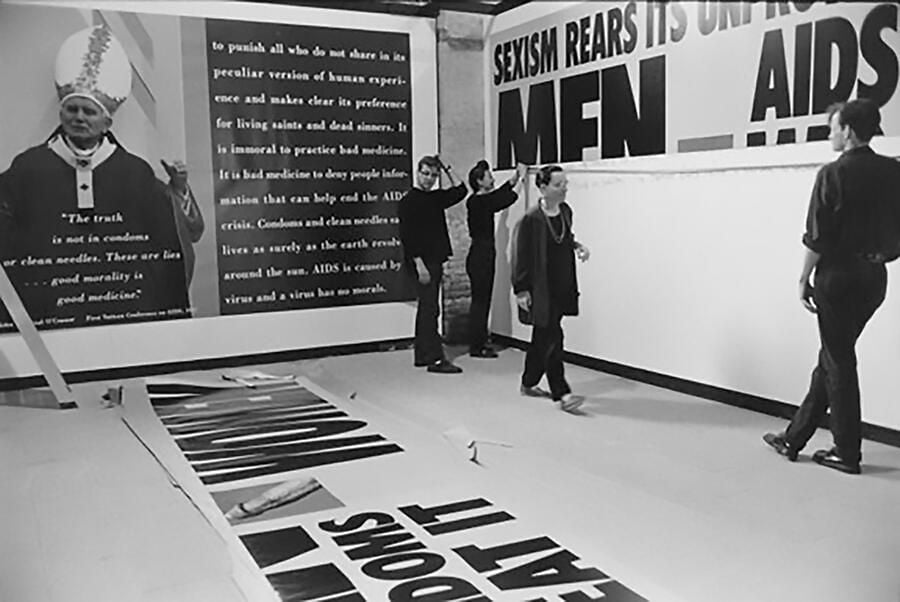
The contemporary Venice Biennale model has given the event the illusion of being a microcosm of the world. But while it might promise a coherent global picture, the biennale provides, in reality, little more than a set of carefully delimited representations moulded by local and international power relations. On one hand, this has prompted critical reflections on the role of the exhibition as a vehicle for dissent. In 1990, the New York-based AIDS activist artist collective Gran Fury were invited to participate in the 44th Venice Biennale, where they exhibited posters condemning the Catholic Church’s stance on sexuality and contraception. Gran Fury’s contribution underscored how the biennale’s structure can accommodate political protest from within, even as it frames and contains it.
Yet critiques once again spilled out beyond the walls of the pavilions in the new millennium, resulting in guerrilla protest actions that have strategically employed the Venice Biennale as an international venue to amplify their calls. Like boycotts, these activities positioned national pavilions as stand-ins for state power, holding them accountable for political and economic injustices enacted beyond the exhibition. Interestingly, and perhaps not coincidentally, this shift towards extra-aesthetic action coincided with growing concerns that institutional critique had become increasingly absorbed into the very structures it once sought to oppose. In 2013, for example, demonstrators associated with the Occupy Gezi movement staged actions in Venice to denounce the Turkish government’s violent suppression of protests in Istanbul.
“Protests surrounding the biennale’s structure and participants bring the relationship between soft and hard power into relief”
Two years later, in July 2015, biennale employees and artists associated with the German pavilion, including Hito Steyerl, hung a Greek flag inscribed with the word “GERMONEY” over the entrance to the pavilion. In an expression of solidarity with Greece in the wake of the Eurozone crisis—and as a rebuke to the German government’s role in enforcing austerity measures—they also issued a public demand for “an end to austerity for health, culture and education while public funding for banks and oligarchs seems unlimited”.
That same summer, Gulf Labor, an art and activism coalition that had been organised to advocate for the rights of migrant workers responsible for building museums in the Middle East, occupied several art institutional sites across Venice. One of these was the Israeli pavilion, which aimed to draw attention to the conditions faced by Palestinian labourers. Such interventions exposed the limits of critique staged within exhibition spaces, extending its concerns into forms of collective action that operated alongside—and at times against—the institution itself.
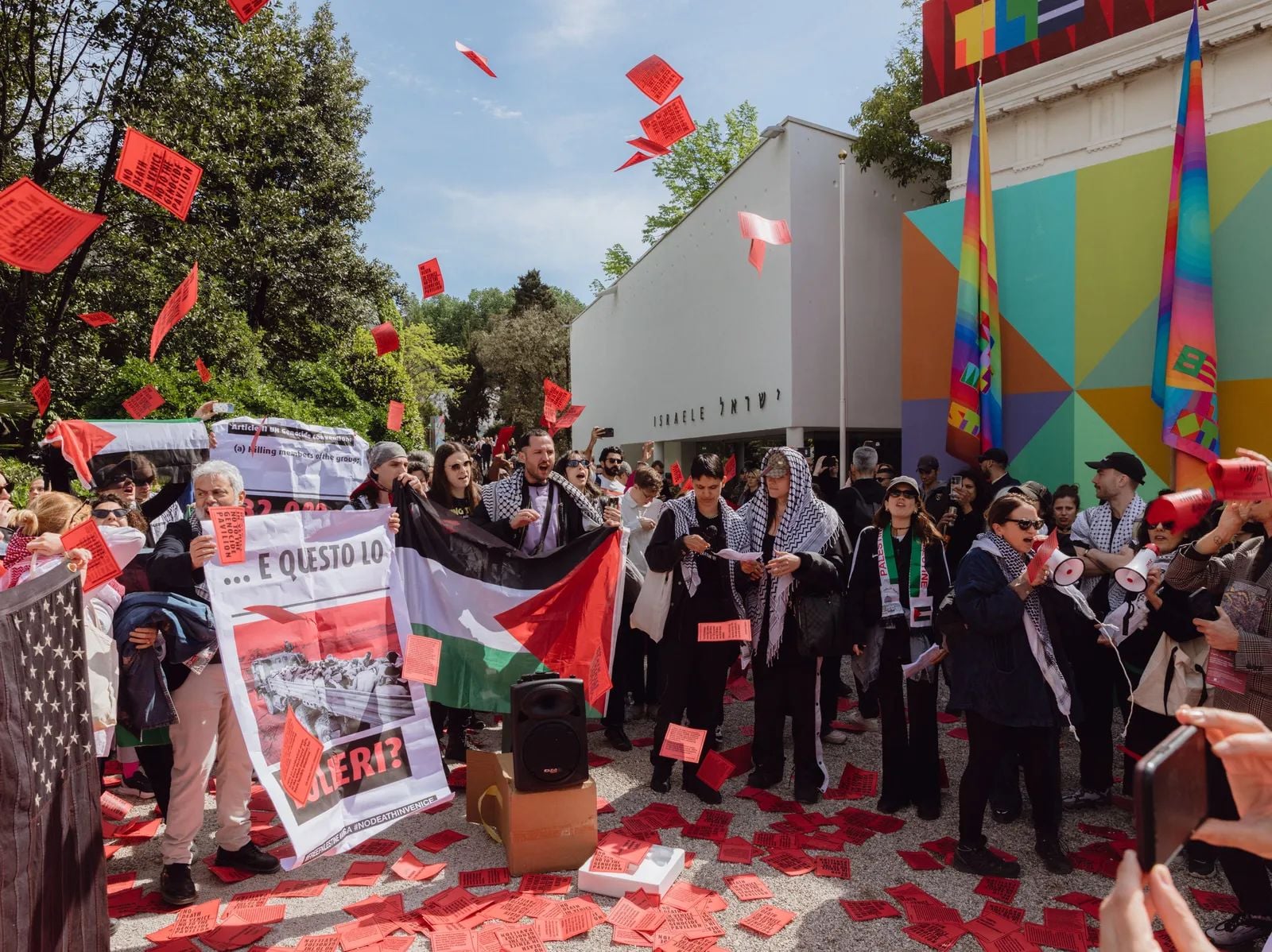
Today, it comes as no surprise that such tensions show little sign of receding. Hundreds of activists, artists and cultural workers involved in the 2026 edition have renewed calls for the Venice Biennale to exclude national pavilions associated with current governments committing war crimes, most expressly targeting Russia and Israel. Such disputes reveal how protests surrounding the biennale’s structure and participants bring the relationship between soft and hard power into relief.
When Lawrence Alloway described the post-war biennale as placing the avant-garde in the “goldfish bowl”, he was commenting on a way of seeing contemporary artworks as objects of display. However, I believe that the 1968 protests shifted our gaze: the glass tank itself has now come into focus, revealing the conditions that hold, show and refract what is inside. As long as the biennale continues to fashion itself as an institution of cultural diplomacy through a delegation model, it will inevitably remain a target of protest and critique. It purports to capture the world but it can only aim to reproduce it through the distortion of a curved fishbowl.
The tricky thing about a glass container is that its transparency makes the structure itself easy to miss. But once you notice it, it’s hard to ignore. —[O]
Main image: Students protesting the 34th Venice Biennale (1968). Photo: Ugo Mulas. Courtesy the artist and Open Eye Gallery, Liverpool.





A respected voice in contemporary art discourse.
Focusing on ambitious storytelling and insightful art-world commentary. Ocula Magazine publishes in-depth interviews, critical essays and timely analysis on the artists, exhibitions and ideas driving the global art world.
Learn more about Ocula Magazine
Showcasing the best of the art world.
Ocula partners with galleries from around the world to highlight their artists, artworks and exhibitions. Gallery membership is by application and invitation, with each member vetted by an independent panel.
Learn more about Ocula Membership
Specialises in the sale of major artworks.
Led by a team with deep ties to the world’s leading auction houses, galleries and collectors. Ocula’s advisory team offers bespoke services to high-net-worth clients from around the world who are looking to acquire the best of contemporary and modern art.
Learn more about our team and services