





Anti-Russia Protests Spread Beyond the Biennale and Into Venice

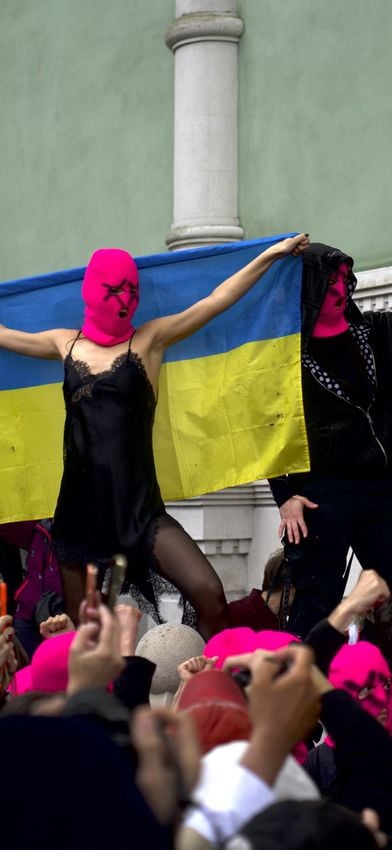
Protests against the reopening of the Russian pavilion have today broken out throughout the Venice Biennale and across the surrounding city, disrupting the second day of the exhibition’s increasingly controversial and political 61st edition.
At 11am, an hour after the biennale opened to the media and invited guests, visual artist Shalva Nikvashvili began a slow walk from an area close to the Russian pavilion to the entrance of the Giardini, where many countries’ pavilions are based. Dressed entirely in black, face covered in a muzzle-style mask and carrying a chair on his back, he held a sign reading “La Biennale di Venezia” and “violence”, accompanied by an image of a heart.
Nikvashvili, who grew up in Georgia in the years following the collapse of the Soviet Union, recalled the moment he first heard that Russia would return to the biennale. He told Ocula: “When I saw this—I can’t even explain the anger and the rage it gave me. And immediately I had an idea in my head: I have to do something.”
The artist self-funded his trip to Venice, accepting donations from friends and fellow artists. His silent performance quickly drew a small crowd outside the entrance to the Giardini, blocking visitors from joining the lengthy queue to enter.
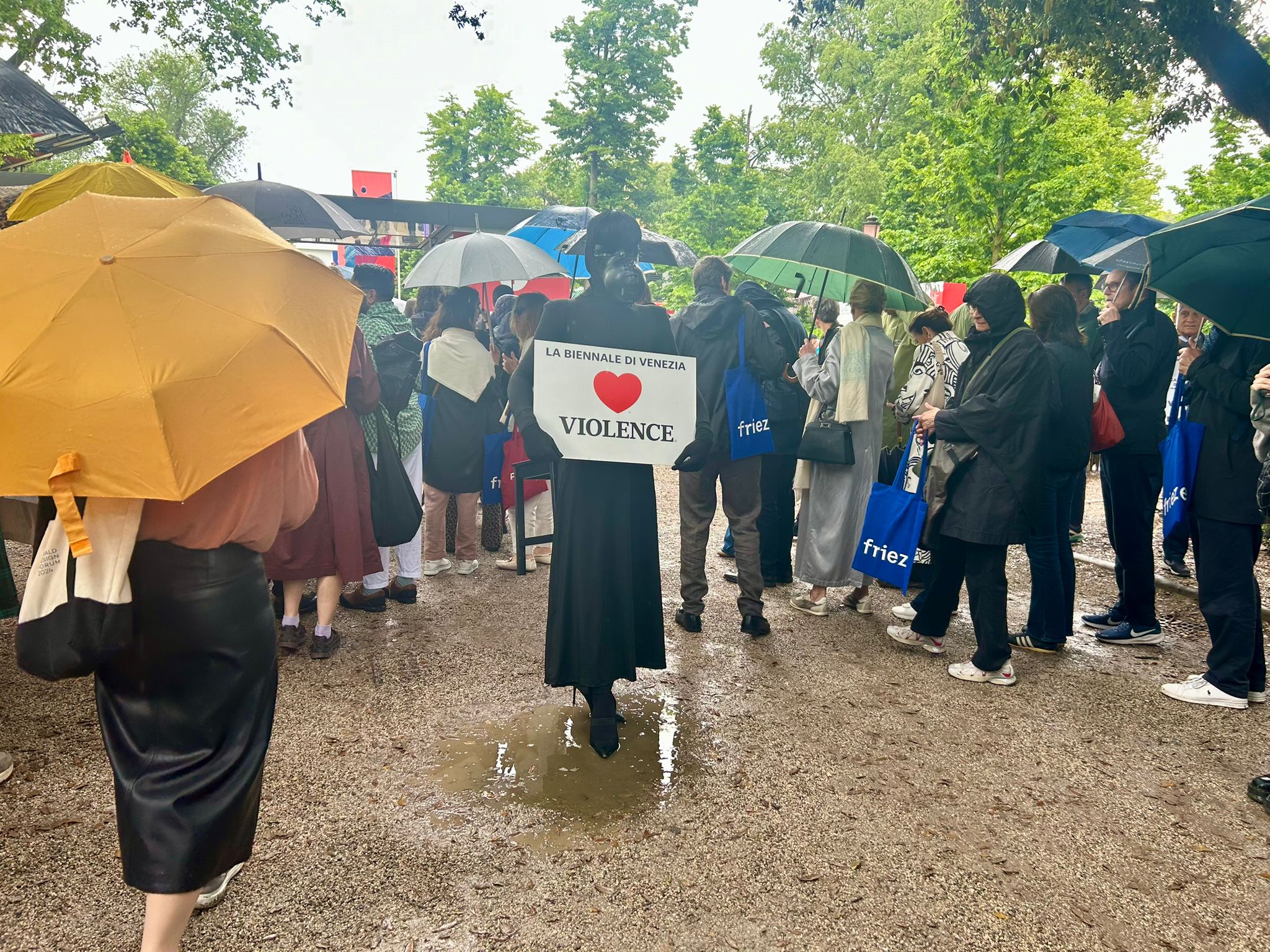
“I won’t show all my anger as a person, because my anger is more wild than, for example, what I did here,” he said. “Because I don’t want to answer the violence with violence.”
Referencing the Russian pavilion, he continued: “For me, this is the violence. This building is full of violence, no matter what they are trying to promote, or how much of a stage they give to the propaganda.”
Ocula approached representatives of the Russian pavilion for comment.
Pressure on the biennale has been growing since it was announced in March that Russia would open a pavilion at the exhibition for the first time since its full-scale invasion of Ukraine in 2022, with artists and international politicians calling for the country’s participation to be withdrawn.
On Monday, Italy’s ministry of culture confirmed that the Russian pavilion will be closed from 9 May when the biennale opens to the general public. However, the space has been open throughout the exhibition’s preview days, during which drinking and dancing has taken place between the show’s floral sculptures.
Pussy Riot and politicians
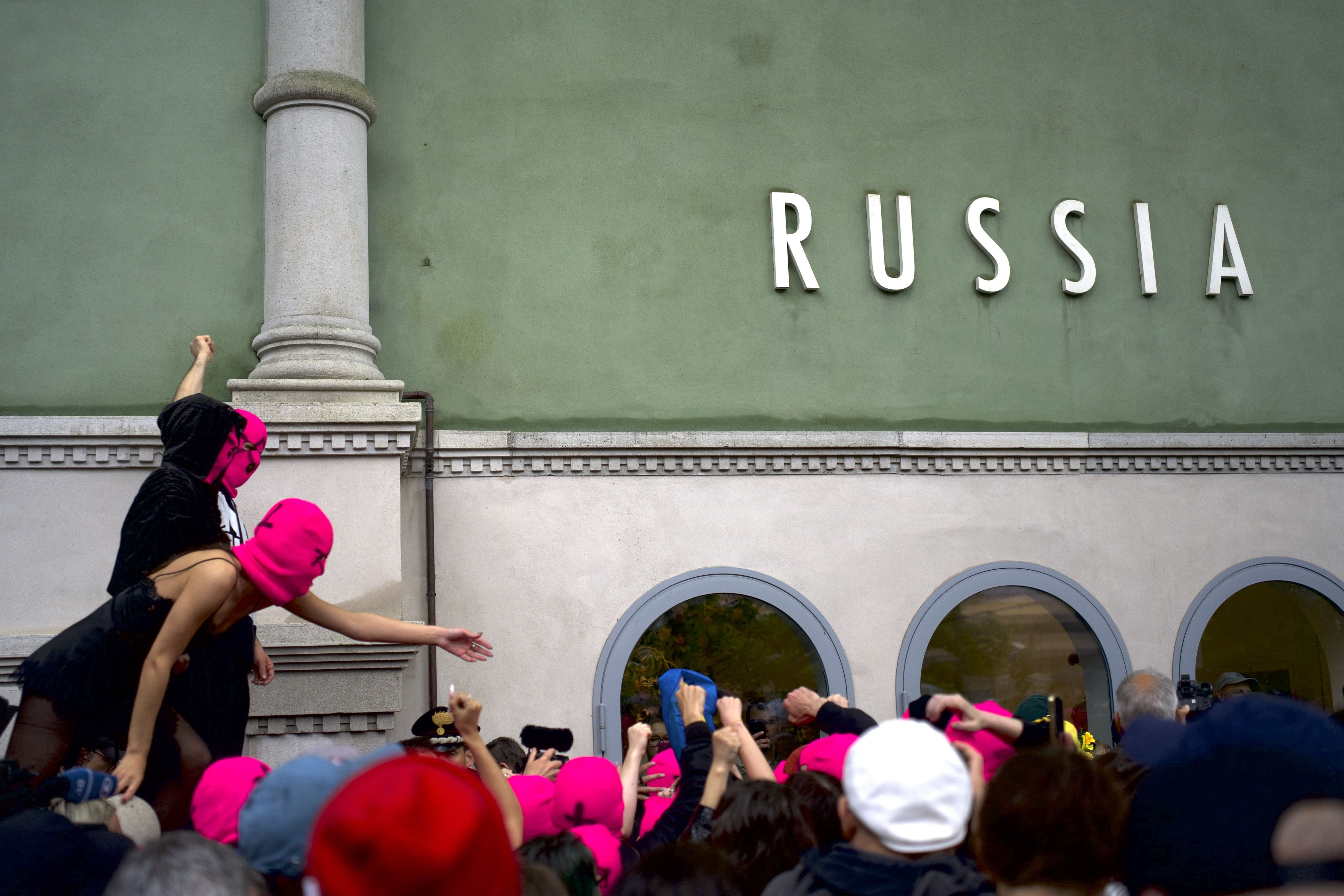
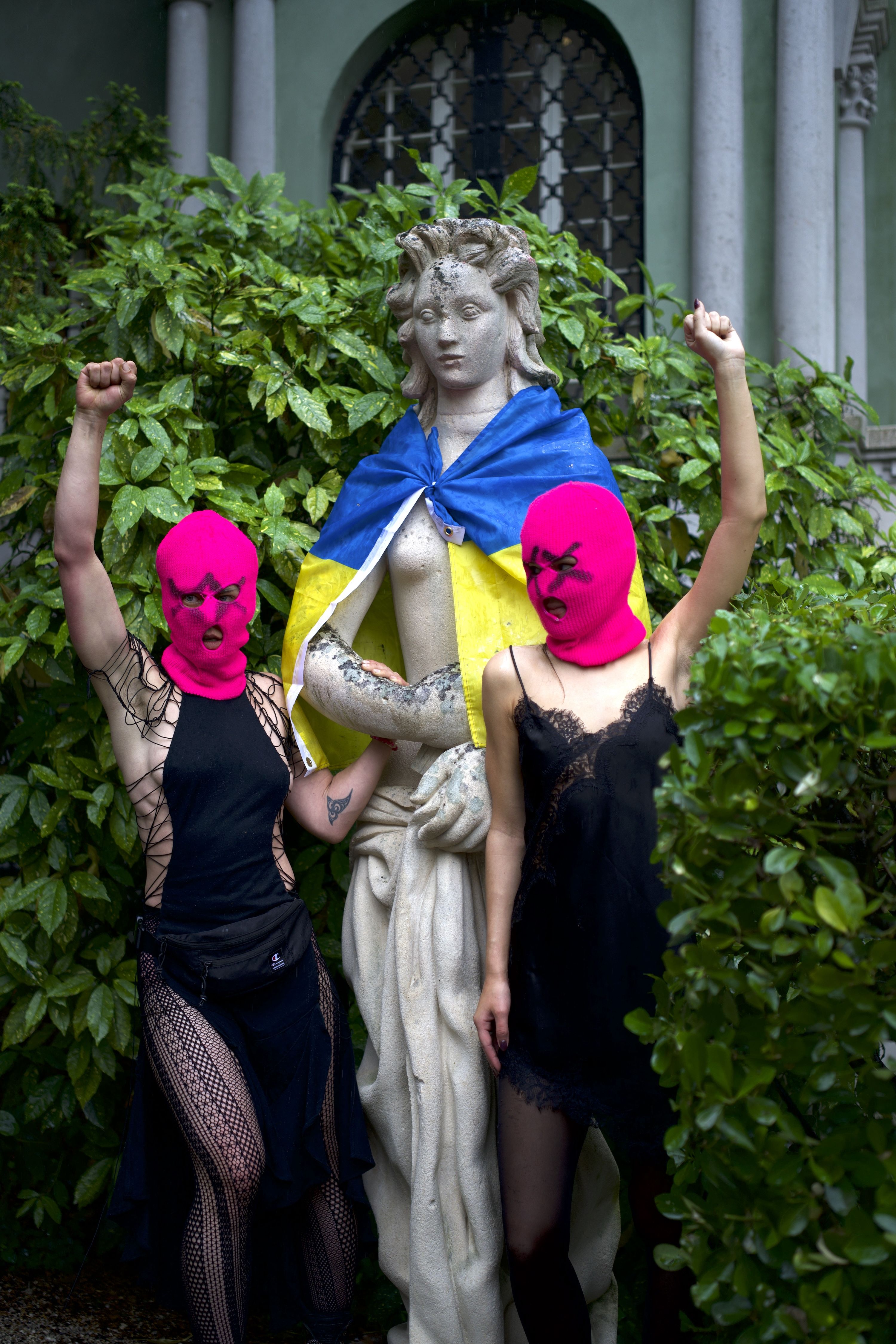
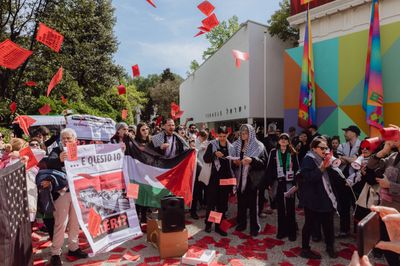
Just moments after Nikvashvili’s protest began behind the Russian pavilion, chants broke out at the front of the building. Inside the Giardini a group of approximately 20 protestors assembled outside the entrance to the Russian space, led by founding member of Pussy Riot, Nadya Tolokonnikova.
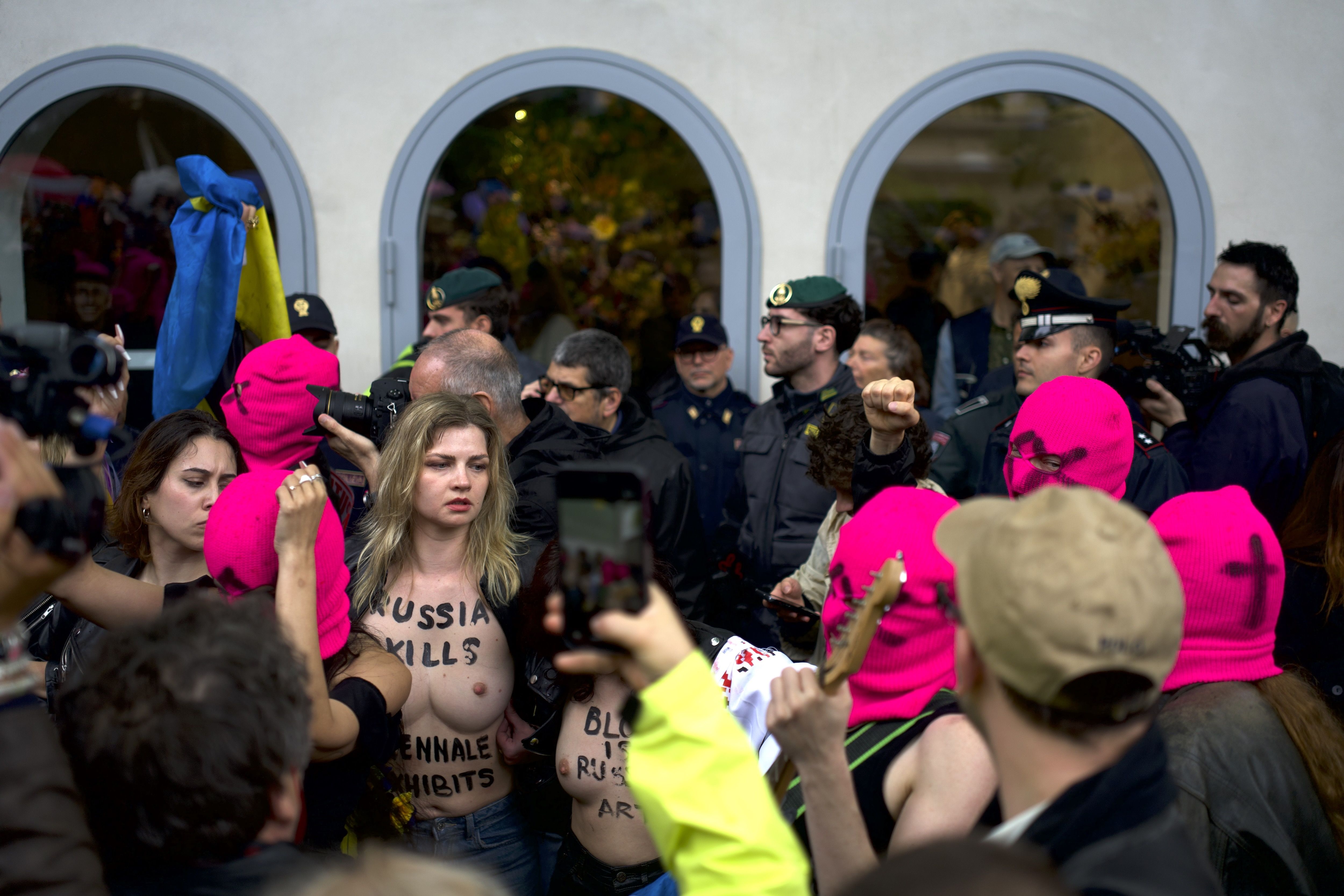
Dressed in black, with faces covered by bright pink balaclavas, the protestors were backed by loud punk music. Several members of the group climbed the stairs to the pavilion, shouting chants criticising Russian president Vladimir Putin.
As a pink smoke flare was released by one protestor, the pavilion’s entrance sign was briefly hidden, obscuring the word “Russia”. Beneath the sign, a line of security officials observed proceedings, but did not intervene.
As a crowd of spectators silently formed, several protesters waved and covered themselves in large Ukrainian flags. When the group dispersed, one flag remained draped across a statue outside the Russian space.
Earlier today the Financial Times reported that the European Union (EU) has warned Italy’s government that the biennale will breach EU sanctions should Russia’s national pavilion open. According to letters seen by the publication, allowing the Russian delegation to participate would violate a ban on “providing services” to the Kremlin.
The biennale foundation previously said it had ‘‘verified and complied with all national and international regulations’’, and had ‘‘operated within the scope and limits of its own authority’’. The biennale did not respond to Ocula’s request for comment regarding today’s protests, but said in March that it “rejects any form of exclusion or censorship of culture and art”.
Later in the afternoon, culture ministers from several Baltic countries gathered at the Polish pavilion to issue a joint statement in solidarity with Ukraine. Speaking on behalf of Poland, Estonia, Latvia and Lithuania, Ukrainian culture minister Tetyana Berezhna condemned Russia’s presence at the biennale.
Addressing a tightly packed crowd of media and guests, she said: “The values of freedom, human decency and democracy that underpin the global artistic community are the same values that Russia’s aggression seeks to destroy. A state waging a war of aggression cannot present itself as a representative of culture.
“We reaffirm our support for artistic freedom and freedom of expression. But these freedoms must not be instrumentalised to whitewash state crimes, or to confer legitimacy upon aggression.
“The aggressor cannot be rewarded with participation in the world’s most prestigious cultural events, including the Venice Biennale, while it continues its brutal war.”
Marching for Ukraine
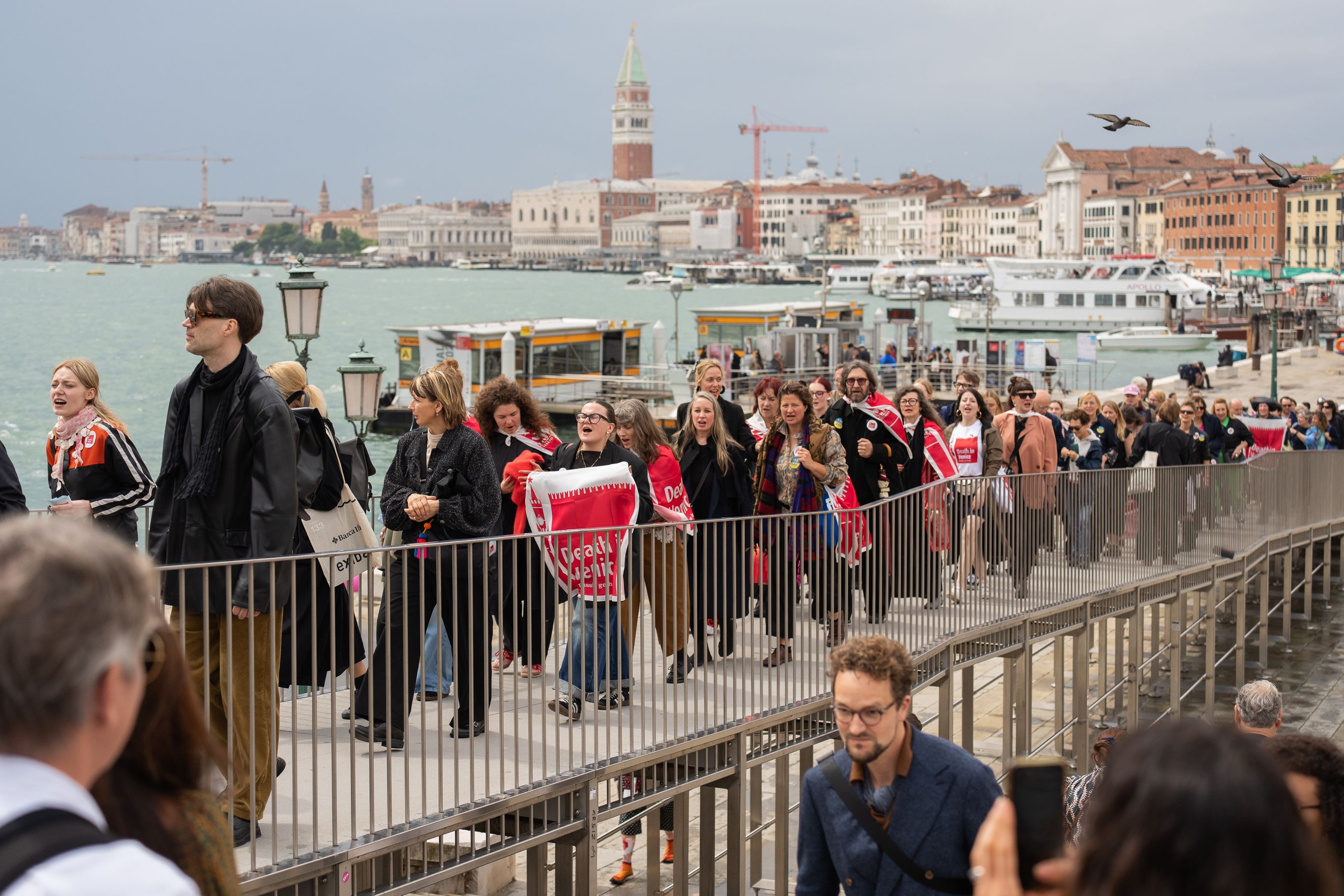
Protests have also spread beyond the Giardini. Even as ministers spoke to reaffirm their support for Ukraine, the teams behind the Lithuanian, Estonian and Latvian pavilions began a march in support of the nation.
The walk began at the Lithuanian pavilion, passed through the Arsenale—home to the Latvian pavilion—and concluded at the Estonian pavilion. It was described in a statement as symbolising a “commitment to stand together in the face of injustice and to emphasise the role of culture as a space of resilience, memory and freedom”.
Lithuania, Latvia, and Estonia regained independence from the Soviet Union more than three decades ago. In March, Latvian minister of culture Agnese Lāce spearheaded a joint letter signed by 22 European nations demanding the biennale to exclude Russia.
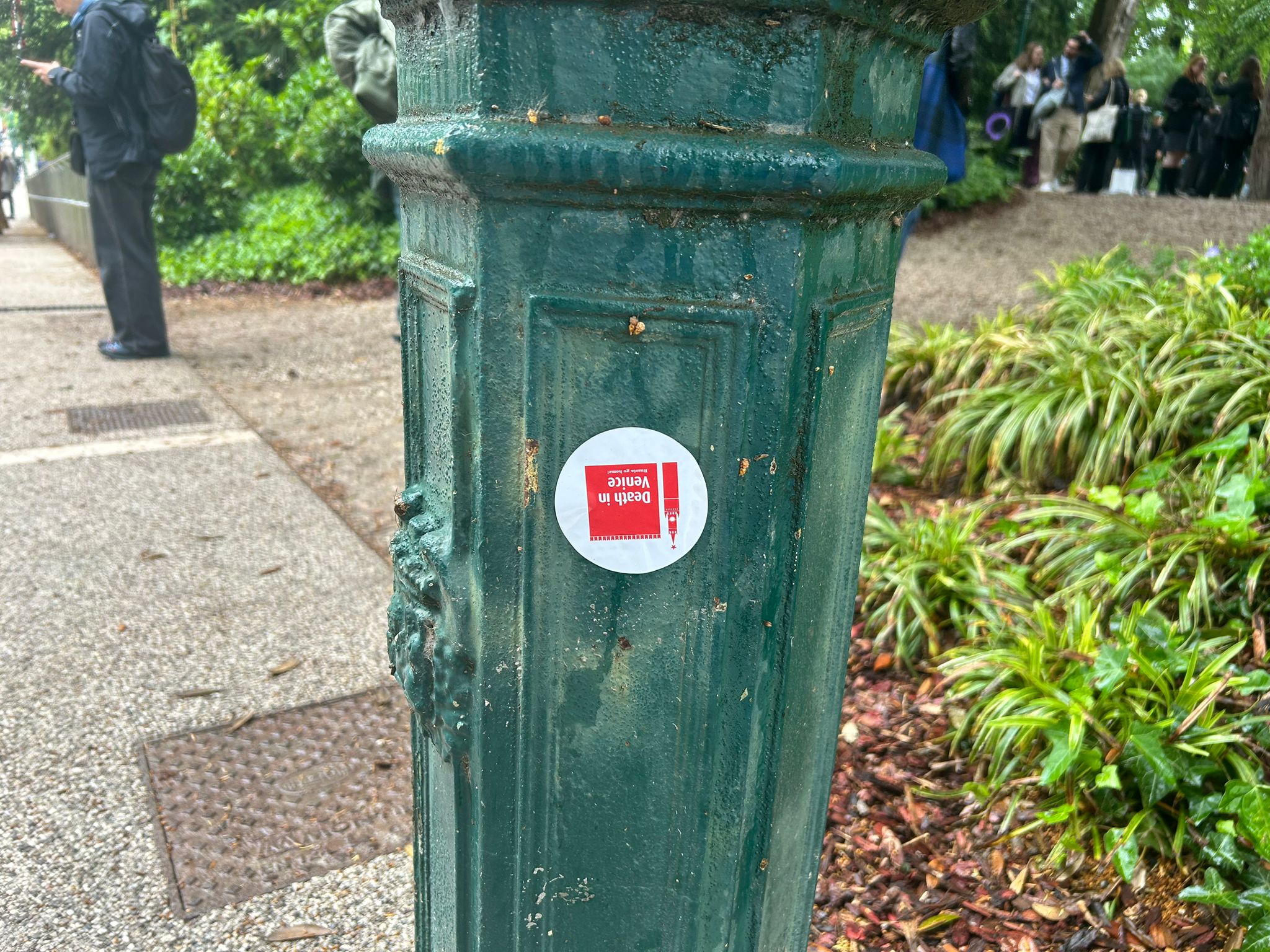
The team behind the Latvian pavilion has also launched a project titled Death in Venice, which features a version of the Venice Biennale logo designed by artist Krišs Salmanis. The work turns the logo’s motif of ramparts into the Kremlin wall, highlighting what organisers described as the biennale’s “compliance with Russia and the betrayal of the idea of European unity”.
The design is free to download and has been plastered in sticker form on surfaces throughout the Giardini. Both the Latvian pavilion and the Latvian Centre for Contemporary Art have encouraged visitors to share photos and videos of their own versions of the image via social media, using the hashtag #deathinvenice2026.
Throughout today’s walk, protestors waved Ukrainian flags and displayed the Death in Venice logo on t-shirts, stickers and signs as they made their way across the city.
Discussing the action, Heidy Purga, Estonian minister of culture, said: “What we address here is neither abstract nor symbolic. It concerns responsibility, values, and the real-world consequences of choices made by La Biennale in a time of war.
“Ignorance of oppression does not excuse complicity. It breeds naïve self-assurance and opens the door to the normalisation of imperial violence.”
Bringing the message to the city
Further afield, a poster campaign has also been bringing the message of those opposed to the Russian pavilion to the city of Venice. Titled The Invisible Pavilion, the project’s flyers each promote an imaginary event: a poetry reading, a novel presentation, a documentary screening or a public meeting with an author.
Each poster also bears the name and image of one of the 274 Ukrainian culture-makers who have been killed since the full-scale invasion, according to figures compiled by the People of Culture Taken Away by the War project. However, this number may not be exhaustive—in March Ukraine’s Ministry of Culture put the total number of artists killed at 349.
The Network of Associations for Ukraine, the organisation behind the city-wide flyering campaign, has described its work as a “silent yet radical transformation of the city”.
A statement from the Italian-Ukrainian group said: “There’s no need to enter a pavilion. No need to buy a ticket. Simply pause for a moment before a sheet of paper stuck to a wall, read a name, and choose not to forget.
“...The Invisible Pavilion is both a cultural and civic act—a way of affirming that memory is a duty, and that murdered art continues to speak as long as there is someone willing to listen.”




A respected voice in contemporary art discourse.
Focusing on ambitious storytelling and insightful art-world commentary. Ocula Magazine publishes in-depth interviews, critical essays and timely analysis on the artists, exhibitions and ideas driving the global art world.
Learn more about Ocula Magazine
Showcasing the best of the art world.
Ocula partners with galleries from around the world to highlight their artists, artworks and exhibitions. Gallery membership is by application and invitation, with each member vetted by an independent panel.
Learn more about Ocula Membership
Specialises in the sale of major artworks.
Led by a team with deep ties to the world’s leading auction houses, galleries and collectors. Ocula’s advisory team offers bespoke services to high-net-worth clients from around the world who are looking to acquire the best of contemporary and modern art.
Learn more about our team and services