






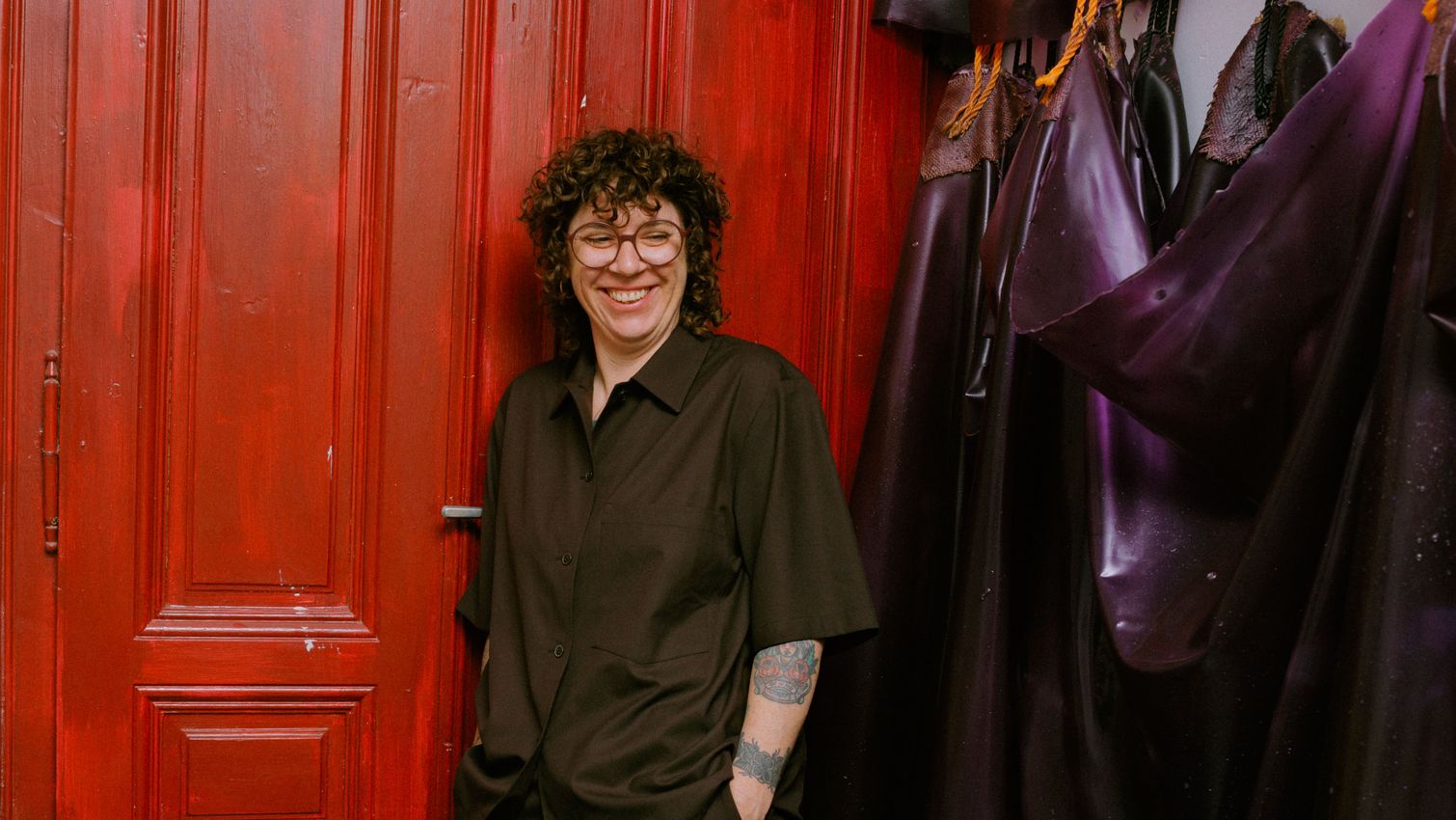
Liesl Raff’s Infrastructures for Intimacy
Liesl Raff describes latex as the kind of friend you would always wish for—‘a good counterpart and a good companion at the same time.’ Ocula talks with the artist about materiality, collective intimacy, and life as an artist in Vienna. Save to My Ocula
German sculptor Liesl Raff describes latex as the kind of friend you would always wish for—‘a good counterpart and a good companion at the same time.’
When we meet over video call on a Monday morning, Liesl Raff is at home and has just received a big delivery of firewood. ‘It’s still very cold in Vienna,’ she tells me. Raff, who is originally from Stuttgart, arrived in Austria somewhat by chance in 2003, after her applications to study sculpture in Germany were rejected and she instead took up a place on a stage design course in Graz. ‘But I’d always wanted to study sculpture,’ she says. ‘So, I decided to try again.’
In 2007, Raff was accepted to study at the Academy of Fine Arts in Vienna. Though she returned to Berlin for a short period after graduating, the more affordable, laid-back lifestyle of Austria’s capital drew her back to stay for good. ‘I had my whole network and I fell in love... All these things around me happened, so I stayed. I’m very lucky to live and work here,’ she says.
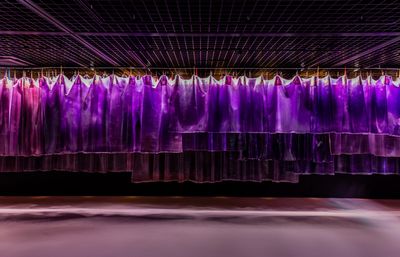
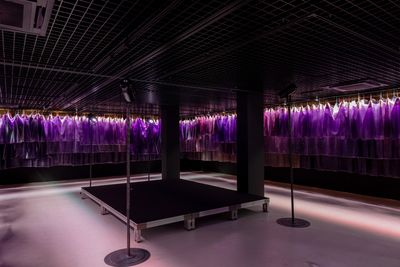
Last year, more than a decade after settling back in Vienna, Raff represented the Austrian pavilion at the 15th Gwangju Biennale with her work Club Liaison (2024), a club-inspired installation made from deep-purple latex sheets. On the occasion of her debut solo show, A Corridor, a Room, and Four Dens (7 February–21 March 2025), with Galerie Eva Presenhuber in Zurich, Ocula met with Raff to discuss materiality, collective intimacy, and life as an artist in Austria.

MK: Can you tell me about the art scene in Vienna?
LR:
There’s a nice community here and a pretty vibrant scene for contemporary art. There are two really good art universities, a lot of nonprofit artist-run spaces and institutions, and rents are not too high for studios. Not many Austrian artists have had an international career—there’s Franz West and Valie Export who have, for example, and of course there are more. But I have the feeling that galleries don’t step out so much of the Austrian scene; they keep things at home.
I wanted to open up my network in Vienna: that’s why I often work with other artists, or try to generate gatherings and social structures where I step out of my solitary life.
MK: Can you tell me about your latest show, A Corridor, a Room, and Four Dens, at Galerie Eva Presenhuber?
LR: My titles always describe what the works are. I don’t want to put too much pressure on them; it’s really very practical. Here, I built a corridor, a room, and four dens.
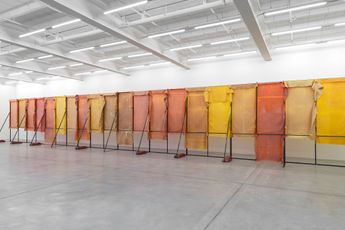
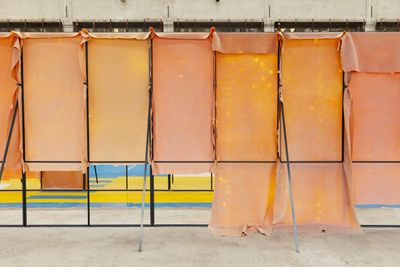
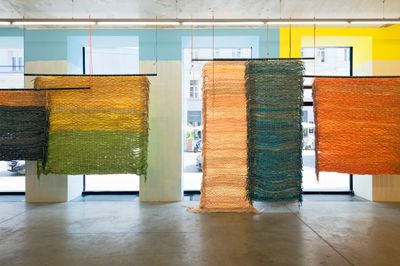
The work I did for the Lyon Biennale [corridor, 2024]—a series of metal frames that I squeezed latex sheets into—is a big part of this exhibition. I decided to transform it for this completely other space. I often make variations out of previous works. I work with natural rubber, which changes from a fluid, milky substance to these flexible sheets. Changeability is really important in my work. I don’t like things to be static.
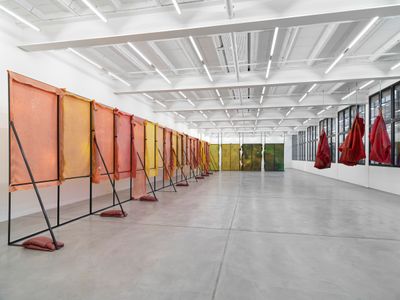
I built a corridor for people to walk through when they first enter the gallery; it’s intended to calm visitors and turn their concentration away from the city vibe on the outside. I often refer to a Luis Barragán house I visited in Mexico City. As an architect, he always included a transitional space as you entered his houses, where you settled down, took off your shoes, gave yourself time, and entered your own private space. You block out all the shit from the outside, and you’re softened a little. This corridor structure at Galerie Eva Presenhuber, it’s not architecture; it’s not a hallway: it’s more like an object which creates a social setting or a social structure.
“I love it when people leave my exhibitions smiling because it means they felt comfy and safe.
The work is also about light, and how light calms us. The orange and yellow latex in the metal frame in the corridor faces the left wall of the gallery, turning the white wall orange. It’s not mirroring the colour exactly; it’s more like a reflection. In German, we would say abstrahlen, which is a really nice word. It means ‘radiate’, but I don’t know if it fits perfectly...
The ‘room’ element of this work is about places of sanctuary and protection. I put a wall in the space, also made of metal frames with natural rubber inside. But this is cast differently; it’s two-coloured. I call it ‘harlequin’ because one side is dark and the other is bright. When you enter, you see the bright side. When you pass through the corridor and come into the room, the light is significantly less.
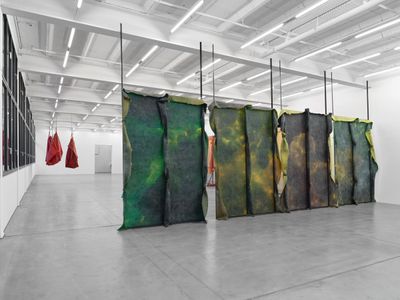
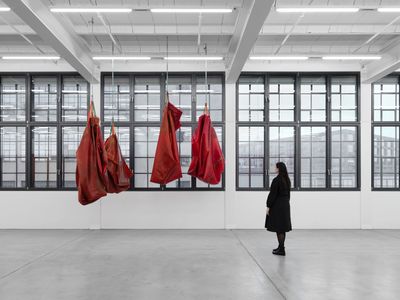
These latex sheets are cast thickly and are oversized so that the material comes out of the metal frames. There’s a tension between the hard and soft. From afar, the work looks very industrial and you don’t initially realise that it’s partially made from hand-coloured latex. When you come closer, you can see a lot of crinkles and holes and bubbles. Finally, when you leave the room, you see the four ‘dens’: objects that look like cocoons, made of latex, rope, and fabric.
My goal for every exhibition is for people to leave feeling differently from when they entered. My work explores the various emotions we all experience: from enjoying being alone at times, to hosting and gathering with others. I love it when people leave my exhibitions smiling because it means they felt comfy and safe. I like to offer the audience this kind of structure: one they can retreat to really be alone, or maybe to share this moment of reflection with others in a collective form of intimacy.
MK: Can you speak to the role performance plays in your practice and to your thinking around clubs as social spaces?
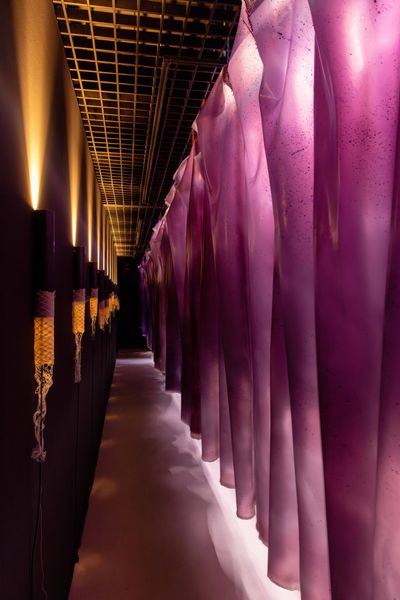
LR: With a project like Club Liaison—where I invited performance artists—I’m the host. I’m in this luxurious position as an artist, where I sometimes create spaces and then I can decide who I want to bring into them. The most necessary thing for me with those kinds of spaces is to create a protective environment for lots of different people—not just for the art bubble who understands it through art language. I want to create spaces that are open to everybody who is looking to connect.
“. . . the sheets were somehow sweating . . . when you touched them, you’d think you were touching a sweaty, nervous hand
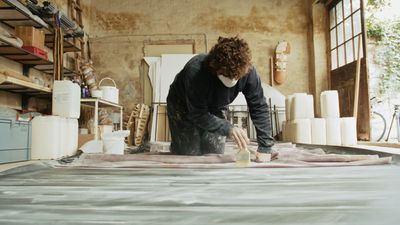
The same is true of my other works, which also look to encourage audiences to connect and to open up. They don’t offer a ‘front-of-stage’ experience, but they open up a desire in you to touch them and to stay with them and be close to them. You have a very bodily reaction. I think it’s due to the natural rubber, which is very close to our own skin, and also to how I produce them. You see my body inscribed how I cast them.
My club culture works and my sculptural objects may seem different from each other, but they’re somehow the same. A lot of my work is about dualities. There’s good and bad. There’s offensive or defensive. You can decide if you want to go on stage or remain backstage. It’s about how we behave with each other in spaces with objects.
MK: How did you decide who to invite to perform at Club Liaison?
LR: I first reached out to a good friend of mine, the performance curator Carolina Nöbauer. I love performance art, but I’m not a professional. I needed someone who could show me the best artists for the club because it was an obscure, sexy, basement cabaret-type thing. It was clear the performances should be by one or two people—the more intimate, the better. Carolina showed me a lot of artists she thought would fit with my own practice. We invited a range, from dancers to musicians, including Stina Force, Hyeji Nam, and Danielle Pamp.
There was one performance per evening. It was super lowkey. For Gwangju, I cast this translucent, sexy dark-purple natural rubber. I put a lot of silicone oil on it. I always add a layer of silicone oil or talcum powder at the end; I call it a protective makeup for my works before I send them out. In Club Liaison, the sheets were somehow sweating; they were tripping. And, when you touched them, you’d think you were touching a sweaty, nervous hand...
MK: If latex was a person, how would you describe them?
LR: Latex has the personality of a friend you would always wish for. It’s a good counterpart and a good companion at the same time. And it has a good memory. It’s dynamic, not static at all. It’s uncontrollable and has its own head, but it’s very gentle, loves cuddling, and it’s good to touch. Latex is a friendly and positive material because it’s all about adding on and not being destructive, which is important for me: I want to be surrounded by positive material.
“It’s about pairing gentle and tender things with harsh and not-so-gentle things. The metal and the latex are highly empathetic.
To use latex in casting is very old-fashioned—nowadays everybody would use silicone. But I use it because my work is also about the haptic moments I have with the material: the smell, the fact that it changes colour and gets dark. It’s like a body growing older.
MK: How should your work be taken care of?
LR: What’s really important for me is that the material is treated in a respectful way. It’s about care, and to foster the materials that are part of the work, which in my case means silicone oil or talcum because I tend to overuse them. What I really like is dripping oil or a lot of talcum. They’re not just for the protection of the work; they’re part of the work.
Every person who has one of my works needs to look after it. That’s also a part of it—you have to put talcum or oil on every millimetre of it once a year. You become differently attached, I think, to the piece when it’s yours and you have to touch it and take care of it.
MK: Your practice very much reminds me of the work of Eva Hesse, in both form and materiality. Who are your artistic influences?
LR: I love Hesse’s work. I don’t remember when I saw it for the first time, but I was attracted to her personal and intimate approach to materials. I think we share views on to how artworks should be put together and displayed so that people can encounter them. It’s a lot about relationships—how you relate to others and to the materials, and how those relate to each other. It’s about pairing gentle and tender things with harsh and not-so-gentle things. The metal and the latex are highly empathetic. These metal frames become gentle somehow, and the latex, through this metal connection, becomes strong.
Another artist who is a big influence on me is Isa Genzken. In 2023, I saw her retrospective at the Neue Nationalgalerie in Berlin—it was mind-blowing. She works a lot in series, which I also do, because I get more confident with the repetition. I mostly do five or six in a series, then I feel secure enough to kick them out of the studio and show them to others. I’m a busy bee but a slow bee: I take my time. I love producing; it’s my favourite thing. —[O]
Liesl Raff: A Corridor, a Room, and Four Dens is on view at Galerie Eva Presenhuber in Zurich from 7 February to 21 March 2025.
Main image: Liesl Raff. Photo: © Marcella Ruiz Cruz.


A respected voice in contemporary art discourse.
Focusing on ambitious storytelling and insightful art-world commentary. Ocula Magazine publishes in-depth interviews, critical essays and timely analysis on the artists, exhibitions and ideas driving the global art world.
Learn more about Ocula Magazine
Showcasing the best of the art world.
Ocula partners with galleries from around the world to highlight their artists, artworks and exhibitions. Gallery membership is by application and invitation, with each member vetted by an independent panel.
Learn more about Ocula Membership
Specialises in the sale of major artworks.
Led by a team with deep ties to the world’s leading auction houses, galleries and collectors. Ocula’s advisory team offers bespoke services to high-net-worth clients from around the world who are looking to acquire the best of contemporary and modern art.
Learn more about our team and services