





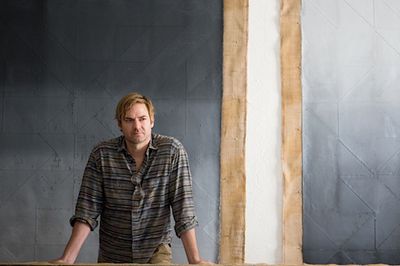
This year, Mark Hagen presented an exhibition essentially split in two parts: the first part being shown in the London space of Almine Rech Gallery, and the second part making its appearance at the gallery’s booth in the 2014 Frieze London art fair. Both bodies of work are exemplary of Hagen’s love affair with material and form, but are also contrasted in colour. For the gallery show, Hagen presented paintings constituting white acrylic pushed through burlap over titanium frames anodized with Diet Coke, shown alongside sculptures produced from volcanic glass, epoxy on aluminum and honeycomb panels. Meanwhile, at Frieze London, Hagen presented gradient paintings and sculptures, in which black acrylic on burlap paintings framed sculptures employing luminous colour gradiations. In this interview, this LA-born and based California Institute of Arts graduate (who studied with Michael Asher, Charles Gaines, Leslie Dick and Sam Durant) discusses the processes behind making his work, and the influences that shape his practice.
Let’s start with your exhibition in London at Almine Rech Gallery, A Parliament of Some Things, which presents sculptures and paintings that allude to minimalism and post-minimalism. First, could you talk about the process in making the works presented here? They have been produced by pushing paint through burlap onto glass planes supporting sheets of wrinkled wrapping plastic, lengths of packing tape, and geometric configurations of cut tile, which reflect the construction of your sculptures.
The various historical movements that these works might appear similar to are not the precedent for the work. There was never a moment when I decided, “Hey, I like post-minimalism, let’s make something that looks like that.” The appearances of the work are the result of my selections of specific materials and methods of making that satisfy my interests. My paintings are produced horizontally, pushing acrylic exterior house paint in white or black—or blends of the two—through burlap onto substrates underneath, plastic sheeting, glass, packing tape, plastic tiles, venetian blinds, even body bags. Gravity and the painting’s own viscosity drives it into the recesses and after drying makes a cast or an analog of this substrate. The paintings are essentially low relief sculpture and in turn, my sculptures are usually painterly.
Could you explain the title of the exhibition, and how it conceptually frames the works on show?
The title comes from a philosophical concept of Bruno Latour’s describing a governmental body in which all things, real and imagined, have equal representation or agency. The agency of artists and of art works is one of my concerns and I design many of my pieces with the possibility of expansion, subtraction, enhancement, and so on, in an attempt to extend their agency in space as well as time.
There is a part of a sculpture in the exhibition called ‘a parliament of some things’, which is a twelve panel, screen-like sculpture made of honey-comb aluminum panels skinned with volcanic glass and titanium sheeting anodized with diet colas. Here it has been divided up into four discrete sculptures, but conspicuous pinholes on the panels reveal the potential for future additions and permutations.
How does this exhibition build on your practice as a whole? I am thinking about past projects, such as your space frame installations, which included a collaboration with D.A.P Artbook to produce a framework at the entrance of Los Angeles Contemporary and bespoke bookends made from polished coprolite.
This London exhibition and my solo booth at Frieze were originally conceived as one show for one space before the opportunity to split them up came about. One grouping would focus on expanding on sculptures and paintings people would be more familiar with, while another grouping introduces new pieces entirely. My space frame—which doesn’t make an appearance here—but is indeed in sympathy with the sculptures that do, I conceived and designed as a catch all for my sculptural aspirations. It can be a discrete sculpture, or an intervention, or a display device, or an alternative space for other works. Like my other sculptures, it aspires to a democratised, sculptural nomadism, all the while approaching the architectural and the monumental yet opposing both with their typical venerations of power, hierarchy, and permanence.
How does this current show also feed into your experiences studying in California and having worked as an assistant to Sam Durant? In this I am also thinking about the aversion you noted to the so-called fetish finish of LA art.
I went to CalArts and studied with Michael Asher, Charles Gaines, Leslie Dick and Sam Durant and worked as Sam’s assistant after school briefly. I don’t have a problem with any of the artistic movements that have come out of California, I just avoid some of the physical, material aspirations of certain ones like “fetish finish”, as they seem too easily aligned with commercial products and interests.
In this, who or what has influenced you as an artist in terms of artists, movements, and techniques amongst other references?
Hans Haacke’s Condensation Cubes and his Shapolsky et al. have always been huge for me, and Seth Siegelaub’s Artist’s Right’s Contract, Edward James’ Las Pozas in the Yucatan, the space frame works of artist/architects Yona Friedman and Constant Nieuwenhuys, the concrete works of William George Mitchell, Dieter Roth’s early books, Olaf Metzel’s Auf Wiedersehen. I also always find inspiration outside of art: the ancient cities of Cahokia and Lalibela, for instance, epigenetics, generational theory, the discovery of exo-planets, the rights of uncontacted tribes, Neanderthal art, animal personhood, ancient Egyptian cement, and African fractals.
Certain phrases and words used to describe past exhibitions have included ‘techno-futurist’ and ‘up-to-date primitivism’. How would you describe your work in a few words?
I’m interested in the breakdown and complication of qualitative hierarchies, history, and vision. As well as the destabilizing effect exploring the origins of things has. Asking, “How could it have developed differently?” conjures unrealised trajectories and sets the stage for change. —[O]



A respected voice in contemporary art discourse.
Focusing on ambitious storytelling and insightful art-world commentary. Ocula Magazine publishes in-depth interviews, critical essays and timely analysis on the artists, exhibitions and ideas driving the global art world.
Learn more about Ocula Magazine
Showcasing the best of the art world.
Ocula partners with galleries from around the world to highlight their artists, artworks and exhibitions. Gallery membership is by application and invitation, with each member vetted by an independent panel.
Learn more about Ocula Membership
Specialises in the sale of major artworks.
Led by a team with deep ties to the world’s leading auction houses, galleries and collectors. Ocula’s advisory team offers bespoke services to high-net-worth clients from around the world who are looking to acquire the best of contemporary and modern art.
Learn more about our team and services