






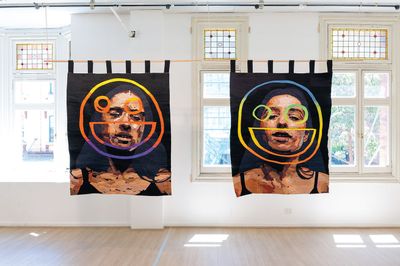
Abdul Abdullah, Don't worry and Be happy (both 2016) (left to right). Embroidery. 150 × 120 cm. Made with the assistance of DGTMB Art Embroidery. Courtesy the artist, Fehily Contemporary and 4A Centre for Contemporary Asian Art. Photo: Document Photography.

Sydney-based artist Abdul Abdullah is the ‘outsider amongst outsiders’, with an interdisciplinary practice that explores the misconceptions and misunderstanding of minority groups in a multicultural society. Born to a sixth-generation Australian father and a Malay migrant mother, Abdullah is the epitome of the contemporary urban Australian. His practice is informed by his experience growing up in suburban Perth, where his embodiment of multiculturalism proved to be confronting for many.
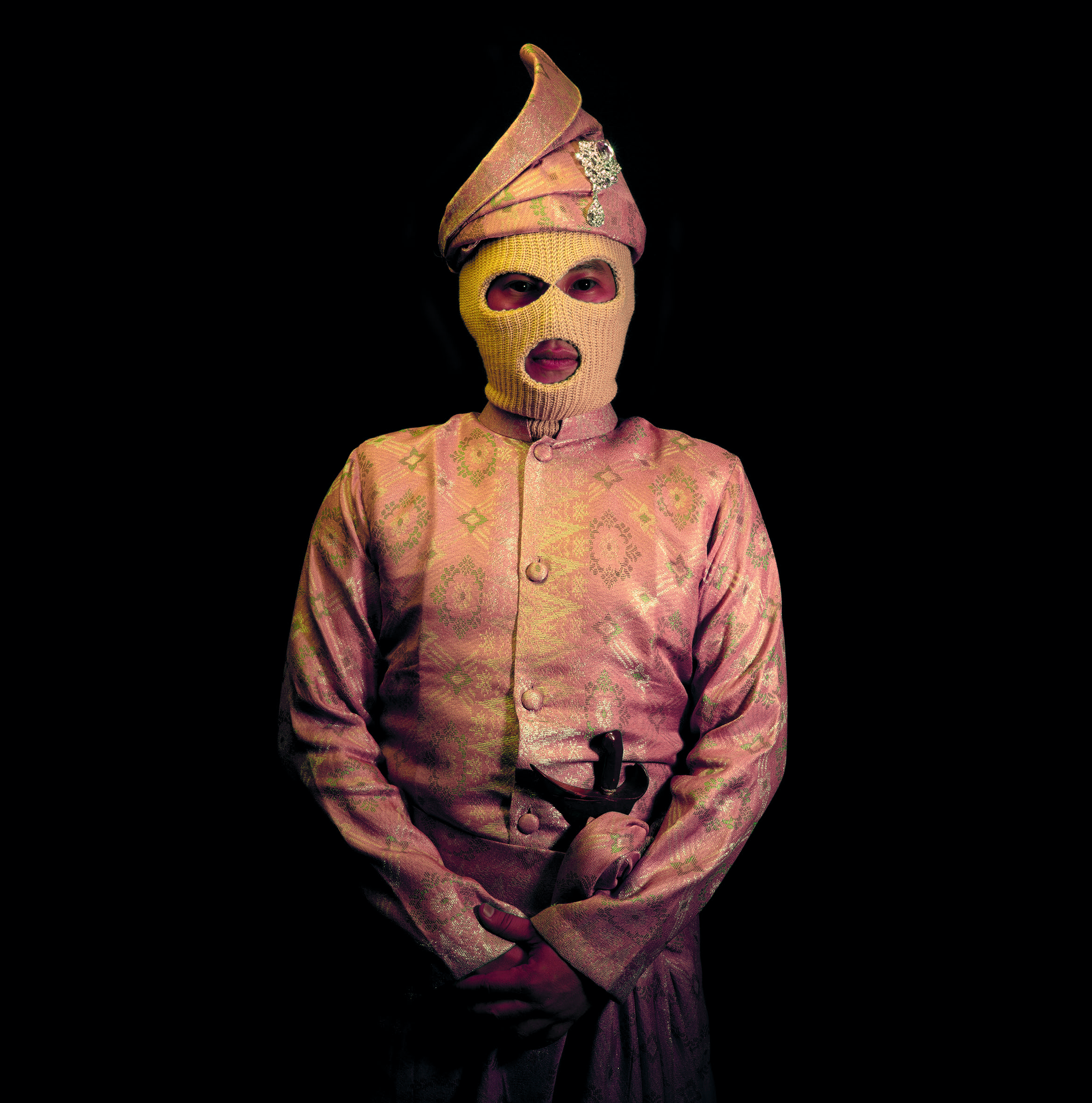
As a young Muslim Australian, Abdullah ensures his practice knits the fringes of society together. He doesn’t shy away from controversy nor is he eclipsed by it; rather, his work contains carefully crafted political commentary that highlights similarities rather than differences and challenges his audience to be better informed. The images he presents are evocative and embedded with contemporary references for the viewer to decode. These mash-ups are interwoven from popular culture, contemporary conflicts and family traditions that together confound cultural divisions. Through the development of his own symbolic rhetoric, Abdullah’s work disintegrates the partitions that criss-cross society and, rather than producing a discordant confusion, reveals similarities through such intersections.
I’m going to start with a big question. Who is your work for? Who is your audience and who is your intended audience? I ask this because there’s substantial writing and commentary about the content of your work, but I’m interested in who you are seeking to address.
It’s a really tricky question. I’ve actually been thinking about it a lot recently, as I have found myself asking other artists the same question about their work. What I’m doing, what I have decided I’m doing and what I have always been doing—without necessarily realising it—is creating a legacy of cultural artefacts to be discovered by the nine-year-old version of me. These kids are out there now—in Bankstown in Sydney, East Cannington in Perth or Sunshine in Melbourne. Living a little bit on the fringe and just discovering that they are a little bit different. Or that the perception of them is that of ‘the other’. They may not be able to articulate that yet, but they will be starting to feel different. So hopefully I am leaving clues for them. And while I acknowledge that they may not necessarily discover them straight away, they are there to, hopefully, comfort someone else going through an experience similar to mine.
I think this intent is so clear and so palpable in your work: your search for solace as a young child critically informs the manner in which you create and practice today. You use terms such as ‘legacy’ and ‘cultural artefact’ as if you are envisaging your works historically. It makes me feel that you are making work for people to see now, but remember later.
I like that. I do feel like I’m planting seeds. When I was eight, my mum took me to the Art Gallery of Western Australia [in Perth], I found a Juan Dávila painting and it was a seed for me to eventually pursue art. His work showed me some of the things that were possible.
Your work speaks to that nine-year-old kid inside of me, but I am always in awe of how many people are also affected by your work. There are clearly many people with a nine-year-old inside of them for whom your work resonates. Does this surprise you?
It really surprises me and I find it particularly heartening when I get an email from a kid who has discovered me through their high-school art class, but who relates to what I am talking about in my work and has taken the effort to email me. I find that particularly interesting. It might sound high-minded, but it has been a priority of mine to have a generous practice. By that I mean I want to offer several access points—whether they are aesthetic, conceptual, historical or political. I want there to be a number of ways for the audience to enter the conversation. The idea of elitism bugs me out.
Your work does feel generous and accessible, reflecting this underlying inclusive nature. In this vein, I feel it speaks of an Australian locality that isn’t bound by borders, but is porous and curious about the region it sits within. You draw links between Australia and the Asia-Pacific and embed shared symbols of the area in your works. You travel often in Southeast Asia and, most recently, travelled extensively in Indonesia and Malaysia. Is this fieldwork research an integral part of your practice?
It is absolutely part of my research and it is strategic in some ways, as I position myself as an artist in the region as opposed to an ‘Australian’ artist. I think in generations past, our regional neighbours, who are so strong creatively, were not engaged very often by Australian artists. However, with our generation, one of the good side effects of globalisation is that we can connect quite quickly over the internet. Another one of the privileges of living and practicing in Australia is the fact that I can afford to go to these places. So I feel that if I have the capacity to travel in Southeast Asia, then I have a greater responsibility to connect artists in these different spaces. And I am not taking credit for all of these connections, but I really want to contribute to this network as much as I possibly can. Beyond my practice, it is important to build relationships between artists in different communities.
These connections between Australia and Southeast Asia are growing exponentially and are occurring between organisations, curators and artists, ensuring that networks of cultural engagement inform our region. The growth of international artist residencies and exchange and visiting programmes has changed the way artists work. You recently undertook a residency in Yogyakarta. Did it have much of an effect on your practice?
Massively so. I have spent quite a bit of time in Southeast Asia, working and researching, but in Yogyakarta—a city saturated with artists—meeting an artistic community with such a collective mentality was amazing. These collectives, without any government support, have come together to support each other in producing work. They have self-funded to support each other, ensuring that they are not only independent but also not obligated to anyone’s interests other than their own. I think that is fascinating, and the conversations that they are having are really relevant and applicable to the entire region—if not globally—and that was also really interesting.
I think your response and engagement with the region are being reflected back with a growing level of interest in your work. Just recently in Dubai, you had several Singapore-based collectors who were interested in your work but were surprised you are Australian. Have you considered that when exhibited internationally, your work complicates people’s understandings of Australia and Australian art?
I think Australia projects itself in a particular way that doesn’t necessarily reflect the reality of the situation: the faces on our city streets in Australia are really racially, ethnically and culturally diverse, and this is not reflected in our mass media and how we present ourselves globally.
But, through art, we can?
Through art we definitely can. And we are really trying. —[O]
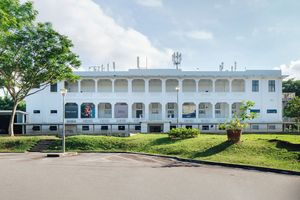
This interview was first published in Art-In-Sight by Gillman Barracks, and it is now reproduced here in full with the permission of National Arts Council of Singapore (NAC). In 2017 Ocula was pleased to partner with NAC to produce the print publication Art-In-Sight to mark the fifth anniversary of Gillman Barracks. Gillman Barracks is a visual arts cluster that was set up to present and generate discourse on international and especially Southeast Asia art. Art-In-Sight features interviews with key figures involved with Gillman Barracks, including artists, collectors and gallerists, alongside wide-ranging essays that survey Gillman Barracks through various lenses. You can view the full book online by visiting Gillman Barracks website here.
Main image: Abdul Abdullah, Don't worry and Be happy (both 2016) (left to right). Embroidery. 150 × 120 cm. Made with the assistance of DGTMB Art Embroidery. Courtesy the artist, Fehily Contemporary and 4A Centre for Contemporary Asian Art. Photo: Document Photography.



A respected voice in contemporary art discourse.
Focusing on ambitious storytelling and insightful art-world commentary. Ocula Magazine publishes in-depth interviews, critical essays and timely analysis on the artists, exhibitions and ideas driving the global art world.
Learn more about Ocula Magazine
Showcasing the best of the art world.
Ocula partners with galleries from around the world to highlight their artists, artworks and exhibitions. Gallery membership is by application and invitation, with each member vetted by an independent panel.
Learn more about Ocula Membership
Specialises in the sale of major artworks.
Led by a team with deep ties to the world’s leading auction houses, galleries and collectors. Ocula’s advisory team offers bespoke services to high-net-worth clients from around the world who are looking to acquire the best of contemporary and modern art.
Learn more about our team and services