





The art world in focus
Subscribe to our newsletter for news and insights on artists, galleries and exhibitions.


I met Le Huu Hieu (also known as Henry Le) in Ho Chi Minh City in April at the same time as his public exhibition From the Victory of Bach Đằng to the Great Victory of April 30, 1975, presented during the 50th anniversary celebrations of the Reunification of North and South Vietnam. The show occupied a section of the centrally located Nguyen Hue walking street with an enormous lacquer painting, dozens of sculptures, and mixed-media installations.
Themed around Bach Dang, the site of a naval victory in 1288 when Vietnamese forces defeated an invading Mongol fleet by luring them into a river and impaling their ships on hidden wooden stakes, Hieu’s installation featured dozens of ghostly, eviscerated figures in front of a massive lacquer painting. Two years in the making and measuring 38 square metres, it is one of the largest-ever Vietnamese lacquer paintings. Wooden stakes, sourced from Bach Dang forest, stood in clusters, and at the centre of it all was a life-sized tank flipped upside down and impaled on the spikes—a shockingly irreverent gesture, given the tank is always triumphantly featured in Reunification Day propaganda posters.
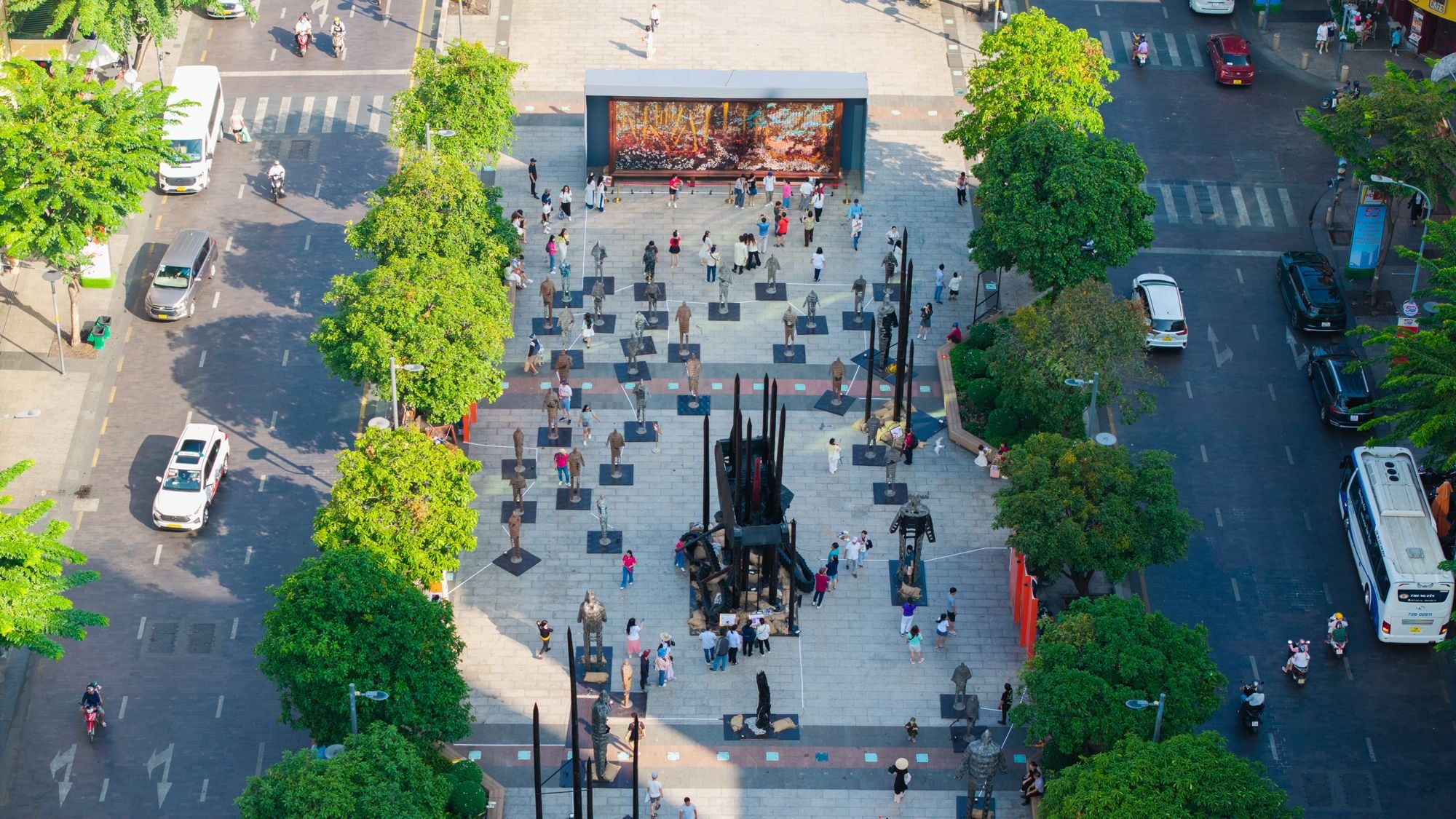
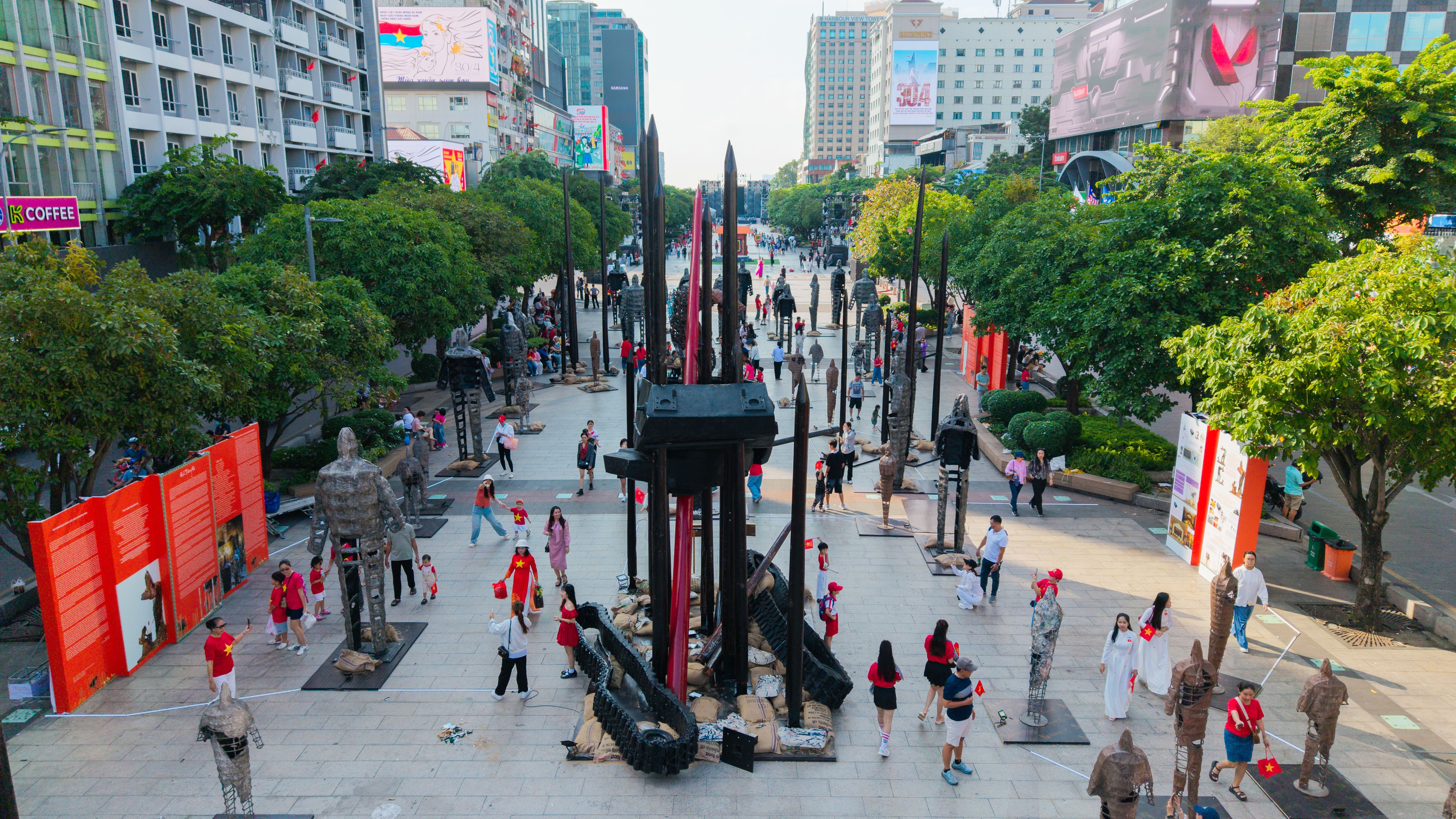

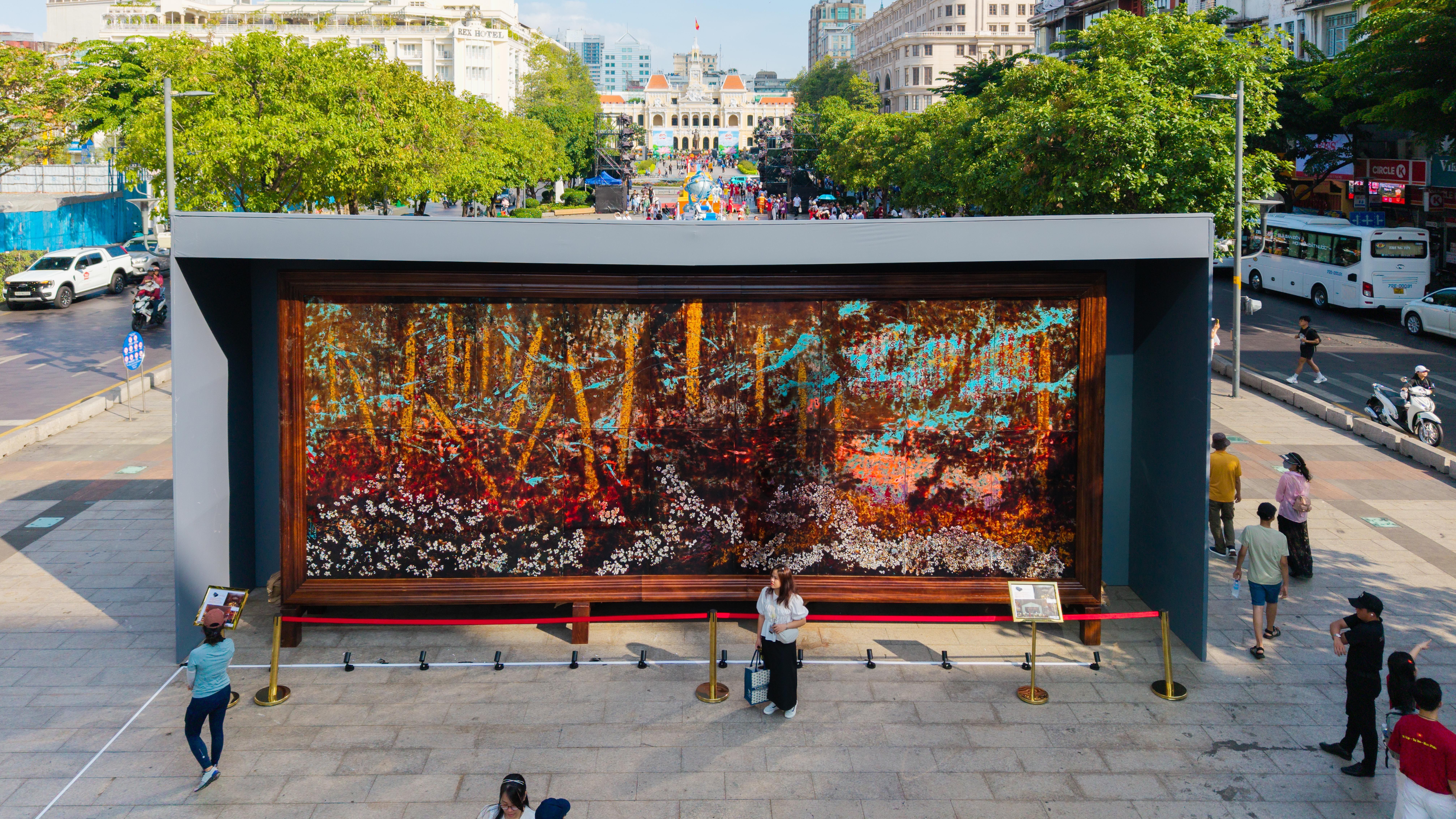
Contemporary artists in Vietnam are almost never afforded the opportunity to exhibit in public when there are matters of political significance at stake. Le’s pop-up show—officially sanctioned by the state and presented just steps away from a statue of Ho Chi Minh himself—marked a notable exception to that rule. His work, while nationalistic in many regards, is not the type of didactic work typically favoured in state-sponsored contexts. The decision to present the work of an unconventional contemporary artist as part of a historic national celebration indicates a shift in the appetite for experimentation with how history is visualised in public space. Millions of Vietnamese people visited the show over the course of its two-week run, and for many of them it was the first time they encountered contemporary art in their entire life.
It’s difficult to understate just how restrictive public policy toward art has been in Vietnam since the end of the war in 1975. It wasn’t until the era of Doi Moi (‘Renovation’) in the late 1980s, when market economics were reintroduced, that artists gained a modest degree of creative freedom. To this day, most galleries avoid applying for the legally mandated exhibition permits—fearful of inviting scrutiny from the authorities, who censor anything that might be construed as casting Vietnam in a negative light.
This year, however, the government allowed not one but two contemporary artists to make public artworks touching upon histories of war and colonialism: alongside Le Huu Hieu’s work, a permanent sculpture by Tia-Thuy Nguyen.
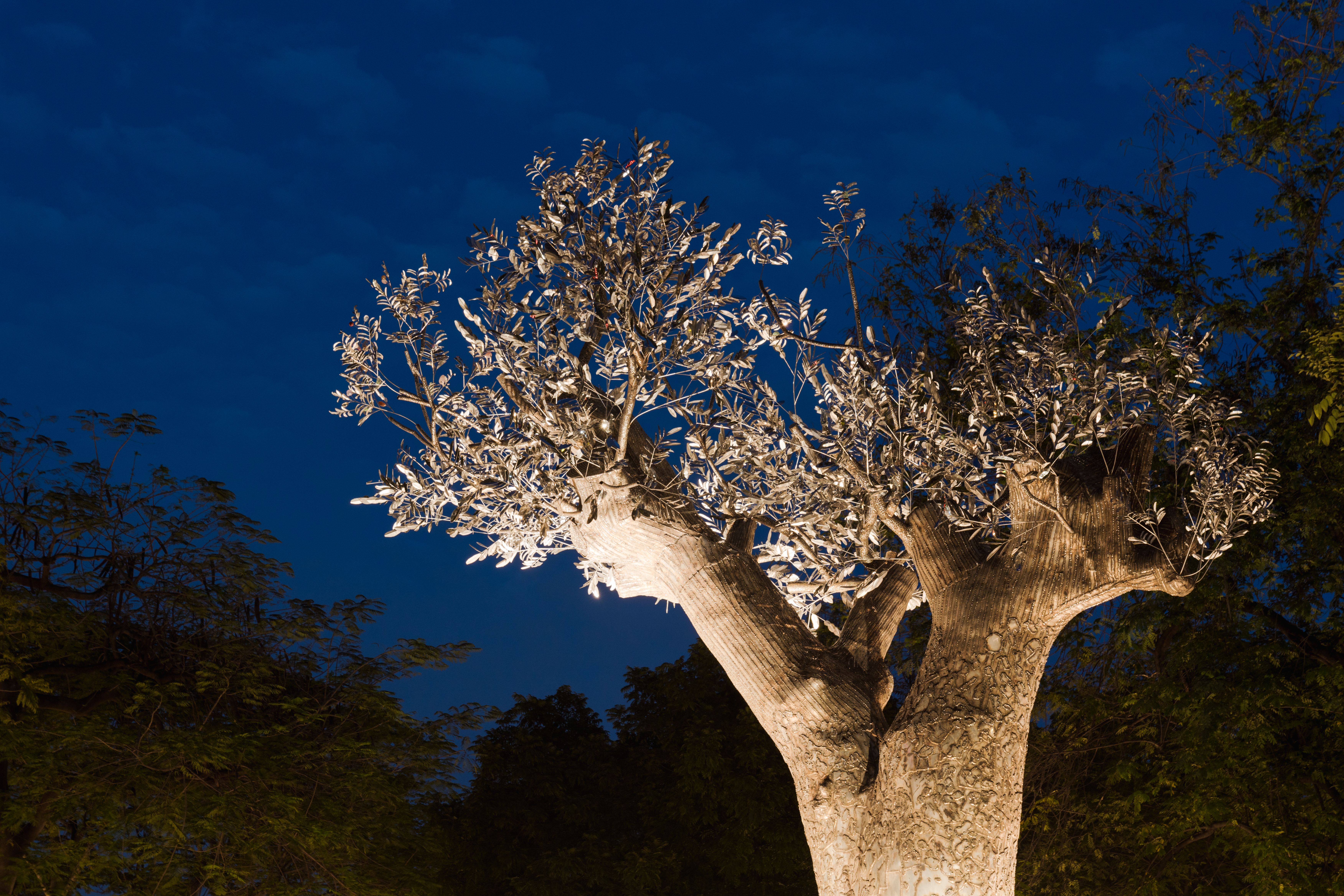
It began in early April with the installation of Tia-Thuy Nguyen’s work Resurrection in the heart of the capital, Hanoi. In 2024, a typhoon hit Hanoi and destroyed 25,000 trees—including a 20-foot-tall Nacre tree in Co Tan square, which Nguyen encased in gleaming silver steel. The choice of tree was significant: Nacre trees were imported by the French from their colonies in Africa. Traditionally, any public monument acknowledging French colonisation would focus on valorizing those who fought to eject them. By contrast, Nguyen’s sculpture memorialises the legacy of French urban planning and trans-colonial cultural pollination in a semiotically polyvalent manner—an approach which would typically make the authorities uncomfortable.
Le’s installation in Ho Chi Minh City dealt with the even touchier topic of the American War and the Fall of Saigon. To understand what made his exhibition so exceptional, it helps to share a bit more context on the history of public art in Vietnam.
In the ‘90s, public contemporary art was only ever executed in guerrilla fashion—like when the artist Dinh Quan installed a series of screaming face sculptures on the banks of the Red River in Hanoi in 1996, a commentary on stifled artistic expression. It wasn’t until 2006, with the liberalisation of the economy in full swing, that a serious effort was made to bring contemporary art into the public eye. That’s when Dinh Q. Le teamed up with Thai artist Rirkrit Tiravanija, the curator Gridthya Gaweewong, and the art dealer Mai Do to stage a sprawling art festival called Saigon Open City.
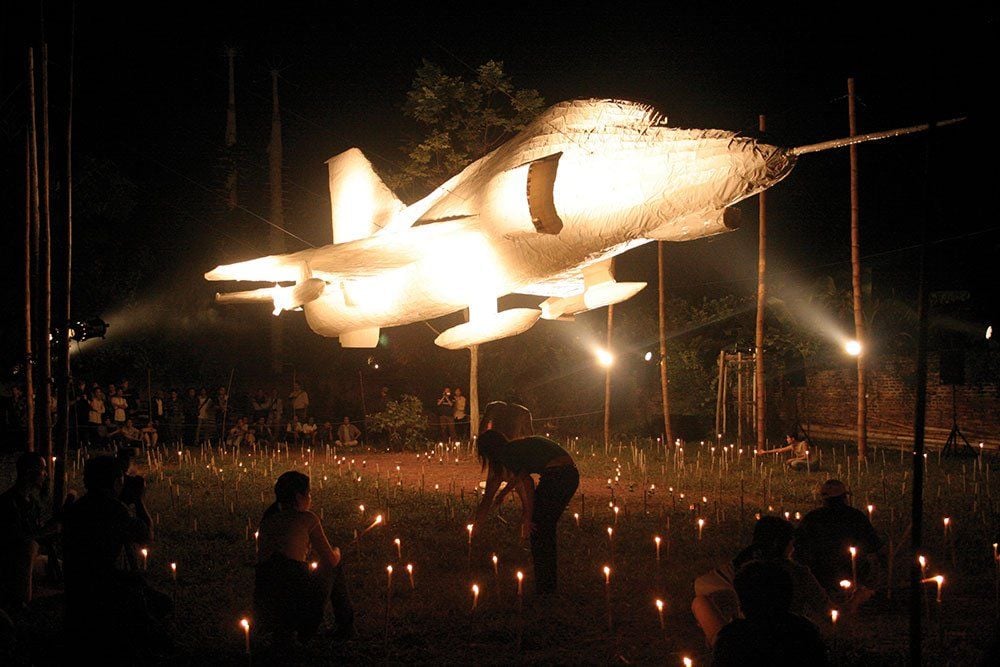
Aiming to ‘promote an awareness of contemporary art to the general public’, the festival planned to show a public artwork by Nguyen Manh Hung and Bradford Edwards titled Flight (2006): a life-sized fighter jet made of bamboo and rice paper. Hung’s father flew a MiG-21 during the war, and Edwards’ father flew a F-4 Phantom, so they combined the two jet designs together. The work was originally displayed at the Hanoi home of Dao Anh Khanh (a former police officer turned artist). Then it was installed on the lawn of the Ho Chi Minh City Museum of History, but the permit was revoked. ‘A jet is a destructive instrument,’ said Edwards, ‘but by using simple materials, we’re creating something soft and harmless and beautiful’. Perhaps the authorities did not wish to soften the memory of the war.
That marked the last time anyone tried to mount a politically sensitive, large-scale public artwork in Ho Chi Minh City—until this past April, when Henry Le presented his epic pop-up installation on the most prominent street in the city. The 50th anniversary celebrations were a tremendous affair, drawing massive crowds for parades, fireworks, drone shows, concerts—and Le’s installation, the only officially sanctioned contemporary artwork in the celebrations.
The reception was not without controversy. Members of the conservative art establishment bristled that an outsider (someone outside the state-regulated National Arts Association) was given such a platform. Many on Facebook said it wasn’t conventionally beautiful. Some contemporary artists privately dismissed the tank as ‘kitsch’, or the entire show as ‘propaganda’. On the other hand, art critic Ly Doi publicly called it a ‘risky exhibition’ and ‘a blessing for the whole city’.
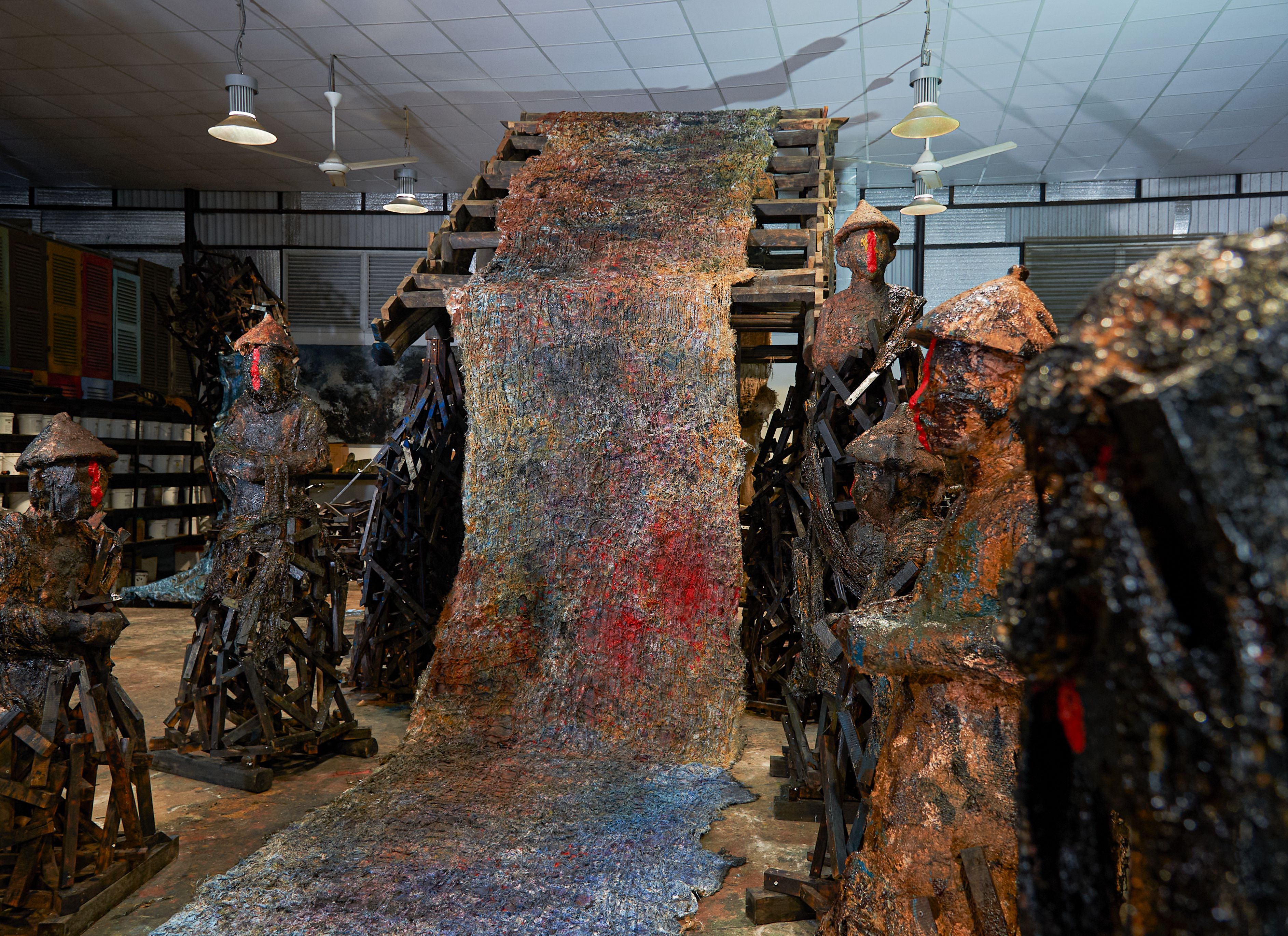
To most people in Vietnam it seemed as if Le appeared out of nowhere, but he has been building his career internationally for years—at the 2017 Florence Biennale, and then in 2021 in Venice, where his privately sponsored exhibition Soul Energy at the Arsenale Nord caught the attention of the Venice Biennale team. He was subsequently invited to officially represent Vietnam in the 2024 Venice Biennale, becoming the first Vietnamese artist to receive the honour. The cultural ministry declined their support, so he showed anyway with the help of private backers. Le has been invited once again to represent Vietnam in 2026, and now negotiations are allegedly underway for the country’s first-ever government-backed national pavilion, featuring a solo presentation of his work.
I met Le on Reunification Day. He looked exhausted but pleased, watching the crowds wander among his sculptures. I asked if it was hard to get the permit. He nodded and said he couldn’t have done it without help from his patrons—and some divine intervention, as he had hired a spirit medium to clear ancestral curses. At one point, a passerby asked him if he knew the meaning of the work. Hieu grinned and feigned ignorance, letting them interpret for themselves. Then he wandered off to savour the experience of watching countless Vietnamese people of every age and from every walk of life engaging with his work—an occurrence which, just maybe, could signal a brighter future for art in Vietnam. —[O]
A respected voice in contemporary art discourse.
Focusing on ambitious storytelling and insightful art-world commentary. Ocula Magazine publishes in-depth interviews, critical essays and timely analysis on the artists, exhibitions and ideas driving the global art world.
Learn more about Ocula Magazine
Showcasing the best of the art world.
Ocula partners with galleries from around the world to highlight their artists, artworks and exhibitions. Gallery membership is by application and invitation, with each member vetted by an independent panel.
Learn more about Ocula Membership
Specialises in the sale of major artworks.
Led by a team with deep ties to the world’s leading auction houses, galleries and collectors. Ocula’s advisory team offers bespoke services to high-net-worth clients from around the world who are looking to acquire the best of contemporary and modern art.
Learn more about our team and services
