





Massimo Giannoni: Painting the Space Between Order and Chaos
Save to My Ocula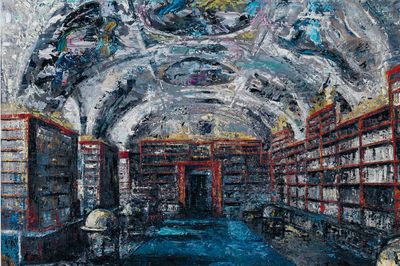
Massimo Giannoni, _Biblioteca_ (2017). Oil on canvas. 120 × 150 cm. Courtesy the artist and Partners & Mucciaccia Modern & Contemporary Gallery, Rome/Singapore/London/Cortina D'Ampezzo.

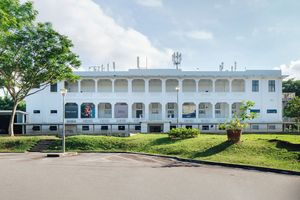
Massimo Giannoni is an Italian artist living and working in Florence. His paintings bear the influence of the old master works that abound in Italy, and remind one of the grand interiors in Renaissance paintings, with deep tones and a strong command of perspective guiding the eye through architectural space. Simultaneously, however, Giannoni imbues his work with a contemporary sense of anxiety. Rather than ones of stoic remove, he makes paintings filled with an emotional intensity that destablises the underlying structural order. This duality is achieved through a painterly bravado that brings together the formal and the expressionistic with a technical multiplicity that remarkably cohabits a single plane.
Since the mid-1990s—following his return to Italy after living for a time in the United States and Australia—central and reoccurring themes of the library (public and private), the bookstore and the stock exchange have frequented Giannoni’s work. Gradually, a conversation has unfolded between these subjects, traversing ideas about time, place and the dissemination of information.
Giannoni has exhibited his work widely, most notably at the 54th Venice Biennale in 2011 (4 June–27 November 2011) where he was one of the artists to be selected to represent Italy in their pavilion. I spoke with Giannoni following the opening of Panopticon, his first solo show in Asia, at Partners & Mucciaccia, Singapore (12 May–24 September 2017).
Can you discuss the importance that books hold for you as a subject matter, and why you have chosen to present them throughout your practice?
I have always been a regular at bookstores and was fascinated by the colours of the book covers lined up on the shelves and by everything that those covers contained: many stories, lives and destinies.
One of these bookstores in particular, the Seeber bookstore in Florence, also had large tables where books were arranged not in a symmetrical way but in a sort of disordered symmetry that reminded me of the skylights in rooftops as I had seen them from above. In all this I found the inspiration for my art.
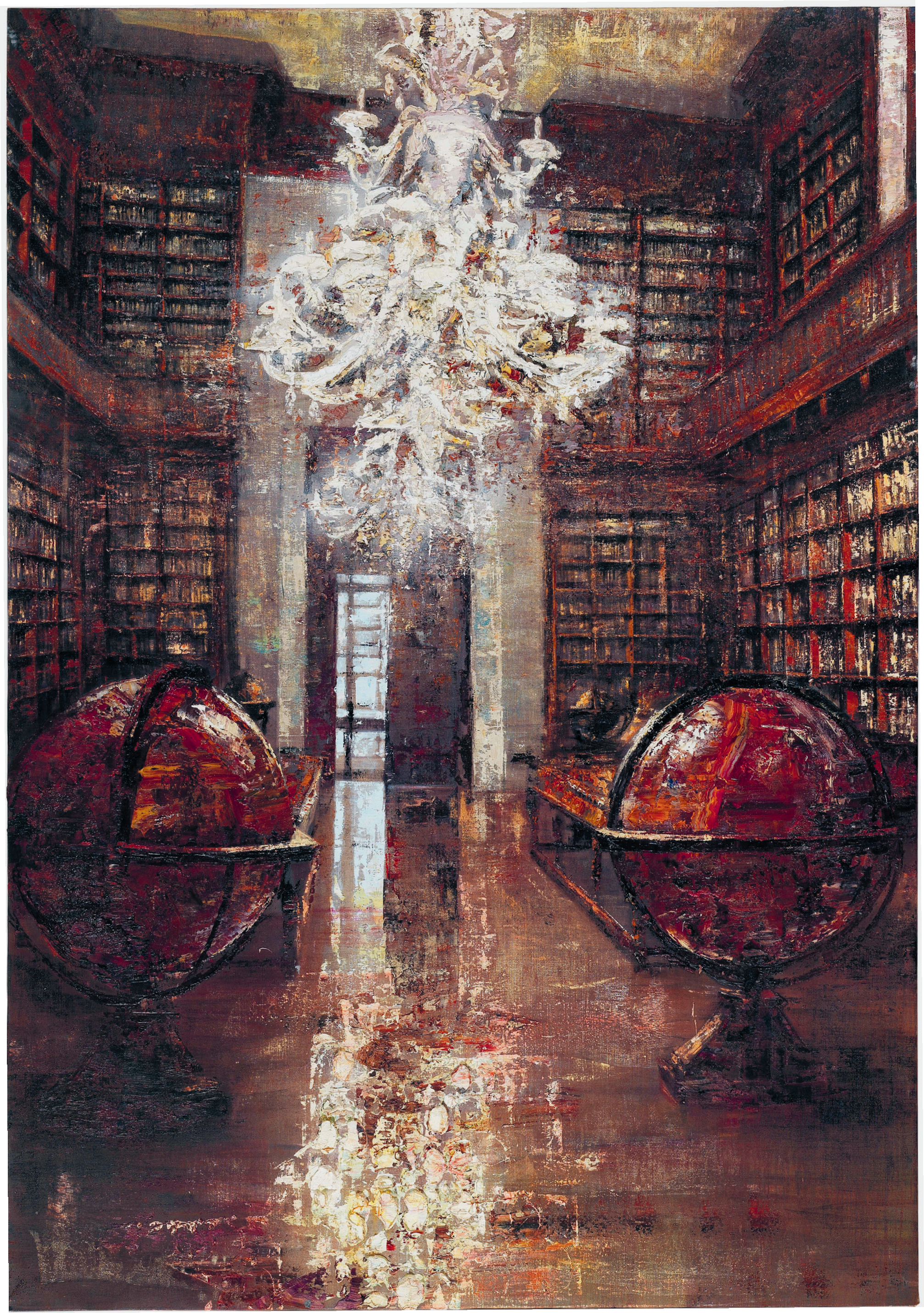
The books you paint in the spaces of public libraries and bookshops are orderly, stacked in shelves or purposefully arranged and displayed. The books depicted in the private spaces, however, are in disarray, strewn on the floor, left open, abandoned mid-read. The bookshelves gape where books once stood, and a sense of anxiety permeates these spaces. Why the difference in the treatment of the literary contents that they hold?
In public libraries and bookstores, what prevails is a sense of conservation and orderly cataloguing. The books are ready to be extracted from the shelves to reveal their stories and the destinies of their writers. In private spaces, on the other hand, books have been accumulated and used by different generations of the same family. What I meant to represent is how a change of one generation can turn what was order and reflection into disorder and abandonment. What survives is only the perspective of the empty shelves that extend towards infinity, beyond the picture frame, waiting for a new generation to restore order and accumulation.
How do your literary spaces relate to your series of stock exchanges? What is the conversation between the two in your latest group of work presented in Panopticon at Partners & Mucciaccia?
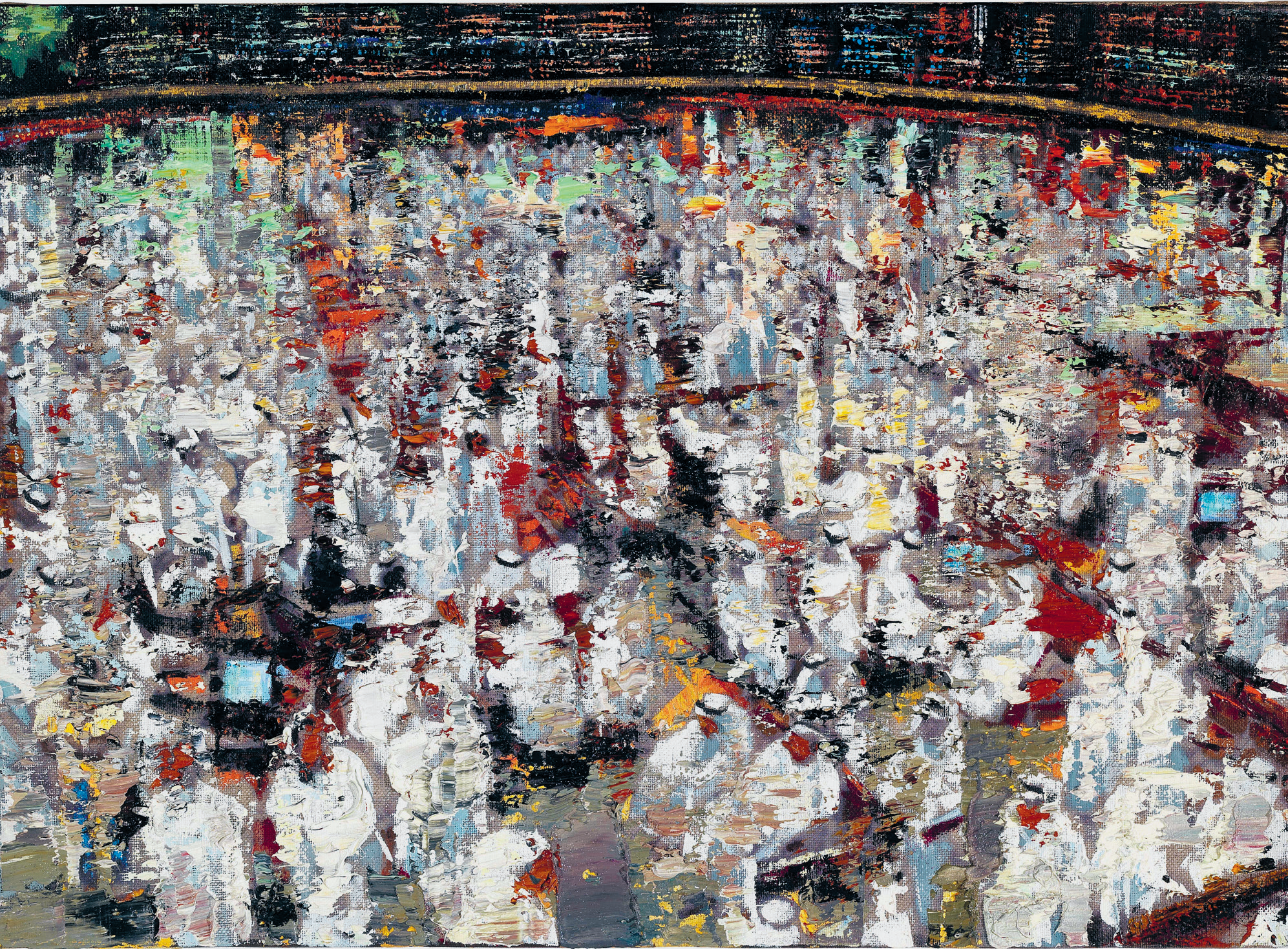
In both the bookstore and library series, the accumulation of information is static, while in the stock exchange series the accumulation of data is fast, ephemeral and determined by the flashes of the acid colours of luminous LED lights that envelop the brokers inside the stock exchange. I am fascinated by the contrast between these two.
Your libraries and bookshops are devoid of figures, whereas your stock exchange images vibrate with human presence. However, even when the figure is present, you tend to abstract it almost to the point of obfuscation. What is the importance of the figure in your work, and how do you choose where, when and how to present them?
In the works of bookstores and libraries, I almost never represent figures. They are nonetheless present in the solidity of the stories they have told. In the stock exchange works, on the other hand, the human figure is almost always fleeting, impersonal, with the face burnt out by the reflections of the LED lights.
Your technical range is wide, bringing together a virtuoso use of impasto, using a spatula to scrape and build up paint, with the ability to flatten and wash. You have a knack for sumptuously drawing paint across the canvas as though it has been visited by Richter’s squeegee, as well as an understanding of the power that can be harnessed by leaving areas of the canvas raw and untreated. Can you speak to what you aim to accomplish by bringing all of these techniques together within a single plane?
I always start from a natural linen canvas, and at the end of the painting process there are always spots where one can see the original weaving of the canvas. The history of painting, from ancient Rome until the 20th century, has been long, and the evolution of modern painting can therefore only be minimal. Essentially, in recent years, art has evolved only conceptually, not technically. My challenge is determined by the drive to represent figurative images through a technique that does not represent subjects but that represents itself. My spatula strokes are completely disconnected from what they represent. For this reason, I want to draw attention to two subjects that I have brought to Panopticon: a view of Singapore and one of Florence. These are quite unusual works for me, but I realised them to pay homage to these cities. They are subjects of a disarming banality, two postcard images, nevertheless constructed with a technique so charged with matter that it has turned them into an almost impossible challenge.
Visually, your paintings oscillate between order and chaos—the architectural and perspective lines that mark the rooms appear to be in constant battle with paint applied expressionistically, which abstracts and levels the image. The image seems to be simultaneously in a state of becoming and deconstruction. What is this metamorphosis that we are witnessing?
I was born in Tuscany, the homeland of perspective and of the Renaissance construction of space. Thus, this structural grid that always guides my paintings keeps me anchored to the awareness of the architectural space in which I work. The paint, on the other hand, is subject to deterioration as much as the elements that it represents.
What is your relationship with time in your work? Is what we are seeing a single moment, or does the evident flux suggest a looser and more circular understanding of the concept?
When I start working on a painting, I think of a very precise moment and image that I have seen either in a magazine, in a book, on the internet, or in a photograph I took. Then, as I paint, my cultural background, my readings and the emotions I have experienced let me insert new elements into the painting. Here I should reveal a small secret in my work: in general, I work simultaneously on more than one picture at a time, creating a microcosm of emotions that get transferred from one painting to another. As a consequence, this microcosm transforms into a more fluid concept of time that is very different from the starting image.
Figurative painting often invites an analysis of where and how the disciplines of painting and photography challenge one another. What is your opinion on this debate? Why paint a space rather than capture it though a lens?
In the past century, photography has replaced figurative painting, surpassing it in the way of representing an image. I could say that I usurp this process by starting from a linen canvas and using an almost sculptural matter that lives autonomously by itself.
This interview was first published in Art-In-Sight by Gillman Barracks, and it is now reproduced here in full with the permission of National Arts Council of Singapore (NAC). In 2017 Ocula was pleased to partner with NAC to produce the print publication Art-In-Sight to mark the fifth anniversary of Gillman Barracks. Gillman Barracks is a visual arts cluster that was set up to present and generate discourse on international and especially Southeast Asia art. Art-In-Sight features interviews with key figures involved with Gillman Barracks, including artists, collectors and gallerists, alongside wide-ranging essays that survey Gillman Barracks through various lenses. You can view the full book online by visiting Gillman Barracks website here.
Main image: Massimo Giannoni, _Biblioteca_ (2017). Oil on canvas. 120 × 150 cm. Courtesy the artist and Partners & Mucciaccia Modern & Contemporary Gallery, Rome/Singapore/London/Cortina D'Ampezzo.
A respected voice in contemporary art discourse.
Focusing on ambitious storytelling and insightful art-world commentary. Ocula Magazine publishes in-depth interviews, critical essays and timely analysis on the artists, exhibitions and ideas driving the global art world.
Learn more about Ocula Magazine
Showcasing the best of the art world.
Ocula partners with galleries from around the world to highlight their artists, artworks and exhibitions. Gallery membership is by application and invitation, with each member vetted by an independent panel.
Learn more about Ocula Membership
Specialises in the sale of major artworks.
Led by a team with deep ties to the world’s leading auction houses, galleries and collectors. Ocula’s advisory team offers bespoke services to high-net-worth clients from around the world who are looking to acquire the best of contemporary and modern art.
Learn more about our team and services