The art world in focus
Subscribe to our newsletter for news and insights on artists, galleries and exhibitions.
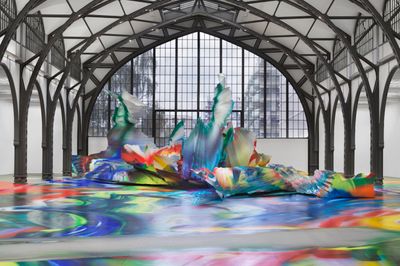
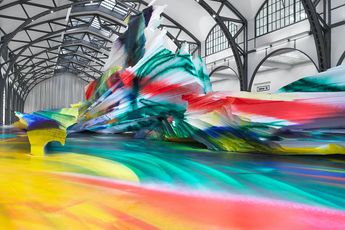
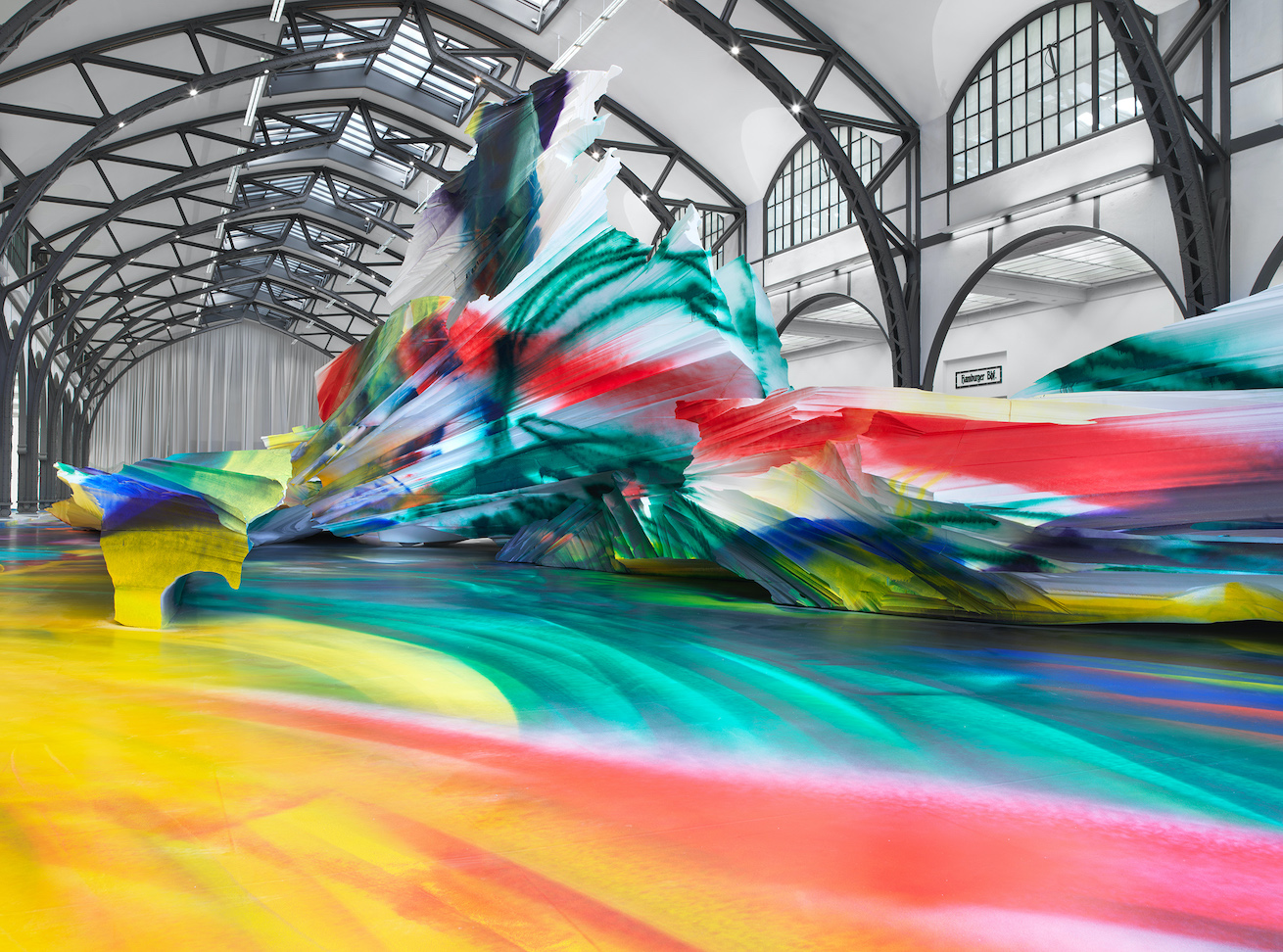
Exhibition view: Katharina Grosse: It Wasn't Us, Hamburger Bahnhof, Berlin (14 June–10 January 2021). Courtesy König Galerie / Gagosian / Galerie nächst St. Stephan Rosemarie Schwarzwälder / Staatliche Museen zu Berlin, Nationalgalerie. © Katharina Grosse / VGBild-Kunst, Bonn 2020. Photo: Jens Ziehe.
In the lead-up to Katharina Grosse‘s solo exhibition at Galerie nächst St. Stephan Rosemarie Schwarzwälder in Vienna (Wolke in Form eines Schwertes [Cloud in the form of a sword], 10 April–29 May 2021), Deniz Pekerman, the gallery’s director, reflects on the key developments of the artist’s practice in his time as her studio manager.
Her painting, which transgresses existing boundaries and can also extend across expanses of space, has not only pointed to new paths and directions within painting, but has also, I believe, increased public interest in painting as such.
Grosse’s idea that painting can appear everywhere and anywhere is an important one, and one that opens up major opportunities and freedoms.
In the first half-decade of the new millennium I was Katharina Grosse’s studio manager. In those years, the artist’s work and also the very structure of her studio began to change markedly.
During my time there, the site-specific works increased vastly in number. In the process, they developed from monochrome or duochrome paintings within a room space into extensive, large-area polychrome paintings that breached and overstepped not only architectural limits but also artefacts such as bookcases and beds or further objects and fixtures.
Equally, the images and their layering became denser and more complex and demanded a greater input and exertion.
During my years in her studio, there were up to 12 or 13 site-specific paintings realised in exhibitions all around the world. Through the resultant need to work both in other locations and in the studio, the structure of work had to change and expand.
It is certainly one of Katharina’s greatest strengths and talents that she is forever reconsidering and altering existing parameters. And yet this bears no comparison with the structures that are required nowadays to realise such an oeuvre.
This is a question that you should ask Katharina Grosse, actually. But it was certainly the case that the new studio emerged out of the confluence of existing needs and the search for new possibilities.
After the move had been made, it became clear that some sculptural works could not be realised in the new space, with the result that, from time to time, yet further studios had to be rented.
Katharina’s exhibition in Vienna is her sixth in our gallery and presents paintings on canvas created over the past year in New Zealand.
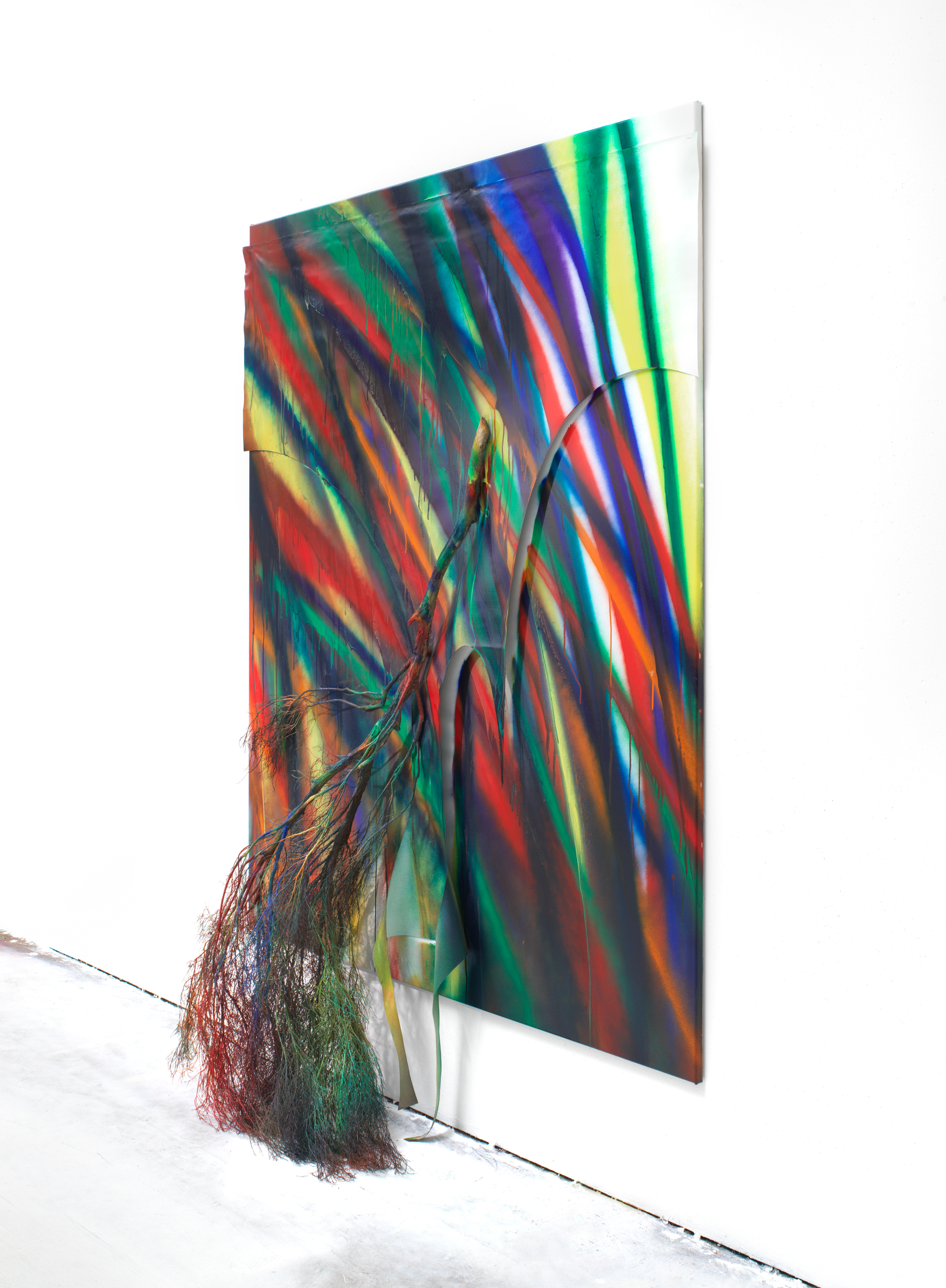
The focus of the exhibition is on a new group of pictures into which branches and twigs, or pieces of driftwood, have been incorporated.
These works are a magnificent coming together of her studio working and her site-specific praxis. Hitherto, the paintings on canvas had not been conjoined with any objects. Katharina’s pictures had already, in some cases, formed integral parts of larger room-commanding works, and some of them had subsequently been extracted from these contexts.
Sand and earth were materials that had remained on the pictorial surfaces as flat residues. In the present case, however, the branches and twigs are mounted on the support surface, giving the mere canvas a further level.
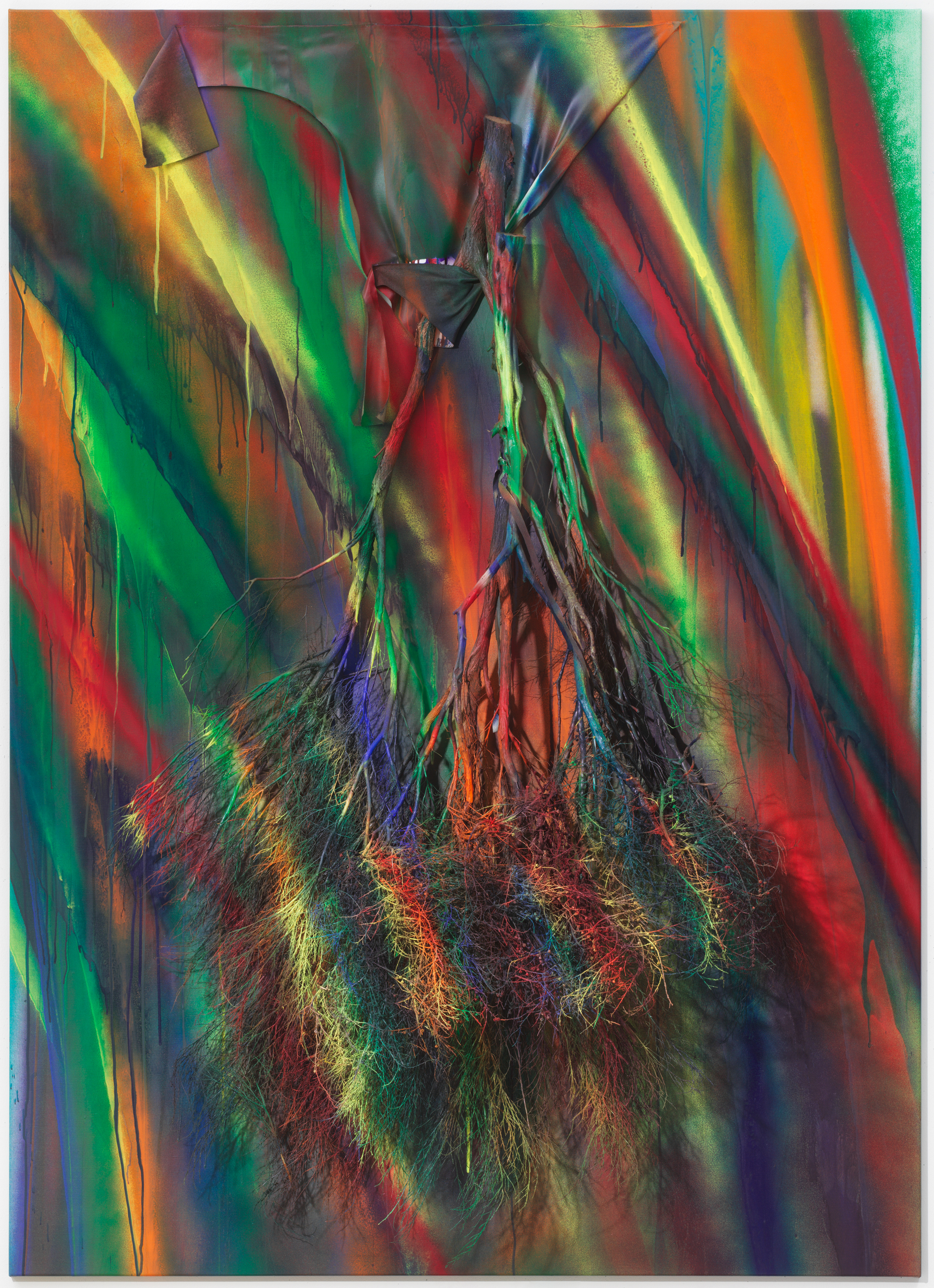
The canvas takes on volume. This volume, however, is not an enclosed surface but has a delicate, filigree structure. At the same time, the combination of the painting with objects from the world of nature gives the works great poetic power.
I can well understand what she means. Since Katharina neither visualises nor inscribes any boundaries or hierarchies for her paintings, the works have a major impact on the beholder.
From the tiniest particle to the most sweeping expanse, the beholder is continually called upon to reconsider and question their standpoint and perception anew. This situation of having to assess what one has seen anew with every movement made or every glance ventured is both a challenge and a stimulus to the viewer.
Katharina Grosse’s exhibition in the Hamburger Bahnhof in Berlin was for certain one of the major exhibition events of last year and one that really drew an enthusiastic and excited response from those who attended.—[O]
A respected voice in contemporary art discourse.
Focusing on ambitious storytelling and insightful art-world commentary. Ocula Magazine publishes in-depth interviews, critical essays and timely analysis on the artists, exhibitions and ideas driving the global art world.
Learn more about Ocula Magazine
Showcasing the best of the art world.
Ocula partners with galleries from around the world to highlight their artists, artworks and exhibitions. Gallery membership is by application and invitation, with each member vetted by an independent panel.
Learn more about Ocula Membership
Specialises in the sale of major artworks.
Led by a team with deep ties to the world’s leading auction houses, galleries and collectors. Ocula’s advisory team offers bespoke services to high-net-worth clients from around the world who are looking to acquire the best of contemporary and modern art.
Learn more about our team and services