
The art world in focus
Subscribe to our newsletter for news and insights on artists, galleries and exhibitions.
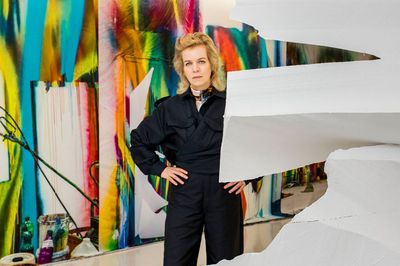
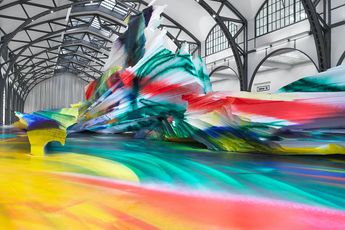
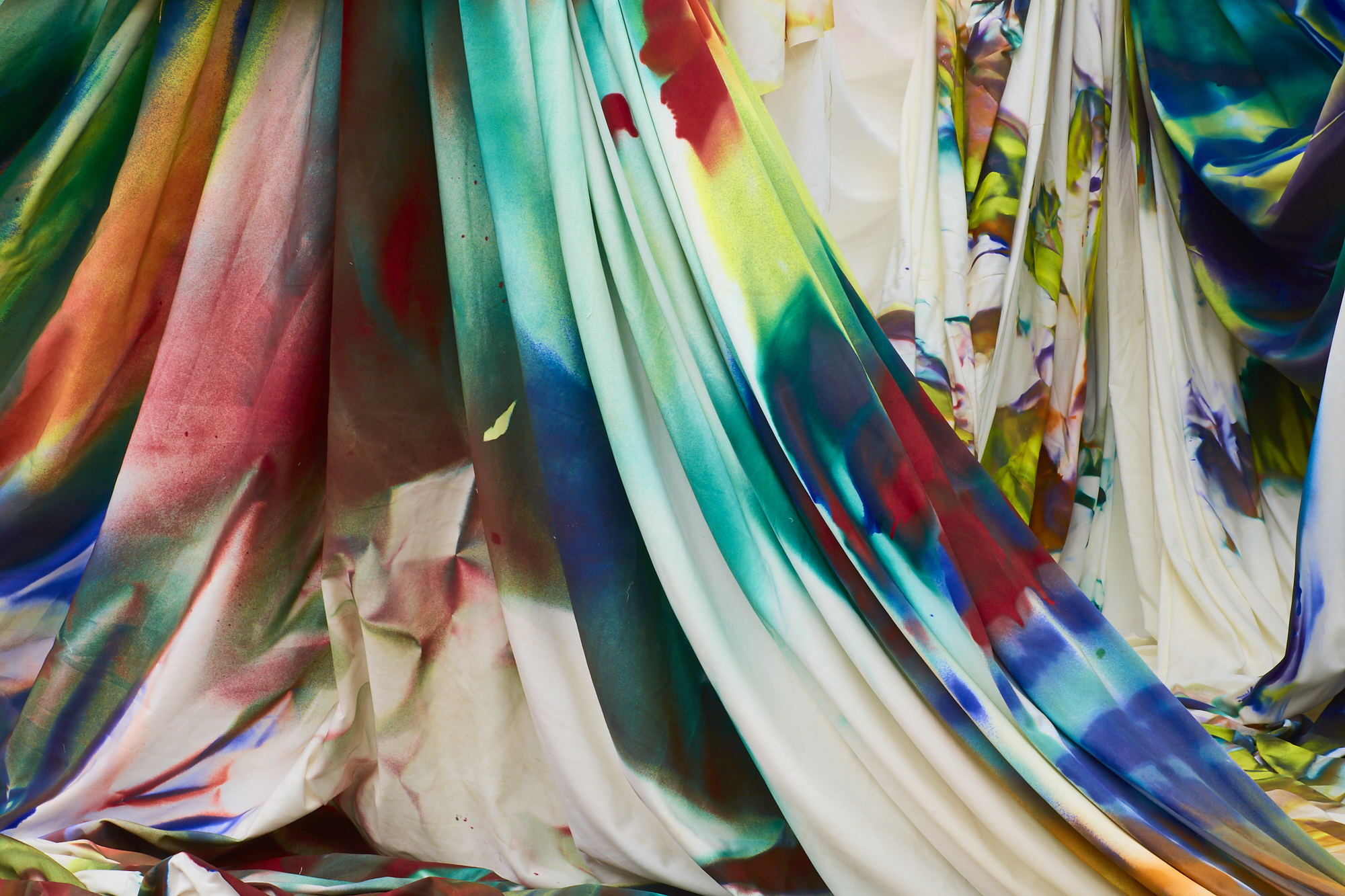
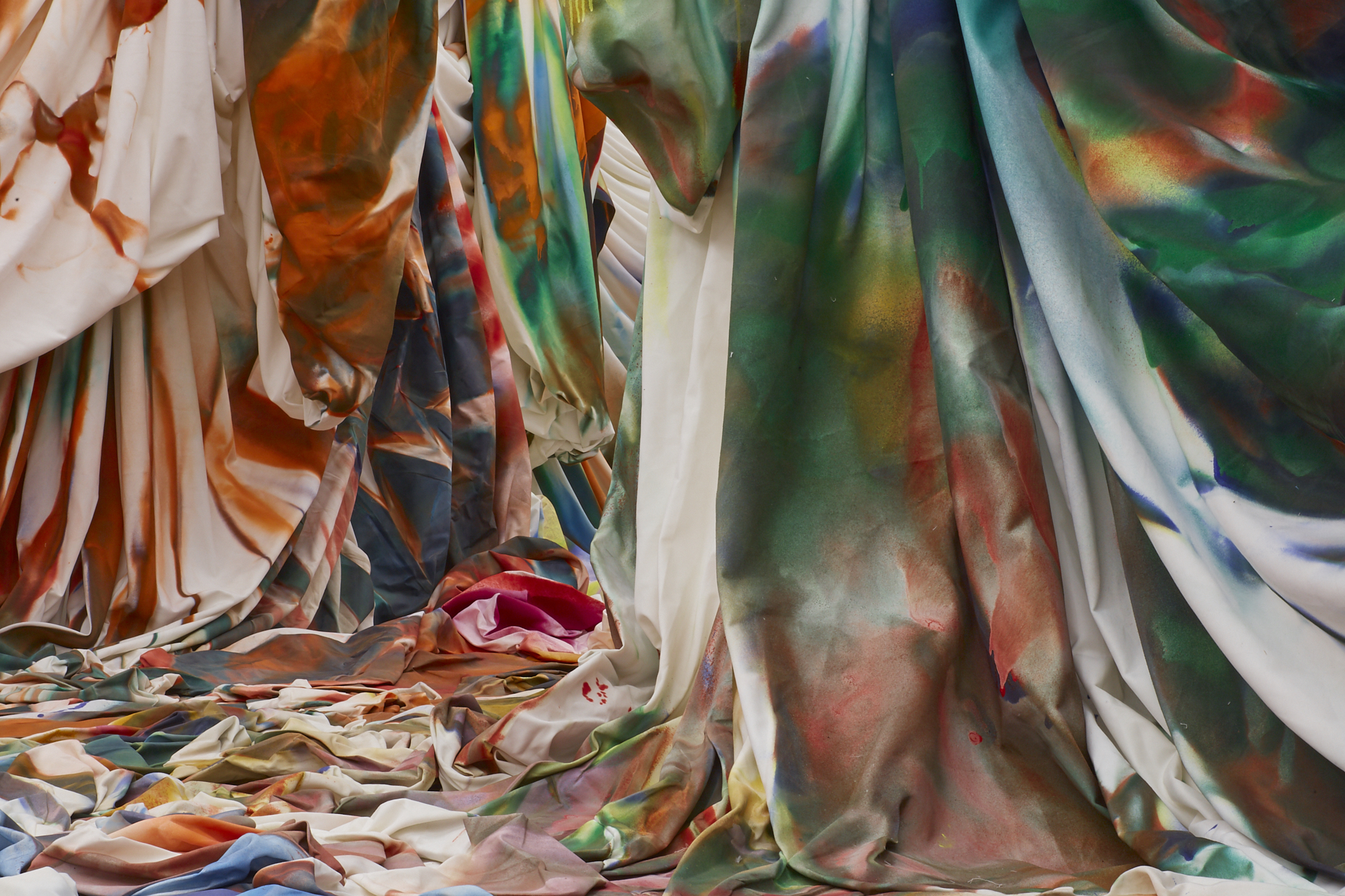
Katharina Grosse. Courtesy K11 Art Foundation and Galerie Nächst St. Stephan, Vienna. © Katharina Grosse and VG Bild-Kunst, Bonn. Photo: JJYPHOTO.
In the summer of 2018, the K11 Art Foundation mounted a solo exhibition of German artist Katharina Grosse in Shanghai, bringing her immersive installations to China for the first time. Internationally acclaimed for a practice that boldly challenges viewers’ perception of space, her playful work has been shown at institutions worldwide, from the Garage Museum of Contemporary Art in Moscow to Mass MoCA in the United States but, despite her 23-year career, never in China.
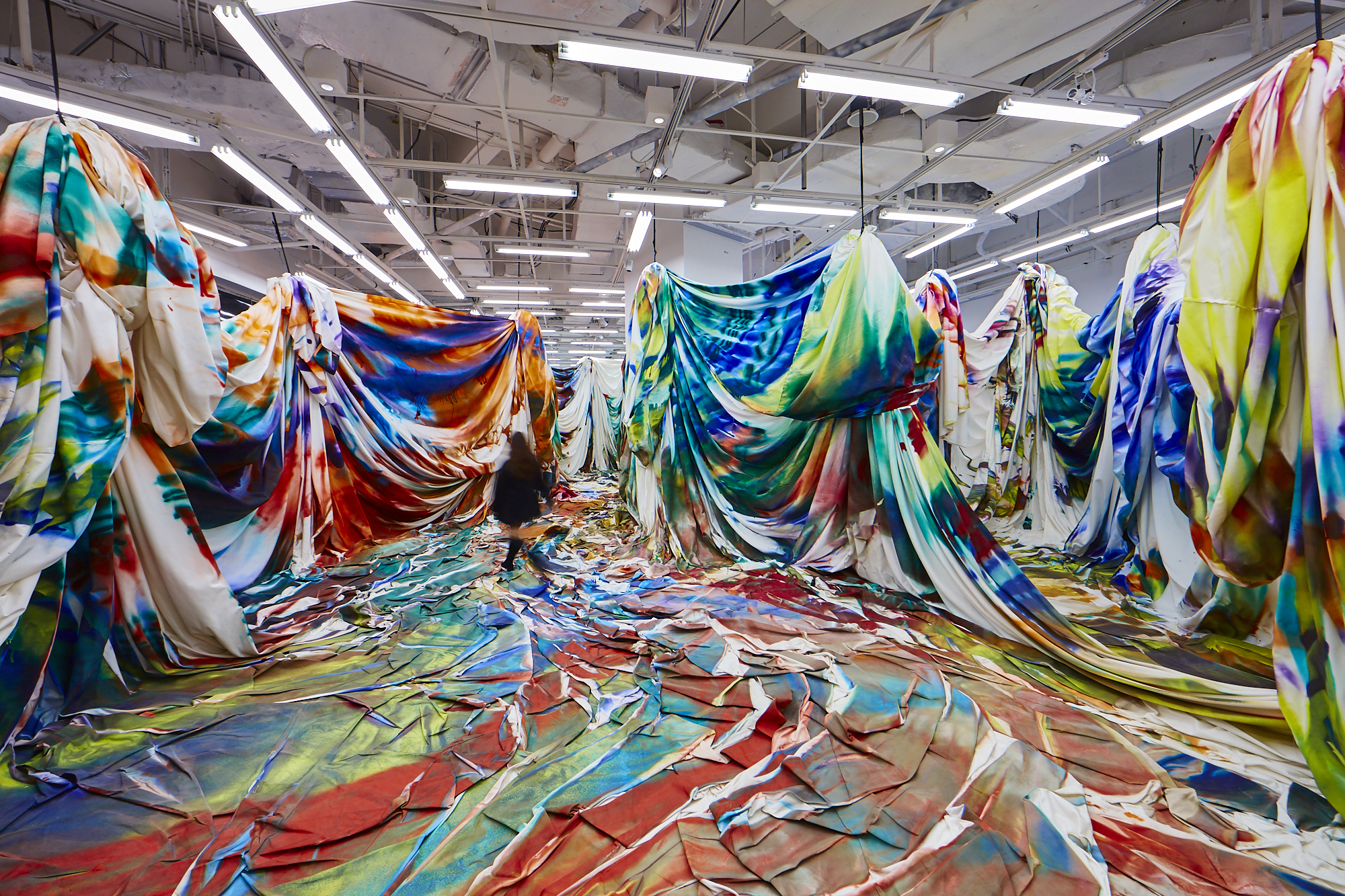
Mumbling Mud was an opportunity for Grosse to return to Shanghai, where she briefly lived in her early twenties. Looking back, she has clear memories of exploring the city’s vibrant fabric markets and it seems only fitting that her first major exhibition in Shanghai—the historical heart of China’s textile trade—saw the space draped in a vibrant canvas of her own. The exhibition is now on view at the chi K11 art space in Guangzhou, where it opened on 30 March and will run until 2 June 2019. Here the exhibition has been adapted and tailored to the space.
Often when artists travel and exhibit in China their work expands. The possibilities of production and of scale in China remain dizzyingly intoxicating; almost everything is feasible. However, for Grosse—a master of scale whose work responds to the architecture that it inhabits—her practice appears perfectly at home in both Shanghai and now Guangzhou. Presented as an exhibition in three stages, Mumbling Mud lures audiences with brazen colour, and overwhelms them with a series of exhibition zones that must be navigated and deciphered. Curated by Venus Lau, the exhibition is one of the most comprehensive and considered explorations of Grosse’s practice to date. With an intention to completely engulf the viewer, Mumbling Mud operates as a parallel world of exploratory visual etymology.
Surrounded by abstracted colour, anchor points of reality are elusive. The viewer becomes untethered from the everyday and must negotiate unfamiliar terrain. Grosse encourages viewers to explore and navigate this new landscape, urging them to let their rigidity of routine slip away. In the ever-expanding Pearl River Delta metropolis of Guangzhou, Mumbling Mud disrupts the monotony of the mundane and compels viewers to return to reality with fresh eyes and a new perspective.
I paint over the border of objects and architectural settings in order to expand the area rather than close it off. I feel borders to be zones of extremely dramatic theatricality, because that is where highly diverse interests overlap, intertwine, and are compelled within a narrow space to engage in competition; to exist in simultaneity. In border areas, we experience mutually exclusive things in an instant, as a paradox. Let’s consider the border between water and land—a concept of the border that is quite familiar. What does the ocean mean for me when I come from the land? What does it mean for those who come from the ocean?
Borders are spaces of negotiation that have to be created again and again. My works provide models for thinking through border-spaces. How would it be if the borders of objects were not so binding for us? If it were possible for objects to be redefined, to be newly materialised by a constant change of perspective? Would we then not encounter our loved ones, neighbours, strangers, or the community differently?
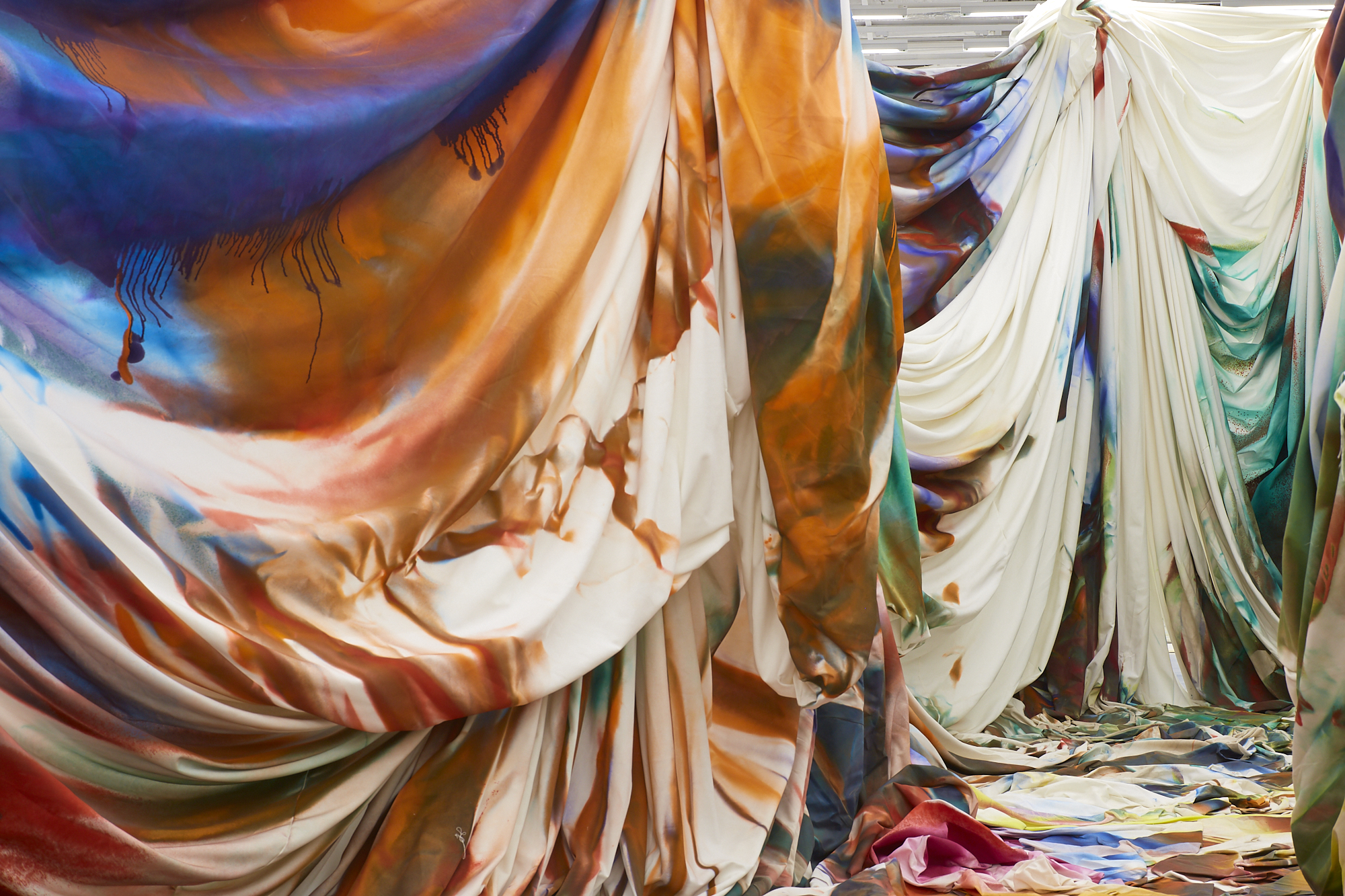
Yes, especially with the large outdoor works and their tendency to expand almost in slow motion. Painting makes possible the simultaneity of imagining and acting in an unusual way, because there is no transmitter between me and my tools. Unlike any other medium, painting allows us to see different moments in time coinciding. You can perceive everything on the canvas at the same time. Movements that have been painted first and last are both simultaneously present on the image field.
All the layers on the surface generate a cluster of the present, past, and future. There is no linear or causal hierarchy of activities in a painting. In that respect, painting is very anarchic and antinarrative. To follow this concept of time, it requires a mind that is agile and ready to give up an adopted point of view at any moment for the next potential constellation or reading. Everything can become anything at any minute.
It was a great opportunity to meet with Cao Fei, Cui Jie, Li Ming, Zhang Enli, and Zheng Guogu, and speak with them about their work, the things that stir them, and their perspective on my works. Parts of these conversations and images of the artists’ work will be published in the exhibition catalogue we are currently working on. To meet every artist for a long talk, and to visit Cao Fei and Zheng Guogu in their work environments brought me much closer to their thinking and concerns.
‘Mumbling’ can be understood as an intermediate state between speaking and silence, while ‘mud’ is an intermediate state between the solid and the liquid. The title Mumbling Mud emerged from a conversation with Venus Lau, the artistic airector of K11 Art Foundation, whose mother tongue is Cantonese.
The saying in Cantonese refers to when someone speaks in a manner that is both audible and inaudible, and literally translates to: ‘ghost eating mud’. Where does the mud go when a ghost, as immaterial a being as could be, swallows it? For me, it marks the transition from imagination to realisation—the very moment when things just come into being, unnamed and indescribable, open to becoming anything.

With my painting, I seek to cause vehement agitation. I want the viewer to be so disturbed—positively or negatively—that they develop the wish to change something. I want to stimulate radical empathy. —[O]
A respected voice in contemporary art discourse.
Focusing on ambitious storytelling and insightful art-world commentary. Ocula Magazine publishes in-depth interviews, critical essays and timely analysis on the artists, exhibitions and ideas driving the global art world.
Learn more about Ocula Magazine
Showcasing the best of the art world.
Ocula partners with galleries from around the world to highlight their artists, artworks and exhibitions. Gallery membership is by application and invitation, with each member vetted by an independent panel.
Learn more about Ocula Membership
Specialises in the sale of major artworks.
Led by a team with deep ties to the world’s leading auction houses, galleries and collectors. Ocula’s advisory team offers bespoke services to high-net-worth clients from around the world who are looking to acquire the best of contemporary and modern art.
Learn more about our team and services